I said in my Mewsings about the 1988 film Paperhouse that I couldn’t think of many children’s books that, when adapted to the big screen, turned into films for adults, but Nicolas Roeg’s Walkabout from 1971 is another to add to the list, as it’s based on James Vance Marshall’s adventure novel for kids, first published in 1959 as The Children, and later retitled Walkabout.
A key difference between the novel and the film is how the children (Americans in the book) find themselves alone in the outback. In the book, Peter and Mary are in a plane crash, whereas in the film (where they’re unnamed), they’re driven to the outback by their father who suddenly starts shooting at them, before setting his car on fire and killing himself — a major change, and certainly part of what takes the film away from being suitable for a young audience. (Though “Hansel and Gretel” starts in a similar way, with a father deliberately abandoning his son and daughter in the woods to starve.)
That infanticidal/suicidal beginning always makes me think of the 60s counterculture’s idea that you should never trust anyone over thirty; also its feeling that modern life was a stifling, dehumanising treadmill that could only end in this sort of psychotic breakdown. Walkabout is very much a film that belongs to the immediate aftermath of the 60s, being at once a product of it and a commentary on it. (As was Roeg’s co-directorial debut, Performance, but I’d also group it with Barbet Schroeder’s La Vallée, a.k.a. Obscured By Clouds, which, like Walkabout, features a small group of drop-outs from the West seeking a deeper connection to life through exposure to a tribal culture.)
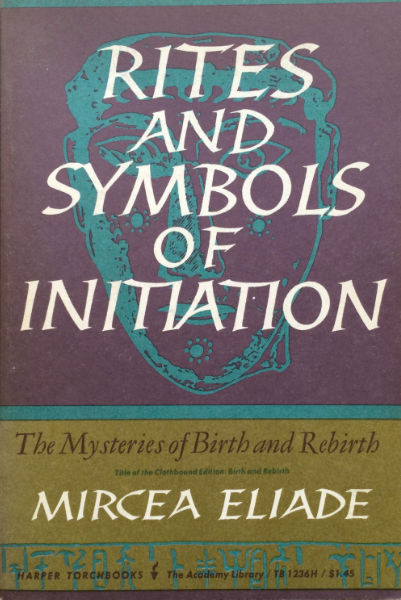
 “It has often been said that one of the characteristics of the modern world,” wrote Mircea Eliade in his 1958 book on the subject, “is the disappearance of any meaningful rites of initiation.” Walkabout is about the rites of passage children undergo to become adults. The Aborigine who helps the schoolgirl and her brother is in the midst of his own initiatory trial, as explained by a title card at the start of the film:
“In Australia, when an Aborigine man-child reaches sixteen, he is sent out into the land. For months he must live from it. Sleep on it. Eat of its fruit and flesh. Stay alive. Even if it means killing his fellow creatures. The Aborigines call it the WALKABOUT.”
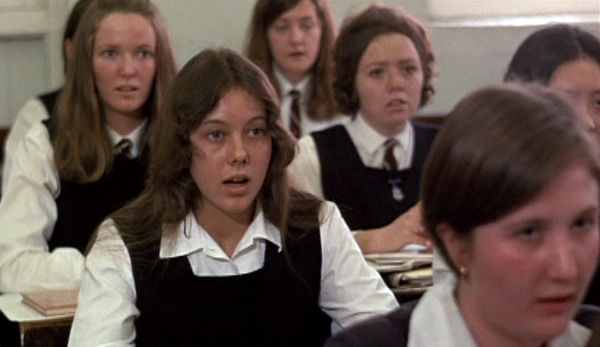
We first see Jenny Agutter’s character engaged in the West’s equivalent, school. She and the rest of her class, sitting in neatly ordered production-line rows, are practising their speech lessons, which seem remarkably like a sort of primitive rhythmic chant. Later, she tunes to a radio programme instructing her on her tribe’s complex eating rituals: which knife and fork to use when eating fish, and how to cover up if you inadvertently pick up the wrong ones.
By this time, we’ve already glimpsed her father sitting alone in the concrete desert between office blocks, and her mother at home preparing dinner, listening to a radio programme describing how a bird called the ortolan is kept in a box, force-fed grain, and drowned in cognac as a delicacy for gourmets. (In contrast to which, we later see the Aborigine youth hunt, kill, prepare and cook animals, as well as use, for instance, the fat of one of them to soothe the young boy’s sunburn.)
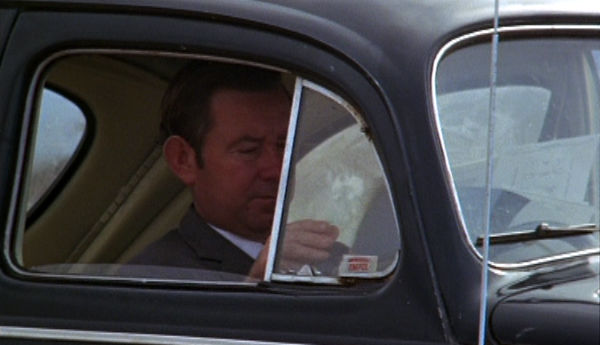
The father (played by John Meillon, who’d later play Crocodile Dundee’s duffer of a business partner, Wally, which makes it even worse that he’s about to start shooting at his children) drives his kids into the desert and, while the boy plays and the girl sets out picnic dishes, reads a report on Structural Geology, as though, even in the midst of the splendour of the outback, he can only relate to his environment as a tabulated business proposal. Spiritually, he’s running on empty, and the car’s almost out of petrol, too. The schoolgirl gives him a slightly worried look, as though she’s half expecting something to happen. Even when he starts shooting, she doesn’t seem entirely surprised — nor too traumatised after it’s happened. (I have to say that one of the things that makes the film slightly difficult, for me, is how she generally doesn’t show much emotion throughout, considering the peril and trauma she goes through. Perhaps it goes to prove how thoroughly initiated she already is in her own stiff-upper-lip culture.)
But even the father’s insane actions have a place in the children’s rites of passage. As Mircea Eliade says, in Rites and Symbols of Initiation:
“Now, suddenly, they are torn from their blissful childhood unconsciousness, and are told that they are to die, that they will be killed by the divinity. The very act of separation from their mothers fills them with forebodings of death—for they are seized by unknown, often masked men, [and] carried far from their familiar surroundings…”
“The universe that the novices now enter is that of the sacred world,” Eliade goes on to say, and the world the schoolgirl and her brother find themselves in is weird and alive, beautiful and deadly, as though supernaturally charged. It’s teeming with life: flies, ants, grubs, locusts, lizards, snakes, birds, kangaroos, camels, and even one desert-venturing wombat.
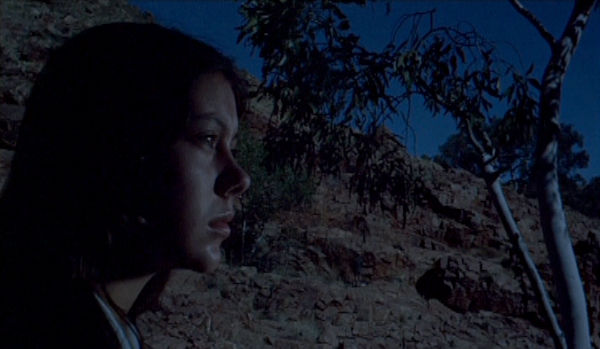
It’s harsh, too. A few days into their adventure, dehydrated and exhausted, the children find a waterhole, and immediately use up the precious water not just in drinking but in pointlessly washing themselves and their clothes. The next day, they wake to find the water all gone.
It’s at this point the Aborigine youth turns up, throwing spears at a lizard. (Later, while this young man makes more spears, the schoolboy boasts that he can multiply 84 by 84, his nearest equivalent skill.) The schoolgirl asks him, rather embarrassingly, “Where do they keep the water?”, as though this were a park with facilities, not a wilderness. And all she can do is ask — it’s up to her young brother, not yet entirely educated out of touch, to get the message through by acting it.
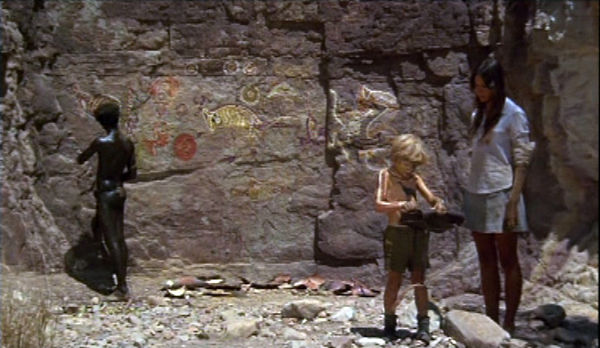
Whenever I watch Walkabout I expect it to be about two Western children gaining a deeper connection to the primal forces of life through sharing in an outback rite of passage, but that’s not what actually happens. The schoolgirl seems quite happy not to learn any of the skills she needs to survive in the outback, and clearly expects to be taken back to Western civilisation by the straightest route possible.
What of the Aborigine youth? At one point, walking atop a ridge, he passes right by a white woman, making no attempt to let the schoolgirl know she’s just yards away from her own folk. Instead, he takes her and her brother to an abandoned house. The girl, after her initial disappointment that there’s no one there to take her and her brother back to their own civilisation, immediately starts turning it into a home. She and the youth move about inside it, avoiding eye contact, suddenly distant in this confined space. At the slightest hint of her own world, she’s back to being a Western would-be housewife, and the youth seems a bit nonplussed.
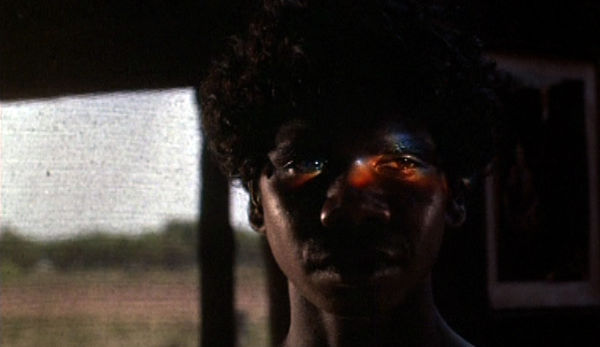
My interpretation of their parting is different from others I’ve read. The Wikipedia article on Walkabout, for instance, says that the Aborigine starts to perform a mating ritual to try to win the schoolgirl over, but my reaction (and this isn’t based on any knowledge whatsoever) was that it wasn’t a mating ritual but a farewell. Just beforehand, the youth goes hunting and sees some white men shooting their prey with rifles. Disgusted, he wanders off — ignoring the schoolgirl when he passes her — to lie among some animal bones. It’s as though he’s trying to come to terms with the idea that white men belong to a different, more savage and strange society, and the schoolgirl is one of them, so he’ll have to leave her. Returning to the house, daubed in white to make himself look like a skeleton, he starts a rather spooky dance which, to me, doesn’t have as much a suggestion of a mating ritual about it, as it does a sort of exorcism. Seeing the film for the first time, I assumed this meant he was saying goodbye to her — ‘dying’ to her metaphorically, while perhaps also trying to scare her from the house, to move her on her way. His jerky stares seem more alienating than inviting. Which isn’t to say his dance doesn’t have a sexual element, but that element may be to add to its magical potency.

When the schoolgirl and her brother find him the next day, suspended from the branches of a tree, I assumed he wasn’t literally dead, but was ‘dead to them’, and was going to stay like that till they left. But the general interpretation seems to be that he is actually dead, and that he died by — what? — dancing himself to exhaustion? Then hanging himself up in the tree?
Is he dead? His body’s in the same position as the father’s corpse was earlier in the film, arms outstretched amidst the limbs of a tree. But neither the schoolgirl nor her brother seem very shocked to see the youth like this. (Though this may be yet more ingrained impassivity from the schoolgirl.) They don’t bury him. The girl just brushes some ants from his body. Neither, though, do they tell him to snap out of it. (I’m sure his face twitches as they walk away, though.) Maybe I just don’t want him to be dead. (In the novel, after all, he catches flu from the children and, having no immunity, dies.)

Really dead or not, though, it’s the end of the trio’s time together. The schoolgirl and her brother walk to a nearby road, and head back to their own world. At the end of the film, we see the girl, now grown up (wearing make-up and smoking a cigarette), in exactly the same situation as her mother was in at the start of the film — a housewife in an apartment, preparing a meal for her husband, who comes home and tells her he’s up for a promotion. For a moment, it’s as though nothing has changed. And if the girl is in the same situation as her mother, does that mean her husband will one day take their children out to the desert and shoot them, too? But then we have a glimpse inside her head. Part of her is still in the outback, with her young brother and the Aborigine youth, swimming in a pool. Perhaps something in her was affected by her time in the outback, after all…
It seems to me Walkabout is doing its best to conjure some hope from the end of the 60s counterculture’s attempt at a revolution. It’s the 70s now, and the hippies and drop-outs have had to grow up and get jobs, and they’ve found that the only way to do that is to fit in with the existing system, become one with the never-to-be-trusted over-thirties. But, like Jenny Agutter’s character, who has a piece of her outback experience permanently (if deeply) lodged inside her, those hippies and drop-outs at least glimpsed an alternative, and even if they’re not living the revolutionary dream, at least something inside of them isn’t given wholly over to the Capitalist treadmill. Their revolution didn’t succeed, but it wasn’t entirely defeated, either.

 My new novel, Hello World is out today. (I actually announced it back in October 2015 as coming out the following year, so it’s only a year late!)