Two E H Visiak Anecdotes

Vera Dwyer

In 1934, the Australian writer Vera Dwyer visited England after her latest novel, In Pursuit of Patrick (1933), had been republished here by John Lane. She wrote a series of articles detailing her literary encounters during the trip (mostly with long-forgotten names such as Hamilton Fyfe and Rose Fyleman, but also JB Priestley and Richmal Crompton), the third of which included a visit to EH Visiak. Not really an interview so much as a brief sketch, it nevertheless gives a little glimpse into the sort of person Visiak was.

Dwyer was the daughter of journalist George Lovell Dwyer, and had been born in Hobart, Tasmania in 1889. She’d married in 1915 a bare few weeks before her husband was sent to fight in the First World War, but the couple divorced in 1925. Her writing career began with a story published at the age of 9, and continued with a children’s book, With Beating Wings (1913), written in her teens. Her adult novel In Pursuit of Patrick is described in a review by The Australian Worker as “a brightly-written book about a Bright Young Thing who chases a Bright Young Man through 200 pages, and over thousands of miles of land and sea”. She died in 1967.

Visiak would have been 55 or 56 at the time, and, from my attempts to work out where he lived throughout his life, seems to have moved this year, some time between March and June, from 30 Cavendish Road in Brondesbury (where he’d lived since at least 1911, and where he’d run his Ascham House preparatory school for boys) to 38 Rutland Park Mansions in Willesden (which suits the description of “a tall, narrow house” in the article, and is close to a railway line). The other writer mentioned as attending this soirée, whom Dwyer calls Visello, must be Arthur Vesselo (1911–2000), who collaborated with Visiak on the story “I Am a Murderer”, which appeared in Thrills, Crimes and Mysteries in 1935, and whose output, according to the FictionMags Index, seems to have been confined to a year either side of this article. He later became a film critic, writing for Sight and Sound, before becoming head of the Central Film Library in London (now absorbed into the BFI).

Dwyer’s article was titled “Meeting the Authors”, and appeared in The Sydney Morning Herald Women’s Supplement, on 20 November 1934:

While I was journeying from Australia to England, a girl who had joined the ship at Port Said, and at whose parents’ home in London I was later to enjoy much pleasant hospitality, gave me an autographed copy of a book entitled “Milton Agonistes—A Metaphysical Criticism,” by E. H. Visiak. It was not very hopefully that I set out to read this highly analytical work, for I am not a Milton scholar, and I feared that many of its allusions would be lost upon me, but I soon discovered that there was so much beauty of thought and phrasing, such a luminous quality in Visiak’s prose, that I was able to enjoy it deeply for its own sake.

In the days that followed I read some of his verses, of which John Masefield himself has expressed admiration. Indeed, although this writer’s work is not much known in Australia, and has no wide popular appeal in his own country, it is held in high esteem by many of his fellow-authors, and when, shortly before I left England, Mr. Visiak gave an afternoon’s reading of his poems at a public hall in London, it was attended by some of the most famous literary men in the land, including Walter de la Mare.

He has written some fine sea chanties and poems about ships. He is not a traveller, but the romance of the sea is in his Cornish blood, and has inspired him to write several novels, too, among them “The Haunted Island” and “Medusa,” a piratical tale, with elements of mysticism and horror, published by Gollancz.

All I heard of his unusual personality interested me, and I was pleased, some weeks after my arrival in London, to receive an invitation to Sunday evening supper at Mr. Visiak’s home, in company with my ship-board friend.

Our host proved to be a tall, thin, worn-looking man, who lived with his mother in a tall, narrow house which, though not handsomely furnished, was stored with unusual treasures, like the mind of its occupant. He showed me his collection of Milton portraits, his books, his models of ships, a pewter jug which Charles Dickens had given to his grandfather, and many curious old prints and engravings.

After supper we sat in the unlighted study, while the summer dust gathered slowly, until the room was filled with gloom, illuminated at intervals by lights flashing through the windows from trains passing along an overheard bridge in the near distance, while a stimulating discussion took place on the problem of good and evil, in which another of the guests, a short-story writer named Visello, took an active part. There were some fine threads of argument to follow, spun from Mr. Visiak’s deep delving among ancient and forgotten books.

I have seldom felt farther away from the modern world, with its often cheap and crude sophistication, its artificiality and blatant commercialism, than in that dim London sitting-room, with the busy traffic flashing and rumbling by outside.


For a second, more amusing, glimpse of Visiak the literary man, there’s this from The Biggleswade Chronicle, 9th April 1937:

Sir Arnold Wilson, MP for Hitchin, and Mr E H Visiak, the novelist, were involved in a misunderstanding at the centenary celebrations of Swinburne’s birth, on Monday night. Mr Visiak was proposing a vote of thanks to earlier speakers, and was speaking on the merits of Swinburne, when Sir Arnold, who was chairman, interjected: “You are here to move a vote of thanks, not to go on eulogising Swinburne.” Sir Arnold said afterwards, “I was chairman of the meeting, when he had spoken for some time on Swinburne, which was not the purpose of his speech. I used my authority as chairman and told him that he was moving a vote of thanks. Mr Visiak misunderstood my motive, and I think he must have forgotten that I was chairman. I meant no discourtesy to the speaker.”

A sequel of sorts is to be found (oddly, three days earlier) in the Manchester Evening News:

Having slept on the matter, Mr E H Visiak the writer whose speech at the Poetry Society’s Swinburne centenary celebrations was interrupted by Sir Arnold Wilson, MP, feels that no apology from Sir Arnold is called for.

“It is true that Sir Arnold used the words, ‘You’re here to move a vote of thanks to me, not to go on eulogising Swinburne,’” Mr. Visiak told me to-day. “I am content to treat that as a jocular but justified reminder that I had gone on talking a bit too long.

“Sir Arnold is a great personal friend of mine, and I am sure that he did not mean to be offensive.”

^TOP

The Shadow by E H Visiak

After The Haunted Island (1910) and Medusa (1929), E H Visiak’s only other substantial work of weird fiction was the novella The Shadow, which was published in 1936 as part of a fat, budget volume (560 pages for 2 shillings and 6 pence) called Crimes, Creeps and Thrills (“Forty-Five New Stories of Detection, Horror and Adventure by Eminent Modern Authors”), with no listed editor, but online sources have John Gawsworth in that role. (And he is the co-author of two tales in the book under his own name, and one under his real name Fytton Armstrong, which feels like confirmation.)

The Shadow is a departure from Visiak’s previous two novels, in that it’s contemporary, and not a sea adventure. It’s told in two parts. In the first, the main character Edmund Shear is fourteen years old, and is spending his school holiday at the house of a fellow pupil, Anthony Layton. The two aren’t exactly friends, as Anthony’s main means of relating to people seems to be mockery and contempt, with the occasional retreat into self-pity when things go wrong. Edmund’s father is a painter of seascapes, and Edmund himself is obsessed with the sea (“His mind ran much upon nautical imaginations”), making him possibly a stand-in for Visiak himself.

In the room where Edmund sleeps is a portrait of one of Anthony’s ancestors, Hamond Layton, who was “a sort of pirate—a smuggler, anyway”, and was hanged for it. The portrait affects Edmund profoundly, as though the long-dead Hamond has perhaps, at moments, started to possess him.

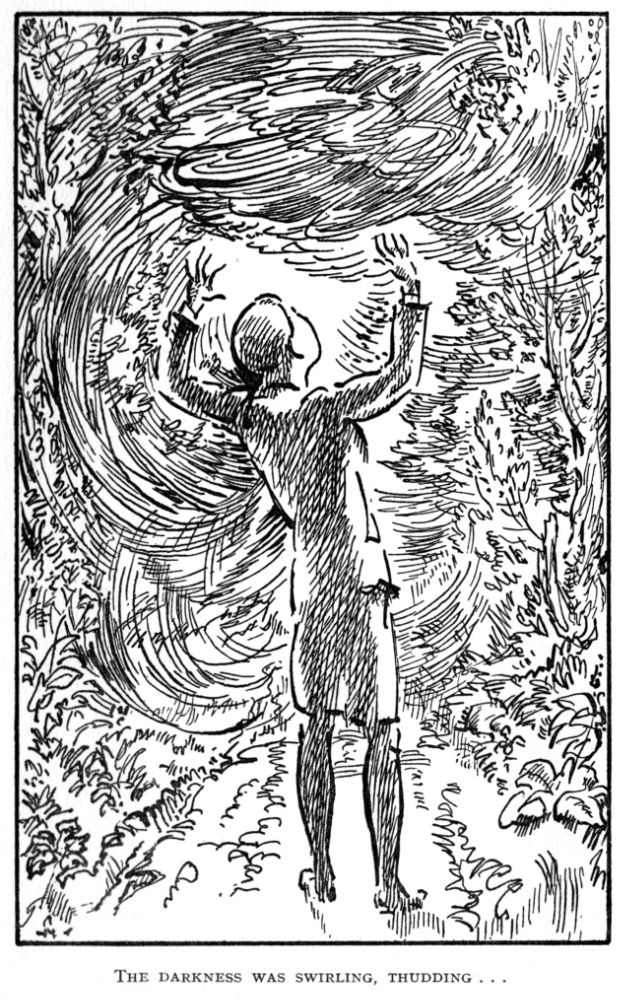
One of eight uncredited illustrations to Visiak’s story.

An initially confusing array of other characters is introduced, including an old sailor known as “Jerusalem John” who actually knew Hamond Layton, a ship-owner called Archie Anderson, a Mr Jervons who spends a lot of his time at Anthony’s home (Anthony’s mother is a widow) and is the main male influence — though “an embittering, belittling, restraining influence” — on the young Anthony’s life, a “prophetess” of the New Idealism called Mrs Evans, her granddaughter Margaret Conyers who writes poetry, and finally a painter, Reginald Rudderford Thurston, who is described by one of the other characters as “a monster in human habit, a psychological octopus”, a vivacious but violent, sly and domineering and perhaps supernaturally-possessed man, “thrilling with ravening spite”.

So many of the relationships between these characters are about various forms of domination. Anthony tries to bully those he perceives as within his range (Edmund and Margaret, neither of whom gives in). Anthony in turn is domineered by the sarcastic Mr Jervons, who has clearly installed himself in the Laytons’ home and is living off it. Mrs Evans so believes in the truths of her New Idealism (whose main tenet is that there is no such thing as evil, only ignorance) that she bosses everyone around (“a look of complacent domination in her eyes”), assuming they’ll come round to her way of thinking and thank her for it. But worst of all is the almost Devil-like Thurston, who seems to have a supernatural insight into others’ secrets, and revels in manipulation, bullying, and generally being extremely unpleasant, and whose one redeeming virtue is that he does it so excessively he is clearly the villain of the piece, even if it’s never clear what he’s up to and why.

The second half of The Shadow leaps forward to Edmund as a young man, having just inherited Mr Anderson’s shipping firm. He returns to the scene of the first half of the book (near Lowestoft) and experiences some sort of breakdown. Ever since encountering the portrait of Hamond Layton (which he now owns), he has moments when the old pirate/smuggler seems to take him over, turning him angry and domineering. In the midst of his breakdown, he’s taken in by his old headmaster, Mr Atwell, who speculates on what might be going on with the young man, and so provides the story’s only lucid explanation. It seems that the smuggler Hamond Layton was, at one point, presented with a choice, either to continue his life of crime, or marry a woman who loved him. He made the wrong choice and was hanged for it, but perhaps his lingering essence is seeking redemption through the young Edmund. But to do this, Edmund has to learn to tame the angry, domineering aspect of Hamond-the-pirate, before he can find love (with poetess Margaret). This makes a sort of sense of most of what’s going on in the novella.

But it raises the question of what the villainous Thurston’s role is. At one point, Thurston is said to be “a representation, in some way, of Hamond Layton”, but if so it’s only of his darker nature. However, Edmund is already battling that darker nature within himself, so why have another character represent the same aspect? It seems more that Thurston is a (or even the) Devil, taking it on himself to try and drive Edmund to the same fate as Hamond — a life of crime, followed by hanging. And certainly Thurston takes a Devil-like joy in sowing discord and misery all around him. Anthony Layton has fallen particularly under his spell, and Thurston urges him to seduce Margaret, to take her potentially redeeming influence away from Edmund.

If one of the story’s main themes is the dominance of some people over others — as well as all those domineering types such as Mr Jervons, Thurston and Mrs Evans, there’s the “shadow” of Hamond Layton’s supernatural dominance over Edmund — a secondary theme is how this domineering impulse, in the male characters at least, is tied to sex.

We’re told early on that the boy “Edmund’s absorbing interest in nautical things had kept his thoughts away from sexual aspects.” At one point, after having met Margaret for the first time, he has a particularly troubling dream, which implies that “nautical imaginations” are, for him, a sublimation of his adolescent sexuality:

“…a woman had changed into a ship; and the ship — which was such a fine one! — had to be sunk for it to become a woman again…”

(Which is perhaps also linked to Hamond Layton, who named his ship Barbara, after the woman who loved him.)

Mr Jervons and the adult Anthony Layton are both casually predatory on women. It all seems to tie in with Visiak’s belief that the Eden-like state of childhood comes to an end with adolescence purely because of the introduction of sexuality — though, here, it seems to be redeemable by love. (Mr Anderson, the main adult male character who isn’t domineering, was in love with a woman who died before they could marry. Edmund and Margaret’s love, when it’s admitted, seems to be the redemption both for Edmund and the shadow of Hamond Layton.)

Mrs Evans’ New Idealism, though probably satirising many beliefs both then and now, is perhaps most notable for its idea that there is no such thing as evil. But Visiak is clearly presenting us with evil in the form of the barely-human Thurston. Visiak, I’d say, believes in real evil.

The Shadow is quite a confusing novel. The opening introduces a lot of characters, all of whom seem to be basically unpleasant and domineering in various ways, painting a very dour picture of the world of human relations. Even by the end, things aren’t very clear, and if it wasn’t for that one chapter where Mr Atwell speculates to himself on what might be going on, I’d probably have no clue as to what Visiak had intended. Take out the supernatural influence of the “shadow” of Hamond Layton, and you’d have the story of a young man with troubled moments of dark, almost hallucinatory depression and bouts of anger, perhaps rooted in a sexuality that can no longer safely be sublimated into boyish thoughts about boats. Perhaps another read might make it all clear… But perhaps not.

However, further clues might be gleaned from Edmund’s speculations at one point, which strays into the territory of cosmic horror. Is it being put forward as a valid interpretation of Visiak’s supernatural world, or is it just a throwaway — if frightening — thought?:

“Perhaps superhuman beings used us as we used animals, for food and work — a different sort of food and work.”

Visiak had another tale in the same anthology, a collaboration with John Gawsworth called “The Uncharted Islands”, that is, again, a sea-adventure, but with no supernatural element.

^TOP

A Voyage to Arcturus by David Lindsay

My cover to the Bookship hardback

David Lindsay’s first novel, which he called Nightspore in Tormance but his publishers renamed to the slightly more comprehensible (if bland) A Voyage to Arcturus, came out one hundred years ago this month. I first heard of it thanks to Moorcock & Cawthorn’s Fantasy: The 100 Best Books, which I’d bought because I’d grown dissatisfied with the sort of genre fare I was finding in my local bookshops, and was wondering if I shouldn’t give up reading fantasy altogether. I decided if I couldn’t find something in Moorcock & Cawthorn’s list to re-enthuse me, I’d look for a different genre to read.

Their summary of A Voyage to Arcturus left me somewhat mystified as to what the book was actually about, and certainly didn’t sell it to me:

Arcturus itself is not an ingratiating work; the shelf it occupies is a short one, reserved for titles more often to be found in lists than in reader’s pockets. The message it spells out is no comforting one.”

I’d probably never have read it had I not found it in a secondhand bookshop with that lovely Bob Pepper cover and thought “Might as well.” Even then, it sat on my shelf for a while before I actually picked it up and gave it a go.

Bob Pepper’s artwork for the Ballantine paperback of A Voyage to Arcturus

At first, I continued to be nonplussed. It seemed a little old-fashioned in style, and along with the freedom of imagination you often find in novels written before their genre conventions gel, it had that quaint lack of scientific or logical consistency that comes from somebody building a world before the idea of world-building set in. It was a strange book, yet not with the poetic strangeness of Clark Ashton Smith, or the uncanny strangeness of Lovecraft. If anything it seemed, stylistically, to be doing its best not to seem strange, but rather to present all its odd characters, sights, and events in as matter-of-fact a manner as any mundane travelogue:

Before many minutes he was able to distinguish the shapes and colours of the flying monsters. They were not birds, but creatures with long, snake-like bodies, and ten reptilian legs apiece, terminating in fins which acted as wings. The bodies were of bright blue, the legs and fins were yellow. They were flying, without haste, but in a somewhat ominous fashion, straight towards them. He could make out a long, thin spike projecting from each of the heads.

“They are shrowks,” explained Oceaxe at last. “If you want to know their intention, I’ll tell you. To make a meal of us. First of all their spikes will pierce us, and then their mouths, which are really suckers, will drain us dry of blood. . . . pretty thoroughly too; there are no half-measures with shrowks. They are toothless beasts, so don’t eat flesh.”

But then something happened. Pushing on through the book (more for the sake of finishing it than anything else), I became aware that some inner part of me, some second, more discerning reader — my inner Nightspore to the outer Maskull — was really caught up in it. It seemed to be saying: Something is going on in this book, and I have no idea what! I finished it in a rush, because I’d suddenly realised I hadn’t been paying it the attention it deserved, and I needed to start reading it again, this time making notes.

Various covers, art by (clockwise from top left): Peter A Jones, Ron Miller, …, Florence Magnin, Karl Stephan, Kato Naoyuki, Lucien Levy-Dhurmer, Jean Delville (design by John Coulthart)

In a sense, I’m still doing that. I’ve re-read Arcturus countless times, and each time I feel the need to read it again, paying still closer attention — or I feel the need to plough through the rest of Lindsay’s novels in succession, to try and grasp them all as one thing in my head and this time work it out. (I’ve even wondered if it’s not part of some “Lindsay effect”, a trick of that matter-of-fact literary style that leaves you constantly feeling you’ve almost-but-not-quite grasped something utterly intriguing.)

Soon after I first got on the internet, I started a website dedicated to Lindsay, mostly because I’d managed to acquire Colin Wilson, J B Pick, and E H Visiak’s book, The Strange Genius of David Lindsay — for £3! — and, feeling privileged to have got it, wanted to share the information inside it, feeling there had to be other people out there as hungry for information on Lindsay as I was. At first I added my own commentaries about the books, but soon removed those sections, feeling that the more I read Lindsay’s work, the less I knew about it. I kept The Violet Apple site (named after a posthumously published Lindsay novel which was the first book I bought online — thanks to Blackwell’s rare book search service, in fact) strictly factual for a while, apart from one article (“Four Approaches to A Voyage to Arcturus”), which was more about how the book defied any single interpretation than an attempt at offering an understanding of it.

(Another thing that has shifted in my view of the book, and Lindsay’s work as a whole, is its darkness. Initially encountering Lindsay and Arcturus, you can get caught up in that darkness — after all, it’s a novel about world-rejection, where only Pain can redeem you from all the terrible pleasures of life; and meanwhile Lindsay himself, after a lack of success as an author, died quite unpleasantly from self-neglect. But the more I’ve read it, the more I’ve seen that actually it’s a book shot through with a vitality that defies the darkness, and seeks something better. With Arcturus, the darkness is not the end point, but the beginning, and the impulse behind it is one of uncompromisingly seeking something better.)

Ad from The Times, September 1920

I like how open to interpretation A Voyage to Arcturus is, even while it has an evident meaning. Yes, it’s a gnostic text, but also it’s an exploration of a certain sort of psychological state that (in my view) is more fundamental than any religious or philosophical outlook: if you are not your authentic self (if you are Maskull, as opposed to Nightspore), then the world will seem like Crystalman’s prison, and it will be hard, dangerous work trying to untangle yourself from it. (Lindsay’s friend, E H Visiak, read the book in completely Christian terms; Colin Wilson read it as an allegory of consciousness; J B Pick saw it as vision.)

Most recently, I’ve come to see A Voyage to Arcturus as an incredibly rich archetype of the quest for truth. (And I think it’s in the book’s archetypal, or mythical, structure that its power lies — it certainly wasn’t its ideas that grabbed me on that first read, but something far more instinctual, mythical, musical even.)

Romanian edition

The protagonist Maskull begins the book not really invested in any search for truth as such, but once he gets caught up in it, he goes through all the possible stages of being deceived, wrong-footed, sidetracked, aggrandised, defeated, converted, bamboozled, disillusioned and overwhelmed, before finally, worn out through a series of breakneck back-and-forths, he snaps, and finds the simplicity and truth he was seeking all along — a simplicity that transforms him from Maskull to Nightspore, and turns the world from benighted deception into one lit by a beacon of pure truth (Muspel-fire).

I still find Lindsay himself something of a mystery. The power of his first novel was never quite equalled — except in snatches — in his subsequent books, though I have found all of them more and more interesting the more I read them. But the question I’m still undecided on is how in command of his material Lindsay was. Did he know what he was doing? I don’t think any creative artist of any real power does entirely, but there’s still the question of how much they know what they’re doing. A Voyage to Arcturus’s utter strangeness could be down to a certain naivety on Lindsay’s part, a beginner’s luck approach of letting his wild imagination go utterly free before the self-consciousness of post-publication hit him with how he ought to write. But hints in his letters — a reference to the mystical German writer Jakob Böhme for instance — make it clear he wasn’t an entirely innocent wanderer in fairyland, either.

Lindsay from the cover of Bernard Sellin’s Life & Works of David Lindsay

“Only a very few people will ever read Arcturus,” he reportedly once said to Victor Gollancz, “but as long as even two or three people will listen to Beethoven, two or three people will read it.” A Voyage to Arcturus now seems to have found an established place on many lists of classics of SF, fantasy, and imaginative literature, as well as Scottish novels, and even early 20th century fiction generally, and every few days I get a Google Alert telling me that someone, somewhere, on Twitter or some obscure internet forum, is recommending it as one of the strangest and most compelling books they’ve read. (Or, more rarely, saying it’s the most boring or incomprehensible book they’ve ever read.)

In a way, then, Lindsay has been proved right. Beethoven is certainly in no danger of not being listened to; now, I hope, A Voyage to Arcturus is in no danger of ever not being read, even if just by a few.

^TOP