Last Men in London by Olaf Stapledon

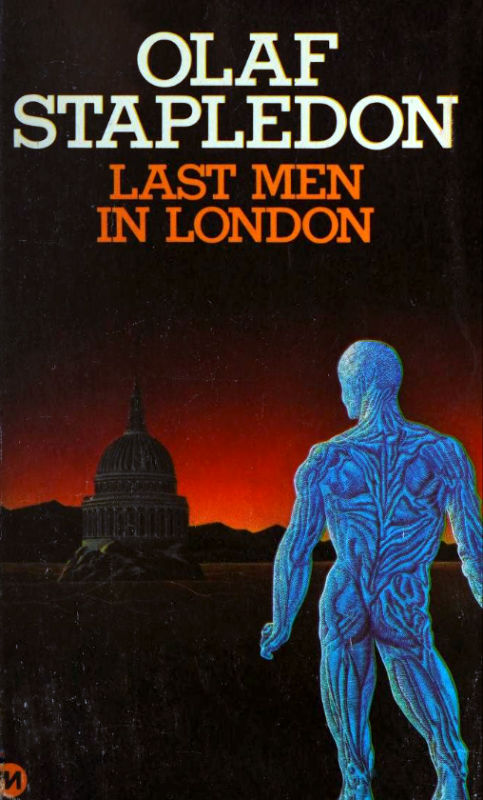
1978 paperback, art by Peter Goodfellow

Olaf Stapledon’s second novel, published in 1932, is not so much a sequel to Last and First Men (1930) as a sort of pendant to it (as his next novel, Odd John, started out as an appendix to this one). Like that first book, it’s dictated by a Neptunian from the far-future final race of humankind, who have developed the ability to project their consciousnesses into minds of the distant past, and not just witness events, but influence them to a certain extent, too. (Stapledon gets over the difficulty of the future being able to influence the past with a little handwaving: “Thus when I am observing your mental processes, my activity of observing is, in one sense, located in the past.” Or, for a little more detail: “though future events have indeed no temporal being until their predecessors have ceased to exist with temporal being, all events have also eternal being. This does not mean that time is unreal, but that evanescence is not the whole truth about the passing of events.”)

Instead of the vast, thousands-of-millions-of-years sweep of Last and First Men, Last Men in London concentrates on one comparatively tiny sliver of time, but one that is nevertheless “a crucial incident in the long-drawn-out spiritual drama of your species”: the First World War and its immediate aftermath. And the Neptunian chooses to approach this period through the consciousness of one individual, a relatively ordinary man called Paul. His intent is to present a deeper understanding of the causes of what was then known as the Great War, but also, by introducing Paul to glimpses of the more cosmic worldview of the Eighteenth Race of humankind, to see how this affects a man of our age. “It is my task,” he says, “to tell you of your own race as it appears through the eyes of the far future…”
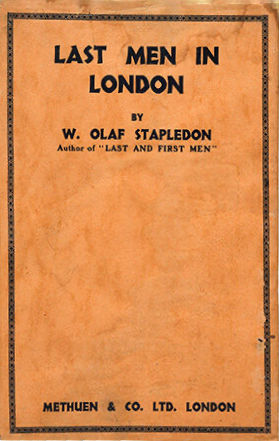
Methuen hardback, 1932

After the immensely compressed tale of multiple human species in his first novel, focusing on a single individual might make it sound as though Last Men in London would read like a more straightforward narrative. In fact, it’s even less of a traditional novel (in terms of character, plot, and so on) than Last and First Men. After an initial chapter which details life on far future Neptune, we get a brief glimpse of Paul as he hesitates before an army recruitment centre in London, wavering between social pressure to join up and his more deeply held belief in pacifism. But this is one of the few conventional scenes in a book that has only about three or four named characters, and almost no scenes with dialogue, action, and so on. Following the introduction of Paul, the narrator digresses for two long chapters on the causes of the Great War (whose roots are not in the messiness of Imperial European politics as you might think, but in the very nature of our simian ancestry), before returning to Paul and his personal experiences in the war, and then onto his life in the years that followed.

This is only partly a criticism—you come to Stapledon for ideas, not realism—but I have to say I still find Stapledon at his most readable when he’s following a narrative, whether it be of the human race as a whole as in Last and First Men, or the life of an intelligent dog in Sirius. (To be fair, Stapledon declares early on: “Though this is a work of fiction, it does not pretend to be a novel. It has no hero but Man.”) Here, he has his exposition dials turned up to eleven—which isn’t a criticism as such, but I have to say I did find these sections, though interesting, a bit of a slog.
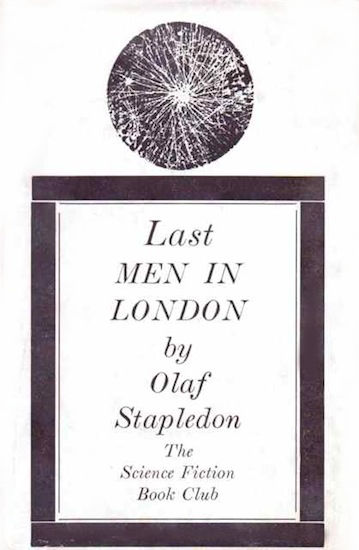
1963 SF Book Club editionBut Last Men in London could also be a kind of autobiographical novel. Like Paul, Stapledon refused the call-up into the army, but elected to serve in the Friends Ambulance Unit as an expression of his pacifism—and, like Paul, he won the Croix de Guerre, and was intensely aware of the irony of a pacifist winning a war medal. Also like Paul he spent time as a teacher. All this leads me to suspect you can probably read Paul’s education in a wider worldview as Stapledon’s own philosophical awakening, with the Neptunian narrator/educator a sort of fictional stand-in for Stapledon’s inner, guiding, slightly alienated deepest self. (It might even be better to read this novel as Stapledon’s attempt to write about the causes of the First World War being derailed by an inner need to tell the story of his own philosophical development.)

As to the causes of the Great War, from the Neptunian perspective it comes down to humankind’s “practical intelligence” getting ahead of its deeper self-understanding, plus a tendency in the First Men (as the Neptunians call us) towards “the importance of personal triumph over others in the great game of life”—the tendency to value heroic individuals over humankind itself, with a corresponding belief in nations as a sort of communal hero-self, with one nation necessarily triumphing over others being the accepted state of things. From the Neptunian point of view, the Great War was on the cards from the moment we came down from the trees (we have “a will that is still in essence simian, though equipped with dangerous powers”), but awaited the technological breakthroughs of the nineteenth century for its fruition:

“…your ‘modern’ world came too soon. In the century before the war it developed with increasing acceleration. You had neither the intelligence nor the moral integrity to cope with your brave new world.”
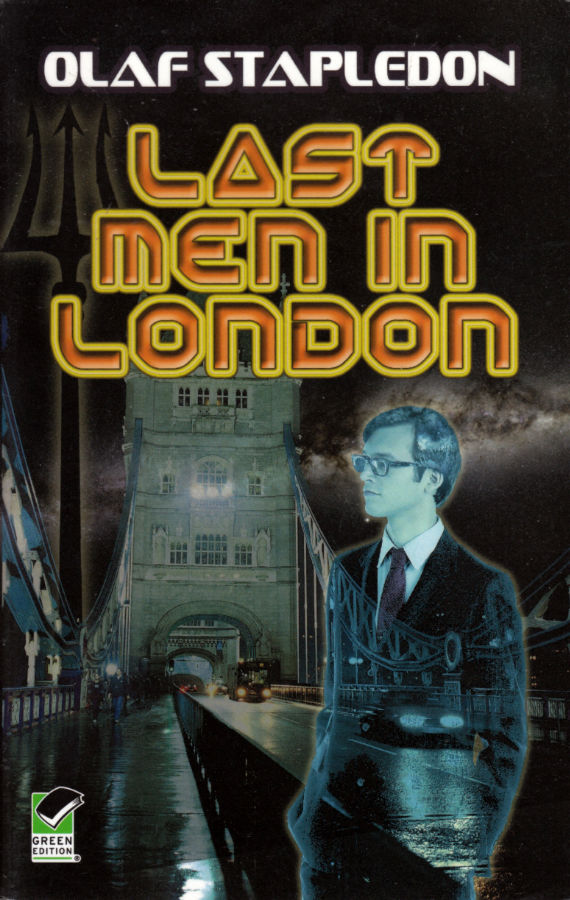
Dover Books edition

More interesting from a present day perspective, perhaps, is Stapledon’s insight into the mood during and after the Great War. There was, he says, a “suspicion in all the combatants that human nature had failed”, its ultimate effect being to “undermine man’s confidence in his own nature”. He goes on, in perhaps his most passionate and forthrightly critical section of the book, to detail how various sectors of society—politicians, religious leaders, teachers, artists and writers, common people—contributed to the war by turning a blind eye or justifying it to themselves. Perhaps the most useful passage to read today, as it still has such relevance, is this:

“Many people seemed to Paul to unearth a new self to cope with [the war], a simpler, less doubting, more emotional self, a self that concealed under righteous indignation a terrible glee in the breakdown of old taboos.”

Post-war, Stapledon describes the mood as one of:

“…a deep and deadly self-disgust, a numbing and unacknowledged shame, a sense of huge opportunities missed, of a unique trust betrayed, and therewith a vast resentment against earlier generations, against human nature, against fate, against the universe.”

Though Paul, in moments of particularly Stapledonian insight, still finds himself thinking:

“How can things be so wrong, so meaningless, so filthy; and yet also so right, so overwhelmingly significant, so exquisite?”

Which is perhaps one of the things that led John Kinniard to write, in Starmont Reader’s Guide 21: Olaf Stapledon, that “Stapledon’s philosophy is best approached as a challenge and a corrective to the disillusionment that became the dominant attitude of the Nineteen-twenties.”

So, what is Stapledon’s answer to all of this? It can be summed up in ideas that were already present in Last and First Men: “loyalty to man and worship of fate”. Or, as the Neptunian narrator puts it in a way that perfectly sums up Stapledon’s mix of the acceptance of cosmic doom with a defiantly joyous optimism:

“The story of your species is indeed a tragic story, for it closes with desolation. Your part in that story is both to strive and to fail in a unique opportunity, and so to set the current of history toward disaster. But think not therefore that your species has occurred in vain, or that your own individual lives are futile. Whatever any of you has achieved of good is an excellence in itself and a bright thread woven into the texture of the cosmos. In spite of your failure it shall be said of you, had they not striven as they did, the Whole would have been less fair.”

Does this help us at all, though, in the prevention of future wars? Stapledon’s notion of “loyalty to man and worship of fate” is a little too vague to be practically useful (unless one were to be faced with a catastrophe that really did threaten the species as a whole like, say, an increasingly unstable climate). Who is to say what best serves “man” or what should be regarded as “fate”? Elsewhere, Stapledon criticises the pursuit of happiness for this very reason:

“For if happiness alone is the goal, one man’s happiness is as good as another’s, and no one will feel obligation to make the supreme sacrifice. But if the true goal is of another order, those who recognise it may gladly die for it.”

Reviews at the time, though fewer than for Stapledon’s first novel, were mostly positive: “one of the most impressive things I have read” (The Birmingham Weekly Mercury), “engrossing and equally stimulating to the imagination and the reflective capacity” (The Aberdeen Press and Journal), “approached seriously, it will be found a rich, stimulating book” (The Daily News). Hugh I’Anson Fausset, in the Yorkshire Post and Leeds Intelligencer, though, offered up a criticism of the Neptunian narrator:

“He may personify ‘the mature individual who has wholly escaped the snares of private egoism,’ and whose will is for the racial good, but only by ceasing to be a person with a real unity of being and a spiritual centre.”

Around the same time, Fausset reviewed (positively) David Lindsay’s Devil’s Tor, a novel which has a few similarities with Last Men in London: both are books in which events and characters are manipulated by science-fictional beings (one from the future, one from space); both touch on the early evolution of humanity and talk of a coming, better race; both make use of sometimes quite intense examination of characters’ inner motives; and both ultimately move towards the metaphor of music made up of many individual instruments as a way of apprehending the cosmic story (and Stapledon’s declaration that “There is no music without the torture of the strings” might have interested Lindsay).
John Wyndham’s Chocky (1963) is a much more readable take on the theme of the alien/futuristic visitor inside one’s own head. I’m sure Wyndham must have read at least some of Stapledon’s works, and wouldn’t be surprised if he’d read them all. Whether he remembered it while writing Chocky is debatable, but there’s a hint of Stapledon’s cosmic vision in Chocky’s parting statement about intelligent life being “the rarest thing in creation, but the most precious. It is the only thing that gives meaning to the universe. Without it, nothing begins, nothing ends…”

Last Men in London is not one of Stapledon’s essential works, but it does make interesting reading as a historical document (its insights into the postwar mood), and as a transition point in Stapledon’s own creative direction: here, he’s working out how to take the themes of Last and First Men and apply them to his evident interest in the philosophical development of an individual. His treatment of Paul’s life is rather distant and unengaging, but he ends the novel with a short episode in which Paul, as a teacher, encounters a weird-looking child prodigy who proves to be, like the next novel’s “Odd John”, a throw-forward to the next step in human evolution. Writing Last Men in London, then, perhaps showed Stapledon the way he should be going, and which he’d do more successfully in both Odd John and Sirius.

^TOP

All Quiet on the Western Front by Erich Maria Remarque

Although it’s far too well known in the English-speaking world by its translated title, Remarque’s original German title, Im Westen nichts Neues, means something more like “Nothing New on the Western Front”. While the English title conjures up a deceptive lull before the storm, the original German is an ironic comment on the death of yet another soldier, and perhaps a whole generation, being nothing sufficiently new to be worth reporting.

The novel was first serialised at the end of 1928, then published in book form in January 1929. It became an instant bestseller. By the end of that year more than thirty translations had appeared, followed in 1930 by an Academy Award-winning Hollywood film directed by Lewis Milestone (and produced by Carl Laemmle Jr., of Universal Horror fame). When the film reached Germany, the National Socialists, newly voted into being the second largest political party in the country, campaigned to have it banned for its supposed negative take on the “reputation of the German soldier”. They saw their success on this front as their first major victory over democratic Weimar Germany. (When they achieved full power in 1933, Remarque’s novel was one of the first books to be publicly burned.)

As a novel, All Quiet on the Western Front doesn’t really have a story. (The very lack of anything by way of a change in the narrator’s fortunes — a way out of his Hell — let alone one due to his own actions, could well be part of the point.) There’s nothing he can do but go where he’s told to go and try to survive. Rather, the novel does its best to present us with all the basic types of situation a WWI foot-soldier might have found himself in: initial training in bootcamp, waiting for orders near the front, at the front and under fire, on leave and unable to adjust, on duty guarding POWs, back at the front and stuck in no-man’s-land, one-on-one combat with an enemy in a bomb crater, in hospital watching fellow patients being taken one by one to the Death Room, then back at the front once more…

US HB cover by Paul Wenck

From the start, it feels like a sourcebook of all those telling moments you find in so many subsequent novels, films, and TV shows, which illustrate the brutality and horror of modern warfare in a single image. One after another, like a series of trump cards being laid down, you get them in single-paragraph snapshots: helplessly listening to screaming, wounded horses; watching a beloved friend dying in a hospital and wondering who will get his boots (“For us, it is only the facts that count. And good boots are hard to come by.”); the young recruit the narrator takes under his wing, telling him all the tricks on how to survive at the front, only for a random chance to blow him away; the wounded comrade the narrator carries back singlehandedly for medical help, only to find, on arrival, he’s been dead for some time…

What will quickly become clichés of modern warfare fiction are all there: the comrade who, despite the privations of the front-line, can always get hold of those little luxuries; the ultra-strict training officer who goes over the top in breaking his charges; the old men at home who know all about how the war should be fought; the dead enemy soldier with the photo of his wife and child in his wallet… But there are also so many scenes you don’t get in subsequent films and fiction, and which must have really been shocking to those first readers — those who hadn’t witnessed such scenes themselves — for instance, when the narrator and a fellow soldier pass an all-but denuded forest, and speculate idly on why the corpses hanging in the trees are all naked. It’s because they’ve been blown out of their uniforms, it’s just a thing that happens.

Poster for the 1930 film

What probably seemed among its most notable qualities back then — and certainly one that riled the Nazis — is it’s not pro- or anti-German. It takes no real political sides at all. As the translator of the edition I read, Brian Murdoch, points out in his afterword, Remarque’s narrator almost never uses the word “enemy”. The soldiers are all too aware that the people they’re fighting are simply recruits like themselves:

“‘It’s funny when you think about it,’ continues Krop. ‘We’re out here defending our homeland. And yet the French are there defending their homeland as well. Which of us is right?’”

To these foot-soldiers, the war’s no longer a thing to win or lose, it’s a thing to endure and survive — and survive at the most basic level:

“We set out as soldiers… we reach the zone where the front line begins, and we have turned into human animals.”

Remarque’s main point, though, is how the war was harshest on one specific generation:

“Things are particularly confused for us twenty-year-olds… The older men still have firm ties to their earlier lives—they have property, wives, children, jobs and interests, and these bonds are all so strong that the war can’t break them. But for us twenty-year-olds there are only our parents, and for some of us a girlfriend.”

This is a generation that went straight from school to the front line, egged on by ultra-patriotic schoolmasters preaching heroism and a greater Germany, and who had no chance to experience anything like the life they’d been brought up to expect. Suddenly, once the shells started falling, they find it has all been a lie, and none of them has had the chance to build up any experience to the contrary:

“They [our teachers] were supposed to be the ones who would help us eighteen-year-olds to make the transition, who would guide us into adult life, into a world of work, of responsibilities, of civilised behaviour and progress—into the future… But the first dead man that we saw shattered this conviction. We were forced to recognise that our generation was more honourable than theirs…”

Education suddenly means nothing, because it had all been preparation for a completely different world:

“Nobody taught us at school how to light a cigarette in a rainstorm, or how it is still possible to make a fire even with soaking wet wood—or that the best place to stick a bayonet is into the belly, because it can’t get jammed in there, the way it can in the ribs.”

Something underlined most poignantly by another comrade’s death:

“Bertinck has been hit in the chest… After a few minutes he sinks down like a rubber tyre when the air escapes. What use is it to him now that he was so good at mathematics at school?”

Remarque in 1929

Erich Maria Remarque (1898–1970) had written one previous novel, published in 1920, under his birth name Erich Remark. He changed the spelling of his surname to the older Remarque (his grandfather’s name) to distance himself from that first novel, Die Traumbude, which he’d begun before the war. It has, apparently, never been translated. (The middle name “Maria” he changed — his original being Paul — in tribute to his mother.)

After having his writing banned by the Nazis, he moved to Switzerland, then to America, and then back to Switzerland in 1948, where in 1958 he married ex-Mrs Charlie Chaplin, Paulette Goddard. He published a kind-of sequel to All Quiet on the Western Front, The Road Back, in 1931.

^TOP

Ashe of Rings by Mary Butts

First UK edition

Written between 1918 and 1919 (or perhaps started as early as 1916, according to her biographer Nathalie Blondel), Mary Butts’ first novel, Ashe of Rings, went on to have a somewhat drawn-out publication history. The American modernist journal The Little Review (which serialised Ulysses between 1918 and 1921), began serialising it in 1921, but stopped after 5 chapters. It was published in full in 1925 in Paris by Three Mountains Press (for which, as with The Little Review, Ezra Pound was an editor), and then in New York in 1926. It was only in 1933 that Butts’ novel — by this time slightly revised, and with an author’s afterword — was published in the UK, by which time she had other books published, including a second novel.

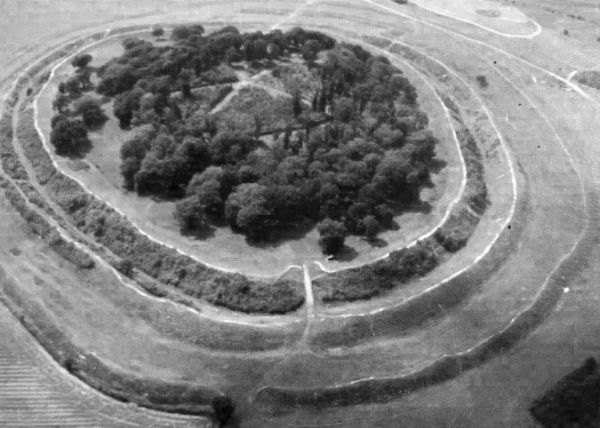
Ashe of Rings is in three parts. In the first, set in 1892, we follow Anthony Ashe’s return to his family home of Rings, a country house named after a three-tiered earth-mound topped with sacred stones in its grounds. (Butts based this on Badbury Rings in Dorset, of which she later wrote that “a great part of [my] imaginative life was elicited by it and rests there”, in “Ghosties and Ghoulies”, an essay on the supernatural in fiction first published in The Bookman in 1933.) Ashe knows he must provide an heir, someone to be guardian to Rings when he dies, and sets about choosing himself a wife on entirely utilitarian grounds. (His lack of emotional regard for the woman he marries, a local called Muriel Butler, is signified by the fact that he requires her to change her first name to Melitta once she’s married.) Melitta provides him with a daughter, Vanna Elizabeth Ashe, but by the time she follows that with a son, she’s in the midst of an affair with another local landowner, Morice Amburton, and it’s unclear if the boy is an Ashe or an Amburton. (To make matters worse, she slept with her lover on the sacred mound of Rings, making it a double slap in the face to Ashe.) Ashe dies soon after; Melitta marries Amburton, and Vanna, the girl who ought to be the new guardian of Rings, is sent off to a boarding school, and after that is given a small annuity, to keep her away from Rings.

Badbury Rings

In the second part, Vanna — known to her friends as Van — is grown up and living in moderate squalor in a London wracked by the First World War, making what money she can by various means including working in the nascent film industry. She occasionally comes to stay with a friend, Judy Marston, who’s having an on-off affair with a Russian painter, Serge Fyodorovitch. Judy, it turns out, is a rather cold and selfish woman who leaves Serge as soon as a more profitable partner turns up (the son of Morice Amburton, Peter, who has returned somewhat shellshocked from the war). Van nurses Serge through a post-breakup fever, then decides to take him on her first return to Rings in her adult life.

It’s only in the third part that things perked up, for me. Van begins to assert her guardianship of Rings, while Judy, using the wounded Peter, tries to oust her. Van now sees her former friend as embodying the sort of dark forces that are behind the war now raging throughout Europe:

“Have you known anyone who loves the war as Judy loves it?”

The Little Review, Jan-Mar 1921, where the first instalment of Ashe of Rings appeared

Rings itself, with its three-tiered mound and sacred stones, its mythic history tying it to Morgan Le Fay, druid priests, a witch called Ursula who wrote a strange book, and Florian Ashe who was crucified on the grounds by angry locals, has the air of a sacred place. Anthony Ashe called it “a priestly house, like the Eumolpidae” (these being the people who maintained the Eleusinian Mysteries in Ancient Greece), while Van says it’s “a place of evocation… where the shapes we make with our imagination find a body”. So, the battle for control over it has to be a magical one — or, rather, a Magickal one, because Mary Butts was a onetime disciple of Aleister Crowley, being named Soror Rhodon in his Argenteum Astrum order, and staying for a while at the Abbey of Thelema at Cefalu. (Which she came to hate, because of the lousy living conditions and poor sanitation, and which left her with a heroin habit — while Crowley hated her back, calling her “a large white red-haired maggot” in his autobiography, but nevertheless saying how grateful he was for her help in the writing of his Magick (Book 4)). There’s no summoning of demons or flinging bolts of magical lightning; rather, the confrontation between Van and Judy is through a symbolic (but still fraught) power-play on top of Rings late one night.

The Little Review, Sep 1921, with the second instalment of Ashe of Rings

Prior to this third part, I found the style of Ashe of Rings a bit too impressionistic and flighty, driven forward by a sort of impatience with words and almost no attribution of dialogue. The characters seemed distant, their outbursts of passionate speech more like a pose than human passion. But this element is very much of its time. Ashe of Rings is a World War I novel, set during a time when, for that generation, life probably seemed both incandescent and fleeting, full of brief bright moments amidst a welter of turmoil and darkness. Butts calls it “the world of the next event” — a world sustained by nothing but a chain of sensations — but nevertheless it was hard to really feel that any of the characters had any depth to them, let alone believe them when they say they love one another (and the next moment say they hate one another).

On a deeper level — on the Magickal level of its plot — this is a novel about a new generation — or part of one, a tribe, perhaps — trying to find its place in a world caught between old, outdated traditions, and industrial levels of darkness and death. How to define this tribe? In its own words it is chic, exotic, damned, wearing “scandalous, bright clothes”. Like Valentine Ashe (Van’s younger brother), it’s “an attenuated exquisite” who:

“Won’t play games. Acts in Greek plays. Keeps Persian cats. All he can do is ride and sail a boat. Worships your ghastly old manor. Goes in for science. Reads German…”

But also it’s a group that understands the sacredness of Rings — perhaps, understands sacredness at all — and though it has to redefine that sacredness in new terms, as those of its forefathers no longer work, it knows it must do so, because of the forces ranged against it: those who have sided with power, with greed, and with the War. As Peter Amburton, allied to those dark forces, says:

“I went out to the war. There I saw what life is. When I come back, I find you people still here… We’re going to clean you out of the world. That’s what the war’s been for.”

I was intrigued into reading Ashe of Rings because of Mary Butts’ being part of the neo-romantic movement of the interwar years, who sought to find new meaning in a rootedness in the English landscape, its folklore, and its magic. This made me think of both the new rise of Folk Horror, and of David Lindsay’s Devil’s Tor, which belongs to the same time. Ashe of Rings has some interesting resonances with Lindsay. It was written in 1918 to 1919 in Cornwall and London — so, in the same place and time as Lindsay was writing his first novel, A Voyage to Arcturus. And there’s one snippet of Rings lore Van mentions that hints at another Lindsay novel, The Haunted Woman:

“…there is a tower in Rings. In the tower there is a lost room… In Ursula’s day the room disappeared. No one has found it again. Only once in a while we walk straight into it.”

Mary Butts in 1919

Ashe of Rings has a few autobiographical touches. Like Van Ashe, Mary Butts’ father died while she was still young, after which her mother sent her off to boarding school and remarried. Mary was a great-granddaughter of Thomas Butts (1757–1845), a government clerk best known for being William Blake’s main patron, and in the house where she grew up there were a number of Blake’s paintings. Mary’s mother, though, sold these soon after the father’s death, and all this must surely have coloured Van Ashe’s relationship with her mother in the novel, who at one point she characterises as being “an almost infernal power”, drawing her “back again into the formulas of childhood”.

In her 1933 afterword, Butts calls the novel “a fairy story, a War-fairy-tale occasioned by the way life was presented to the imaginative children of my generation”, and one which was written under the “overwhelming influence of Dostoevsky”.

It was only in the third section that it really caught fire for me, but enough so that I now want to read her next novel, Armed with Madness (1928), which apparently mixes interwar bohemianism with the Grail myth.

^TOP