
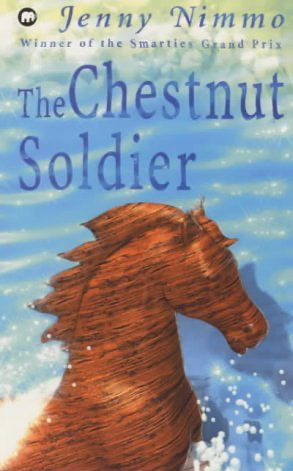
The Chestnut Soldier by Jenny Nimmo

Egmont 2001 edition

Four years have passed since the events of the previous two books in Jenny Nimmo’s Snow Spider trilogy, and The Chestnut Soldier (first published in 1989) feels a bit more grown-up, with boy magician Gwyn nearly thirteen and starting to notice girls in a different way (he thinks Nia Lloyd’s sixteen-year-old sister Catrin the most beautiful girl in Wales, but “Lately he had found it difficult to talk to her”). The narrative is divided between Gwyn and the now eleven-year-old Nia (the main character in Emlyn’s Moon), with Gwyn no longer feeling like the distant and wise boy-magician from the second book: he’s trying not to use his “power” (as he’s come to call it, thinking the word “magic” childish), partly because he keeps getting it wrong and making mistakes, but also because he feels he should be taller by now and is worried magic is stunting his growth.

One day, the Lloyds learn that their mother’s cousin, Evan Llŷr, is coming to stay. It has been ten years since they last saw him, and he’s now a major in the British Army. He has, though, been wounded somehow, and is seeking a place to convalesce. In his thirties, handsome and mysterious, he comes across instantly as something of a romantic figure. Nia thinks him “the prince from every fairy tale; he was fierce and kind—and immensely troubled”, and every woman in the narrative from Nia to Gwyn’s grandmother Nain are under his spell. Particularly so is Catrin, who neglects her boyfriend, an Irish lad called Patrick McGoohan, who likes to ride by on his horse to be admired, but now finds himself ignored.
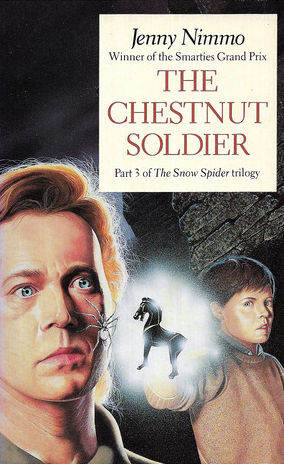
1990 edition, art by Bruce Hogarth

The mystery of Evan’s “wound” takes a while to come out. It’s not physical. He went into a burning building while posted in Belfast, to rescue some of his men who were trapped inside, but he was the only one to escape alive. These elements—his being a soldier, an association with fire, and a potential friction with the Irish—act as a sort of mythic-magnetic pull between him and a story that has already appeared in the first volume of the series, the legend of Efnisien, who maimed the King of Ireland’s horses when the King came over to marry Efnisien’s sister, and whose angry spirit became trapped in the broken wooden horse that was among Nain’s gifts to the young Gwyn. Now, this wooden horse uses Nia’s younger brother Iolo to get itself free of Gwyn’s control, and the spirit of Efnisien enters, or blends with, Evan.

After this, Evan becomes increasingly dark and cruel. Poltergeist activity begins to surround him, breaking young Iolo’s toy horses and Idris Llewelyn’s carved unicorn, and driving Patrick McGoohan’s horse, Glory, to madness. Books fall off shelves, plates break, storms descend on the town, and the Lloyd home looks like it’s been hit by an earthquake. Catrin is hopelessly drawn to Evan, even when his kiss is rough and not at all to her liking. He becomes a sort of Heathcliff figure, romantic and dangerous in a way that skews into the supernatural.

Gwyn realises he has to do something, and after another few failed attempts which increasingly convince him he was never meant to be a magician at all, travels back in time to speak with his ancestor, Gwydion Gwyn, to work out how to deal with this demonic force. (Gwydion, who anachronistically asks “You’re not blaming your genes, are you?”, assures him that he, too, made plenty of mistakes.)
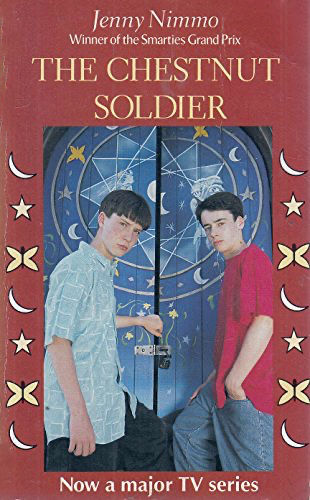
TV tie-in cover, 1991

Like the preceding book in the trilogy, the supernatural element in The Chestnut Soldier enters gradually, at first being indistinguishable from the story of a troubled but handsome man suddenly entering the lives of the Lloyds. But unlike with Emlyn’s Moon, there’s not so much of an alternative story to be going on with while the supernatural builds. (In addition, although there’s just as much light comedy as in the previous book, it doesn’t feel as light, couched as it is amongst much more serious-seeming darkness.) In both books, everything is resolved in a brief but confusing showdown involving magic and mythical figures, but whereas in Emlyn’s Moon this released all the tension in the mundane narrative in a way that made sense, here it’s unclear how—or if—Evan’s real-life troubledness is fixed along with his supernatural possession. Things are resolved, but they don’t really feel resolved—though this could be taken as part of the series’ growing up along with its characters, having them face messier situations and messier resolutions.

The “It’s another Harry Potter” style cover from 2009, art by Brandon Dorman

I was disappointed to find no return of the faerie-like “White People” from the first two books, particularly as they were the most intriguing element, for me. Here, Gwyn only thinks of them briefly, to note that his sister is surely happy with them, so he feels no need to try and bring her back, and besides, he’s grown up and she is now a perpetual child, so what would the two have to talk about? It seems rather dismissive and cold, particularly as I can’t help thinking that Bethan’s supposed happiness with the fairy folk is the sort of happiness a cult member has with their cult—it may require deprogramming to reveal it’s not happiness at all. (I think The Snow Spider could do with a Boneland-style sequel, where an adult Gwyn has to either rescue his sister properly, or at least face up to the reality of what happened to her.)

Like Alan Garner’s The Owl Service (which Nimmo hadn’t read, at least before writing the first book in the series), myth, here, is a thing that threatens to take over modern generations, replaying its tragedies and re-inflicting its suffering. But unlike in The Owl Service, Gwyn’s approach is to fight myth with myth: just as Evan becomes infected with the mythic presence of Efnisian, Gwyn allows himself to become, in part, his ancestor Gwydion Gwyn. (Which leads to some comic moments, as this Welsh ancient’s presence in Gwyn leads to him suddenly finding all sorts of aspects of modern life hard to deal with. Only, as this happens in the final chapters, with the darkness around Evan building, it’s hard to really feel the comedy.)

The series ends with Gwyn saying “I’m grateful for the adventure but I don’t believe I’ll need magic for a while.” Which leaves things somewhat unresolved—he’s still evidently living in a world where myth leaks through into reality, so how does he know he’s not going to need it?

For me, this may be the least successful of three books. The Snow Spider worked as an introduction to the difficulties and wonders of this world of myth and magic; Emlyn’s Moon was the most satisfying as a novel, with its nicely-balanced magical and mundane storylines; The Chestnut Soldier seems almost consciously messier, reflecting the main characters’ entry into adolescence and an awareness of greater moral ambiguity, but ultimately ending in a mood where the characters just felt they’d outgrown magic, as though it were their choice to make, in a world that seems dangerously fraught with myths and faerie.
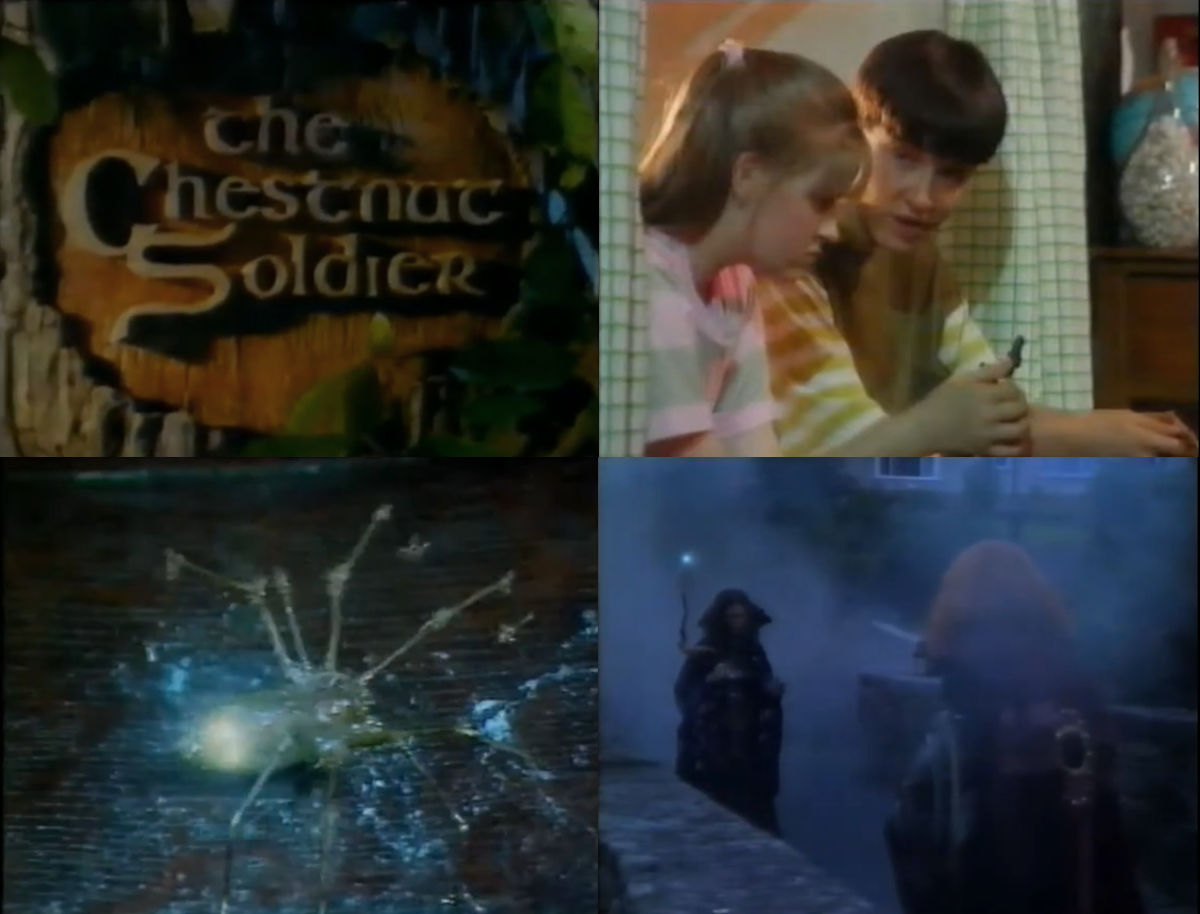
The 1991 adaptation of The Chestnut Soldier

Like its predecessors, The Chestnut Soldier was adapted for television, being broadcast in four parts in 1991 (produced by HTV Cymru/Wales), running from Wednesday 20th November to 11th December, and retaining all the same actors for the main roles. Interestingly, in McGown and Docherty’s encyclopaedic look at children’s TV drama, The Hill and Beyond, they say: “The Chestnut Soldier loses the subtlety of its predecessors, opting instead for a more teen angst approach”—but as I’ve said, this feels true of the book, too. I can’t help wondering how this third instalment would have been dealt with had the 2020 BBC adaptation got this far. On the one hand, that series clearly implied that there was going to be more of a showdown with the faerie-like people who’d taken Gwyn’s sister, and their by no means friendly intentions; on the other, how would a 2020s adaptation have dealt with the romantic relationship between sixteen-year-old Catrin and thirty-something Evan? It’s accepted without comment in the book (even from Catrin’s mother), but I can’t imagine how it would have been treated in the style of the more careful 2020 version of The Snow Spider.

^TOP

The Penny Tin Whistler by Sylvia Fair

Gollancz 1976 HB, art by Sumiko

This is Fair’s second novel for pre-teens/young adults, published in 1976. It has a number of similarities with her previous book, The Ivory Anvil, in that it combines a light touch of fantasy with a gentle tale about children exploring a landscape. Here, there’s a bit more of a threat to the landscape—though, again, a light one—and like the previous book there’s a mystery from the past to be solved.

The landscape in this case is the area surrounding a canal in rural Derbyshire. The Atkins family have just moved into Bickley Mill, a disused water mill in need of renovation. (Their father, a teacher, tells them it’s going to take two years to get it into the state he wants it in, including completely replacing the plumbing and installing an interior staircase, as at present the only way to get to the bedrooms is via outside steps. 1970s dad that he is, he intends to do all this work himself, with a little help from his kids.) In their spare time, the kids, twins Rachael and Rowan, explore the canal, and get to know Mr Benson, whose job it is to care for it. Like the mill, the canal is basically disused, and Benson is battling to keep it going, as he knows certain local forces—farmers and factory-owners—would rather it was closed for good. People dump rubbish in it, and others engage in outright vandalism. Unlike similar books such as The Grey Dancer and The Walking Stones, the threat to the canal isn’t a threat to a whole rural way of life, then. Rather, it’s an interesting piece of the past, one that adds charm to the landscape, and provides a habitat for local wildlife, including kingfishers, ducks, moorhens, swans, frogs, water voles, pike, carp, tench, roach and woodpeckers. Part of the appeal of the The Penny Tin Whistler is being allowed to dwell in this country environment with the kids as they explore it. (There’s even a map, spread out over three pages at the start of the book. It seems to have been cut off, though, and there was presumably meant to be more of it. I suspect the author, who was an artist and I’m guessing is the one who drew it, wanted it to be a fold-out. I certainly wanted it to be a fold-out.)

The fantasy aspect is, as with Sioned in The Ivory Anvil, a sort of enhanced sensitivity to people and to the past. Twins Rachael and Rowan have a telepathic bond: they’re always aware of where one another is, and though they can share thoughts, they’ve agreed not to be too intrusive. It also turns out, though, that they can pick up lingering memories from the past. It’s nicely done, as when Rachael finds an out-of-the-way nook under the ivy and finds herself thinking:

Me. Dressed in green,
Cat’s cradle,
Hairy string,
Knotted, beneath the ivy.

Only, she knows the “Me” isn’t herself. She’s picking up someone else’s memories. Rowan, meanwhile, gets impressions in his dreams. After some investigation, they discover that a pair of young twins like themselves used to live at the Mill, but were separated when they were evacuated during the War, after which their grandfather, who lived at the Mill and was their only family, died, meaning they never returned. (One slight niggle: why were they evacuated from such a rural spot?) Rachael and Rowan realise that these twins, being younger than themselves, and whom they know never returned, might never have been able to find one another after that separation, and perhaps that’s why they’re picking up these memories. (The title of the novel comes from what Rachael and Rowan call one of these twins for a while, as Rachael senses her, at one point, playing a penny tin whistle.)

Gollancz 1976 HB back cover, art by Sumiko

As with The Ivory Anvil, the investigation is dotted throughout the daily life of the twins as they go to school, help with the house, and explore the canal. But the quiet pace of the story never feels boring. The only complaint I have about the book, plot-wise, is it leaves its resolution so late that some points aren’t fully resolved. One of these is that, in order to fully access his dreams and learn where the lost boy-twin might be, Rowan has to mentally detach from the telepathic bond he’s shared with his sister since birth. This is a scary moment for him, and he wakes the next morning to find himself without it for the first time—in part, though, appreciating the sense of individuality and privacy that comes with it. But is it permanent? I’m supposing it is, but I felt there had to be at least one revisit, one exchange between the pair about the loss of their deeper connection, or something like that, just to resolve the issue. (The other main plot point that doesn’t get resolved is that, although the lost twins are located, we never get to see them, or know they’ve got together again. Perhaps that might have proved too emotionally weighty a scene compared to the rest of the book, but still, I felt it was needed.)

I found two reviews from the time, one positive, one negative. Juliet Page in the Times Literary Supplement wrote:

“Sylvia Fair knows well how children think, talk and act, and her twins, with their grouches and enthusiasms, are the genuine article. Though steeped in atmosphere, this adventure is set firmly in the everyday world of plumbing, homework, and conservation… As Sylvia Fair admirably demonstrates, it is possible to be both down-to-earth and enchanting. Her novel is to be thoroughly applauded; it is one of those delightful children’s books that reanimates one’s own memories of magical times spent in secret places.”

But Stuart Hannabuss in The Times, dismissing the book as “a generic package” in comparison with her previous novel, goes on to say:

The Penny Tin Whistler with its children in telepathic contact with spirit children of the past and with its workable theme of saving a canal, evokes a mood like Lucy Boston’s Chimneys of Green Knowe, but does little to bind the themes together or to pin down the people. Children grow used to themes cropping up again and again, but have every right to expect that a story should do its own work.”

(I wonder if he expected child readers to all be as well-read as himself.)

To me, The Penny Tin Whistler seemed a perfect follow-on from Fair’s previous novel, and I’d have been happy to read more in the same vein, but her next books were for much younger readers. At least she got a good cover, this time, though.

^TOP

The Ivory Anvil by Sylvia Fair

Gollancz HB, 1974

I came across this novel while looking up reviews for another book. It sounded just like the sort of 1970s YA rural fantasy (though the fantasy is very light) with an otherwise realistic air that I’ve been reviewing on this blog for a while. The Ivory Anvil (published 1974 in hardback, 1977 in paperback) was Sylvia Fair’s first novel, and was runner-up in the 1974 Guardian Children’s Fiction Award. It also got a reading on Jackanory in February 1979.

The setting is rural Wales, often a presence in these 1970s YA books, such as The Owl Service and The Earth Witch, but in this case there’s an added authenticity as Fair was born in Wales, and based the main character on herself as a girl.

Sioned Jones is the daughter of a pharmacist in Nantyglyn, the sort of village, nestled in the Welsh mountains, where everyone knows everyone. Artistic but somewhat shy, Sioned has recently befriended the far more outgoing and good-with-words Anna Lind, whose family moved to a nearby farm from somewhere in England. Anna’s father is a sculptor, which fascinates the artistic Sioned. One day, her mother sends her on an errand to buy a new basin from Dinah China’s shop. Dinah (real name Meredith) is known throughout the village for her fractious relationship with her older sister Eva, though the two have lived in the same house all their long lives. Leaving the shop, Sioned is called back inside by the other sister, Eva, who wants to show her something: the treasures their uncle brought back from China. Among them is an ivory cube, a three-dimensional puzzle made up of three hundred and forty three (seven cubed) pieces. “When you see real beautiful things like these,” Eva says, “other things don’t matter. You can sense the power that beautiful things have?” And the ivory cube certainly has that effect on Sioned:

“Of all the treasure strewn about the room this one small glowing piece of ivory held her open-mouthed and blank-eyed, compelling her gaze until everything else around it blurred. As though it were suddenly in command of her soul, forcing her eyes to stare, reaching out towards her in an effort to grasp her mind, giving out signals she knew not how to receive. What does it want of me? she thought desperately.”

1977 Puffin PB

Sioned returns to Dinah China’s the next day, to show her a drawing she made of the shop, and is bowled over when Dinah hands her the ivory cube, saying “A little problem for you to solve… I think you’re the one to do it.” Somewhat overawed to be in the care of this surely priceless object, Sioned can think of nothing to do but keep it in her pocket, even when she and her friend Anna go on a bike ride into the mountains. It’s only afterwards that she gets the chance to sit down and examine it — to find one piece, shaped roughly like an anvil, and “no bigger than a baby’s tooth”, is missing. Horrified that she’s lost something of immense value, Sioned vows to search everywhere till she’s found it.

But, heading out with Anna again to look for it — even though it could be anywhere on the “huge, rocky, heather-filled sheep-speckled mountain” — Sioned instead finds herself drawn downwards: “Like a migrating bird she followed some guiding instinct which was pulling, tugging her down the valley so that she flew as though on wings…”

Like two similar books I’ve covered recently — The Grey Dancer and The Walking Stones, both set in Scotland — a valley near to Nantyglyn has been dammed up and turned into a reservoir, though where the damming in those books was seen as a threat to the rural way of life and a potentially exploitative disruption of the environment, Sioned (and, presumably, the rest of the village) see the dam as nothing but a positive. For her, the reservoirs “added so much charm and character to ordinary, everyday valleys.” And the possibility of a new, more modern dam is even a thing to be welcomed:

“The building of a new dam would mean new routines, new people, opportunities for exciting things to happen.”

At this point, after low rainfall, the reservoir is almost empty, and the fabled Drowned House can be seen in the reservoir bed — or its remains, anyway. And it’s here Sioned finds herself being drawn. She’s already been dreaming of a young woman in old-fashioned dress, standing in a triangular room, and now she finds the outline of that room in the levelled brickwork on the reservoir bed. Inspired, she starts digging in the mud, and finds it: the anvil-shaped ivory piece. Returning to Anna’s house, she, Anna, and Anna’s older brother Robert set about the intricate task of disassembling the puzzle so they can replace the missing piece, none of them realising till after it’s done that such a piece couldn’t have come loose on its own. It wasn’t Sioned who lost it. It had, she learns when she returns it to the Meredith sisters, been lost since they were children, and their cousin Lizzie had died trying to retrieve it when the valley was flooded back in 1894.

Aside from the many similarities in setting and its light air of fantasy, there’s a lot that’s different between The Ivory Anvil and, say, The Owl Service, The Earth Witch, or even something less intense like The Wild Hunt of Hagworthy. Usually in a book like this, the main character would be the newcomer to the rural setting. Here, even though Anna would be perfect for that role, it’s Sioned who’s the main character. And this allows her love of Wales, its landscapes, people, and language to provide a warm backdrop throughout the book. (Sioned doesn’t speak Welsh — everyone, she says, stopped speaking Welsh when the dam was built — but she wishes she could, and vows to learn.) Also, in any other 1970s rural fantasy of this type, there would be some sort of class tension, but here, there’s none. Aside from the lost puzzle, in fact, the only tensions are within Sioned herself: her shyness, and her sometimes finding Anna doesn’t appreciate Wales as much as she wants her to (though Anna comes round without any need for a confrontation). Perhaps the only real conflict in the book is between Dinah and her sister Eva, rooted deep in the past.

Overall, it’s an evocatively-written, gentle and sensitive tale, with a touch of the fantastic and an idyllic air of dwelling in the landscape of rural Wales. The book got some positive reviews on its release, as in this from the Birmingham Daily Post:

“Her heroine is intelligent, artistic and passionately fond of her Welsh heritage, and struggles to sort out herself and the mystery of an intricate Chinese puzzle which is somehow linked to the past. The people and emotions are refreshingly real.”

And this, from Sarah Hayes in the Times Literary Supplement:

“…a story which begins slowly but gathers momentum as the pull of the past becomes stronger, and as friendship develops between two very different girls. Wales plays an important supporting role, and the compelling natural descriptions are essential to the story itself.”

Fair was born Sylvia Price in Rhayader, Radnorshire, in 1933. She studied at the Bath Academy of Art and went on to teach art for a while. She married Keith Fair (who would go on to become head of art at Grosseteste College in Lincoln), and had five children. Her next book after The Ivory Anvil was The Penny Tin Whistler (1976), which was followed by two books for younger children, The Bedspread (1982 in the US, 1983 in the UK) and Barney’s Beanstalk (1989). She returned to YA in 1997 with Big Talk. By the 1980s she’d remarried, to poet Bill Turner.

The Penny Tin Whistler is already on my to-read shelf. It’s about telepathic twins!

Sylvia Fair in 1983, in The Lincolnshire Echo

^TOP
