
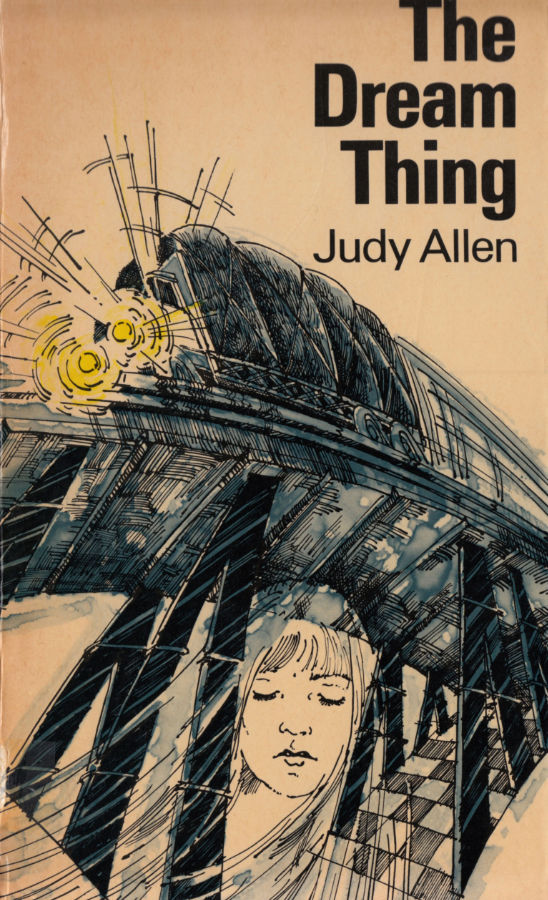
The Dream Thing by Judy Allen

cover art by Rowan Barnes-Murphy

As the 1970s moved towards the 1980s, and as punk rock replaced prog, it seems the inner city began to replace the countryside as the standard location for YA novels. Where formerly the natural world had been the more closely associated with childhood (endless summer holidays spent mucking around in fields), the inner city, with its more evident social problems, came to seem the more authentic, or at least relevant. Judy Allen’s first two YA books, The Spring on the Mountain and The Stones of the Moon, were firmly set not just in the country, but in the Earth Mysteries-flavoured country of Janet and Colin Bord’s Mysterious Britain—stone circles, ancient tracks, Merlin, Arthur, druids and so on. With her next two YA fantasies, Lord of the Dance (1976) and The Dream Thing (1980), the action moved to the town/city, and the fantasy element was no longer ancient forces in the landscape but dreams and the inner world.

(After writing on her first two YA fantasies a while back, I was hoping to review her next book, Lord of the Dance, but it’s been impossible to find a copy. Eventually, I gave in and read the ebook version that’s currently available, only to find something odd. It was originally published in 1976, but the ebook contained references to things like CDs and horror films on home video. I looked up some reviews for the original release, and even their brief plot summaries made me realise it must have been extensively rewritten at some point, presumably in the 1980s.)

The Dream Thing starts with its teen protagonist Jen sitting down to write a school essay about what matters most to her, and realising what she’s most concerned with is hate. Some gypsies have recently moved into a patch of unused land under a nearby motorway flyover, and she wants nothing more than for them to go away. She herself is half-gypsy—her father was a gypsy, though he was killed in a fight with his cousin before he could marry her mother, and before she herself was born—and now everyone at school is taunting her about “her relatives” having moved in, and asking if she’s going to join them.
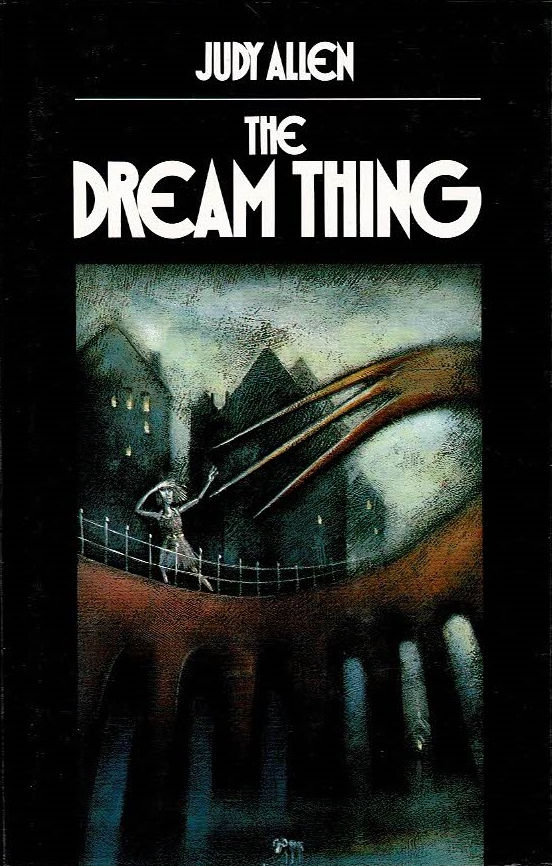
1990 reissue

She starts to have a frightening dream dominated by some monstrous thing, all sharp metal scales and a big tail spike. Convinced the gypsies (whom she early on confronts, telling them they’re not wanted round here) have put a curse on her—she also feels random sharp pains all the time, is convinced she’s going to die, and thinks she’s being followed—she draws this dream monster, in an attempt to work out what it might be. Having finished the drawing, she realises this dragon-like thing has no eye, so she puts one in, to finish it—and, like the old rabbi putting the final letter on the golem’s forehead, she feels something change, as though it has now come alive. Soon after, one of the gypsy caravans seems to have been attacked, with a large dent and suggestive scratches along its side, as though something big and rough had scraped against it.

Jen learns from her friend Tom (whose fascination with Native Americans, and his understanding of their persecution by European settlers, makes him sympathetic to the gypsies) that the land the travellers are on was bequeathed to the public over a century ago. Researching the exact wording of the bequest in the local library, she finds the land was actually given to the residents for their use, which, strictly speaking, excludes the gypsies; she brings the book to Tom’s and accidentally-on-purpose lets his parents (who are very much anti-gypsy) see it. Soon after, the police turn up in force to tell the gypsies to move on. They can’t immediately—one of them has recently given birth—so they’re given a week. Jen, weirdly open and honest about her dislike of them, takes the opportunity to let the head gypsy know that she was the one who provided the clue that meant they were going to have to move. But when she finds herself still gripped by nightmares of the dream-thing, her mother says the only thing to do is go to the gypsies and ask if they, with their knowledge of such things, can help.
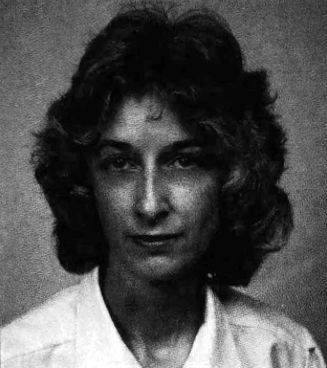
Judy Allen, from the 1990 reissue

Jen is plainly not what you’d call an entirely sympathetic character. Having decided it’s the gypsies’ fault she’s being bullied at school, she focuses entirely on wanting rid of them. In a way, the reader is left in the position of watching the car crash she’s making of the situation, how she’s letting this hatred of the gypsies take over her life, to the point where it acquires a supernatural life of its own. (And mentioning car crashes, I couldn’t help wondering if the patch of wasteland the gypsies occupy might be near the one where Maitland is stranded in Concrete Island, while Crash’s Robert Vaughan perhaps cruises by on the motorway above. Such hemmed-in remnants of the natural world took on a certain resonance in this time of cultural handover from countryside to city.)

But as an adult reader, I couldn’t help being aware of Jen as a troubled child (a teen, yes, but still a child) under serious pressure. The gypsies didn’t just kick off a spate of isolating bullying at school—which even her supposed friend Tom joins in with—their presence brings up Jen’s buried feelings about her father, whom she never knew, and his violent death. And all this is packed into the dream-thing: not only is it a scaly metal dragon-thing intent on attacking the gypsies, it’s also an armour-plated symbol of Jen’s own spiky self-protectiveness covering her emotional vulnerability. It’s also a thing that persecutes her, through nightmares and a sense that she’s being followed, just as this melange of hatred and fear is persecuting her. She’s a girl in serious need of guidance.

Her mother does make some attempts at help, but I can’t help feeling they’re woefully inadequate (though perhaps up to 1970s standards). Learning that Jen is being bullied at school, her mother says “they tease you because you rise to it”, as though it were basically her fault. In a midnight talk after one of Jen’s nightmares, after which Jen admits to feeling she’s going to die, her mother does at least talk about Jen’s father’s death, but goes on to say that Jen is too young to think about death and should just not do it. (Despite the fact that Jen’s father clearly died too young.) There’s a distinct sense of the adults giving one piece of cool advice, with an air of, “Well, I’ve told you how to deal with it, the rest is up to you.” (Jen’s best friend Tom, meanwhile, tells her “You share the Führer’s views on gypsies.” True—if exaggerated—but also perhaps a little unhelpful.) It’s the how of dealing with it that Jen clearly doesn’t have, and nobody guides her towards it.
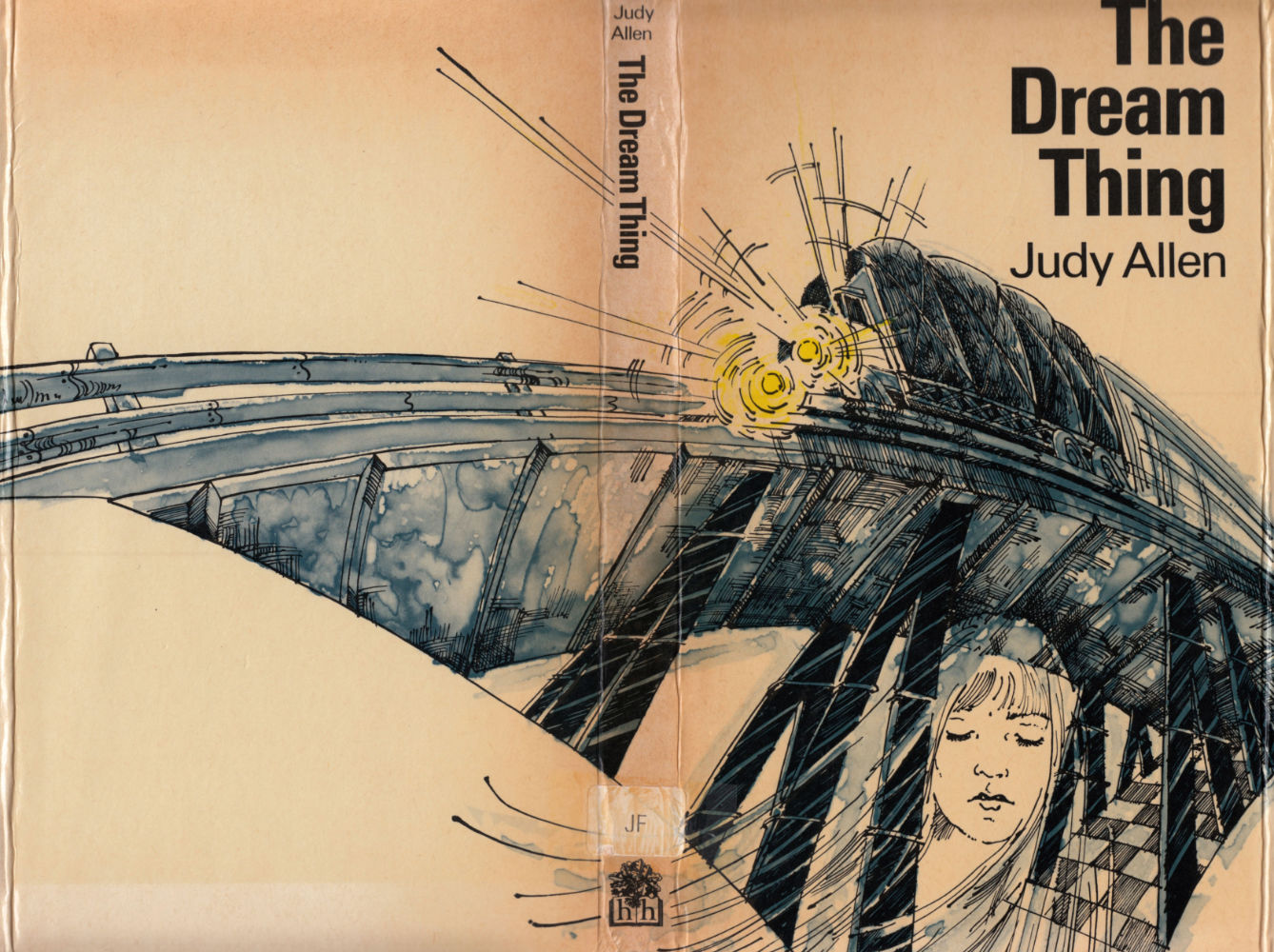
full wraparound from the UK first edition, art by Rowan Barnes-Murphy

Dream-fantasy like this, with a clear psychological grounding, can easily turn into straightforward allegory: Jen’s hatred of the gypsies gains a monstrous autonomy in the dream-thing dragon-scorpion whatever-it-is. Her hatred is monstrous, and the monster is her hatred. But that symbol, of the armour-plated spiky monster, has a lot more resonance than that—as I said above, it’s as much about Jen’s self-protection and self-persecution as it is her hatred. But I can’t help feeling that The Dream Thing resolves by treating it entirely as Jen’s hatred, and nothing else. The head gypsy tells her “Your dream… is born of your venom. It has nothing to do with us…” Which is perhaps a truth Jen needs to be told, but it’s also not the whole truth. The symbol of the dream-thing itself is far more eloquent than any of the reductive explanations, but there’s an air, at the end, of tying it to this too-simple explanation, and so leaving its many resonances unexplored. We’re left with a simple message: hate is bad, and it can take you over. But the roots of that hatred in fear and loss and isolation aren’t addressed.

(To give another example. Jen lives with her mother in a small flat, and the building is surrounded by a black metal fence with semi-ornamental spikes. The fence is only a short distance from the building itself, so what it’s protecting is a basically useless strip of land, and anyway, the fence can just be walked around, so its protecting nothing. It is, instead, an embodiment of the feelings people have about their homes, the need that they have a certain space around them, and an air of protection. In the limited space of a city, this has to be formalised into an ornamental fence and a tiny strip of land, but the psychological value is still there. The metal of the railings, and the spikes of the ornaments, clearly tie in with the metallic spikiness of the dream-thing, and bring out the feelings of self-protection rather than hatred in the dream-thing—though, such self-protection can also spill into hatred: the gypsies offer no threat, but so many people want them “not in my back yard”.)

I can’t help feeling that if the fantasy element had been given freer reign instead of being tied down to one interpretation, the ending might have been richer and more satisfying—a true resolution rather than a lesson only apparently learned. If, for instance, Jen had seen her own dream-thing in the metal/flesh, she might have seen herself in it, both her vulnerability and her spikiness. (A situation handled far better, and also with a dragon-sized thing of hate, disgust, and vulnerability, in William Mayne’s A Game of Dark.) But she doesn’t face it like that, it’s explained away. The fantasy loses its resonance, and becomes an allegory.

The Dream Thing’s ending does have a certain bleakness of realism. The gypsies are forced to move on. Jen’s friend Tom is no longer speaking to her, but she has a female friend in reserve, so it’s not the end of the world. It’s all part of the messiness of growing up.

It’s an interesting book, praised in its day for the realism of its characters, and certainly unafraid to take its main character through some uncomfortable emotions. It was reissued in 1990 (and, from a quick comparison of the text thanks to an Archive.org scan, it seems the same as the 1978 version, rather than being rewritten as with Lord of the Dance).

^TOP

The Spring on the Mountain by Judy Allen

Children’s Book Club edition, art by Kay Wilson

The Spring on the Mountain, first published in 1973, was Judy Allen’s first novel. It evidently had some success because, after being published by Jonathan Cape, it was brought out by the Children’s Book Club (run by Foyles) in 1974, and then as a Puffin paperback in 1977. Like her second novel, The Stones of the Moon (which I looked at a few mewsings back), it takes some traditional YA elements (city kids spending their holidays in the country get tangled up in a mystery) and brings them in contact with early-70s concerns, such as Earth-mysteries, sacred sites, and the oppressive influence of the past.

A trio of twelve-year-olds, Emma, Michael and Peter, are spending the end of their school holidays at the cottage of Mr and Mrs Myers. Mr Myers has recently retired from a city job to live on the interest from his savings in “a large cottage in a high moorland valley”, and his wife has decided to earn a little extra (and, perhaps, stave off boredom) by taking in children for the holidays. Emma, Michael and Peter haven’t met before, and are, it seems, from quite different backgrounds (though we only learn about Peter’s, that I recall, and then only that he has a “blunt Yorkshire manner”), and at first they fail to gel. But they go for a walk, and soon get introduced to some local mysteries: there’s a lane with a sort of dark-feeling, maybe-haunted corner, and beyond that, over the moor, reached by a straight path, a single mountain that Peter instantly decides he wants to climb.

The trio are introduced to a local old woman, Mrs White, who provides some no-nonsense explanations about lingering energies and powers within the earth. For the haunted lane, there’s this:

“At some time… fear has been felt at that place, very, very strongly. No one knows what the cause of the fear was, and it doesn’t really matter. That’s gone long ago. But the emotion itself has become trapped and repeats itself in an endless cycle.”

And for the mountain, Mrs White says that its remarkably straight approach is known as:

“…Arthur’s Way. That’s because some people an exceedingly long time ago had the idea that the Holy Grail was hidden at the top and that Arthur’s knights would have come this way in search of it.”

HB from Jonathan Cape

But Mrs White, it turns out, has had her own direct experience of the strangeness of the mountain. Years ago, she climbed it and found a spring which had a magically rejuvenative effect (“I was refreshed beyond all possible expectation. I felt more alive, more awake.”), and since then she’s always meant to return and divert the spring so it joins the river flowing into the local village, so everyone can feel the benefit. She, though, has got old — or perhaps some force is preventing her from being able to climb the mountain — so when she learns Peter, Michael and Emma are interested in going up, she persuades them to have a go at finding the spring and diverting it at the source.

Michael is established early on as being a sceptic as far as earth-energies and the like go, saying “I believe what my eyes tell me” — whereupon Mrs White ridicules him for having to believe, then, that objects in the distance are smaller than those that are close by. Peter, on the other hand, is of a more mystical bent, and has already had a vision of sorts by gazing into a crystal ball (though the Myers say it’s only a fisherman’s weight). Michael thinks Peter has “no intellectual discrimination at all”. Emma, meanwhile, keeps out of the debate. (Though Peter says “You want to believe him [i.e., Michael] because it sounds safer. But really you believe me.”)

It sounds like a set-up for an interesting exploration of scepticism and belief with regards to the supernatural, but by the halfway point Peter is proved right in his belief that “There are forces on the earth, you know there are.” “Why,” he continues, “shouldn’t a sort of life-force flow in straight lines?”, and Allen is evidently on his side, as she concludes the book with an author’s note:

“There really are ancient tracks, like Arthur’s Way, all over Britain. If you would like to know more about them and about how to discover if there is such a track in your area, you will find information in The Old Straight Track by Alfred Watkins and The View of Atlantis by John Michell, both published by Garnstone Press, London.”

Alfred Watkins was the first to suggest the existence of “ley lines” linking ancient and modern sacred sites through a series of straight lines. The View Over Atlantis (1969), meanwhile — “the book which”, historian Ronald Hutton says “more than any other, defined and energized the earth mysteries movement” — links ley lines to UFOs and flows of earth-energies, like the lung-mei or “dragon paths” of ancient China. This, and other post-60s beliefs, led to an alternative archaeology movement throughout the 1970s, though it wasn’t till Tom Williamson and Liz Bellamy’s Ley Lines in Question (1983) that the idea of ley-lines was subjected to more rigorous and academic interrogation, and found wanting.

None of this should detract from Allen’s book, but I have to admit I felt a slight C S Lewis-like sense that here the writer was, by making their own beliefs the justification for the fantastical elements in a story, going to skimp on giving their tale that deeper sense of reaching for the truly mysterious that a less dogmatic basis would have had.

Puffin PB, art by Jill Bennett

Michael, Peter and Emma climb the mountain, encounter some weirdness — including a Merlin-like figure called Aquarius who warns them away from diverting the spring, not because it shouldn’t be done but because it’s Mrs White’s Quest, not theirs — but the ending is a bit rushed. Why shouldn’t the kids divert the spring? Why should Mrs White be the one to do it, or attempt to do it? Why hasn’t she managed to do it? What would happen if she did? Or didn’t? These questions don’t get answered (nor the larger question of who’s deciding all this “meant to be” stuff), but we do at least glimpse the event that sparked off that haunted feeling in the lane (a hanged man, intense emotions, and a divergence in the straight track causing an energetic “whirlpool” where life-energies get trapped), thanks to Peter slipping briefly into the past.

There are similarities with other YA novels of the same era — William Mayne’s IT, for instance, with its need to rebalance some ancient boundaries in the land so as to lay a troublesome power — but Allen’s novel lacks the sense (in Mayne’s IT) of a redoubtable protagonist ultimately overcoming a supernatural difficulty in their own personal, if quirky, manner.

But I think that’s why it’s interesting to read the, as it were, second-rank offerings in a genre, just to find out what makes the top rank work. Garner, Mayne, John Gordon, and Penelope Lively bring in the supernatural but the focus is always on the characters first of all and, ultimately, the way they deal with these pervasive influences from the past, from myth, from the landscape: because, supernatural though they may be, they always tie in with the characters’ personalities and relationships, meaning they can be read without having to believe in anything but the story as a story. Allen’s, I think requires a measure of belief in earth-energies, and semi-human powers like Aquarius, who pop up to tell us that certain things are just meant to be this way or that way, but without any reason behind them. Not to believe means you can be left wondering what it was all for. (Though I am, of course, approaching these books as an adult. The top rank YA books can be re-read as an adult, less so the lesser works.)

^TOP

The Stones of the Moon by Judy Allen

UK HB, art by Pat Marriott

David Birch is the son of a professor of archaeology currently working on a Roman mosaic uncovered during the construction of a new motorway in a small Yorkshire town. Although he’s been taken out of school to be with his father as he’ll supposedly learn more on an archaeological dig, Professor Birch is happy to let his son follow his own interests. David fixates on a local stone circle, something his father — and, it seems, just about everyone else — has no interest in at all. Standing among the Weeping Stones, though, David gets a strong feeling of fear:

“He didn’t believe that they wished him harm, only that they were dangerous, unimaginably dangerous, just as heavy machinery in action is dangerous.”

Touching one of the stones as he leaves the circle, he gets an electric shock. These things, then, have a power, but what it is and what it’s for, nobody, at first, can tell him.

He bumps into a pair of local kids of his own age, Tim and Jane. Tim wants to be an ecologist when he grows up and is, as part of a school project, checking pollution levels in the local river, both above and below the local mill. He knows that downstream from the mill the amount of life in the river declines, but keeps wanting to double-check his results, not because he’s unsure of them, but because his father works at the mill and they need the money. Jane, meanwhile, has some unspecified connection to the stone circle.

Paperback from 2000

It’s not until David meets John Westwood, though, that he learns anything more about the Weeping Stones. John is, in the eyes of about everyone else in the book, just “some elderly hippie”. He’s fascinated by the stones, and has embarked on a fifteen-year-long project of self-education so he can understand them, a syllabus that not only includes history, archaeology and geology, but astrology and folklore. He believes the stones are associated with the moon, and tells David’s father the mosaic, when uncovered, will show that the Romans knew this too. When the mosaic proves to be of Diana, though, Professor Birch shrugs it off:

“I’ve come across them before, these people. The world of what you might call Alternative Archaeology is full of them. They give up everything of real value in their lives to prove something they believe to be external. In fact it’s all inside their own heads…”

“Or it could be,” David counters, “that he’s being true to himself. He’s given up all the things society thinks are important…” But David also starts to doubt Westwood when Tim and Jane’s father says the old hippie is into drugs, and doesn’t want his kids having anything to do with him. When David asks Westwood if it’s true, he says:

“I began to use drugs about five years ago in the hope of finding a short cut to the knowledge I was looking for… I met strange and magical things, but the only knowledge I found was this—that illusion blurs the perceptions even while seeming to heighten them… Now… I try to approach the truth as it should be approached, with directness.”

But, he admits, “the drugs I used are using me. They have left my mind just a little clouded…” When Tim and Jane’s father sees his kids with Westwood again — even though they’ve only bumped into him by chance — he gets the police onto him, and Westwood is taken away. Sure that he was onto something about the stones, David goes through Westwood’s papers (they were staying at the same boarding house) and comes to realise the stones do have a sort of power: they were created long ago to draw water up from deep in the ground so as to replenish the river in times of drought. Back then, they’d be activated by singing to them, but now it seems the sound of the machinery at the mill is providing a constant vibration of exactly the same note, and the stones are set to flood the town…

Judy Allen

Judy Allen’s The Stones of the Moon (1975) is a very short novel, chiming in with some of the folk-fantasy themes of the day, as well as the belief in “Earth mysteries” that took off in the 1960s, before going into flying saucer overdrive in the 1970s. As a YA novel, it doesn’t quite have the toughness of Alan Garner or the quality of Penelope Lively, but it does hit a few of the same notes. Tim, for instance, taciturn throughout most of the novel, at one point bursts out with an “it’s all right for you” type of speech about how it’s easy for middle-class David to talk about shutting down the mill to stop the stones from destroying the town or polluting the river, but his working-class family needs the income. But some aspects of the novel — such as Jane’s odd link with the stones, which never gets developed (I was expecting to find she was possessed by Diana, or something), or the fact that Westwood never gets his “I told you so moment” when the town is flooded — made me feel this isn’t quite as strong a work as the real classics of the era. (It was re-released in paperback in 2000, though, so it evidently had some staying power.)

What was most interesting to me was the attitude it takes to Westwood. It’s one of my fascinations with the culture of the early 1970s, how it deals with the aftermath of the late-60s upheavals not just in social change, but in imagination. The hippie era dumped a whole lot of weirdness into the culture, and suddenly everything, from aliens and UFOs to magical stone circles, ley lines and paranormal powers, not to mention psychedelic weirdness generally, were seeping into the mainstream.

Here, Westwood is dismissed by everyone as a slightly crazy hippie, mixing astrology with archaeology and using it to come to conclusions no one in their right mind would accept. His one-time drug use is latched onto as an excuse to dismiss him entirely. Even David, though drawn by his enthusiasm, starts to doubt him, comparing drugs, and the ideas they conjure, with the notion of the “fairy food” of folklore:

“In every story it is made plain that eating the fairy food is an irrevocable move, and that those who once taste it pursue it to the detriment of their lives, right to their lives’ end. It is never a beneficial or nourishing food; it is a teasing food, and it changes the personality.”

“So did the fact that Westwood had made that mistake [taken drugs] invalidate all his ideas?” It’s as though we’re also being asked, “Did the fact the hippies believed in so many crazy things mean that nothing they valued — all the social changes, and so on — is worth holding onto?”

Ultimately, in this book, Westwood is proved right, but, as I say, he never gets his “I told you so moment”, as though to keep his right conclusions at some distance from his unsound methods. Once he’s been carted off by the police, he’s not seen again — which is, perhaps, a symbolic ushering out of all that suddenly seemed slightly embarrassing, naïve, garish, or just plain wild-and-weird about the 60s, by the harsher side of reality. David is the one who’s left with Westwood’s ideas, to try to sort out what’s right and wrong, just as (it seems to me) Children of the Stones-era kids were perhaps being handed all that Earth-mysteries/UFO/psychic-powers craziness of the 60s as though to say: we don’t know what to make of it, you sort it out.

^TOP
