The Earth Witch by Louise Lawrence

UK HB, art by Ronald Himler

Having recently read Lawrence’s 1978 YA novel Star Lord, how could I resist following it up with 1981’s The Earth Witch, sounding as it does so much like a companion piece? And there are a few similarities between the two. Both, for instance, are set in rural Welsh valleys, and in both the teen characters find themselves dealing with the archetypal/mythic entity of their book’s title, both of which sound like one of the major arcana from an alternative Tarot deck laid down by the post-60s imagination.

In The Earth Witch, the main characters are a trio that recalls Alan Garner’s The Owl Service: we have an English brother and sister, John and Kate Henderson, whose parents have recently bought Tregarron Farm in Wales, and Owen Jones, Welsh working class to the English pair’s middle class, adopted son of Ifor and Gladys, who have worked on the farm and lived in its tenant cottage all their lives. Owen is Ifor and Gladys’s nephew, abandoned by his mother when she had him out of wedlock — “born on the wrong side of the sheets”, as Aunty Glad puts it — after which she left for America, where she’s now married and has all but forgotten her son. Though his aunt and uncle look after him like a mother and father, there’s nevertheless a mother-shaped hole in his life, just from the knowledge that she’s out there but not in his life.

Lions UK HB, art by Jeff Cummins

The book opens in February, as the first signs that winter may be on the way out bring a new sense of life to the valley. The three teens learn that a new tenant has moved into the dilapidated cottage of Mynydd Blaena, formerly the home of the eccentric (perhaps outright mad) Megan Davis, who was somehow involved in the death of a local man a little while back, and was then found dead herself in her isolated home. The new woman, Bronwen, claims to be a relative of hers. In fact, to Owen, she claims to be something more:

“I am her… I am her blood. The white roots woke me and I rose from the grave of her bones and her dust. I know all that she knew.”

Owen is the only person to offer Bronwen help with the cottage, though she seems more to resent than welcome it, while at the same time feeling it’s exactly what she’s due. She has her distinctly witchy aspects: control of a crow and a sometimes-vicious black dog, as well as a thorough knowledge of the magical uses of plants. And as winter turns to spring, her personality thaws. She starts to act like the mother Owen never had. She becomes a teacher in the local school, and her relationship with Owen shifts from the motherly to that of a lover. In the fullness of spring, she’s the May Queen at the village celebrations, though some locals still mutter darkly about what happened with Megan Davis and the ill-fated Gareth Llewellyn, and how they expect it all to happen again.

Ace PB, art by Winslow Pinney Pels

To Owen, Bronwen speaks openly about what she believes herself to be: not just the valley’s May Queen but a Goddess, at once Rhiannon of the Underworld, Blodeuwedd of the Owls, Angharad of the Lake, Cerridwen the Shape Changer, and the embodiment of Nature itself, who “gives life and destroys it, like the earth, like the seasons”. (In many ways, she’s a human version of the unforgiving Mawrrhyn mountain in Star Lord, a force that encapsulates all that nature gives in bounteous spring and summer, and the harsh price it demands in winter.)

She has moments of bitterness directed against the male-dominated modern world:

“Goddess I was once but they are despising me. They are setting up the male God in their own image and casting me down… You [men] are all one to me. All answerable for the crimes you have committed.”

She seems to come round when Owen reminds her she has “no right… to blame a single person for the sins of all”, but the cycle is started and just as she — and nature in the valley — gives of her great bounty in the year’s harvest, so she’ll demand her price. One life for all that she has given. And whose life but the boy she lavishes her greatest attention on?

Kate is the other character to feel something of Bronwen’s archetypal nature:

“Kate could feel her. She was cold in the river voices, hard in the heart of stones and black as hell. She was cruel as the peak of Pen-y-Craig and the look in the crow’s beady eyes. She was bats and moths and crane flies, everything Kate hated and feared…”

Yet:

“She seemed to embody the spring within herself; the song of the river over its stones, the wind through the sedge and the drift of willow leaves. She was the essence of flowers, the soul of the sunlit land, old as the maypole dance and eternally young…”

But in her case it’s what the sight of this powerful woman awakens in her own depths:

“Below the surface of herself Kate could feel something so hideous she could not bear to think of it… an instinct of blood sacrifices and fertility rites, ancient rituals of birth and death…”

“She doesn’t want love,” she tells Jonathan. “She wants worship.”
There’s so much in this novel that ties in with the strand of living-myth-meets-kitchen-sink-drama I love in 1970s YA (here lasting into the 80s). There’s rural Wales as a place on the border between myth and gritty reality, where folk beliefs sit unexamined alongside a fading Christianity, while both are being replaced by a scientific rationality that denies they exist — which simply means that those who encounter these mythic forces must do so without help. Modern and traditional ways rub together to produce a weird, magical, and often tragic friction. Like so many of these books, it’s about that 1970s balance point where the modern, technological, and rational meet the ancient, imaginative, and sacred: something that’s fading away, or perhaps only temporarily sleeping, and prone to rise up in all its dangerous, harsh, timeless and often inhuman power. As Kate says — talking simultaneously about Bronwen, the Goddess, and Nature all at once:

“The earth… That land out there… We’ve forgotten what she means. We’re not connected anymore. We just live on the surface and nothing touches us. We don’t think deeply of the soil and the stones and the hearts of the hills. We’re not part of the land… [We] just use her.”

The theme is just as relevant today, but I can’t imagine it being put in similar terms, framed as a sacred thing. Now, the landscape is a thing to manage, to care for, like a sick patient, not the wounded Goddess she may in fact be. The difference being that a sick patient may die, but a wounded Goddess is likely to hit back…

^TOP

The Wyndcliffe by Louise Lawrence

cover art by Anthony Maitland

I came across this book while looking for art by Anthony Maitland (having seen his cover for John Gordon’s Giant Under the Snow and wanting more). Louise Lawrence was the pen-name of Elizabeth Holden (1943–2013), and this was her third novel, published in the UK in 1974. (It came out in the US in hardback in 1975, but doesn’t seem to have got a paperback edition in either country.)

It opens with the Hennessey family buying a house in a remote spot near the village of Oakers Mesne. Hollies Place, as the house is known, stands atop the Wyndcliffe, an escarpment overlooking the River Wye. As well as Mr and Mrs Hennessey, the family comprises Simon, 22, who’s studying at the Royal Academy of Music; Ruth, 17, who at first thinks moving to so remote a part of the country will leave her cut off from the world, but soon finds that being from London makes her somewhat glamorous and interesting at her new school and it’s not long before she’s set up with a boyfriend with a motorbike; and Anna, 15, who is lonely at the beginning, and remains lonely as she fails to click with her new classmates.

The contrast between Ruth and Anna is set up from the start:

“Only eighteen months divided Ruth and Anna in time, but Anna seemed so much younger, still a little girl who showed no sign of growing up. Anna at fifteen was very different from Ruth at fifteen, and Ruth at seventeen had left Anna far behind.”

Ruth is destined to fit in, while Anna seems bound for the opposite:

“Ruth had always said she [Anna] wasn’t normal and now Anna knew what she meant. Anna didn’t care about pop singers, and Georgie Best, and eyeshadow, and what her hair ought to look like, and what she ought to wear. But worst of all Anna had never had a boyfriend. There was something wrong with her and they all knew.”

But Anna soon finds a friend. John Hollis is a poet and lover of the natural landscape that surrounds the Wyndcliffe, and he’s 22 years old — but he’s been 22 for nearly a century and a half, as he died in 1823. (Lawrence dedicates the novel to Keats, who is presumably the inspiration for Hollis.) Though both dead and insubstantial, Hollis can be seen and heard by Anna; what’s more, Anna can feel his sensations and emotions, and comes to see the natural world around her in an entirely new way thanks to his presence:

“Perfect. Everything was so perfect. Each feathered grass, slender, delicate, separate and perfect. She was afraid to touch them for fear they’d break. Every frond of bracken, intricate, tinted, perfect. Spiders’ webs, filigree strands, complex, woven, perfect. Everything sprang at her, alive, vibrant with colour. It was as if she became part of the sunlight, insubstantial, intangible, slipping through pink flower petals that brushed her face, smooth, china-smooth, strong and cold…”

If this novel is a kind of supernatural teen romance, it’s clear from the language it’s not a romance between Anna and John Hollis so much as it is between Anna and the landscape, which takes her up and caresses her with its poetry:

“She was helpless in the booming wind. It clutched her with hollow hands as it beat on the percussion sky. It touched her with gentle fingers that played the harpstring trees. She was drowning in the sky full of sounds. Sinking and there was nothing to hold. She reached out for the moving wings, the drifting leaves, the propeller parachutes of white whirling seeds but everything eluded her. She was left to sink. But her falling brought no fear, only a thrill for she was buoyant and the wind always held her.”

Where Anna was lonely before, she comes to learn to appreciate solitude — that is, the solitude of being with John and the countryside that surrounds the Wyndcliffe:

“Solitude and loneliness, John had told her they were different. Once she’d been lonely, she’d had no one and she’d found it terrible to be alone. But now she chose it and was glad.”

back cover detail from the UK HB, art by Anthony Maitland

The Wyndcliffe started by reminding me of other YA novels in which the (often lonely or troubled) protagonist’s coming of age is achieved through contact with a supernatural entity, as in John Wyndham’s Chocky, or William Rayner’s Stag Boy. But whereas Chocky is being told through the sceptical father’s eyes, and he can never be sure, till the final chapter, that Chocky’s not just an imaginary friend, so for most it the whole thing’s treated with a sort of parental indulgence, the second half of Wyndcliffe is all about the very serious struggle to wrest Anna from her relationship with Hollis.

US HB. Art by Stephen Bommell (if I’m reading the signature correctly)

But it’s not her parents who do the wresting. Mr and Mrs Hennessey don’t stay around long enough to establish themselves as characters. Mr H has to go on a month-long-plus business trip to the States, and Mrs H goes with him, leaving Anna and Ruth alone in a new house. Ruth starts to suspect Anna has a boyfriend and follows her to find out who it is, but only sees her sister wandering the countryside talking to herself. When she hears Anna calling out John Hollis’s name, she asks around and though what she hears is clearly folklore, it’s evident this John Hollis is dead. There’s tales of “Mad Edie” who also walked about talking to him, and a story that, because he took the stone to build Hollies Place from the Wyndcliffe, he’s been cursed to haunt that location till he’s driven enough suicides over the cliff’s edge to repay each pound of stone with a pound of flesh. Ruth at first doesn’t believe it, but she can see it’s driving Anna to spend too long in the foul weather, making her ill. She calls Simon back home, and suddenly the pair are like stand-in parents — though far from ideal ones. Simon is condescending, still treating Anna like a little sister half her age and threatening to smack her if she doesn’t simply obey him; Ruth is indifferent and at times doesn’t seem to care if Anna is determined to self-destruct.

But both come to accept, to some degree, that Hollis is real. Both even talk to him, despite not seeing or hearing him: Simon to castigate him for preying on someone who’s still just a girl, Ruth to tell him to face up to reality — the reality being that he’s dead, and ought to act that way.

from the spine of the UK HB, art by Anthony Maitland

There are moments when the book teeters on the edge of Owl Service territory, with Ruth unintentionally taking on the appearance and manner of Sorrel Lancet, the girl who Hollis originally fell in love with, and who his attempts to please led to his early death. Is there to be a replaying of past tragedies? But ultimately, John Hollis is not the implacable force that haunts Garner’s Welsh valley, and Anna, by the end, achieves a new depth and maturity, though on her own terms. She doesn’t give in to Simon and Ruth’s demands she behave and fit in, but neither does she become wholly unworldly like Mad Edie. She hardens, but only to the extent of accepting that life for someone as sensitive and imaginative as she is will likely be tough, and not to the extent of giving up on being who she truly is.

Lawrence wrote a sequel, Sing and Scatter Daisies, published in 1977, but it’s pretty hard to find at a reasonable price, so it might be a while before I read it (if I ever get to). Instead, I think I’ll try some of her other books. She clearly has a way with language — she’s brave enough to give us a full poem from Hollis at one point, and it doesn’t fail to convince — plus a sensitivity for the solitudinous, imaginative type of soul that used to so populate 1970s YA.

^TOP

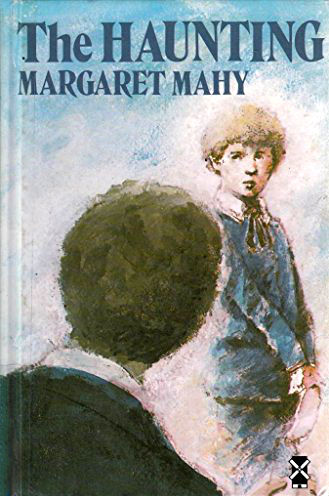
The Haunting by Margaret Mahy

1986 paperback, art by Alun Hood

Researching Robert Westall’s The Scarecrows for a recent Mewsings, I was intrigued by the book that won the Carnegie Medal the year after it, Margaret Mahy’s The Haunting, which was published in 1982. Mahy, it turns out, was another who, like Westall, won the Carnegie twice.

The Haunting opens with young Barney Palmer seeing a ghost. He’s not entirely shocked, as he’s seen something similar before — though these were more by way of extremely vivid imaginary friends he’d had in his earlier years — but is a bit concerned by what the ghost says:

“Barnaby’s dead! And I’m going to be very lonely.”

Barney’s full name is Barnaby, after his great uncle, and he can’t help wondering if the ghost is telling him he’s going to die. When he gets home he finds his two sisters (both older) waiting for him, mostly silent Troy (the oldest) and her wordy opposite Tabitha (who intends to be the world’s greatest living novelist). They’re bursting to tell him the news: Great Uncle Barnaby has died. Partly in relief, partly in fright, Barney faints.

1984 Heinemann HB

Great Uncle Barnaby Scholar is a relative on the children’s mother’s side. She died giving birth to Barney, and the Palmers haven’t since had much contact with the Scholars, particularly after the kids’ father remarried (to Claire, who, contrary to all YA novel expectations, is a wonderful step-mother, loved by her step-children). One of the reasons, perhaps, the Palmers have seen so little of the Scholars is that the Scholars are an off-putting bunch, largely due to their matriarch, Great Grandmother Scholar, a judgemental and unforgiving old woman whose intensely controlling way with her children has left them all slightly damaged. As Great Uncle Guy says:

“My mother wasn’t a woman who enjoyed having children… She would have preferred to have a set of chessmen, I think.”

And:

“She clipped and pruned us as if we were a family of standard roses.”

It turns out one child escaped her clipping and pruning — at least for a short while. Not present at the funeral, and not mentioned till the subject can’t be avoided, is Great Uncle Cole, the boy who ran away and was, it seems, drowned shortly after. He and his mother didn’t get on (they were “at war from the moment he was born”), and he’s since become, as Guy says, “a guilty secret, and it’s always been easier just to be silent.”

Orion PB, 2018

It’s evident, though, that Great Uncle Cole is still around in some form, for he’s the one haunting Barney. This is confirmed by a scrapbook Barney finds while at the Scholar household, containing a photo of Cole that looks exactly like the ghost he saw — and which immediately spawns inky words, writing themselves on the page before his eyes: “Barnaby’s dead! And I’m going to be very lonely.” After this, Barney finds his world increasingly invaded by visions and messages from Cole, as well as the constant awareness of his presence:

“Someone was walking behind him — a long way off — still hidden in a misty distance but coming closer and closer, holding out a hand lined with the map of another world — a magical world, wise and beautiful perhaps, but not Barney’s own.”

The visions are:

“…little pictures, coming and going without warning… things that someone else was seeing… They were given to Barney as presents, as promises, for the person who was seeing these things thought they were beautiful and wanted to share them with someone.”

But they’re scary all the same, because Cole makes it clear he’s coming for Barney, to claim him and take him away, and there’s nothing he can do about it.

Apple PB from 1987, which may be spoiling part of the plot

But while Barney lapses into despondency, his would-be-novelist sister Tabitha is keen to do something, because, in an unusual move for a ghost story, she also saw the writing appearing around the photo in the Scholar scrapbook, and needs no convincing it’s real. The only reason she can’t immediately enlist adult help is that Barney insists their stepmother Claire shouldn’t be told, because she’s pregnant, and Barney (whose birth resulted in the death of his natural mother) is terrified of causing Claire any worry in case it increases the chances that she might die, too.

Cole, Tabitha learns, is or was a “Scholar magician”, a type the family produce every generation or so, someone with “powers and peculiarities” that “have nearly always brought misfortune on them and on those around them”. They can make things happen, induce visions and create objects out of thin air. Cole’s powers seem too strong for Barney to resist, and he tells Barney he’s a Scholar magician too, and so is best separated from his “normal” family, just as Cole himself had to escape his.

The Haunting treads a line between the comic (usually when in the company of Tabitha, to whom everything is material for her novel) and the despondent (for Barney), and builds up to something like a supernatural equivalent of Mike Leigh’s Secrets and Lies, where a family get-together, plus an unexpected guest, results in a whole host of long-held secrets tumbling out into the open. (None of The Haunting’s were complete surprises to me as an adult reader, but may well have bowled me over in my early teens. Still, the revelation scene was very satisfying.)

Puffin 1999 cover, by Mark Preston

In essence, The Haunting is about how a family can become entirely skewed by its need to repress some innate characteristic. To all outward appearances such families are entirely “normal” — perhaps, even, a little too normal for comfort, being too regimented and controlled. Here, of course, that characteristic is magical ability, but I tend to read it as a metaphor for other, similar tendencies families can feel the need to repress, particularly in more buttoned-up times, such as creativity, sensitivity, particular emotions, or even all emotion. All of this is centred on Great Grandmother Scholar, who is unrepentant to the end, even when everything’s explained and in the open:

“I’m not one of your weak, whining ‘sorry’ people. I’m too old to be sorry for anything now.”

The Haunting was made into an hour-long children’s TV film in New Zealand (Margaret Mahy’s homeland) in 1987, as The Haunting of Barry Palmer. Perhaps because it was a co-production with a US network, it has some good effects for a kids’ TV show of the time (it seems to have had a slightly higher budget than an equivalent UK show, anyway), and only alters the plot to bring a bit more explicitly magical conflict on screen. (It can be seen, cut into 10-minute segments, at NZ On Screen. It’s probably on YouTube, too.)

(There seem to have been a few supernatural/science-fictional kids’ TV productions in New Zealand around the same time, and it’s a pity they’re not more available in the UK. There was Under the Mountain in 1981, based on Maurice Gee’s novel about telepathic twins, and the TV-original Children of the Dog Star in 1984, which features those two 80s standbys, unscrupulous property developers and child contact with aliens. I wonder if there are more. Do tell me if you know of any.)

Mahy’s second Carnegie win was for another supernatural YA, The Changeover (1984), and odds-on I’ll be reviewing that in Mewsings some time soon.

^TOP