The Scarecrows by Robert Westall

1981 HB, art by Gavin Rowe

Six years after the death of his father, 13-year-old Simon Wood (“Awkward age”, as one character puts it) learns his mother is to remarry. Simon pretty much worships his father, a major in the army who was killed in Aden in circumstances that hint he may have been acting a little more imperialistically than he should have. His mother’s new man, Joe Moreton, is his father’s opposite: “pacifist, ban-the-bomb”, an artist no less (a newspaper cartoonist and painter), a man who rose to success from a working class background, with the result that he has, to Simon’s mind, “too much money and no sense of how things were done”. Simon — who comes across as a bit of a snob, for instance in the way he’s ashamed of his school’s plastic guttering — finds him “animal and yobbish”.

Worse, Simon learns what’s going on not from his mother, but through an overheard conversation at the art gallery where she works. They’re having a show of Joe Moreton’s paintings and cartoons, and Simon, bored, drinks a few complimentary glasses of wine before hiding away behind some decorations. From there, he hears a couple of snide, gossipy patrons talking about Joe Moreton and “the brigadier’s daughter”. “Hot little lady, that one,” one says, before Simon realises they’re talking about his mother. I love how Westall describes the moment Simon is found and confronts his mother and Joe:

“Then suddenly, without a thing being said, everybody knew that everybody knew.”

PB, art by Alun Hood

The next thing, Simon’s mother is informing him they’re selling the family home in Croydon and she and Simon’s young sister Jane are moving up to Joe’s house in the village of Gorsley in Cheshire. Simon at first refuses to go with them. He’s a boarder at a private school, and is going to spend some of his holidays at an army camp. But when that’s finished, he relents and hitchhikes up to join them. (So we now have drinking alcohol and hitchhiking unaccompanied, both at age 13. There’s worse to come.) But he takes one look at how close his mother, sister, and Joe have already become — loving and playful, warm and far more domestic than his own father ever was — and just has to run away from it. Taking refuge in an abandoned mill in the next field, he spins a fantasy around three old coats hanging on the wall, of:

“…a mum who stayed home and was always there when you needed her; a father around who you could help and ask questions.”

But when he finds a starving cat and her kittens near the mill, he goes back to his mother so they can help the kittens. He can show a fierce, almost angry protectiveness for this helpless animal family, but can’t show affection for his own human one. He agrees to move in with his mother, sister, and step-father, but is constantly finding himself driven to destructive attacks against Joe and his mother. (As he owns his father’s army kit — his most precious possession — he at one point ends up with a loaded revolver. At age 13.) And this is where the supernatural starts to find its way in.

Puffin PB

Simon sees three scarecrows in the field by the old mill. They weren’t there before. He feels there’s something familiar about them, and finds himself constantly watching them. When he finally connects them with a story he’s heard about the mill — a love-triangle that turned murderous — and connects that with how he feels about his mother and her new husband, he starts to grow afraid. And each day, the scarecrows get closer. Even if Simon knocks them down, the next day they’re up on their stilts again, heading for him.

Simon obviously has “issues”. He has sudden, uncontrollable bursts of anger he calls his “devils”. The only emotion he’s been taught to process is fear, and that by his father, whose advice was to turn towards what you fear and deal with it in the most confrontational way — which may be what finished him off. This is why Simon’s grief for his father is so unacknowledged and unprocessed, until it becomes so strong it can only be dealt with as anger. And how does he deal with the many complex emotions brought up by his mother’s remarriage? Anger. And one of the first things we learn about Simon is that his anger, his “devils”, have left him “very frightened of himself”. So, if his only way of processing fear is through anger, and that anger makes him afraid of himself, it’s no wonder he’s messed up.

The scarecrows, seemingly driven to relive a past event through Simon’s pent-up emotion (a situation that recalls Alan Garner’s Owl Service and Penelope Lively’s Astercote) are themselves things of unresolved, frustrated anger:

“They had lived on their own hate for thirty years, and it was a thin, bitter, unsatisfying thing.”

US cover

Reading The Scarecrows is like being jostled between Simon’s increasingly unpleasant outbursts (calling his mother a whore, waving a loaded revolver) and how poorly he is dealt with by his mother and step-father. It’s evident nobody has helped him process the death of his father — he has been stuck away in a private school most of the time, with fellow pupils as likely to bully him as befriend him. While his sister has had plenty of time to get to know Joe Moreton as a person, and so love him as a stepfather, it’s a done deal by the time Simon gets to know him. And while his mother, thanks to Joe, is only now learning how unloving her first husband was, how self-destructive and ultimately afraid of the human part of life — “afraid of going grey, getting old, coming home every night and letting the kids jump all over him while he was watching the telly” — she doesn’t give any thought to how having such a father must have affected Simon, how it must have taught him all the wrong ideas about what it was to be a man. “I never knew what love was, till I met you,” she tells Joe, but doesn’t seem capable of passing the lesson on to her much-in-need-of-it son. It’s a situation of emotional blindness in one generation inculcating it in the next, and so perpetuating the misery.

The Scarecrows was first published in 1981, and won the Carnegie Medal (making Westall the first person to win it twice). Published for the first time today, I think any review would likely bring up the term “toxic masculinity”. For here we get a look at its origins in the ways some families deal — or don’t — with that “awkward age”, and with such supposedly un-masculine emotions as grief and vulnerability. Troubled boys, forced to act like little soldiers, become hounded by devils, and end up acting like them.

Penguin 2016 cover

The Scarecrows doesn’t spell this out, but leaves it to the reader to judge both Simon and his situation, which seems to be another characteristic of the more powerful YA novels of that era — an often unflinching harshness of material, dealt with in a very matter-of-fact style, and no explicit authorial judgement. In this way it reminds me of Alan Garner’s Red Shift and William Rayner’s Stag Boy. But also of Patrick Ness’s A Monster Calls, proving it’s not just a thing of that era, after all.

I didn’t feel The Scarecrows had quite the cathartic resolution it needed — I’ve no sense that anything is definitely going to change for Simon, though it’s certainly not as bleak as Garner’s Red Shift — but it’s a powerful novel all the same, and certainly makes me want to read more from Westall.

^TOP

Harry Potter and the Prisoner of Azkaban by J K Rowling

Art by Jonny Duddle

…So, maybe bathrooms aren’t that important in the Harry Potter series, as they don’t feature at all in the third book. Harry Potter and the Prisoner of Azkaban (1999) feels different in a number of ways from the first two books. The basic elements of a Harry Potter story are here — the eruption of magic into the Dursley’s ultra-mundane lives at the start, leading to a spectacular magical-form-of-transport escape (this time the Knight Bus), a visit to Diagon Alley (the Harry Potter equivalent of James Bond’s visits to Q before a mission), a new Defence Against the Dark Arts teacher first encountered outside of Hogwarts, Quidditch, Quidditch, and more damned Quidditch (too much Quidditch in this one), a dark character assumed to be the cause of the main evil but who turns out not to be (previously Snape, then Malfoy, now Sirius Black), an underground chamber (or at least one reached by an underground tunnel) where we get a long exposition before a showdown with the actual evil… But some of the other elements I listed as part of the Harry Potter “formula” in my entry on The Chamber of Secrets are getting a lot more tenuous. The magical item unknowingly acquired in Diagon Alley that turns out to drive the rest of the plot, here, is Ron’s rat. He’s been around for a lot longer, of course, but his oddity (his long-livedness) gets highlighted in Diagon Alley for the first time. Ron and Harry don’t, as they do in the last two books, venture into the Forbidden Forest to meet a dangerous-but-neutral magical creature and gain a vital clue, but Sirius Black has been living in the Forbidden Forest for most of the novel; he just comes out to meet them. And the usual resolution, where Harry pulls a magical object out of an item of clothing — a pocket, a hat — might in this case be fulfilled by Peter Pettigrew, who emerges from Ron’s pocket.

Cliff Wright cover

Perhaps most different to the previous two books is that this is the first in the series (the only one, I think) not to feature a personal appearance by Voldemort (or even a fragment of him). This easily might not have worked — normally, you’d expect each book in a series to up the stakes each time — but actually it allows for a much more satisfying and complex resolution, as it can’t all be explained away as the actions of pure evil, but of human beings in all their complexity of flaws, failures, and virtues. By not featuring Voldemort, the third Harry Potter book actually takes the series up a notch in terms of moral and emotional complexity.

I do think that this book — which is half again as long as either of the previous two — feels a bit baggy in the middle, with a lot less focus, and a few scenes on the soap-opera-ish side that add a little colour to the characters but nothing to the plot. Plus, it’s particularly Quidditchy, and Quidditch — whose matches are, in a way, echoes of the main story’s Eucatastrophic endings, with Harry snatching the Snitch out of nowhere to win the game, just as he pulls a Philosopher’s Stone from his pocket, or the Sword of Gryffindor from a hat — feel a bit manipulative in story terms, as it’s all about Harry feeling bad (when his team loses) or good (when he wins), but without gaining any knowledge or interesting experience en route. (Except for the usual mid-match attempts on his life, I suppose.)

But the ending, as I say, is the best so far — helped no end by being a double ending, as the final events are replayed by Harry and Hermione’s use of the Time-Turner, giving them a much-needed nudge towards another (but not wholly) happy ending. That’s satisfying on a plot level (and it’s done even better in the film, where they have a lot more fun with it), but there’s also deeper emotional satisfaction in Harry’s finding he’s gained a godfather and thinking at one point he’s seen his father.

Brian Selznick cover

There’s a lot more of a personal connection between Harry and the past events that drive this book, too. There’s always the connection of Harry wanting to get his own back on Voldemort for killing his parents, of course, but here we learn a lot more about Harry’s father and his friends at school, and how one of them betrayed him, and how another took the blame. We also learn that Harry’s father and his friends weren’t entirely “good”, as they played a prank on a young Severus Snape (who, in this book, is at his most venomous and mean) that could have killed him. For added poignance, we get to witness a moment whose significance it’s easy to miss, as it’s not underlined in the text, as Harry finds himself in a position very similar to that of Voldemort on the fateful night when his parents died. Voldemort wanted to kill baby Harry, but Lily Potter stood in the way; now, we see Harry wanting to kill Sirius Black (who he thinks is responsible for his parents’ death), only to have Crookshanks the cat leap in the way. It’s like a test of how different Harry is from Voldemort — or, maybe, it’s a living flashback. And Harry’s been having plenty of those, thanks to the Dementors bringing back in vivid detail his mother’s screams on the night she died.

Olly Moss ebook cover

I said in my entry about The Chamber of Secrets that memory and memory-related magic were important to the series, and it’s even more true in this book. Rowling finds all sorts of ways of bringing the past alive as a living force. It can be in characters who were thought to be dead coming back to life (Peter Pettigrew), Harry’s Dementor-driven flashbacks (traumatic memory as a source of weakness), or the counter to them, where positive memories can power a Patronus (memory as a source of strength). Harry and Hermione’s use of the Time-Turner to revisit their own close past and make a few changes is like another version of the series’ use of relived memories (the Mirror of Erised in Stone, Tom Riddle’s diary in Chamber, and Dumbledore’s Pensieve later on). Meanwhile, the malleability of memories and stories about the past are highlighted by Peter Pettigrew’s faking his own death to frame Sirius, but also perhaps in this book’s other memory-themed thread, Divination, where prophecies are a sort of memory of the future, and just as deceptive as memories of the past. (And just as powerful in their ability to reshape the world, too, as comes clear in a later book, where we learn Voldemort’s motive in seeking Harry that night — and thus bringing about his own demise — was down to his believing one particular prophecy.)

Recovering — and correcting — memories and stories of the past, in this book, are part of Harry’s role as a truth-seeker, which can lead not just to a sense of the truth revealed but to a righting of wrongs. Given the chance to kill Pettigrew, the man who brought about his parents’ death, Harry decides to hand him over so his story can be told, meaning not only will Pettigrew get his proper punishment, but Sirius Black can be absolved. As Dumbledore says, in one of his wise summings up at the end of the book:

“Didn’t make any difference?” said Dumbledore quietly. “It made all the difference in the world, Harry. You helped uncover the truth. You saved an innocent man from a terrible fate.”

Kazu Kibuishi cover

And it’s no surprise that a book with such a title as The Prisoner of Azkaban is full of prisons both literal and metaphorical, as well as escapes from them. There’s Harry’s escape from the Dursleys in a burst of magic (and a certain amount of wild-talent psychokinesis, too, which makes this now-teen resemble Stephen King’s Carrie, in a way — both get locked in cupboards by their parent/guardians, after all). There’s Sirius’s escape from Azkaban. There’s Harry’s being told to stay at the Leaky Cauldron and Diagon Alley till he’s released by the arrival of the Weasley clan. There’s Buckbeak’s escape from a sentence of death. There’s Pettigrew’s escape from a self-imposed imprisonment as Ron’s rat. Hogwarts becomes a sort of prison for Harry when he doesn’t have the signed form to let him visit Hogsmeade — until he escapes with the aid of his sneaky magical possessions, the Cloak of Invisibility and the Marauder’s Map. Hermione gets herself trapped in a self-imposed prison of too much schoolwork, till she sets herself free by admitting how much she’s expecting of herself (which is also part of the theme of mental illness that runs through the book, including Lupin’s self-injuring when he struggles with his wolf-side, Harry’s traumatic flashbacks, Sirius Black’s purported “madness”, and Hagrid’s despair at Buckbeak’s fate). Harry learns to escape a little from his own past, too, by learning to counter the traumatic memories the Dementors bring out in him. (And I can’t help likening Harry’s fainting fits before the dark-hooded Dementors to a wounded Frodo’s wooziness before the Nazgûl in Lord of the Rings.)

Along with this theme of imprisonment and freedom is one of punishment and retribution. As usual, it’s introduced in comic form in the Dursley section, with Harry having to pretend he goes to school at “St Brutus’s Secure Centre for Incurably Criminal Boys”, which leads Aunt Marge to ask if he’s “beaten often”. Uncle Vernon, meanwhile, on hearing the Muggle-friendly version of Sirius Black’s supposed atrocities, asks:

“When will they learn,” said Uncle Vernon, pounding the table with his large purple fist, “that hanging’s the only way to deal with these people?”

Back cover of UK paperback, art by Cliff Wright

While the series has had dark moments from the start, they become less comic and more oppressive in The Prisoner of Azkaban, with its decidedly Gothic tinges of trauma, betrayal, depression, and madness. This is all part of the series’, and its main characters’, growing up. (Their entry into adolescence — the start of their transformation from childhood to adulthood — is perhaps heralded by the four key figures from the past, Moony, Wormtail, Padfoot and Prongs, all being animagi, wizards who can transform themselves.) Harry is more outspoken against the Dursleys, and experiences a killing hatred in this book, something I don’t feel would fit in the previous two. Perhaps the ultimate sign of his growing up is that he at one point mistakes himself for his own father. Hermione, meanwhile, learns not to expect so much of herself, and indulges in a little uncharacteristic rule-breaking. Ron, um… Well, Ron learns to get over the loss of his rat.

(And it’s nice to see that, as Harry’s Patronus is a stag, he’s joining other YA protagonists covered on this blog — Stag Boy, A Monster Calls — in allying with the horned god Cernunnos.)

^TOP

The Owl Service by Alan Garner

After the full-on fantasy of his first two books, The Weirdstone of Brisingamen and The Moon of Gomrath (a trilogy to be completed later this year), Alan Garner’s subsequent two novels saw a reining in of fantastical elements, as well as a much sparser approach to writing, with description so cut back, at times we’re left with nothing but unattributed dialogue. Elidor (1965) still features a trip to another world, enchanted artefacts, and a unicorn, but in The Owl Service (1967), the fantastical is more about a force shaping earthly events into an age-old mythical pattern than explicit magic (though there are few poltergeist-like phenomena to let us know just what sort of a power we’re dealing with).

You might be forgiven for thinking, from its title, The Owl Service perhaps influenced a certain aspect of the Harry Potter novels. I certainly imagined, before I read it, that it would feature scenes of owls swooping into rooms delivering important messages about magical things to breathless teens — but the “service” of the title in fact refers to a dinner service, a set of plates patterned with a design which at first glance appears to be flowers, but which can also be seen as owls. (This is an actual dinner service Garner’s mother-in-law discovered, and which is reproduced in the book.)

A set of plates? It might sound a disappointing basis for a fantasy novel, but Garner’s book is all about the meeting of the mundane and the mystical/mythical, the way an ancient story can overwrite everyday reality, forcing it towards potentially tragic ends.

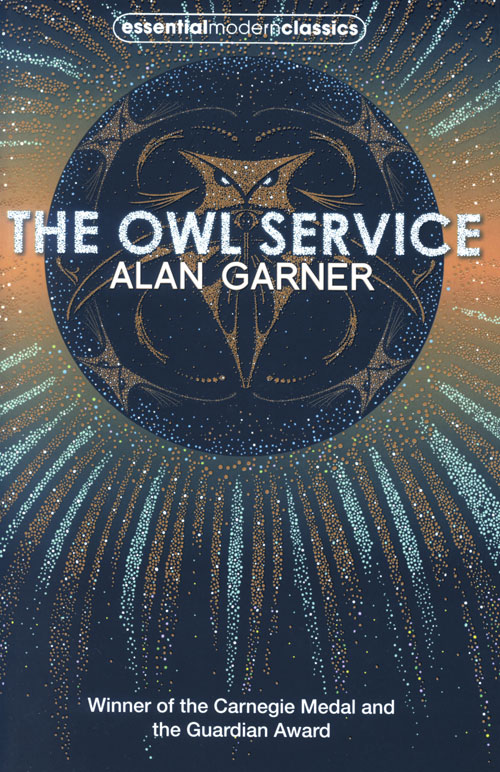
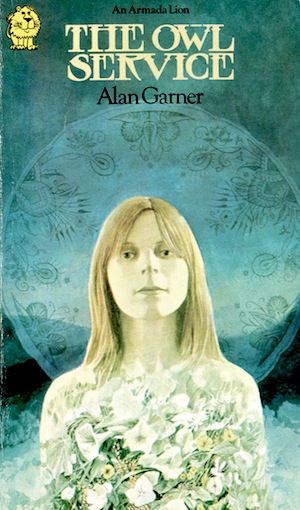
The Owl Service, cover by Alan Lee

The link between owls and flowers is the story of Blodeuwedd, a woman created out of flowers at the behest of Lleu Llaw Gyffes. Although created for him, Blodeuwedd turns out to have a mind (and heart) of her own, and falls in love with Gronw Pebr instead. Gronw kills Lleu; Lleu is resurrected and kills Gronw; then Blodeuwedd is turned into an owl for her part in her husband’s murder. This is the pattern of events that, building up in a static-like charge around one particular house in an isolated Welsh valley, seeks to impose its tragedy on a trio of youngsters once every generation. The “Owl Service” of the title, the plates with the flowers/owls design, was one particular generation’s attempt to trap or divert the energy of the myth away from an actual murder. It failed, and the events of the novel are heavy with the never-to-be-spoken-of tragedy of the previous generation. And of course the very keeping of that secret only serves to make it more likely to play out again, as, in The Owl Service, we get to see how a contemporary (mid-1960s) trio of teens, two English and middle-class comfortably-off, one Welsh and poor, deal with it.

The writing style, with its cut-back descriptions and dialogue free of any sort of adjectival prompting, means you, as the reader, have a little bit more work to do than in the average novel. This quickly proves to The Owl Service‘s advantage, though, as that little bit extra work creates a great deal more emotional investment. (I could hear the voices of the characters far better than in most novels.) Garner trusts his readers to be as sensitive and intelligent as he is about the micro-politics and emotional tussles of a small household held back by a little bit too much English reserve and oppressive class-consciousness. It also means that, when something strange happens, you often end up doing a double-take — did what I think happened really just happen? — which is of course what the characters are thinking, too.

Although it’s quite a short novel, it builds its power gradually, leaving it right to the end to resolve — something I loved in Elidor, and which worked only a little bit less effectively here. The sense of the tragedies of the past — both the ancient, mythical past, and that of the previous generation — weighing in on the innocents of the present, at the very moment they lose their innocence, and the horror of their inability to see just how they’re being twisted into playing parts in an ancient tragedy, creates a tight drama using only a few characters that nevertheless feels as though it’s reaching epic depths.
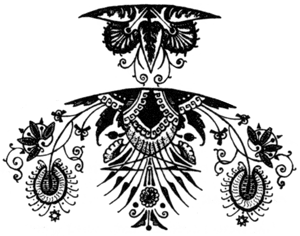

Garner is, along with Robert Holdstock, one of the few writers I know to really capture the dark, barbarous, wild side of the mythical imagination, to write about the way myths and stories really can affect us to the core, modern-minded though we are. Both writers also have a strong sense of the landscape they’re writing in, how it surrounds, traps, inspires, enchants, and shapes the characters within it. Despite the sparse descriptions, something in The Owl Service made me feel that this was very much a landscape I knew, which is something that’s always made me connect with a book (or film — it’s partly why I love 70s Brit horror and Doctor Who) that much more.

Of Garner’s later work, I’ve only read Thursbitch, an adult novel which is even more cut-back in its descriptions, and even more intense in its tying together events past and present, people and the landscape they move through. I can’t work out why I haven’t read more of his work. I certainly intend to.

^TOP