Two E H Visiak Anecdotes

Vera Dwyer

In 1934, the Australian writer Vera Dwyer visited England after her latest novel, In Pursuit of Patrick (1933), had been republished here by John Lane. She wrote a series of articles detailing her literary encounters during the trip (mostly with long-forgotten names such as Hamilton Fyfe and Rose Fyleman, but also JB Priestley and Richmal Crompton), the third of which included a visit to EH Visiak. Not really an interview so much as a brief sketch, it nevertheless gives a little glimpse into the sort of person Visiak was.

Dwyer was the daughter of journalist George Lovell Dwyer, and had been born in Hobart, Tasmania in 1889. She’d married in 1915 a bare few weeks before her husband was sent to fight in the First World War, but the couple divorced in 1925. Her writing career began with a story published at the age of 9, and continued with a children’s book, With Beating Wings (1913), written in her teens. Her adult novel In Pursuit of Patrick is described in a review by The Australian Worker as “a brightly-written book about a Bright Young Thing who chases a Bright Young Man through 200 pages, and over thousands of miles of land and sea”. She died in 1967.

Visiak would have been 55 or 56 at the time, and, from my attempts to work out where he lived throughout his life, seems to have moved this year, some time between March and June, from 30 Cavendish Road in Brondesbury (where he’d lived since at least 1911, and where he’d run his Ascham House preparatory school for boys) to 38 Rutland Park Mansions in Willesden (which suits the description of “a tall, narrow house” in the article, and is close to a railway line). The other writer mentioned as attending this soirée, whom Dwyer calls Visello, must be Arthur Vesselo (1911–2000), who collaborated with Visiak on the story “I Am a Murderer”, which appeared in Thrills, Crimes and Mysteries in 1935, and whose output, according to the FictionMags Index, seems to have been confined to a year either side of this article. He later became a film critic, writing for Sight and Sound, before becoming head of the Central Film Library in London (now absorbed into the BFI).

Dwyer’s article was titled “Meeting the Authors”, and appeared in The Sydney Morning Herald Women’s Supplement, on 20 November 1934:
While I was journeying from Australia to England, a girl who had joined the ship at Port Said, and at whose parents’ home in London I was later to enjoy much pleasant hospitality, gave me an autographed copy of a book entitled “Milton Agonistes—A Metaphysical Criticism,” by E. H. Visiak. It was not very hopefully that I set out to read this highly analytical work, for I am not a Milton scholar, and I feared that many of its allusions would be lost upon me, but I soon discovered that there was so much beauty of thought and phrasing, such a luminous quality in Visiak’s prose, that I was able to enjoy it deeply for its own sake.

In the days that followed I read some of his verses, of which John Masefield himself has expressed admiration. Indeed, although this writer’s work is not much known in Australia, and has no wide popular appeal in his own country, it is held in high esteem by many of his fellow-authors, and when, shortly before I left England, Mr. Visiak gave an afternoon’s reading of his poems at a public hall in London, it was attended by some of the most famous literary men in the land, including Walter de la Mare.

He has written some fine sea chanties and poems about ships. He is not a traveller, but the romance of the sea is in his Cornish blood, and has inspired him to write several novels, too, among them “The Haunted Island” and “Medusa,” a piratical tale, with elements of mysticism and horror, published by Gollancz.

All I heard of his unusual personality interested me, and I was pleased, some weeks after my arrival in London, to receive an invitation to Sunday evening supper at Mr. Visiak’s home, in company with my ship-board friend.

Our host proved to be a tall, thin, worn-looking man, who lived with his mother in a tall, narrow house which, though not handsomely furnished, was stored with unusual treasures, like the mind of its occupant. He showed me his collection of Milton portraits, his books, his models of ships, a pewter jug which Charles Dickens had given to his grandfather, and many curious old prints and engravings.

After supper we sat in the unlighted study, while the summer dust gathered slowly, until the room was filled with gloom, illuminated at intervals by lights flashing through the windows from trains passing along an overheard bridge in the near distance, while a stimulating discussion took place on the problem of good and evil, in which another of the guests, a short-story writer named Visello, took an active part. There were some fine threads of argument to follow, spun from Mr. Visiak’s deep delving among ancient and forgotten books.

I have seldom felt farther away from the modern world, with its often cheap and crude sophistication, its artificiality and blatant commercialism, than in that dim London sitting-room, with the busy traffic flashing and rumbling by outside.


For a second, more amusing, glimpse of Visiak the literary man, there’s this from The Biggleswade Chronicle, 9th April 1937:

Sir Arnold Wilson, MP for Hitchin, and Mr E H Visiak, the novelist, were involved in a misunderstanding at the centenary celebrations of Swinburne’s birth, on Monday night. Mr Visiak was proposing a vote of thanks to earlier speakers, and was speaking on the merits of Swinburne, when Sir Arnold, who was chairman, interjected: “You are here to move a vote of thanks, not to go on eulogising Swinburne.” Sir Arnold said afterwards, “I was chairman of the meeting, when he had spoken for some time on Swinburne, which was not the purpose of his speech. I used my authority as chairman and told him that he was moving a vote of thanks. Mr Visiak misunderstood my motive, and I think he must have forgotten that I was chairman. I meant no discourtesy to the speaker.”

A sequel of sorts is to be found (oddly, three days earlier) in the Manchester Evening News:

Having slept on the matter, Mr E H Visiak the writer whose speech at the Poetry Society’s Swinburne centenary celebrations was interrupted by Sir Arnold Wilson, MP, feels that no apology from Sir Arnold is called for.

“It is true that Sir Arnold used the words, ‘You’re here to move a vote of thanks to me, not to go on eulogising Swinburne,’” Mr. Visiak told me to-day. “I am content to treat that as a jocular but justified reminder that I had gone on talking a bit too long.

“Sir Arnold is a great personal friend of mine, and I am sure that he did not mean to be offensive.”
^TOP

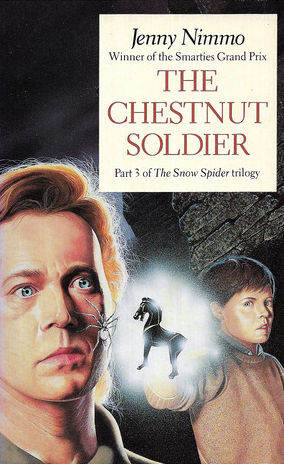
The Chestnut Soldier by Jenny Nimmo

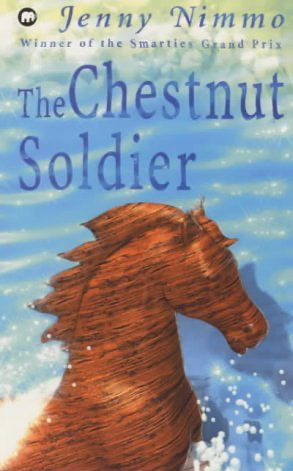
Egmont 2001 edition

Four years have passed since the events of the previous two books in Jenny Nimmo’s Snow Spider trilogy, and The Chestnut Soldier (first published in 1989) feels a bit more grown-up, with boy magician Gwyn nearly thirteen and starting to notice girls in a different way (he thinks Nia Lloyd’s sixteen-year-old sister Catrin the most beautiful girl in Wales, but “Lately he had found it difficult to talk to her”). The narrative is divided between Gwyn and the now eleven-year-old Nia (the main character in Emlyn’s Moon), with Gwyn no longer feeling like the distant and wise boy-magician from the second book: he’s trying not to use his “power” (as he’s come to call it, thinking the word “magic” childish), partly because he keeps getting it wrong and making mistakes, but also because he feels he should be taller by now and is worried magic is stunting his growth.

One day, the Lloyds learn that their mother’s cousin, Evan Llŷr, is coming to stay. It has been ten years since they last saw him, and he’s now a major in the British Army. He has, though, been wounded somehow, and is seeking a place to convalesce. In his thirties, handsome and mysterious, he comes across instantly as something of a romantic figure. Nia thinks him “the prince from every fairy tale; he was fierce and kind—and immensely troubled”, and every woman in the narrative from Nia to Gwyn’s grandmother Nain are under his spell. Particularly so is Catrin, who neglects her boyfriend, an Irish lad called Patrick McGoohan, who likes to ride by on his horse to be admired, but now finds himself ignored.

1990 edition, art by Bruce Hogarth

The mystery of Evan’s “wound” takes a while to come out. It’s not physical. He went into a burning building while posted in Belfast, to rescue some of his men who were trapped inside, but he was the only one to escape alive. These elements—his being a soldier, an association with fire, and a potential friction with the Irish—act as a sort of mythic-magnetic pull between him and a story that has already appeared in the first volume of the series, the legend of Efnisien, who maimed the King of Ireland’s horses when the King came over to marry Efnisien’s sister, and whose angry spirit became trapped in the broken wooden horse that was among Nain’s gifts to the young Gwyn. Now, this wooden horse uses Nia’s younger brother Iolo to get itself free of Gwyn’s control, and the spirit of Efnisien enters, or blends with, Evan.

After this, Evan becomes increasingly dark and cruel. Poltergeist activity begins to surround him, breaking young Iolo’s toy horses and Idris Llewelyn’s carved unicorn, and driving Patrick McGoohan’s horse, Glory, to madness. Books fall off shelves, plates break, storms descend on the town, and the Lloyd home looks like it’s been hit by an earthquake. Catrin is hopelessly drawn to Evan, even when his kiss is rough and not at all to her liking. He becomes a sort of Heathcliff figure, romantic and dangerous in a way that skews into the supernatural.

Gwyn realises he has to do something, and after another few failed attempts which increasingly convince him he was never meant to be a magician at all, travels back in time to speak with his ancestor, Gwydion Gwyn, to work out how to deal with this demonic force. (Gwydion, who anachronistically asks “You’re not blaming your genes, are you?”, assures him that he, too, made plenty of mistakes.)

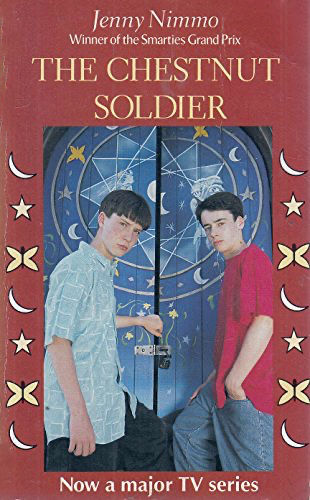
TV tie-in cover, 1991

Like the preceding book in the trilogy, the supernatural element in The Chestnut Soldier enters gradually, at first being indistinguishable from the story of a troubled but handsome man suddenly entering the lives of the Lloyds. But unlike with Emlyn’s Moon, there’s not so much of an alternative story to be going on with while the supernatural builds. (In addition, although there’s just as much light comedy as in the previous book, it doesn’t feel as light, couched as it is amongst much more serious-seeming darkness.) In both books, everything is resolved in a brief but confusing showdown involving magic and mythical figures, but whereas in Emlyn’s Moon this released all the tension in the mundane narrative in a way that made sense, here it’s unclear how—or if—Evan’s real-life troubledness is fixed along with his supernatural possession. Things are resolved, but they don’t really feel resolved—though this could be taken as part of the series’ growing up along with its characters, having them face messier situations and messier resolutions.

The “It’s another Harry Potter” style cover from 2009, art by Brandon Dorman

I was disappointed to find no return of the faerie-like “White People” from the first two books, particularly as they were the most intriguing element, for me. Here, Gwyn only thinks of them briefly, to note that his sister is surely happy with them, so he feels no need to try and bring her back, and besides, he’s grown up and she is now a perpetual child, so what would the two have to talk about? It seems rather dismissive and cold, particularly as I can’t help thinking that Bethan’s supposed happiness with the fairy folk is the sort of happiness a cult member has with their cult—it may require deprogramming to reveal it’s not happiness at all. (I think The Snow Spider could do with a Boneland-style sequel, where an adult Gwyn has to either rescue his sister properly, or at least face up to the reality of what happened to her.)

Like Alan Garner’s The Owl Service (which Nimmo hadn’t read, at least before writing the first book in the series), myth, here, is a thing that threatens to take over modern generations, replaying its tragedies and re-inflicting its suffering. But unlike in The Owl Service, Gwyn’s approach is to fight myth with myth: just as Evan becomes infected with the mythic presence of Efnisian, Gwyn allows himself to become, in part, his ancestor Gwydion Gwyn. (Which leads to some comic moments, as this Welsh ancient’s presence in Gwyn leads to him suddenly finding all sorts of aspects of modern life hard to deal with. Only, as this happens in the final chapters, with the darkness around Evan building, it’s hard to really feel the comedy.)

The series ends with Gwyn saying “I’m grateful for the adventure but I don’t believe I’ll need magic for a while.” Which leaves things somewhat unresolved—he’s still evidently living in a world where myth leaks through into reality, so how does he know he’s not going to need it?

For me, this may be the least successful of three books. The Snow Spider worked as an introduction to the difficulties and wonders of this world of myth and magic; Emlyn’s Moon was the most satisfying as a novel, with its nicely-balanced magical and mundane storylines; The Chestnut Soldier seems almost consciously messier, reflecting the main characters’ entry into adolescence and an awareness of greater moral ambiguity, but ultimately ending in a mood where the characters just felt they’d outgrown magic, as though it were their choice to make, in a world that seems dangerously fraught with myths and faerie.

The 1991 adaptation of The Chestnut Soldier

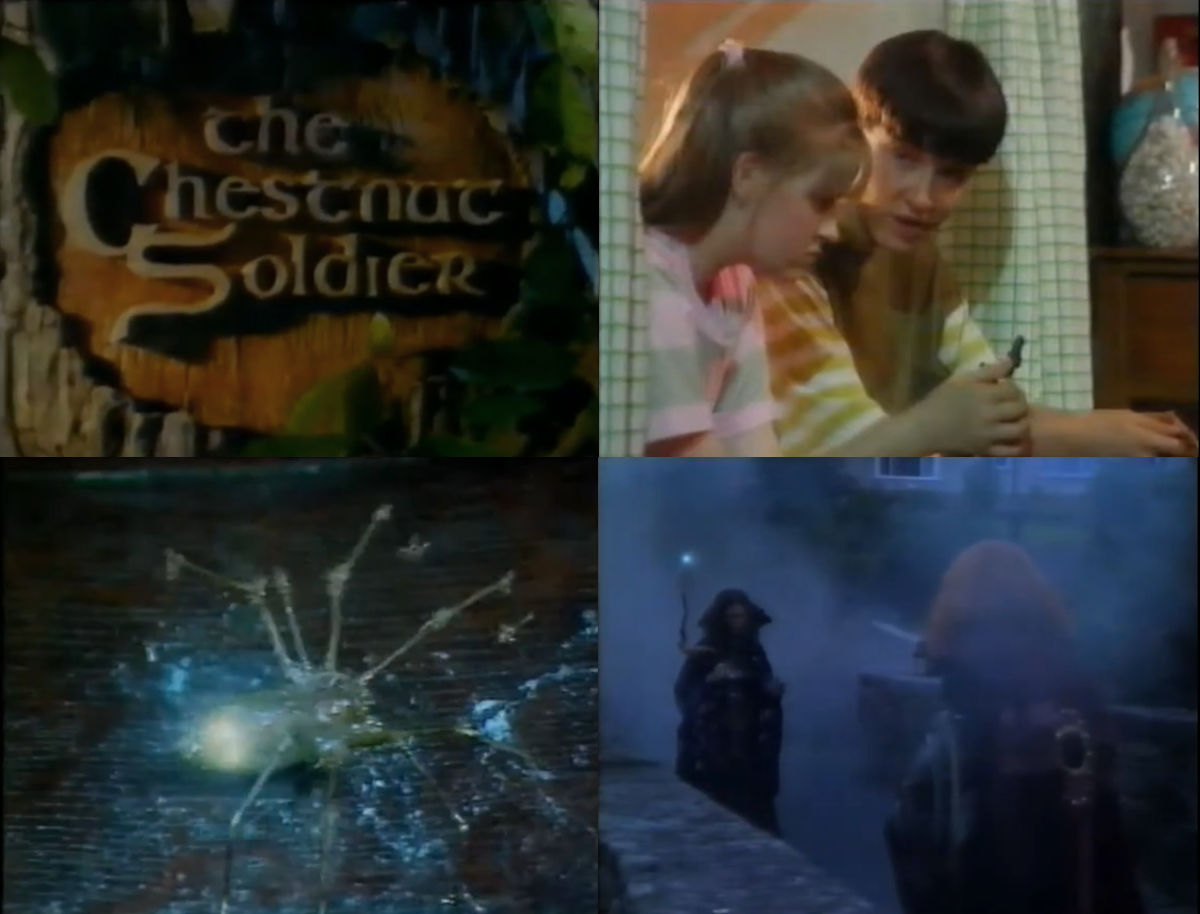
Like its predecessors, The Chestnut Soldier was adapted for television, being broadcast in four parts in 1991 (produced by HTV Cymru/Wales), running from Wednesday 20th November to 11th December, and retaining all the same actors for the main roles. Interestingly, in McGown and Docherty’s encyclopaedic look at children’s TV drama, The Hill and Beyond, they say: “The Chestnut Soldier loses the subtlety of its predecessors, opting instead for a more teen angst approach”—but as I’ve said, this feels true of the book, too. I can’t help wondering how this third instalment would have been dealt with had the 2020 BBC adaptation got this far. On the one hand, that series clearly implied that there was going to be more of a showdown with the faerie-like people who’d taken Gwyn’s sister, and their by no means friendly intentions; on the other, how would a 2020s adaptation have dealt with the romantic relationship between sixteen-year-old Catrin and thirty-something Evan? It’s accepted without comment in the book (even from Catrin’s mother), but I can’t imagine how it would have been treated in the style of the more careful 2020 version of The Snow Spider.

^TOP

Three Clive Barker plays

I thought I’d take a side-step from re-reading Barker’s novels to look at some of his plays, written in the days prior to the publication of (but in some cases alongside the writing of) the first Books of Blood stories and The Damnation Game. A good selection are currently published in individual editions from the Clive Barker Archive, complete with Barker cover art, photos, and informative afterwords.

Barker had been creating plays since his days as a teenager at Quarry Bank School in Liverpool, which from the start were both horrific and fantastic in nature. According to Douglas E Winter in his Barker biography The Dark Fantastic, Voodoo (1967) was “a living horror film”, Inferno (1967) a “weird reinvention of Dante” complete with “Hell and Nazis and God knows”, and the title of Neongonebony (1968) refers to our current neon-lit age descending into a bone-choked post-apocalypse. The Holly and the Ivy (1970, when Barker would have been eighteen), was a three-hour take on the King Arthur story, ending with the revelation of a homosexual relationship between two of its main characters, which caused some consternation among the school staff—not for the first time, with Barker. These early works were collaborative and partly improvised (an approach Barker would encourage even in his later works, as he says in his introductions to the published editions: “These plays are not finished things, they’re invitations to collective work.”). Nevertheless, he was the one who assigned parts and determined the purpose of each scene within an overall narrative. Playwriting, acting and production continued for Barker throughout his time at university (where he switched from philosophy to English Literature), in first the Hydra Theatre Company, then the Theatre of the Imagination, and for a short while the Mute Pantomime Theatre. These all seem to have been small groups, mostly of the same people (Pinhead actor Doug Bradley, and Hellraiser II scriptwriter Pete Atkins, for instance). They all moved to London around 1977, and formed the Dog Company, where Barker, now out of university, concentrated entirely on the stage. He continued to act in his own plays for a while, but gave that up in 1980 to concentrate on writing and directing, and in 1982 gave up directing too.

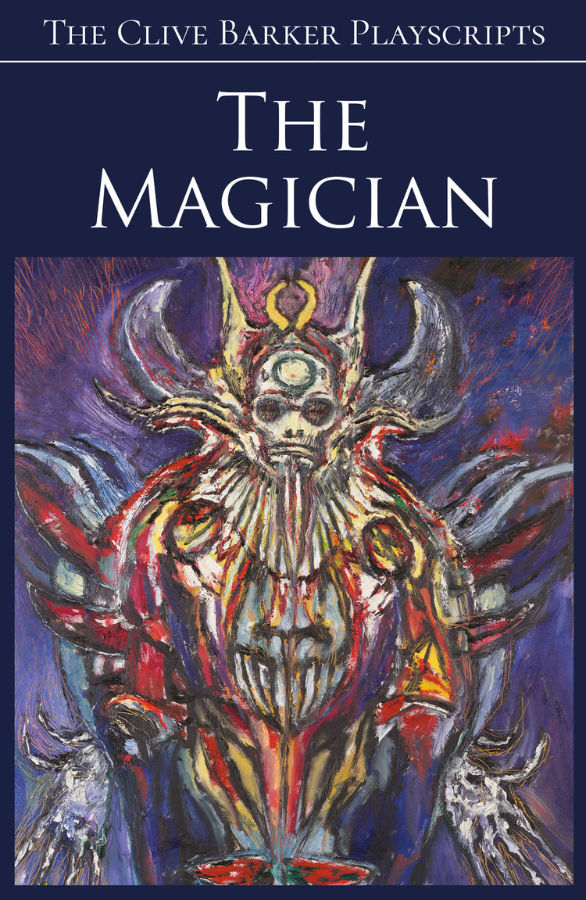
The three plays I chose to read (and I’ve seen none of these performed, so I’m sure I’m missing a lot of how they’d actually be experienced) all had the more obviously fantastical titles. First among them was The Magician: A Farce in the Style of the Commedia dell’Arte, which was first performed from November to December 1978. As the title says, this is a take on the traditional comedy form the Harlequinade, with its set character-types (Pantalone, Columbine, Pierrot, and so on). Here, Pantalone is the governor of an unnamed European city-state, where rumours arrive that the great magician Cagliostro is on his way. But is he a real magician or “all reputation, no power”? It turns out he did perform one genuine act of magic many years ago, the creation of an homunculus, which he proceeded to drown, in horror at what he’d made. But the creature survived, and was raised in ignorance of what it really was, to become the governor of this city-state. The play ends with a reconciliation between the father/creator Cagliostro and his fantastical “son”.

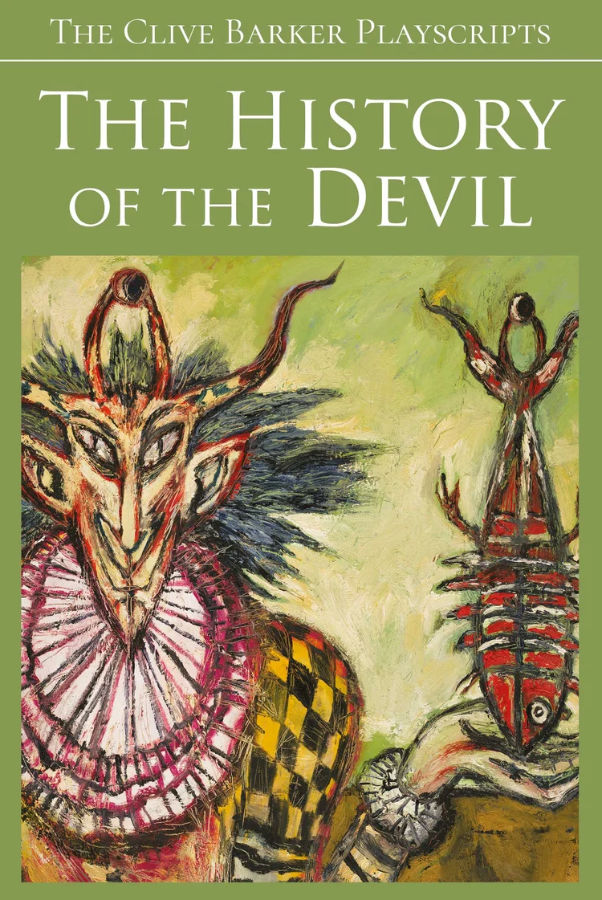
The History of the Devil was first performed in September 1980, and went on to have a run at the Edinburgh Fringe, where it was listed among the twelve best plays of the festival. It would be the Dog Company’s most performed play. In it, the Devil has himself put on trial in the hope that, if found innocent, he’ll be allowed back into Heaven. Witnesses (most of them summoned from the grave) appear, and their testimonies turn into on-stage enactments, including the story of the Devil’s first arrival on Earth (in what seems to be medieval Russia), his encounter with Christ in the desert, his attempt to get a Renaissance architect to build him a palace (if not on Earth, then in Hell), and his freeing some women accused of being witches in Puritan America. For me, although these episodes provide plenty of variety, they don’t really add up to an argument for or against the Devil as a source of evil, and it’s the court scenes that are the best parts of the play. The Devil’s ultimate justification is that none of this would be any different if he weren’t here:

“Is there a moral sky over me? No. Does this dirt suffer morality? No. In all the natural world there’s no moral thing. You ask why you are unhappy. Why, why? Morality. You go against nature.”

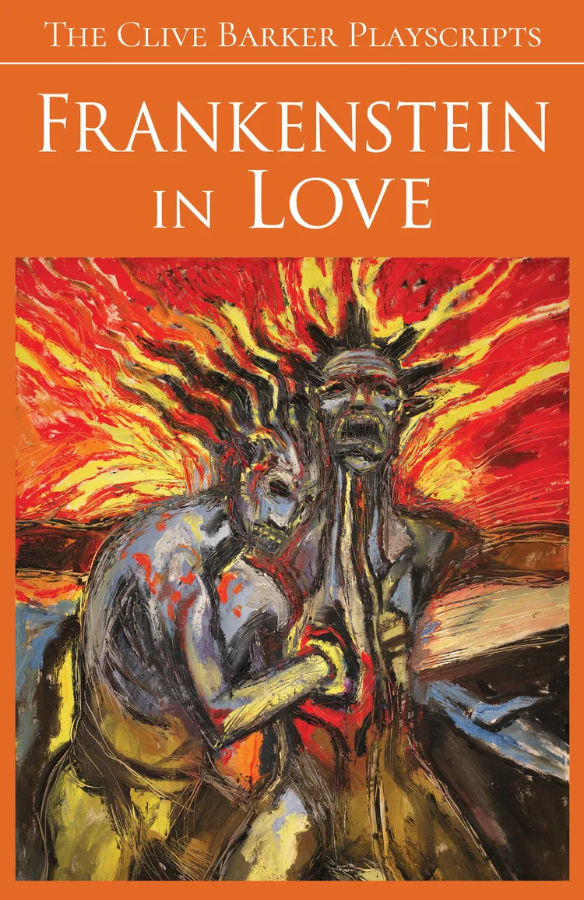
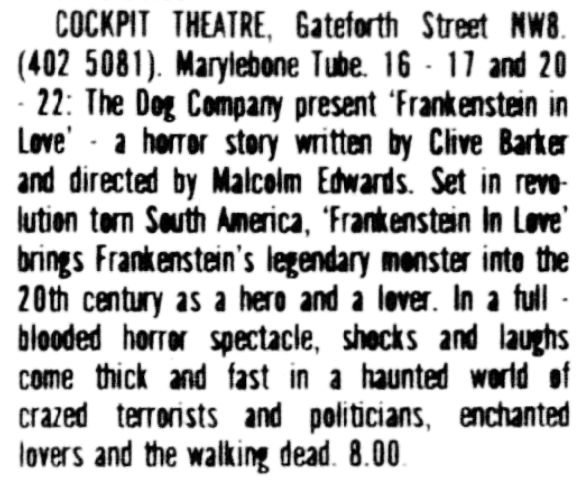
Frankenstein in Love was first performed from April to May 1982, after which it was taken to Holland, Belgium, and again to the Edinburgh Fringe. It’s set in an unnamed South American country at the point where its current dictator, Perez, is being overthrown by the revolutionary forces led by El Coco. Perez’s chief executioner, it turns out, is Doctor Frankenstein (who has been allowed to experiment to his heart’s content on the regime’s political criminals), while El Coco is actually his first creation, the famed “monster”. After the revolution, El Coco is assassinated, but, being dead already, cannot die, and returns to revenge himself on Doctor Frankenstein, arriving on his wedding day (where the doctor is marrying one of his experimental subjects). Of the three plays, this is the most out-and-out horrific, dripping in gore, death, shock and transgression, including a man’s heart being ripped out on stage, another having his head trapped in a box of knives, and another having a new face sewn on, all wrapped up in an air of political oppression, medical experimentation, plague, cannibalism, and the misuse of corpses (“hardly the standard ingredients of British theatre” as the reviewer for The Scotsman put it).

Despite the political background, Frankenstein in Love doesn’t feel like a political statement (unless it’s in the overall tone of misused power and constant backstabbing), but rather presents a vision of a world in which all is merely flesh and death, but in which flesh is not ended by, but transformed by, death. As Veronique, one of Frankenstein’s experiments, says:

“Yes, I’ve learned that lesson. Flesh is trash. Its natural state is meat. Everybody is just meat. The rest is the will to be more than meat.”

Or, Frankenstein himself:

“We look at our bodies and we see them putrefying around our living minds and we know, finally, that the enemy is our flesh. The body is a prison and must be escaped by metaphysics, or changed by wit and knife and courage.”

Far more relentlessly grim than anything Barker put into his fiction—perhaps doubly so because it was being put on live, on stage, where the horror is unrelenting—it was actually written shortly after the most powerful of Barker’s initial Books of Blood stories, “In the Hills, the Cities”.

Aside from the general air of horror, these plays are speckled with hints of what was to come in Barker’s more well-known works. For instance Christ, in The History of the Devil, when planning his means of martyrdom, asks “Isn’t there something they do in the East with hooks in the skin?”, which recalls the hooks in the skin in Hellraiser. In Frankenstein in Love, after El Coco’s assassination (by fire), he becomes a skinless walking corpse, “A walking anatomy lesson”—which recalls Frank from Hellraiser, as well as the “anatomy lesson, raw and wet” of Gentle’s homunculus in Imajica.

More generally, I think it’s possible to see how Barker’s approach to writing fiction has been informed by his background as a playwright. All three of these plays feature a narrator who speaks to the audience and interacts with the characters, and who talks knowingly of the events being played out as a drama (somewhat like Puck when he addresses the audience at the end of A Midsummer Night’s Dream, only in this case throughout the play), and there’s certainly a similar tone in Barker’s fiction, where he’s always highlighting archetypal aspects like character roles and story-types (it’s so ingrained in Barker’s prose style it’s hard to isolate in a good quote, but here he’s describing Gentle and Judith’s love affair in Imajica: “one death short of tragedy, and one marriage short of farce”). In addition, I think his penchant for making his monsters such eloquent, often philosophical beasts, is rooted in writing them as characters for the stage.

Sphere 1988 PB, art by Steve Crisp

The theme that kept standing out for me, even if it wasn’t the main one of each play, was that of monstrous sons and their fathers/creators. I’ve already mention the reunion of the homunculus and his creator in The Magician, but there’s also the Devil seeking reconciliation with his father/creator God in The History of the Devil, and El Coco/Frankenstein’s monster seeking revenge on his father/creator (he calls him his father, but it’s pointed out a couple of times that, no, he’s his creator) in Frankenstein in Love. In the latter two plays, these attempts at reconciliation (if the last one can even be called that) end in failure, if not tragedy. This is a theme I thought popped up in some of the early Books of Blood stories, too, such as “Skins of the Fathers” and “Rawhead Rex”, and now I think about it can also be found in The Damnation Game (most explicitly in the character Breer, who’s resurrected by Mamoulian, and so in a sense becomes his “monster”, though the Faustian pact-that-isn’t-a-pact between Whitehead and Mamoulian perhaps makes more sense if read as a father/creator-son relationship) and in Gentle’s created double in Imajica.

Notice of a performance of Frankenstein in Love, from the Marylebone Mercury, 16 April 1982

The end of the Dog Company came, ironically, not through failure but success. As well as Frankenstein in Love (the first of Barker’s plays to be directed by someone else, which was partly done to ensure the Arts Council took the company more seriously), they put on another Barker play at the Edinburgh Fringe, The Secret Life of Cartoons. This was enough of a hit that the troupe recognised they’d need to bring in other people to give it its full due if they were to take it further (which they did), and this meant leaving the days of a six-actor, one-playwright fringe group behind. Barker continued to write plays (for the Cockpit Youth Theatre), but was already working on The Books of Blood and The Damnation Game, with Hellraiser and international bestsellerdom looming fast.

^TOP