
In a 1931 letter to Frank Belknap Long, H P Lovecraft summed up what he was trying to do in his fiction as striving for “a form of non-supernatural cosmic art”, one that adhered to the new and increasingly strange ideas about reality that twentieth century physics was coming up with, yet still managed to convey the weird thrill and “sense of outsideness” of cosmic horror.
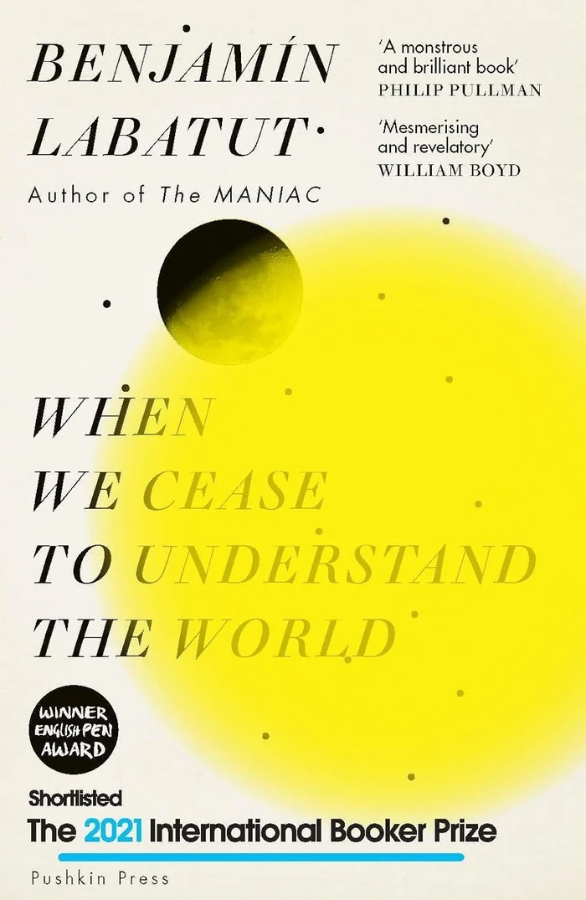 I couldn’t help but think of this when reading Benjamín Labatut’s collection When We Cease To Understand The World, in particular its third story, “The Heart of the Heart”. In When We Cease To Understand The World (a title with evident Lovecraftian resonances) and his subsequent novel The Maniac, Labatut focuses on the lives of the real-life mathematicians and scientists who formed the theories (relativity and quantum physics) that brought their own particular style of cosmic weirdness to the twentieth century. Mostly, Labatut deals with early-twentieth century figures, but “The Heart of the Heart” opens with a modern mathematician who is actually still living (Shinichi Mochizuki), and mainly focuses on another, from the second half of the twentieth century, Alexander Grothendieck. It begins with Mochizuki quietly publishing an enormous proof of “one of the most important conjectures in number theory”, known as the “abc conjecture”. It’s a proof so complicated that even when the world’s leading mathematicians pore over it, they can’t be sure it has achieved its aim. Sometime later, Mochizuki withdraws it. He has, Labatut writes, succumbed to “Grothendieck’s curse”, and goes on to outline the career of the man who (according to Wikipedia) is “considered by many to be the greatest mathematician of the twentieth century”. Grothendieck seems to have been a wellspring of new, complex theories of mathematics, finding immense depths and interconnections in even the simplest of notions. Behind it all, Grothendieck believed lay “the heart of the heart”: “a ray of light capable of illuminating every conceivable incarnation of a mathematical object”, but which was also “an entity… at the very centre of mathematics, which had completely unhinged him”. Something about this “entity” causes Grothendieck to retreat from mathematics—indeed, from the world at large, as he moves to a remote village and attempts to live on nothing but dandelion soup—and to demand certain of his works be removed from library shelves. He has, Labatut implies, glimpsed an idea so disturbing that it should remain hidden, “for the good of all of us”. The implication is that Mochizuki, a former disciple of Grothendieck, has glimpsed the same thing.
The imagery and language Labatut uses is rife with Lovecraftian resonances. That disquieting “entity… at the very centre of mathematics, which had completely unhinged him”, sounds something like Lovecraft’s idiot god Azathoth, “which blasphemes and bubbles at the centre of all infinity”. More Lovecraftian still, Grothendieck, after his retreat, “came to believe dreams were not proper to human beings, but missives from an external entity he called Le Rêveur”—which also recalls, for me, Ramsey Campbell’s Incarnate, with its inhuman source of all dreams.
 There are physicists and mathematicians throughout When We Cease To Understand The World dealing with strange and disturbing new insights into the cosmic order, many of whom find themselves driven to the edge of sanity, if not beyond. (Labatut’s fiction is full of madness, fevers and suicides.) His novel The Maniac (2023) opens with the tale of Paul Ehrenfest, known to such colleagues as Einstein and Bohr as “the Conscience of Physics”, but who suffers from bouts of extreme depression, and ends up shooting not only himself, but his mentally and physically disabled son. The main subject of the novel, the mathematician John von Neumann, is, however, a complete contrast. If Grothendieck is perhaps the greatest mathematician of the twentieth century, von Neumann is surely the most influential, certainly in terms of our daily lives. The list of areas he either pioneered or took a key part in includes the development of the atom bomb (von Neumann was the one who said it should explode before it hit the ground, so as to cause the maximum damage), the Cold War (after the bombing of Japan, von Neumann urged the US to immediately bomb Russia before they could develop a similar weapon, this being, in his mind, “the only fully logical decision to make”; afterwards, he advocated the idea that came to be known as Mutually Assured Destruction—the development of such an overwhelming stock of nuclear weapons that it could destroy the world several times over, thus, in a way, “ensuring global peace by taking us to the brink of Armageddon”), the subsequent development of the hydrogen bomb (five hundred times more powerful than the atom bomb, and described in the novel as “a true horror, something that could not be justified in any sense, an evil by any measure”), but also computing (“The DNA of the entire digital universe”—the von Neumann architecture—is still the basic structure of all modern computers), game theory (an apparently abstract mathematical idea that nevertheless informs all modern warfare), AI (a late obsession with self-replicating digital entities and the workings of the brain) and, to name one positive, weather-forecasting.
 Unlike the subjects of so much of Labatut’s fiction, von Neumann is free of mental instability—at first, anyway. His “intelligence was playful, not tortured”; he was “Brilliant but childish, insightful yet incredibly shallow”. At first pursuing the logical basis for all mathematics (something that also forms the subject of one of my favourite graphic novels, Logicomics)—until Gödel’s Incompleteness Theorem proved one would never be found—von Neumann then becomes “more practical and effective than before, but also [more] dangerous”, freely engaging in “so many top-secret projects that his suit pockets were overflowing with security cards”. Where Ehrenfest, though burdened with depression, was “the Conscience of Physics”, von Neumann, free of all doubt, seemingly has no conscience at all.
(He does, though, have his own ultimate date with mortality, when it’s discovered he has terminal cancer, in all likelihood caused by his exposure to radiation during the development of the atom bomb. Previously so sure of his own special status, this proves to be the one thing the genius von Neumann cannot comprehend: “He suffered,” one of Labatut’s narrators records, “from the loss of his mind more than I have seen any human being suffer, in any other circumstance.”)
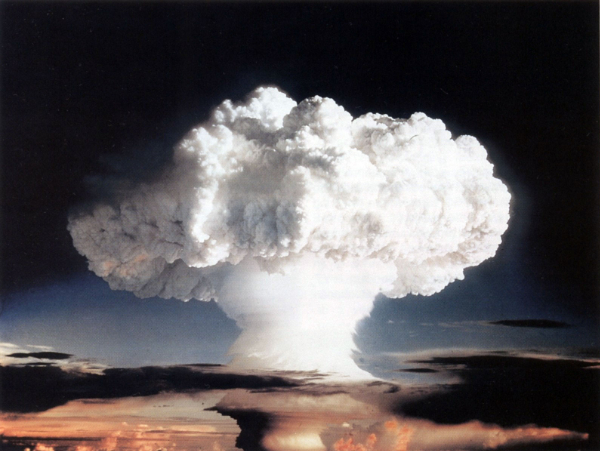
And I can’t help but reach for Lovecraftian parallels again as, aided by an elite possessing abstruse and occult knowledge, something insanely destructive and utterly without conscience rises in a remote Pacific island: Cthulhu from his sleeping depths, the first hydrogen bomb explosion from the Enewetak Atoll.
Labatut writes with a feverish, propulsive style, a headlong rush of ideas, anxieties and desperation in his subjects’ lives. (Full of long sentences, and page-spanning paragraphs, it’s a nightmare to find your place again if your concentration wavers.) But, as the sort of scientific and mathematical concepts he writes about (very lightly—you won’t come away understanding Quantum Mechanics, let alone Inter-Universal Teichmüller Theory), are usually covered much more soberly in non-fiction, there’s something fresh about Labatut’s addressing them in such an emotionally inflated, even melodramatic style.
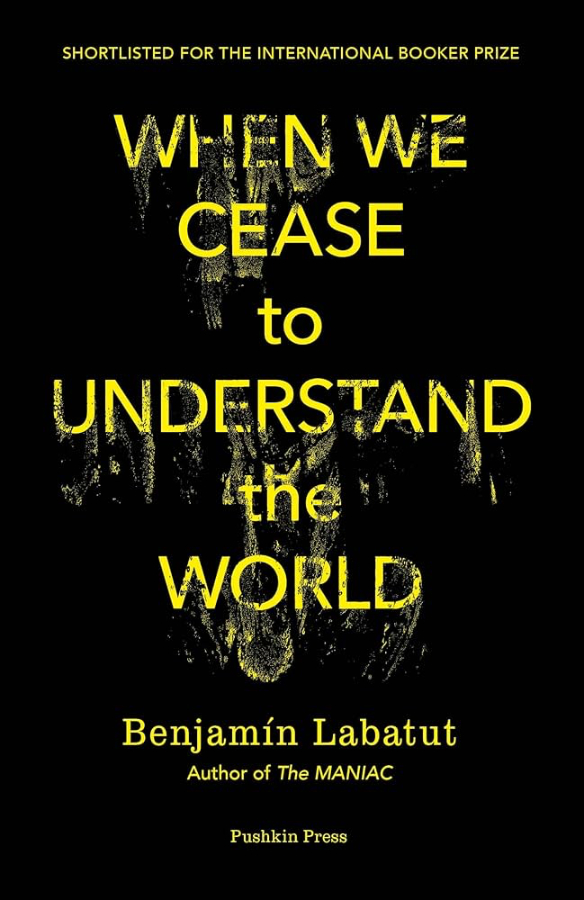 I found both the collection When We Cease To Understand The World and the novel The Maniac very readable, but I’m a bit torn about them. They use real-life figures (The Maniac has chapters narrated by Richard Feynman, among others) to tell real-life stories, but how reliable are they? This is a heightened, compressed version of events, foregrounding insanity, desperation and genius. It is fiction, and so not necessarily true—but, at the same time, I sort of want this, Labatut’s version, to be the truth. It fits so neatly into wonderfully Lovecraftian ideas about the cosmic dangers of forbidden knowledge. But the one case where he deals with a still-living figure—Mochizuki’s withdrawal of his massive proof—has since been undermined by real-life events: Mochizuki published his proof in 2021, a year after When We Cease To Understand The World came out. (But even if it does contain Azathoth in the form of a mathematical theory, who would understand it but the insane?)
Labatut’s stories appeal to something other than knowledge about the world, though. These are modern myths about the nature of knowledge and its consequences—myths that Lovecraft, too, addressed in his fiction, which was itself written under the influence of the shockwaves of those early-twentieth century notions such as relativity and quantum physics. Perhaps Labatut’s use of real people and events could be understood by another of Lovecraft’s ideals for weird fiction: “My own rule is that no weird story can truly produce terror unless it is devised with all the care & verisimilitude of an actual hoax.” The ultimate hoax, then, is to use so much of the truth that the weird comes through merely in the embellishments: the facts are true, but the way they’re spun brings in the darkness and weirdness.

Labatut is terrific. He has two earlier works as yet untranslated. La Antártica empieza aquí (Antarctica Begins Here) is a collection of short stories that uses the image of Antarctica as a metaphysical boundary between our reality and another. La piedra de la locura (The Stone of Madness) contains two non-fiction essays that actually name-check HPL and Philip K. Dick. Labatut argues that we have reached a threshold where a knowledge of reality is completely beyond our grasp. Themes he explores in his later fiction.
Those both sound interesting. I hope they get translated.