
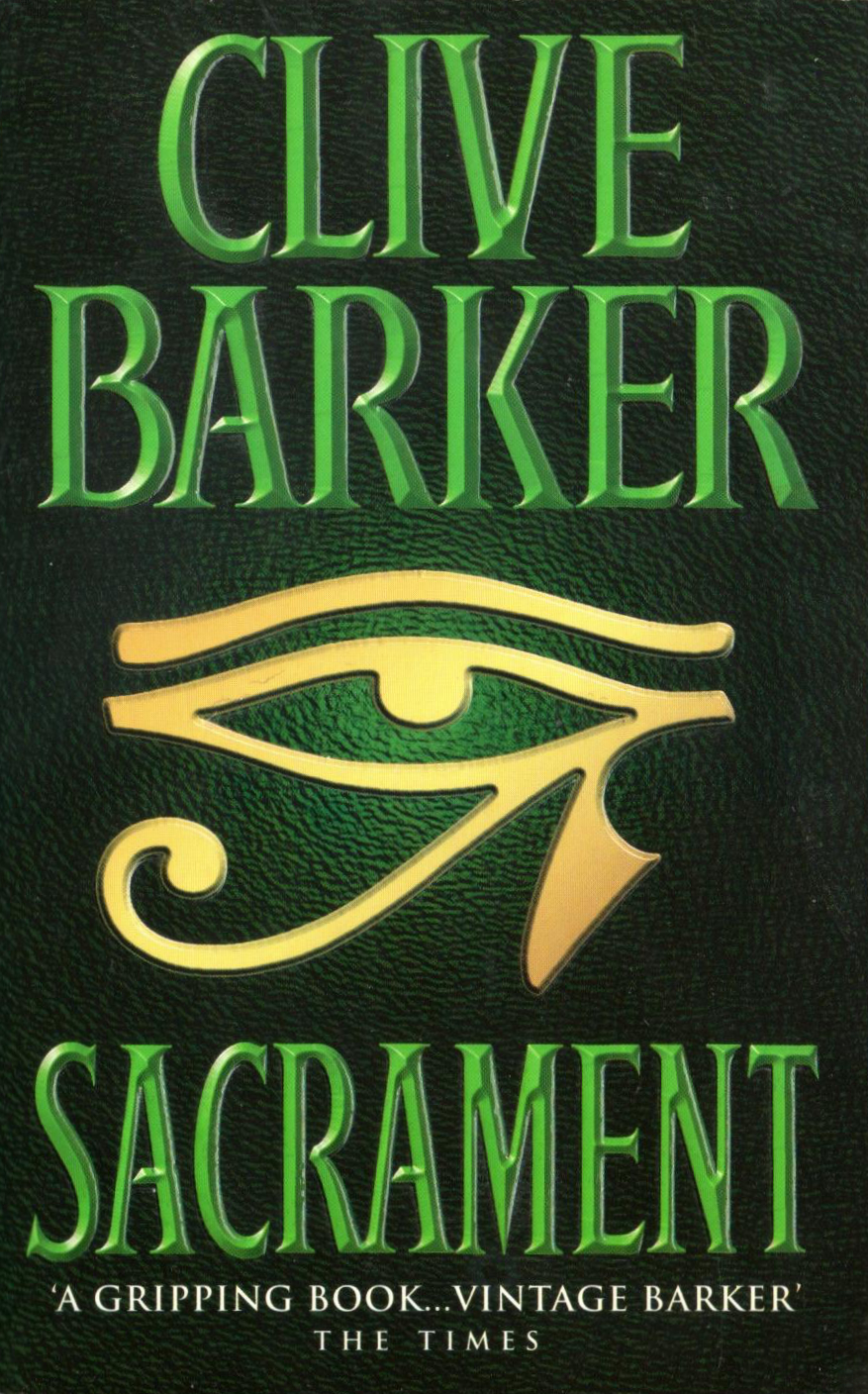
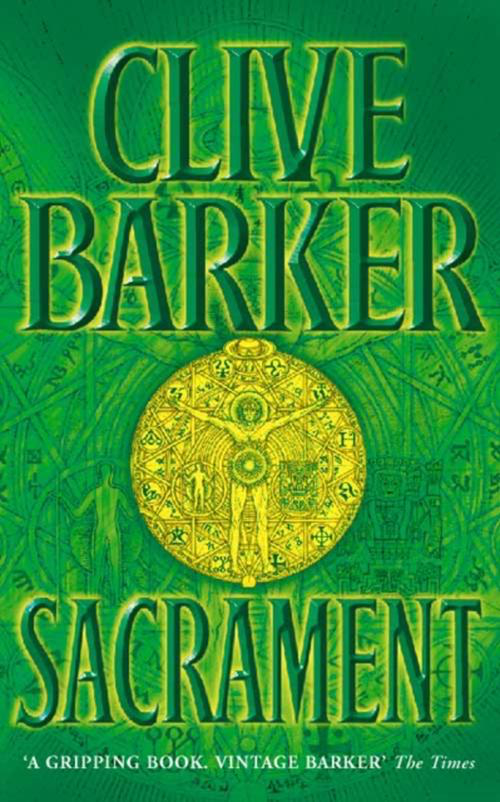
cover art by Bob Warner
Having by now spent ten years publishing blockbuster novels that mix horror and fantasy on an often Biblical scale, Sacrament (first published in 1996) saw Barker taking a step back from the multiple worlds and earth-shaking events of Imajica, The Great and Secret Show and Everville to something less chock-full of entire carnivals of the fantastique. Here, he addresses some issues of concern in the real world around him. And though, this being Barker, there are still moments when it all strays into the metaphysical, fantastic and luridly horrific, it does, at times, even get a little autobiographical.
The protagonist of Sacrament is Will Rabjohns, a world-renowned wildlife photographer known for his images of animals brought up hard against humankind’s impact on their home environments. The novel opens as he’s finishing his latest project, on polar bears hunting through the rubbish tips of Balthazar in northern Canada. But a bear attack puts him into a four-month coma, during which he revisits the events of thirty years ago when, as a thirteen year old, he encountered a strange and beautiful pair of vagabonds, Jacob and Rosa.
Back then, Will’s parents had just moved from Manchester to the Yorkshire village of Burnt Yarley following the death of Will’s older brother, who had always been his parents’ favourite. Still left very much in the shadows of his parents’ affections, when he meets this strange pair, and finds Jacob taking a keen interest him, Will decides to run away with them.
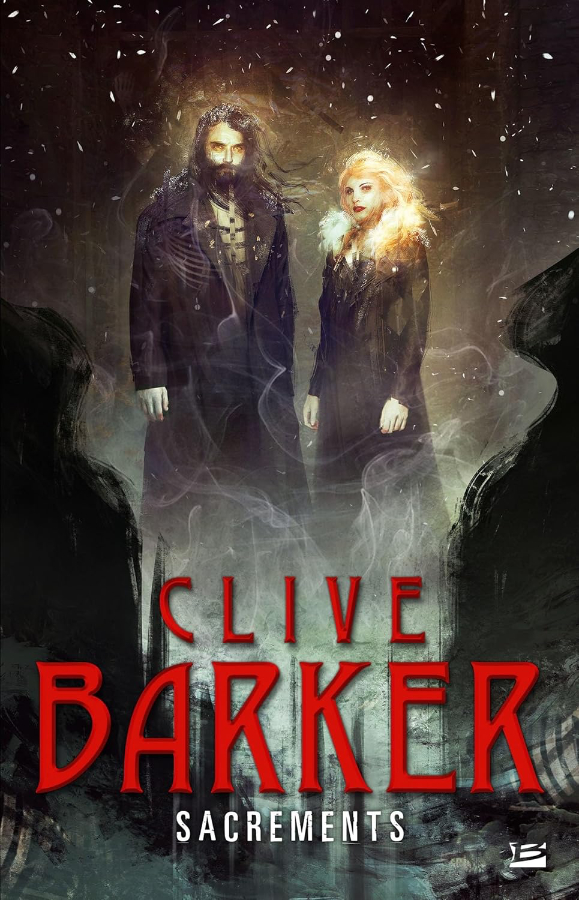
French cover, art by Bastien Lecouffe-Deharme
Jacob has a strange avocation as “the Killer of Last Things”: he seeks out the final mating pairs of dying species, documents them thoroughly in his journal, then kills them, thus making what he sees as an irreversible impact on the world. Something passes between Jacob and Will, and the boy experiences some of the older man’s memories, including one of a dead painter, Thomas Simeon, from two centuries ago (Jacob and Rosa are, it seems, immortal, and have a Cenobitish air of ennui’d repletion about them), whose body, left in the wilds, was partially eaten by a fox. (In his coma, Will sees that fox once more and speaks to it—Lord Fox, it calls itself.) In the end, events transpired to prevent Will from joining this dangerous but alluring couple, but he left the town and his parents as soon as he’d grown up: a gay man, he knows his parents—and, indeed, most of society at the time—couldn’t accept what he was. He left England for America, settling in San Francisco.
Recovering from the coma, Will says he’s finished with photography, but has no plans for what he’s going to do instead. He returns to San Francisco, only to find himself in a community ravaged by AIDS. And Lord Fox, stirred into wakefulness inside him, starts visiting, enlivening his senses with a fresh acuity, and driving him to Barkerian excesses in the city’s gay nightclubs. Will realises he has to rid himself of this troublesome animal spirit just as Jacob, elsewhere in the world, decides he needs to rid himself of the connection he still feels to Will. To this end, Jacob and Rosa return to Burnt Yarley and assault Will’s father, putting him into hospital, thus sending the message that they want Will back for a confrontation.
As ever with Barker’s fiction, that confrontation doesn’t go according to anyone’s plan, and turns into a quest that heads further north to the Isle of Tiree, where Jacob and Rosa’s former master—perhaps, even, creator—the magician Rukenau, dwells in the magical structure known as the Domus Mundi, the House of the World.
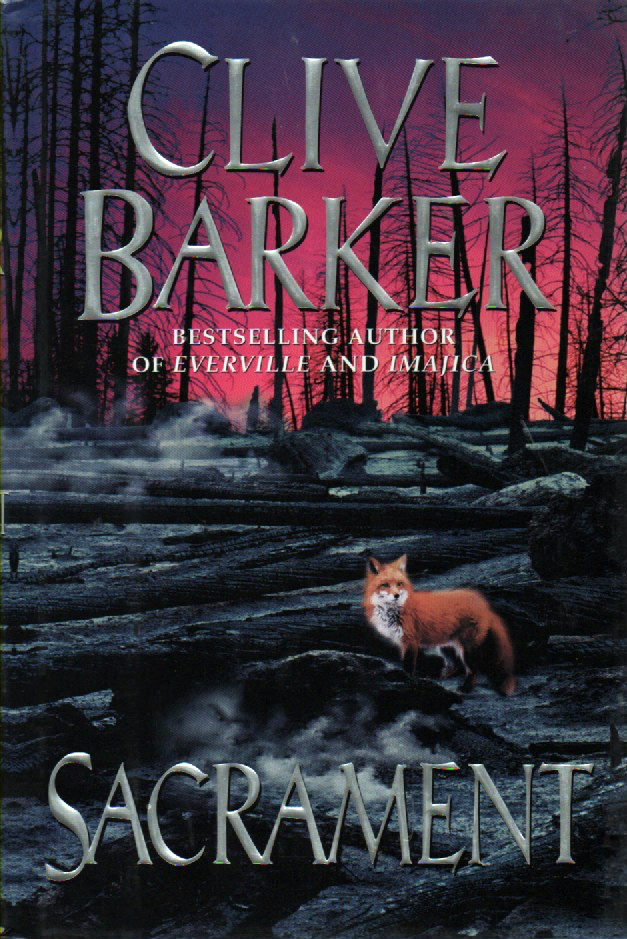 Barker has said this is a novel infused with autobiographical elements (his biographer Douglas E Winter says “Sacrament is arguably the best of Clive Barker’s novels, and one of the most directly and profoundly autobiographical of his fictions”). It’s broad strokes stuff, though, as this is a novel about a creative gay man who has moved from the north of England to the West Coast of the USA. And Will’s critics say, of his art, what Barker must have heard many times himself: “Why did he have to seek out images that evoked despair and death when there was so much beauty in the natural world?”
The main fantastical element centres on Jacob and Rosa. (Winter writes: “The bloodthirsty scourge known as Jacob Steep is only the most recent of the light-bearing zealots who burn their way through the pages of [Barker’s] fiction,” which is a wonderful description.) Both have some power, most explicitly in Rosa’s case, as she has an animated string of rosary beads that does her bidding (usually murder). Like so many Barker figures, the couple exist in a twilight world, or perhaps an elevated version of this one, their concerns philosophical and aesthetic rather than the mundane ones of daily survival, blessed visionaries and cursed wanderers in one.
As so often in Barker’s fiction these are figures on a quest for deeper, or higher, knowledge. Like The Great and Secret Show’s Jaff or Weaveworld’s Shadwell the Salesman, their power derives from an awareness of another world, but one they are not the masters of. Jacob and Rosa, in fact, do not really understand what they are. They know they’re immortal; they’re haunted by certain memories (an ice palace they visited many years ago reminded them of something, though they can’t recall what). Jacob in particular is troubled and inconsistent. Despite his extinction-killings, he seeks forgiveness somehow, and a clear view of God—who is drowned out, in this world, he believes, by the “smothering, deafening fecundity” of its animal life, hence his need to kill it off—but, at the same time, he’s contemptuous of the deity, saying “God’s a coward and a show-off, Will… He hides behind a gaudy show of forms, boasting how fine His workings are…” Zealot he may be, but his faith blows hot and cold.
Jacob and Rosa know they owe their existence to the magician Rukenau, who dwells in the Domus Mundi—which they, somehow, helped build—and it’s when they, and Will, start to learn more about both Rukenau and the painter Simeon (who was, for a while, Rukenau’s partner in magical endeavours) that the novel really starts engaging with its ideas, and became much more fulfilling, for me.
Simeon’s is the clearer, more positive, vision, as he (in one of the memories Will has experienced) holds up a flower petal to Jacob and provides the novel with its title: this petal is “the true sacrament”, “the Holy of Holies… the Ark of the Covenant, the Sangraal, the Great Mystery itself”, as is all of the natural world. He has something of Algernon Blackwood’s panpsychism about him as he says: “God knows the world through us, Jacob. He adores it with our voices. He makes our hands do it service…”
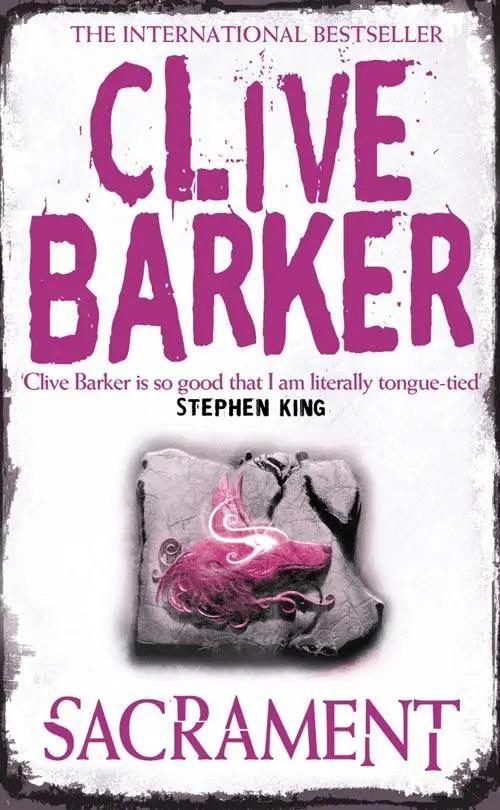
cover art by Bill Gregory
But Simeon died centuries ago, and we only get to meet Rukenau here, living a squalid existence in the out-of-this-world structure known as the Domus Mundi. Whatever it is or was meant to be, this structure (I don’t recall it getting a full explanation) is a shining thing that seems to contain the essence of the world’s animal and plant life, a light full of “hints of living things”—or would do, but because Rukenau is unable to face its constant light, he has covered the interior walls in “mud and excrement”—the main image that lingered from my first reading of the book, making me wonder at the time just what Barker was saying. (I’m still not entirely sure. Perhaps it’s more by way of a complaint, that we live in such a wondrous world, but insist on polluting it in every way we can?)
One notable shift in Barker’s fiction that comes through in this novel is its attitude to death. In his previous fiction, death has only ever been a transformation, a change of state rather than an ending, and one it’s possible to return from (however painfully—think of all those half-made Uncle Frank-like “walking anatomy lessons” throughout the novels). In Imajica, a man who died from AIDS became a voice that spoke from the afterlife, an “angel” to one of that novel’s characters; here, when a man dies from AIDS, it’s the end. Resurrection has been a key theme of Barker’s fiction from the start, but “This is not a world of resurrections.” Rather, it’s a world of “early and unexpected goodbyes”, where “Life was not a reversible commodity. Things passed away, never to return: species, hopes, years.”
Jacob and Rosa, though, belong “to a race or condition which was in some unfathomable fashion beyond the frailties of disease, or even death.” In the end, though, they are revealed to be not human at all. They form part of another theme in Barker’s novels, of created beings, like the homunculus of his play The Magician, or the magical doppelgängers of Zacharias and Judith in Imajica.
What humanity they have, in particular their characters as a man and a woman, was acquired by “learning the cruel assumptions of their gender from what they saw about them”. Jacob, then, is death (“It was one of this appetites as a man; to love the hunt, the blood-letting and the kill”); Rosa is a combination of lust and a constantly-frustrated desire to have babies.
 Overlapping with this Barker theme of the created being is another that’s closely allied to it, the relationship between fathers and sons. Here, it’s dealt with in entirely non-fantastic terms in Will’s relationship with his monstrously unemotional father, a philosopher whose response when his son says they should try to talk his mother out of her mournful depression, is to go on about the inadequacy of words to express any sort of meaning. “Nobody can ever feel what somebody else feels,” Hugh tells the boy, which is basically his excuse for doing nothing. His mockery of the idea of human emotion reaches its nadir when, pushing the question to its absurd extreme, he asks Will to imagine “a portion of excrement which may be dubbed loving”, and thinks that this disproves love, when it in fact only invalidates his methods of enquiry. Will finds a far better father-figure in the murderous Jacob, who at least, for a while, is interested in the lad (even if he later wants to kill him).
Sacrament received some friction at the time for centring on a gay character, both from critics and its first (soon-replaced) editor (who apparently asked Barker if he couldn’t swap Will’s boyfriend for a girlfriend, scared it would hurt sales). Surprisingly, for a book that depicts the gay community as Barker knew it, and so which presumably could have provided it with a de-stigmatising voice at the time, the sequences in San Francisco are a little bleak, and not just because of the presence of AIDS. (Douglas E Winter writes: “its take on gay lifestyles is by no means a gentle or encouraging one”.)
Kirkus Reviews, though, gave the book a mostly-thumbs up critique:
“By turns suspenseful, intellectually exciting, wildly melodramatic, turgid, and bombastic, Barker’s novel is charged—in its complex development and surprising resolution—with very real, very human emotion. A weirdly absorbing and entertaining tale that offers more disturbing delights from one of our most inventive and risk-taking writers.”
I certainly enjoyed it, perhaps more than the first time around, as I can maybe appreciate its maturity and depth a bit more. The first half felt a little unsatisfying, perhaps because of the lack of Barker’s usual profusion of fantastic images and ideas suddenly leaving his characters with nothing to be beguiled by, but as the themes kicked in, in the second half of the novel, it certainly grew on me.
Some questions seemed unanswered, particularly about Rukenau (just what was he up to when he had the Domus Mundi built?), but ultimately it’s a book that retains Barker’s usual visionary concerns, just versed in slightly less fantastic terms. Inclusionist that he is, Barker sees the wonders of creation at all levels of existence, in all aspects of being human, and in the natural world:
“The creators of the world had not retreated to the heights. They were everywhere. They were stones, they were trees, they were shafts of light and burgeoning seeds. They were broken things, they were dying things, and they were all that sprang up from things dying and broken. And where they were, [Will] was too. Fox and God and the creature between.”
