
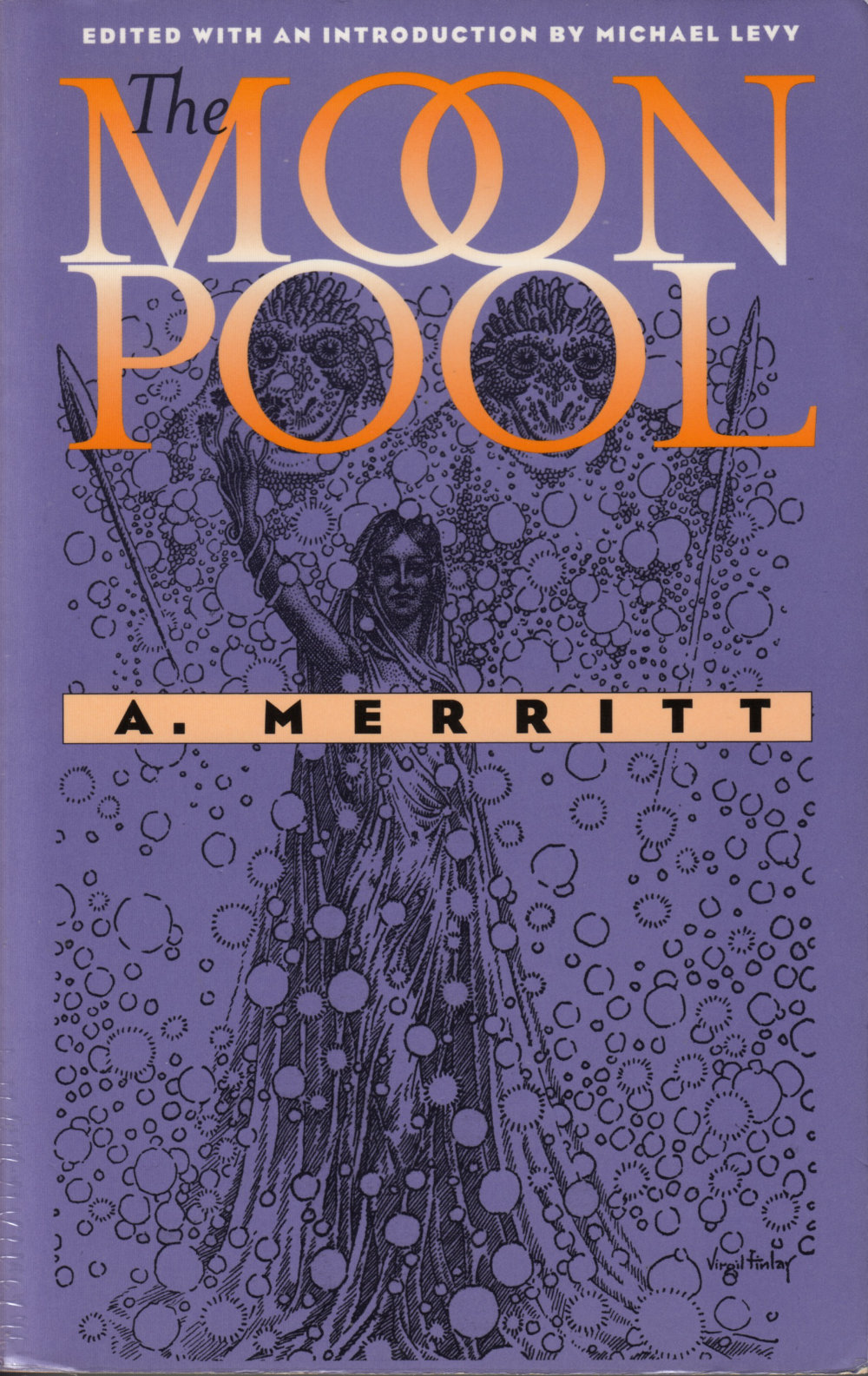
2004 edition from Wesleyan University Press, art by Virgil Finlay
Abraham Merritt is one of those writers I’ve long meant to read, and despite owning various paperback editions of his books, and making two attempts to get into The Ship of Ishtar, it’s only now I’ve finally read one—his first—The Moon Pool.
This began life as a short story, published in All-Story Weekly (22 June 1918), where it was popular enough for Merritt to write a longer sequel, “The Conquest of the Moon Pool” (in six instalments from 15 February 1919), and then incorporate the two into a single novel-length work. (Which, for some reason, was published in book form twice in 1919, first by Putnam, then by Liveright—apparently with some revisions to the latter, which included changing the villainous Prussian Von Hetzdorp to a villainous Russian, Marakinoff. Merritt apparently preferred the Putnam text, but I ended up reading the Liveright text.)
The book starts with its narrator, Dr Goodwin (“the foremost of American botanists”), meeting a well-respected colleague, Dr Throckmartin (or “Throck”), who’s evidently in the grip of “some searing shock of mangled rapture and horror”. Throck tells the tale of what happened to him in the ruins of Nan-Matal in the South Pacific: of a certain door that only opens by the light of the full moon, releasing a being of shining light which proceeded to carry off, one by one, everyone else in his expedition, including his young wife. Throck has vowed to return with the necessary resources to rescue them, but having told his tale is himself snatched away by this creature of scintillant moonlight before Goodwin’s very eyes. Goodwin, who has promised to take over the task should Throck be unable to, begins making plans. (This is the point at which the initial short story ended.)
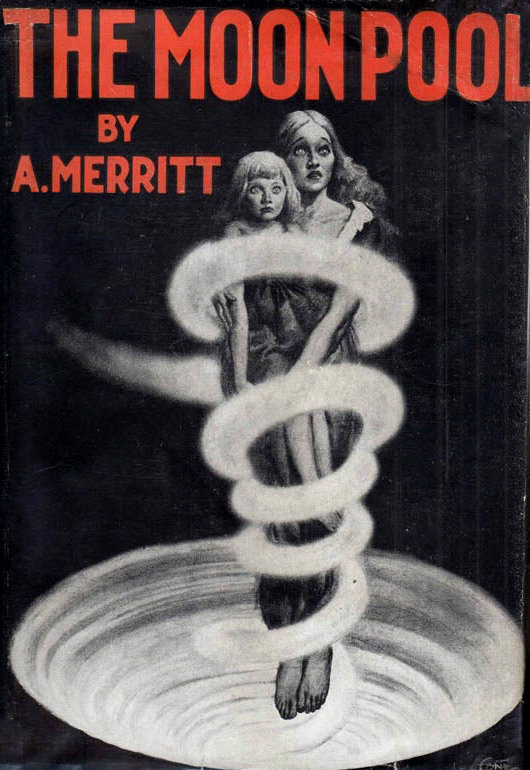
Liveright HB from 1929, art by Lee Conrey
Heading for Nan-Matal armed with, among other things, “a set of Becquerel ray condensers” (an early name for radiation, apparently), Goodwin assembles an odd cast of helpers, including a younger action-hero type in the Irish-American Larry O’Keefe (who’s sceptical of all of the supernatural except, apparently, banshees and leprechauns), the somewhat simple strongman Olaf Huldricksson, and the morally ambiguous (at first, anyway) Russian scientist Marakinoff. All manage to get through the moon-activated door to the chamber of the mysterious and deadly moon pool beyond, but are saved from becoming victims of the “Shining One” by a vision of a beautiful woman and her attendant human-sized frog-creature, who show them how to open a hidden door. Exiting the chamber, the band of adventurers find themselves in Muria (as in Lemuria), a subterranean land presided over by an ancient, advanced civilisation. Muria is ruled by the beautiful Yolara, Priestess of the Shining One, and the stocky-but-strong Lugur, Voice of the Shining One. (In this world, all women are tall and beautiful—though only the blondes seem to attain positions of authority—and all men strong and stocky.)
There’s a healthy dose of Haggard’s She going on here, with O’Keefe as the equivalent of the young heroic Leo, Dr Goodwin as the professorial Holly, and Yolara to some extent as Ayesha. Yolara falls in love with O’Keefe, and while he’s beguiled in turn, he’s really smitten by the visionary woman who guided them by the moon pool, who turns out to be Lakla, Handmaiden of the Silent Ones. This isn’t, though, quite the Ayesha/Ustane set-up from She, as although Yolara has all the fatal allure and power of Ayesha, the morally pure and innocent Lakla is essentially her equal, only serving different—and older—gods. Yolara serves the rapacious Shining One, and when she hears of the upper world from which O’Keefe came, makes plans for her deity’s conquest of it. Lakla’s Silent Ones, on the other hand, are a trio of ancient beings who originally created the Shining One, and though they’ve now lost control of it, and are somewhat fearful of it, nevertheless oppose its hunger for destruction. There are, even, echoes of the scene where Leo steps with Ayesha into a magical flame, only here the flames are “shining coils of moon fire”, and the outcome somewhat different, though just as perilous.
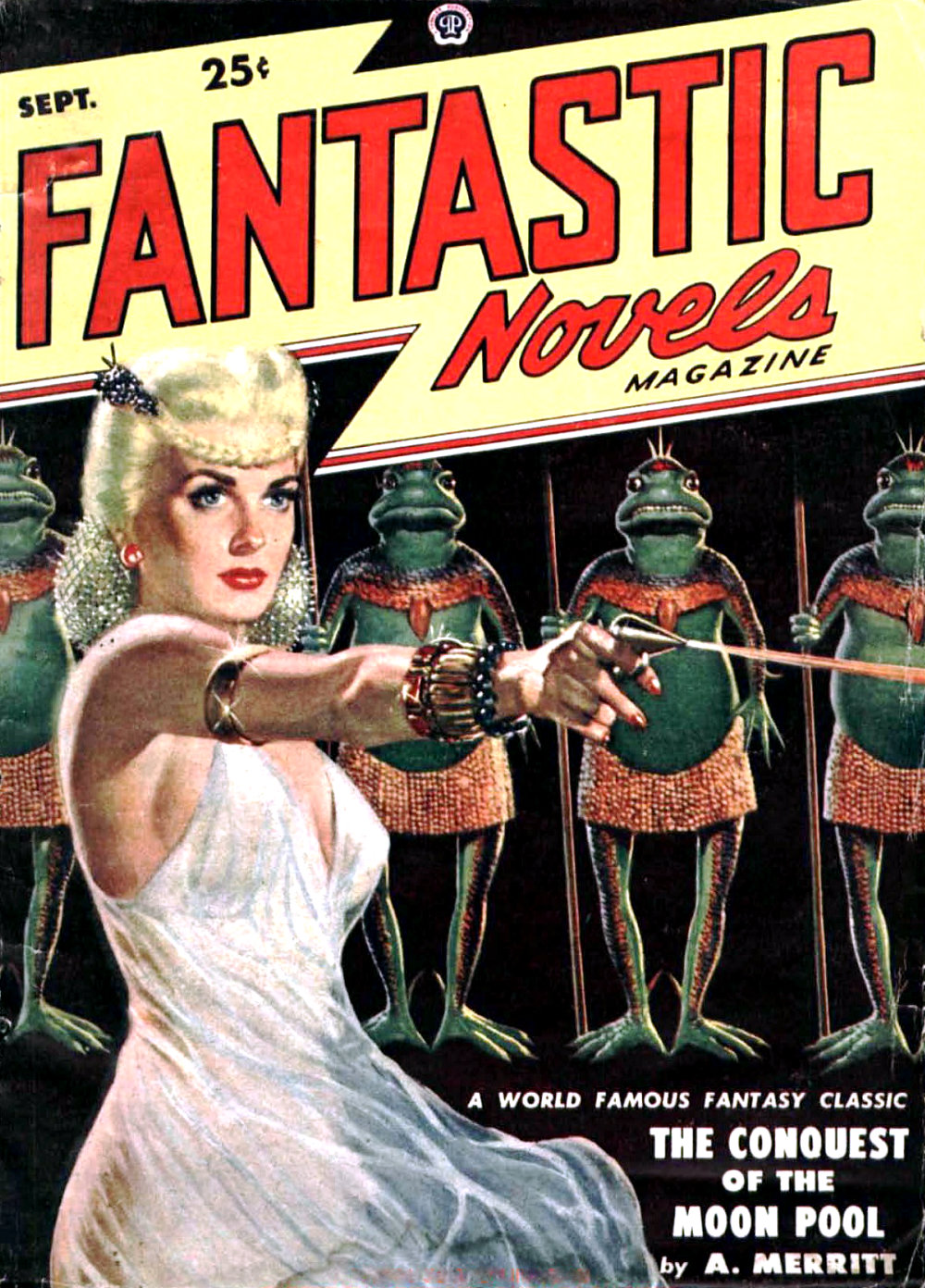
cover art by Lawrence
Merritt brings two things to this (by then) standard-feeling adventure formula, to make The Moon Pool distinct from She. One is a much greater degree of fantasy than Haggard employed. Merritt’s subterranean Muria possesses super-weapons including rays that shiver things (and people) to fragments, gravity-destroying bombs, invisibility devices; there’s also frog-people, a landscape of fungi that instantly devour living flesh, and the weird Shining One itself (which I can’t help picturing like the many glittery energy-beings in the original Star Trek series).
The other thing Merritt brings to this essentially Haggardian lost world adventure—and also what damned him for the more serious SF crowd of the 1950s and early 1960s—is his prose. Although James Blish (among others) would go on to dismiss it as “windy and cliché-ridden”, I think Merritt’s writing shows a real poetry when he turns it on at the right moment:
“There was no sky—at least no sky such as we know—all was a sparkling nebulosity rising into infinite distances as the azure above the day-world seems to fill all the heavens—through it ran pulsing waves and flashing javelin rays that were like shining shadows of the aurora, echoes, octaves lower, of those brilliant arpeggios and chords that play about the poles.”
(And if this sounds somewhat psychedelic, it may well be. As Douglas A Anderson shows in his essential article fact-checking Merritt’s autobiography, there’s an interview in which Merritt claims to have taken peyote, saying it “results in a color reaction. I remember sitting on the grass and watching it change into a variety of colors. Out of that came geometric patterns. I had a consciousness throughout of music that blended with the colors.” Just the melange of music and colour to be found in the above-quoted example of his prose, then.)
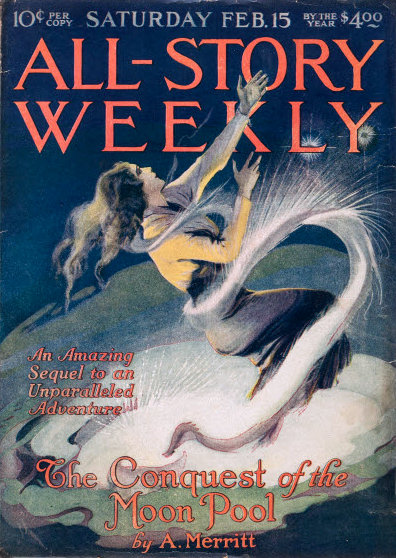
All Story Weekly, 15 Feb 1919, art by Frederic Small
I have to admit that not all of Merritt’s writing excited me to the same level. His non-American characters tend to suffer from a touch of the Van Helsings, not just talking in garbled cod-English, but doing it at great length, which implies the author was really enjoying it, but to me it was just readerly friction. (And O’Keefe, despite speaking English, descends into long, lyrical passages infused with Irish folklore and mythology, as though to so underline his archetypal Irishness that you can’t help feeling he must be compensating for something.)
Lovecraft was an admirer, writing in a letter to Robert H Barlow that Merritt “has a peculiar power of working up an atmosphere and investing a region with an aura of unholy dread”. And there are a few pre-echoes of Lovecraft’s own stories here. Not only does The Moon Pool, like “The Call of Cthulhu”, centre around a ruin on an island in the South Pacific, but the Norwegian captain of a ship found drifting nearby—Huldricksson—recalls, for me, the Norwegian captain Johansen from Lovecraft’s tale, both of whom have survived an encounter with their story’s monster. (Which, made of moonlight as it seems to be, has a touch of “The Colour Out of Space” about it.) And then there’s the theme of the scientifically-created servitor that turns against its makers—the shoggoths in At the Mountains of Madness, the Shining One here—though of course that could be read as just one more variant on the Frankenstein theme inherent in all science fiction. (Or the Morlock/Eloi relationship from The Time Machine.)
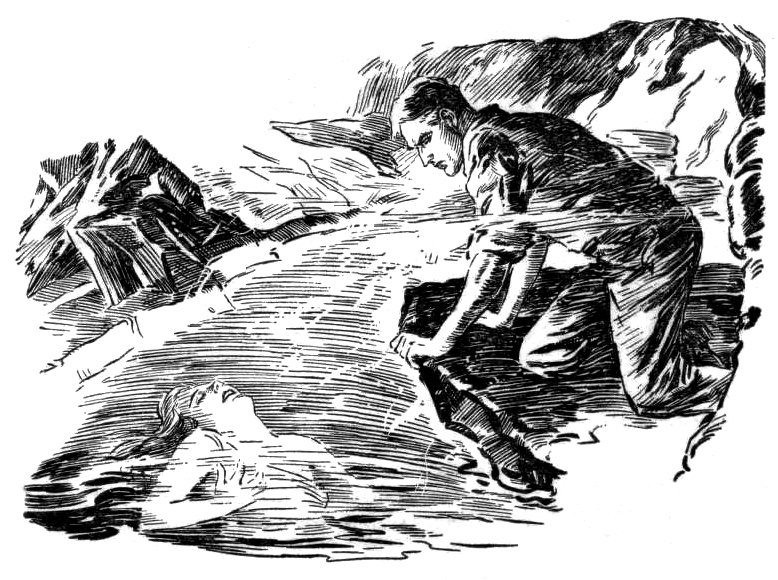
Illustration from Famous Fantastic Mysteries #1, Sep–Oct 1939
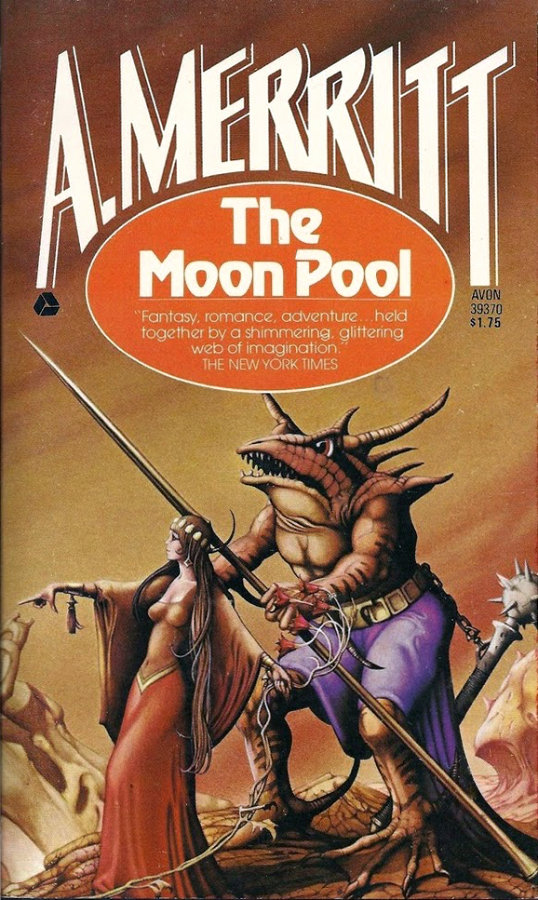
cover art by Rodney Matthews
Merritt was a tremendously popular author in his day, even having a periodical (A. Merritt’s Fantasy Magazine) named after him (though only after his death, and only lasting five issues). He was taken up by early SF fans, perhaps to his later detriment as, when SF started getting serious about the science in its fiction, his was found to be lacking, and he had to wait for his re-identification as a fantasy writer for his works to start being republished in paperback. Now he’s settled into place as one of the deep-cut classics of the fantasy field (I read it in an edition with footnotes and an introduction, from the Wesleyan University Press), not quite at the level of Haggard or Edgar Rice Burroughs, but somewhere, perhaps, in the Clark Ashton Smith zone. (CAS on Merritt: “Merritt has an authentic magic, as well as an inexhaustible imagination.”)
Merritt is a clear Romantic—not just in his lush prose, vivid imagination and high adventure, but for his ultimate message that “Love is stronger than all things.” (Even though it doesn’t help Throck, nor Huldricksson.) Although I enjoyed The Moon Pool well enough, the characters and situations were perhaps too archetypal, even clichéd, to really make it work for me. The descriptive prose is definitely good, though, as are the moments of bizarre fantasy. His subsequent output seems to be divided between further lost world adventures and a few occult thrillers. Perhaps if I read some more Merritt, I’ll go for one of the latter.
