
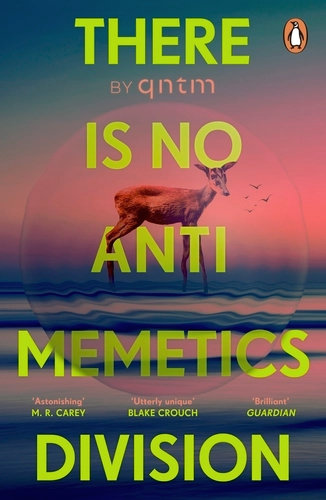
cover design by Dan Simpkins
Of course, there is an Antimemetics Division, you’ve just forgotten about it… The thing that threw me initially about this book is I thought it was Antimimetics Division—mimesis as in mimicry—which was compounded by the Penguin UK edition having a deer on the cover, making me think of aliens imitating Earthly forms. (A four-eyed deer, at that. Which makes me wonder if there might be a rebus puzzle going on here. Four-eyed-deer? No idea.) But it’s memesis as in memory. Antimemetics are beings, ideas, forces, that devour, negate, or generally affect human memory. So the science-fictional question behind this book is, “How do you combat an entity whose existence you’ve likely already forgotten?”
The job of doing that—and it is a job, mostly made up of meetings, training updates and paperwork (“Paperwork saves lives”)—is the purview of the Antimemetics Division, part of the larger Unknown Organisation, which is not an organisation that’s unknown, but one that deals with Unknowns. As the head of the AD (as I’ll call it from now, to save my word-processor’s spellcheck facility from a meltdown), Marie Quinn, explains:
“When empiricism and the scientific method were first starting to take shape, we realised that there were phenomena in the world that actively defied reason. Violations, weirdnesses, defects… places, events, ideas…”
Or, as one of her co-workers says, on reading through the AD’s database of known Unknowns:
“They have to be jokes. That’s how most of them read. Like very bad, dark, frightening jokes.”
 The first half of the book is, essentially, a collection of short stories or episodes in which the AD deals with a variety of often invisible, sometimes humanoid (so it’s mimesis as well as memesis) Unknowns—antimemes, infovores, memory-corrupting entities, you know the sort of thing. Despite having at their disposal a variety of technologies, including hi-tech containment units, a pharmacy full of mnestic drugs (for the enhancement and restoration of memory), advanced concepts (“ideatic space”, “consensus nominality”), rigorous training (you might think it’s your first day in the Division, but it’s possible you’ve just had the memory of an entire career there wiped out), and lots of paperwork, but what they’re dealing with, ultimately, defies reason, and requires a sort of practical knowhow (or unknow-how) to defeat, or at least contain. It also requires a certain amount of bottom-line “is it better to let one person die than risk the release of a dangerous entity on the entire human race?”-style thinking.
The protagonist throughout this first half is Marie Quinn, whose life is a constant battle with some entities, and an attempt to keep numerous plates spinning with regard to others. (She regularly reads trivia so as to keep a certain low-level memetic entity that’s attached itself to her from feeding on her more important memories).
In the second half, the book leaves the short story feel for a single narrative about a far more apocalyptic and world-threatening entity, and it’s this I found a little less engaging. What worked in the first half of the book—a lot of quick ideas, sharp narrative turns, a somewhat absurd level of humour, and a number of characters you meet only to witness their demise—worked less, for me, in the more sustained narrative of the second half. There, the quickfire plot-turns, for instance, left me unsure what was actually going on, and while that might accurately represent what it would be like to deal with a reality-warping incursion, it also lead to a certain disengagement from the narrative on my part.
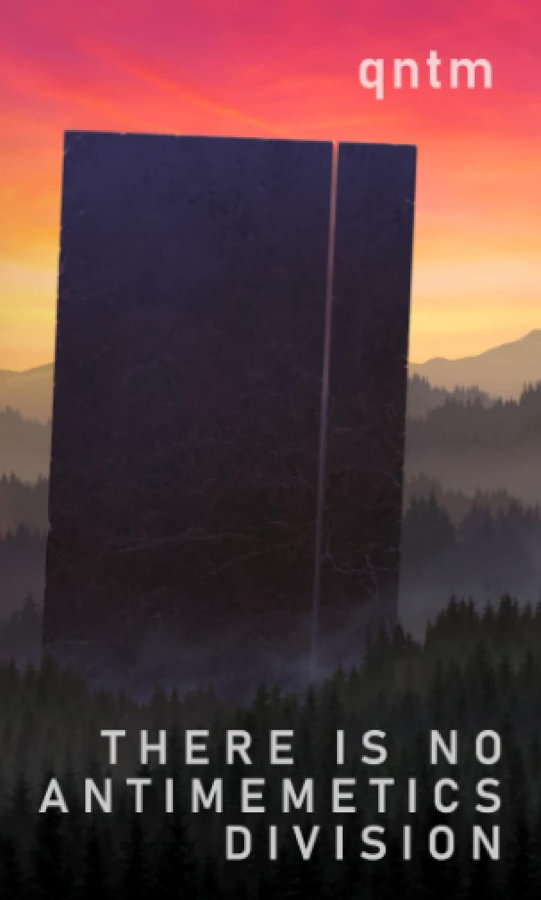
Cover to an earlier, self-published version.
I really enjoyed the first half of the book, though, making the whole thing worthwhile. There might be touches of Lovecraft here—in particular “From Beyond”, with its idea that we’re surrounded by invisible entities that will turn on us as soon as they realise we’ve worked out how to see them—as well as Ligotti, for his sense of absurdist humour. qntm, though, doesn’t share Ligotti’s misanthropy or truly nihilistic (even joyfully-nihilistic) levels of despair. (And I can’t help feeling that a writer with a pseudonym like qntm is surely bound, at some point in a book, to use the phrase “non-trivial”—and he does.) This is a book that brings the can-do science fictional mindset to cosmic horror, even when it takes us into the sort of apocalyptic levels of threat to reality you find at the end of, say, Alan Moore’s Providence. As Marie Quinn says—and no Lovecraft protagonist ever said:
“I’m going to win this war… I’ll beat the universe.”
The loss of memory has a lot of potential for real human drama—no mention is made, as far as I recall, of the potential use of mnestic drugs to combat dementia—but this is a book of quickfire ideas and narrative brio, not so much character and poignancy. (There was some of that, but I felt it less because of the general idea-driven momentum of the book—plus the sense that I shouldn’t get too attached to anyone.)
Which makes me think that may be the solution to the cover’s rebus (which qntm refers to as a “braindeer” on his site): it’s a book to read for the ideas (four-eyed deer)…
