Arthur Machen’s The White People, Jo Walton’s Among Others

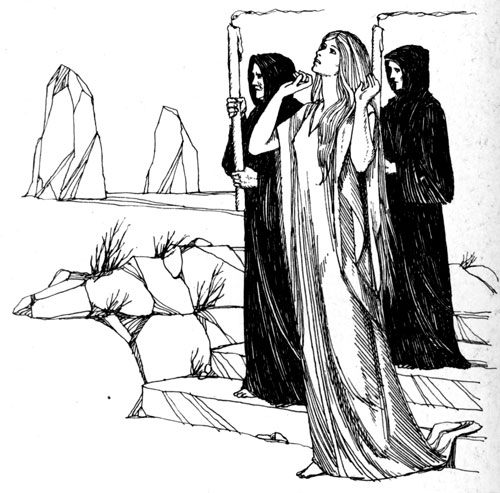
Arthur Machen’s “The White People” is one of the true masterpieces of short fantasy fiction, one that never fails to surprise me with its downright weirdness whenever I read it. Its main portion purports to be the journal of a young girl initiated by her one-time nanny into a strange world of rural magic and skewed faerie folklore. Its narrative veers from fragmentary dark fairy tales to the narrator’s exploration of the weirder, wilder regions of the surrounding countryside, all written in a breathless stream-of-consciousness style that predates the experiments of the Modernists by almost a decade.

Machen wrote the core part of “The White People” in the 1890s, but (quite understandably) didn’t know what to do with it, and it remained unpublished till 1904, when he packaged it up with an explanatory prologue and epilogue and submitted it to Horlick’s Magazine. Or was it Ovaltine Monthly? Either way, some magazine with far too cosy a title for such a twisted little tale. Perhaps because it was the only way it could be published, Machen’s prologue and epilogue try to turn the tale into a decadent horror story, with two gentlemen aesthetes discussing the young girl’s journal as an example of “sin”, and concluding with the information that the young girl was found dead, probably poisoned by an overdose of whatever had been giving her all these weird visions. This, perhaps a necessary defensive manoeuvre on Machen’s part to fend off the criticisms of literary conservatives, has always struck me as a false note. The narrator of “The White People” is just too full of vitality, and of magic, to be the mere victim of a horror story. “The White People” touches the genuine twilight world of early adolescent imagination gone weird, blurring the dividing line between childhood games and magic ritual, fairy tales and ecstatic religious vision.

This is a whole favourite sub-genre of mine: stories of the superheated twilight world of adolescent imagination, particularly where fantasy is used to make the distinctions all the more explicit. Examples include Shirley Jackson’s We Have Always Lived in the Castle, Steve Cockayne’s The Good People, (is Iain Banks’s The Wasp Factory one? I can’t remember, now) and films such as Spirit of the Beehive and of course the superb Pan’s Labyrinth. The most obvious thing to do with this sort of story is to equate the fantasy/magical aspects with childhood imagination, and to have the adolescent narrator come to terms with the loss of their childhood by having them lose the magic. This is the Peter Pan approach, where the only way to retain the magic of childhood is to remain stuck as a “Lost Boy”, an eternal child, regressed and cut off from adulthood. But the best of these stories see through this rather obvious use of fantasy-as-metaphor for childhood, and do something different. The best of them take the magic through to the adult world. Doing this convincingly, and meaningfully, is difficult, which is why a good example can be hard to find.

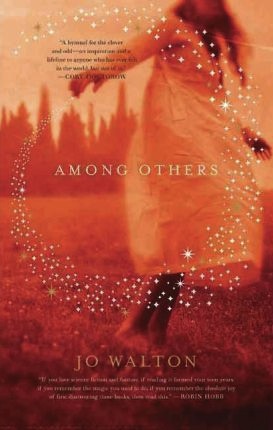
Jo Walton’s Among Others does it marvellously. Like Machen, Walton is Welsh, as is her narrator, Morwenna. (I did my best to sound the story in a Welsh accent as I read it. It probably wouldn’t have convinced a native speaker, but what would a native Welsh speaker be doing in my head, anyway?) Written in the form of Mor’s diary when she is fifteen (and set quite specifically in 1979 and 1980), Among Others starts soon after a terrible event in its young heroine’s life. She was born with a twin, with whom she shared the intensely imaginative world of her childhood life. Like Machen’s heroine, the pair rambled the Welsh countryside, naming its ruins and hidden pockets with fantasy-tinged names (many of them lifted gleefully from The Lord of the Rings), and quite naturally interacting with the wonderfully imagined faerie folk they find there. But Morwenna and Morganna’s mother is a witch; she is also insane (the two may go together), and has dark plans. The girls go against their mother. The story of exactly what happens is spread out through the novel, so I won’t say any more on it, but by the time Among Others begins, Mor is living in the aftermath. Her twin is dead, she herself has a badly injured leg, she has run away from her mad mother, and her childhood is over forever.

The fantasy elements in Among Others are spot-on subtle. Mor spends a lot of time wondering about the fairies she sees and the magic she does, and how it is different from the way the world operates anyway. The book provides one of the best, most succinct, explanations of faerie nature when it says fairies are as they are because they’re “part of everything”. But for much of it, Among Others could be a non-fantastic novel, merely about an imaginative teenager. One of the best parts of the book is Mor’s passion for science fiction, which she consumes by the bookload. It’s amazing how fun it can be to read about a fictional character’s reaction to a book you yourself have read. It’s not essential to know a bit about late 70s SF, but it would certainly add to your appreciation of the book. (If not, anyway, the internet can provide all the footnotery you need. Not having read Kurt Vonnegut’s Cat’s Cradle, I had to look up “karass“, for instance, which is a key word in Among Others, referring as it does to a group of true friends who share your interests; one of the main threads of Mor’s story is her wish to find such a group, and what happens when she uses a little magic to do so.)

A wonderful book. I’m amazed it hasn’t yet found a UK publisher, as I think it could well be a mainstream, as well as an SF/fantasy, success over here. Still, perhaps in the current Amazonian age of bookselling, such things matter less. (Actually, now I come to think of it, I got mine through the Book Depository.) (And I should point out that I first heard about the book via the wonderful Notes from Coode Street podcast.)

But to return to “The White People”, Among Others reads more like how Machen’s tale should have ended, with its teen narrator not losing herself in the horrors of a dangerously un-Christian world of imagination, but finding the proper place for magic in a real, adult world. Among Others has a wonderfully affirmative ending. It’s one of those rare books that blends its fantastical and realistic elements seamlessly into a single vision, that manages to seem far more true, and far more insightful, of what it means to be a human being than a merely realistic novel ever could.
^TOP

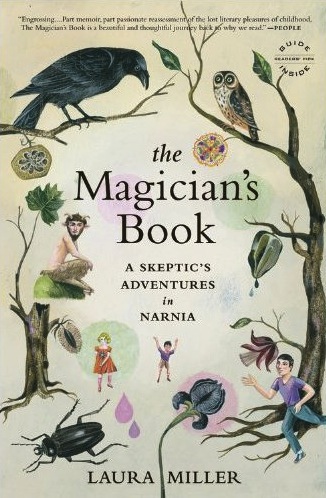
The Magician’s Book by Laura Miller

I was intrigued into reading Laura Miller’s The Magician’s Book: A Skeptic’s Adventures in Narnia because my own experience was similar to hers: I loved the Narnia books as a kid, but felt rather betrayed when I learned they were generally seen as blatant Christian propaganda. At which point, though it hadn’t been obvious at all to me when I read them (or, rather, had them read to me), it suddenly was, and obtrusively so. I was hoping, in reading Miller’s book, to resolve the question of whether the Narnia books can be redeemed, and re-read, despite their didactic intent, or whether, once the childhood bubble of their purely imaginative world has been burst (by the pin of propaganda!), the magic can ever be recovered.
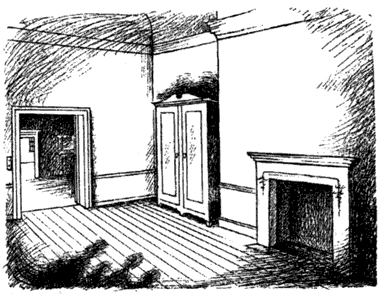
Miller’s book is divided into three sections: one covering her childhood love of the books, another covering the difficulties with them she became aware of as she grew up, and a third about revisiting them as an adult. Her method is basically discursive. She explores, chapter by chapter, various aspects of the Narnia books, and of C S Lewis as a writer, academic and person. This book is not a single, focused, critical argument, but more a literary stroll through Narnia and associated topics. I like books about books, and prefer most of all books aimed at a non-academic audience — books that focus on the joys of reading, and its links to everyday life, rather than on some particular aspect of literary theory. Miller’s book is, thankfully, not academic, and though the lack of footnotes or even a bibliography was sometimes annoying, it at least meant the book was written on my level. And, while she doesn’t treat the book as an argument in Narnia’s defence so much as an exploration of its various aspects, good and bad, she does provide some worthwhile insights on the way.

To Miller as a child, the Narnia books were a revelation. In a rather magically-tinged incident in her young life, a teacher lent her The Lion, the Witch and the Wardrobe, having decided she was a “child who needed to read C S Lewis”. This teacher later said that, on handing the book back after reading it, “You told me, and this I have always remembered, that you didn’t know that there were other people who had the kind of imagination that you did.”

It’s the middle section that really confronts the issues an adult (or even adolescent) reader has with the Narnia books. First, that they’re sometimes blatantly propagandist; second, that they contain all of Lewis’s faults as a person — his dated attitudes towards women and race for instance, which nowadays go as much to spoil the paradisal nature of Narnia as, in Lewis’s mind at least, they once went towards building it. Miller doesn’t attempt to justify the Narnia books in the face of these faults, but makes the point that “A perfect story is no more interesting or possible than a perfect human being”. The Narnia books have flaws just as Lewis, the person, had flaws, and as an adult you have to accept that is how they — and, really, all books — are. In literature (and fantasy, particularly), we may seek ideal worlds to make up for the real one’s flaws, but all we’ll find in the end is more flaws, even though very human ones.

In the book’s final section, Miller spent so much time talking about Tolkien, rather than Lewis, I wondered if she was tacitly proving Lewis’s faults by saying you couldn’t justify the Narnia books on their own terms. Compared to The Lord of the Rings, it’s easy, as an adult reader, to think the Narnia books a lesser effort, because less consistently imagined, less unified in vision. (Tolkien certainly thought so.) But, Miller says:

“The Chronicles are unified, not by anything resembling the exhaustive cultural stuff that Tolkien invented for Middle-earth, not by a single aesthetic or style, and not even, really, by a cogent religious vision, but by readerly desire. Lewis poured into his imaginary world everything that he had adored in the books he read as a child and in the handful of children’s books he’d enjoyed as an adult.”

That wonderful phrase “readerly desire” is they key to appreciating the Narnia books. “Narnia,” Miller says, “is the country of literature, of books, and of reading, a territory so vast that it might as well be infinite.” Like certain other fantasy worlds — Oz and Xanth for instance — Narnia isn’t designed to live up to Tolkien’s ideal of something that demands “credible, commanding Secondary Belief” from the reader, as set out in his essay, “On Fairy Tales”. Narnia, Oz and Xanth are more like grab-bags of all the imagination can contain, and so come to represent imagination itself. Access to Narnia is access to the imagination; the cupboard that, like the TARDIS, proves to be larger on the inside than out, and contains a whole, living, magical world, is just the human mind. Which may be why, once a relationship with such books is forged as a child, it can be so difficult to break, and feel so much like a betrayal if it is broken. But also why it is well worth recovering as an adult.

^TOP

Michael Powell’s Wizard of Earthsea

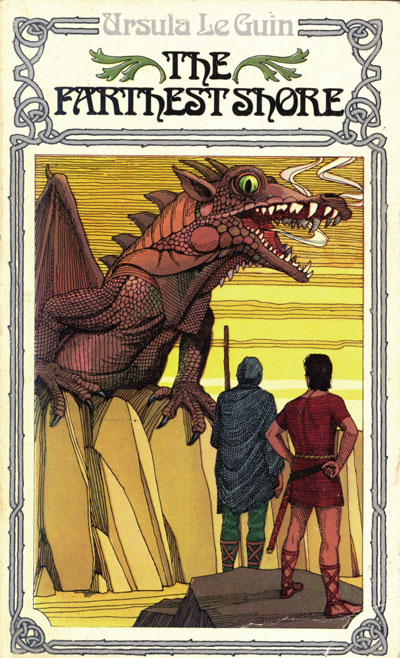
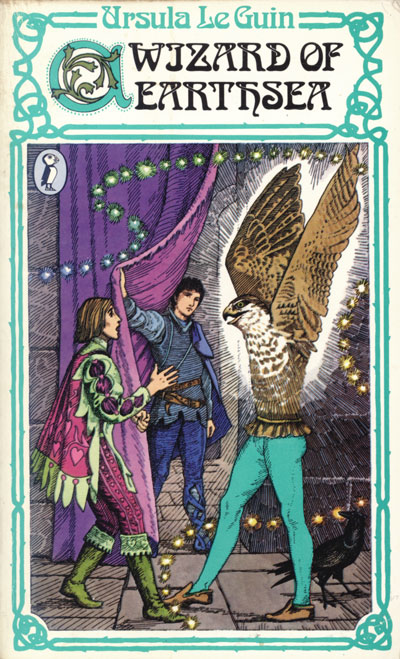
Ursula Le Guin’s Earthsea books have been adapted for the screen twice, once as a TV mini-series in 2004 (which Le Guin didn’t like), and once as an animated film from Studio Ghibli in 2006 (which fared a smidgen better with Le Guin, though she originally sold the rights on the understanding it would be Hayao Miyakazi making the film; in the end it was his son), but there was another, earlier, attempt at adapting the first two Earthsea books, a live action feature film written and directed by Michael Powell, he of Powell & Pressburger (The Life & Death of Colonel Blimp, A Matter of Life and Death, Black Narcissus, The Red Shoes, Tales of Hoffmann), and, on his own, the notorious Peeping Tom (1960). Apparently, Powell wrote to Le Guin to tell her how much he’d enjoyed the books, a correspondence ensued, and that led to their collaborating on the script by mail. (There’s a good account of how the two got started in a comment over at Tor.com.)

Powell had grand plans for the film, including bringing in David Hockney as designer (because of some illustrations he’d done for an edition of Grimms’ Fairy Tales — you can see some of them here, and, if you’re like me, wonder what he saw in them); Francis Ford Coppola was to have provided financial backing. The whole project never got further than the script, though — one account says it was due to Coppola going bankrupt, another that it was down to the ageing Powell not being able to get insurance — but the script is available to read over at Scribd.com. As the first two Earthsea books are perhaps the earliest-read books I still own, and occasionally re-read, I was curious to see what such a reputable filmmaker, with a definite artistic talent of his own, would have made of them.

Although it’s titled A Wizard of Earthsea, the script actually adapts the first two Earthsea books, A Wizard of Earthsea (which makes up the bulk of the film) and The Tombs of Atuan (which is mostly a subplot till the two come together at the end). And, apart from some jiggery-pokery needed to squeeze that pair into a two-hour film and bring it all to a satisfying conclusion, it generally remains very faithful to the books. The ending of Wizard (where Ged sails beyond the Archipelago in order to face the shadow he’s brought into the world alone) is lost, that final confrontation being merged with his and Tenar’s escape from the subterranean labyrinth of Atuan. For a long time, I preferred The Tombs of Atuan to its predecessor, and I couldn’t help being disappointed at how abbreviated Tenar’s story ends up in the script — her rejection of the gods she was brought up to serve is pretty much over in a line (“Oh Nameless Ones! My name is Tenar — Tenar — TENAR! I am not your servant any more!”), whereas, of course, she had a whole book to build up to that point in Atuan. But, allowing for the necessary abridgement, the feel of the stories is still very much intact in the script.

One question, though, is would it have remained that way? It’s notable that one of the scenes from A Wizard of Earthsea that didn’t make it into Powell and Le Guin’s script is probably the very one that would have sold it to a modern-day producer: the bit where Ged goes head-to-head with a dragon. Dragons appear in the script’s prologue, which ranges over the lands of Earthsea, introducing the Archipelago to the viewer, but aren’t seen again. Perhaps that was due to FX concerns, but it seems more to be because they were deemed extraneous to the story Powell and Le Guin were telling. Still, a dragon at the beginning (rather like a gun on the wall in the first act of a play) implies a promise of further dragonry to come, and in this case, the audience would have been disappointed.

There are some FX sequences left in. There’s a lot of illusion-weaving in the School for Wizards, for instance, and one intriguing scene where we first see the Archmage:

173. THE TALL WHITE FIGURE OF ARCHMAGE NEMMERLE materialises out of the shape and the spray of the falling water. A great black BIRD, a RAVEN of OSKILL, walks across the COURT to the Archmage and pecks at his STAFF.

Most of Le Guin’s magic, though, is understated and probably not as cinematic as a modern audience would expect — no flinging of fireballs or bolts of magical energy, for instance. If the film were to be made today, in this post-Peter Jackson age, that would almost surely be changed, or certainly cause the filmmakers to come under pressure from their more commercially-minded backers.

Another interesting point was that Powell obviously wasn’t thinking of this as a children’s film. His reaction to the books was, apparently, surprise that they were being published by Puffin, a children’s publisher, because he thought they were for everyone, adults included. I agree, but they certainly start off as being accessible by children. Powell, though, seems to have put his foot firmly down on the “for adults” camp, with a section of the script that details Ged’s stay with the people of the Terranon. Having just made it into their stronghold after being chased by the shadow-creature he loosed upon the world as a student mage, Ged collapses; there follows a slightly feverish sequence as he recovers, which starts with this scene:

486. HOT SPRINGS. Colors — weird rocks — old dwarf trees — NAKED WOMEN IN THE STEAM — THEIR VOICES. MUSIC AND SINGING. MUSCULAR MEN. EROTICA.

…and that mood continues with the appearance of Serret, a woman who “is elaborately dressed, she gleams with jewels, rings, earrings, toerings: her body, which can be glimpsed through the diaphanous gown she wears, shines with jewels. The nipples of her breasts are ornamented with rubies, her navel is set with diamonds. She is definitely a Princess.”

Definitely a Princess; definitely not for children, either.

Having read the script, I’d love to have seen the resulting film. If it had managed to stay true to what they’d put down on the page, and not be changed by producers wanting something more commercial, I think it would have been one of the better fantasy films of the eighties — or even the current decade.

Pity it wasn’t to be.

^TOP