The Purple Cloud by MP Shiel

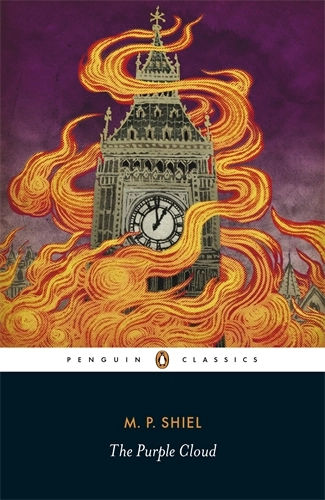
Penguin Classics edition, cover art by Yuko Shimizu

I’d long meant to read The Purple Cloud, partly because it appears in a number of “Rare Works of Imaginative Fiction” lists alongside David Lindsay’s A Voyage to Arcturus and The Haunted Woman. I think I’d been aware of it, though, since reading King’s The Stand, on which it had a minor influence (The Stand’s “Trashcan Man” and The Purple Cloud’s Adam Jeffson are both post-apocalyptic pyromaniacs). But perhaps the closest he comes to any author I’ve covered on this blog is John Wyndham in Day of the Triffids. Shiel’s is, in some ways, more of a “cosy catastrophe” than Wyndham’s: at one point, Shiel’s narrator reflects how, in the post-catastrophic world, “Everything, in fact, is infinite compared with my needs”—food is somehow preserved forever in Shiel’s world, and there are no pesky triffids to upset his narrator’s wanderings; on the other hand, for the bulk of Shiel’s novel, its narrator believes himself to be the last human being alive, which isn’t the case in Triffids.

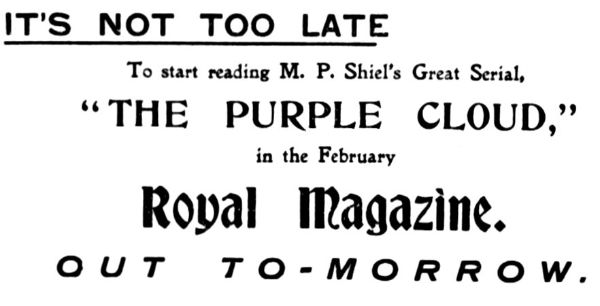
The Purple Cloud was first published in 1901, initially as an abridged serial in The Royal Magazine, then in hardback towards the end of the year. Later reprints, from 1929 onwards, incorporated edits Shiel made, which downplayed some of the increasingly unfashionable religious references in the text. I read the Penguin Classics edition, based on the 1901 hardback.
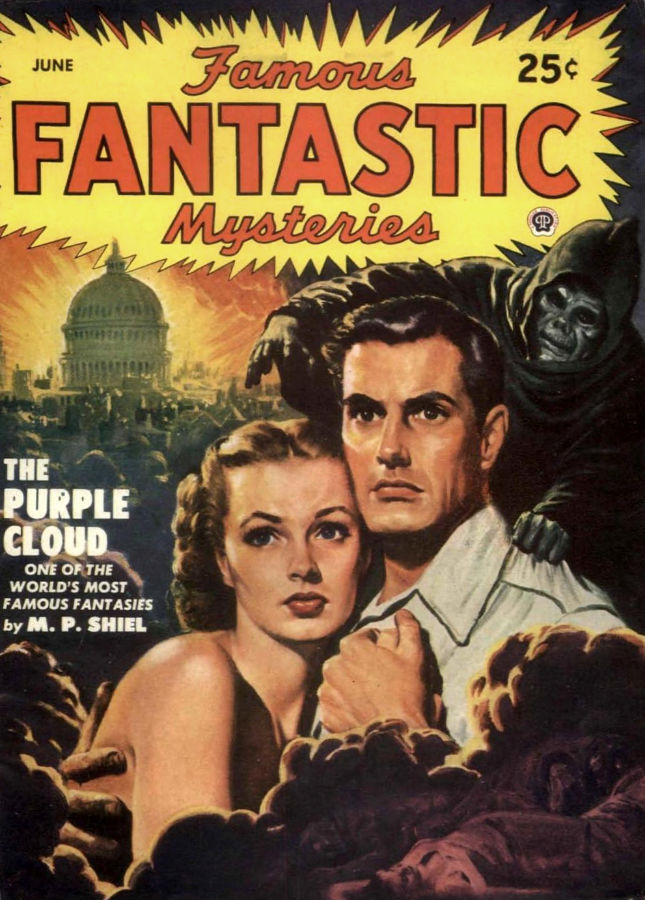
Stephen Lawrence cover for Famous Fantastic Mysteries June 1949

The narrator, Adam Jeffson, a young Harley Street doctor, finds himself part of an expedition attempting to be the first to reach the North Pole, after his fiancé, a scheming countess called Clodagh, deliberately poisons the doctor who was due to go. Adam turns out to be the only member of the expedition to reach the Pole (a massive pillar of ice, inscribed with indecipherable writings), but returns only to find that an enormous volcanic cloud of poisonous gas has swept the globe, killing all human and animal life. He searches for survivors, initially in towns and cities, later in mines, where he believes people might have sealed themselves in to escape the gas, but finds no one—no one alive, anyway, for everywhere is thick with preserved corpses, including the many people fleeing foreign countries as the gas cloud advanced. (Shiel is particularly effective in peppering his narrative with numerous tableaux of the dead caught in a variety of end-of-life dramas, including a massive, tight-packed crowd of “the standing dead… propped by their neighbours”.)
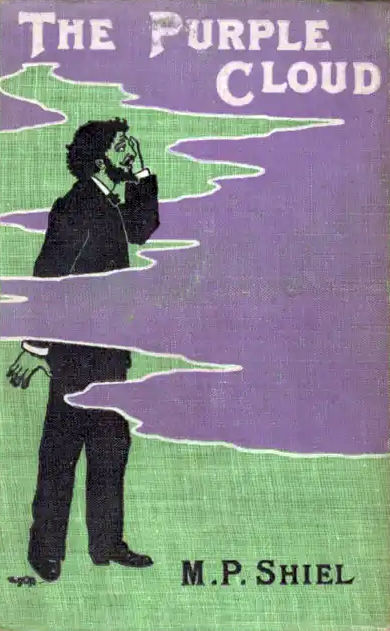
Chatto and Windus HB, 1901

Eventually, he has to accept he’s the last human being left alive, and it’s at this point he starts to indulge a new hobby: the burning of entire cities, starting with London. After a long bout of this, he flips to the other side of the creative/destructive coin, and decides to build, single-handed, a combined temple and palace, complete with gold roofs and wine-filled pools (not, he insists, out of luxuriousness, but for reasons of aesthetics and practicality). Finally, in one last bout of pyromania (Constantinople, if I recall), he accidentally sets free a young woman who was born, and spent her entire life so far, in a large, sealed cellar (which fortunately was filled with a lifetime’s supply of white wine and dates—how this must have affected her digestive system is never discussed).

Used to having the world to himself as he is, Adam’s first impulse is to kill her, and even when he finds himself incapable of that, spends most of the rest of the novel believing they should live a world apart, to prevent the slightest chance of restarting the human race. (Aware of the irony of his own first name, he quickly dismisses the idea of calling this young woman Eve. He opts for Clodagh, as a warning reminder of his poisonous fiancé, but she insists on Leda.) Eventually, after one final attempt to kill either her or himself, hints that another purple cloud of volcanic gas might be on the way (though this might be a fib of Leda’s to force him to rethink their relationship), Adam renounces his murderous impulses, admits his love for her, and a new human race is begun.
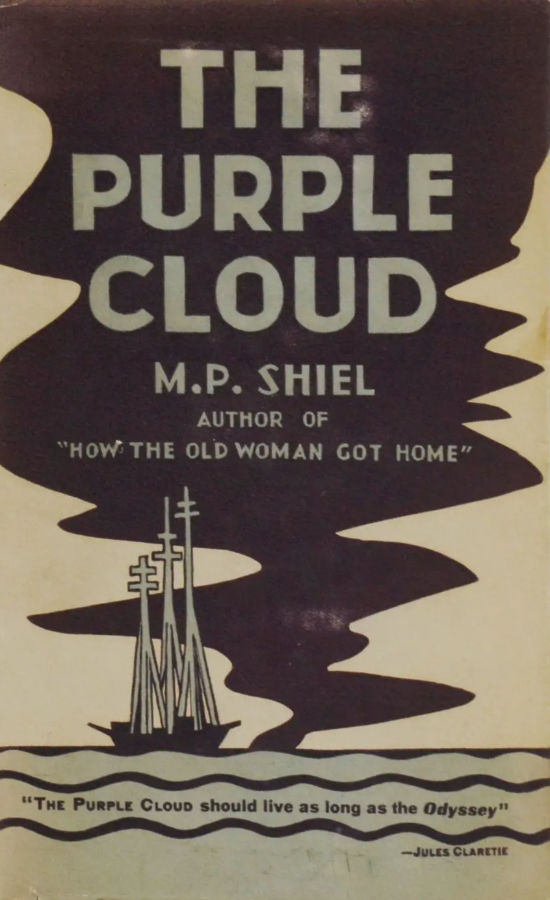
1930 edition

The main argument against this being what Brian Aldiss called a “cosy catastrophe”, is Adam’s descent into madness once he accepts he’s the last of the human race. He first of all passes through a phase of cosmic-level horror at the situation (“and I can feel now that abysmal desolation of loneliness, and sense of a hostile and malign universe bent upon eating me up”), then comes to feel that, no, this is how things are meant to be:

“…the arrangement of One planet, One inhabitant, already seems to me, not merely natural and proper, but the only natural and proper condition…”

It’s only when he sees Leda, and decides to murder her, that he realises (or the reader realises—it takes Adam a while longer) how far he’s gone. But though he later admits that “after twenty years of solitary selfishness, a man becomes, without suspecting it… a real and true beast, a horrible, hideous beast, mad, prowling…”, and that “man [is] at his best and highest when most social… for the Earth gets hold of all isolation, and draws it, and makes it fierce, base, and materialistic,” there is also a sense in which Adam is quite glad to be free of the bulk of humanity (“putrid wretches—covetous, false, murderous, mean, selfish, debased, hideous, diseased, making the earth a very charnel of festering vices and crimes”, as he says, at one point).
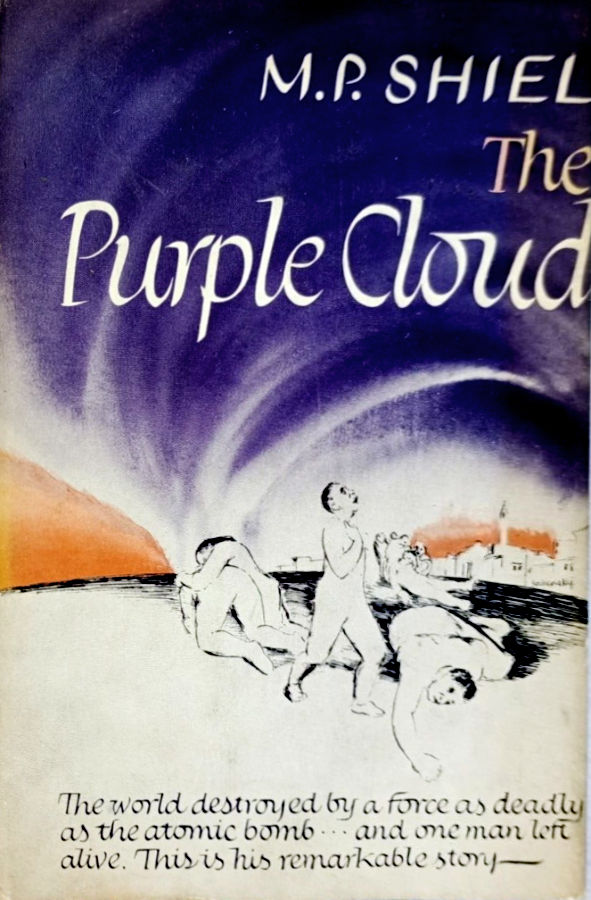
1946 US HB

Shiel belonged—or wanted to (he was published by John Lane, but never appeared in the aesthetic movement’s defining journal, The Yellow Book)—to the aesthetic/decadent crowd of the 1890s, and I can’t help reading The Purple Cloud as being driven by the key themes of literary decadence. When Adam sits back to watch London burn—itself a scene redolent of that founding myth of cultural decadence, Nero fiddling while Rome burns—he does so in Oriental dress, and having supplied himself with “a jar of pale tobacco mixed with rose-leaves and opium, found in a foreign house in Seymour Street, also a genuine Saloniki hookah, together with the best wines, nuts and so on, and a golden harp of the musician Krasinski”. (He uses to the harp to play Wagner’s “Ride of the Valkyries” as the city burns—Wagner being the Decadents’ favourite composer. It’s an image that would conjure thoughts of Apocalypse Now!, if only it weren’t so hard to imagine “Ride of the Valkyries” being played effectively on a harp.)

The complete depopulation of the world can’t help feeling like a Decadents’ dream—so much of literary decadence celebrates solipsism—while Adam’s creative impulse to build a temple/palace is just as Decadent as his burning of cities:

“I will build a palace, which shall be both a palace and a temple: the first human temple worthy the King of Heaven, and the only human palace worthy the King of Earth.”

It’s perhaps telling he can’t separate the ideas of temple and palace—or whether it’s dedicated to God, the King of Heaven, or himself, the King of Earth—as a luxuriant materialism combined with guilt-ridden hints of intense religiosity is another characteristic of the Decadent movement.
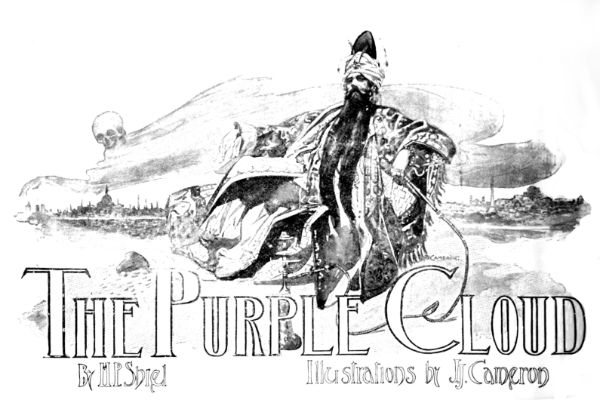
J J Cameron illustration from the Royal Magazine

There are elements of the fantastic in The Purple Cloud. It’s hinted, for instance, that the North Pole is a forbidden place, and that it was Adam reaching it, and touching it, that released the purple cloud. (Another, more misogynistic reading, is that the “sin” which leads to the unleashing of the purple cloud is Clodagh’s poisoning of Adam’s rival, making her a sort of anti-Eve.)

More explicitly fantastic is that Adam has, all his life, been aware of two voices in his head, urging him to good (the “White” voice, as he calls it) or evil (the “Black”), and that these may have been behind the whole story of his reaching the Pole, surviving the purple cloud, going on to burn entire cities (which eventually releases Leda) and finally restarting the human race.
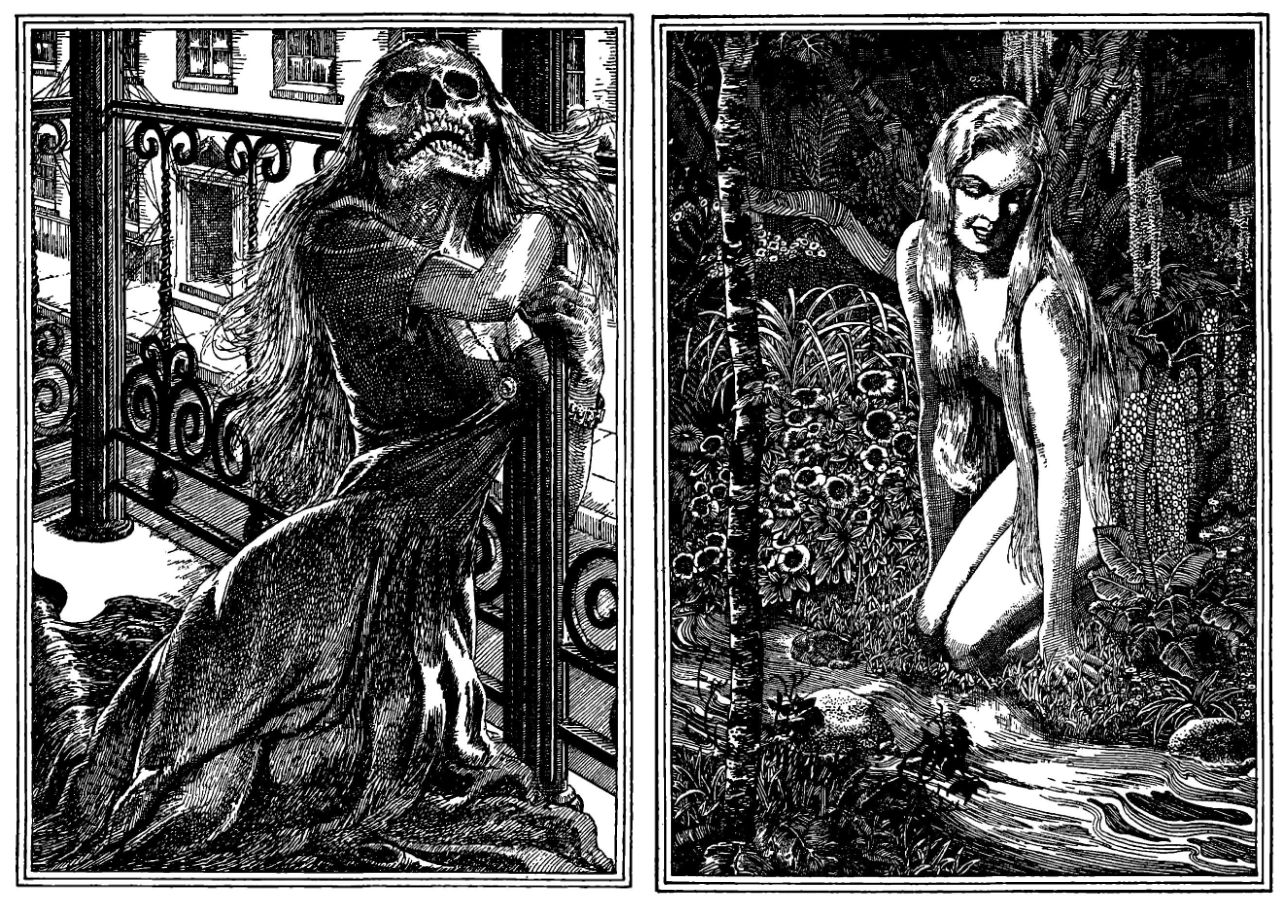
Stephen Lawrence illustrations of the corpse of Adam’s fiancé Clodagh, and Leda

Leda herself is an element of The Purple Cloud that pushes it into cosy catastrophe/daydream territory. Because she has spent her life in a cellar, she’s entirely innocent of the world. She’s so much younger than Adam that he can, effectively, overrule her in everything and, through education, shape her how he wants her to be (he even says “For she is my creation, this creature”). Her lisp, by which she replaces every “r” with an “l” (perhaps meant to be endearing, quickly becoming as irritating as Van Helsing’s cod-Dutch accent in Dracula) can’t help but infantilise her, which is particularly troubling considering the revelations that came out about Shiel in 2008, that he spent a year in prison for sexual relations with a twelve-year-old girl—certainly not the only such incident in his life.

Lovecraft mentions Shiel in his essay, “Supernatural Horror in Literature”, and the reaction is pretty similar to how he felt about Hodgson’s Night Land: the book as an imaginative narrative is great—in fact, it’s written with “a skill and artistry falling little short of actual majesty”—but “Unfortunately the second half of the book, with its conventionally romantic element, involves a distinct ‘letdown’.” Shiel’s “romantic element”—mostly consisting of Adam’s trying to bring himself to murder Leda, or at least abandon her—is hardly conventional, but all romance was, I suspect, “conventional” for Lovecraft: he simply couldn’t understand any other reason why it might be there.
^TOP

The Thief of Always by Clive Barker

Conceived of while writing his previous novel, Barker’s children’s fantasy The Thief of Always came out in 1992, a postprandial belch after the massive banquet that was Imajica. As this was in the days before the Potter-powered YA boom, and Barker was very much considered an adult author, he licensed the book to HarperCollins for a dollar (a silver dollar in one telling, half a sovereign in another); it not only sold well, but has been widely translated, and has several times been touted for a film adaptation, either animated or live action.

It starts with ten year old Harvey Swick bored in his bedroom, wishing away the dull month of February, when the grinning Rictus (with a smile “wide enough to shame a shark”) flies in through the window Peter Pan-style. He offers to take Harvey to the Holiday House, “where the days are always sunny… and the nights are full of wonders”. This House, hidden behind a magical wall of fog, offers its guests the best of each season every day: spring-like mornings, sunny summer afternoons, Halloween each evening, and Christmas every night, complete with the perfect gift (on his first night, Harvey gets the wooden toy ark his father made for him years ago, which was at some point lost). There are two other children there: Wendell, with whom Harvey spends his days making a treehouse, and the more retiring Lulu who, after she shows Harvey her dolls’ house populated with tiny lizards, seems to spend most of her time hanging around the gloomy lake at the back of the House, with its strange, darkness-dwelling fish.

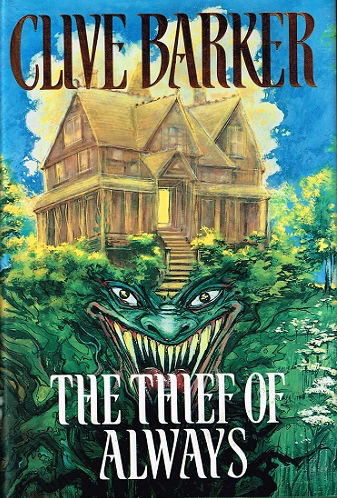
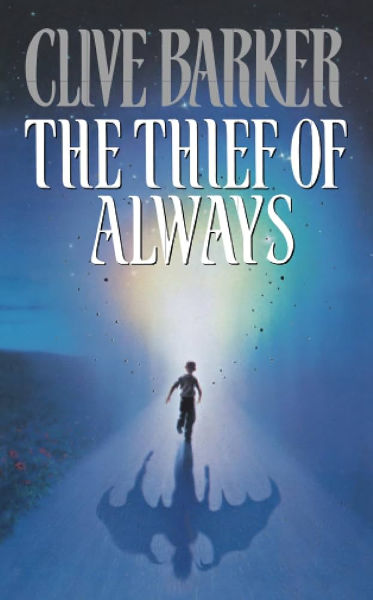
First edition HB cover, artwork by Clive Barker

There are a few hints that everything is not so perfect. The man behind all this, Mr Hood, is never seen, though Rictus and his colleagues (the jittery Jive, and the sluggish Marr), and the cook Mrs Griffin, often refer to him, making it clear he not only knows everything that goes on in the House, but “every dream in your head” too. And Mrs Griffin warns Harvey that Hood “doesn’t like inquisitive guests”. Rictus, on first flying through Harvey’s bedroom window, invited him to ask all the questions he wanted, but as soon as he did, accused him of being “too inquisitive for your own good”. “Questions rot the mind!”, he warned—a telling echo of The Prisoner’s “Questions are a burden on others.” Harvey, though, quite naturally wants to know all there is about this evidently magical place.

After Wendell plays a Halloween trick on him, Harvey is determined to get his own back, and with the help of Marr, who can change people’s shape, allows himself to be turned into a bat-winged vampire monster, to swoop down on Wendell and give him a real scare. Rictus and Marr egg him on, to turn it into a real attack; Harvey fights the temptation, but genuinely frightens the boy. The next day, Wendell tries to leave, but finds he can’t get through the wall of fog. Meanwhile, Lulu, who has been hiding away for some time, calls goodbye to Harvey from behind a tree, saying she doesn’t want him to look at her. He realises she has slowly been transforming into one of the fish that haunt that gloomy lake, and has now gone to join them. Is this the fate awaiting all of them—those, that is, who aren’t claimed by the fourth of Rictus’s colleagues, Carna, who seems to be quite capable of killing children who try too hard to leave the House?

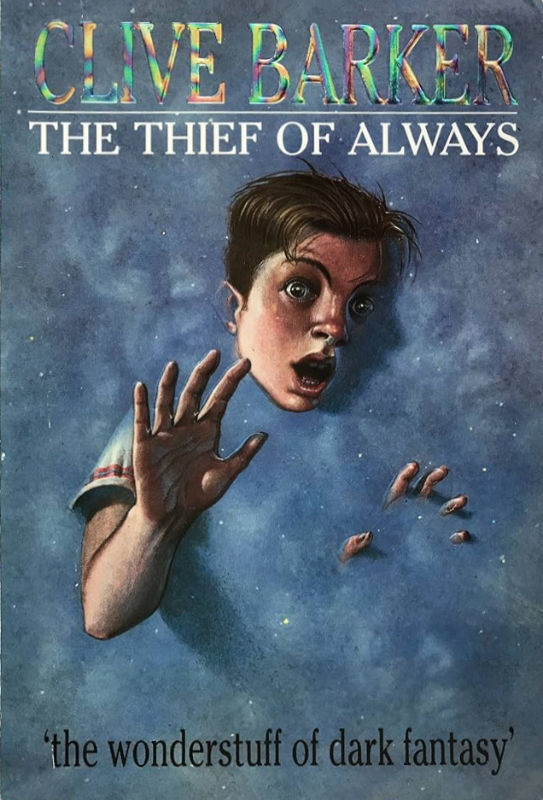
1995 edition, art by Stephen Player

The basic idea, of being in a place that seems like paradise but is in fact not just a trap, but a downhill slope to losing one’s humanity, is as old as the Lotos Eaters episode in The Odyssey—and is quite often paired, as here, with something of the Circe episode, too, as for instance when Pinocchio starts turning into a donkey on Pleasure Island, or Chihiro’s parents transform into pigs in Miyazaki’s Spirited Away. It has always felt a familiar plot-line, but when I come to list examples, I usually can’t find as many as I’d expect. There’s elements of it in Ramsey Campbell’s Incarnate, and it’s the plot of Neil Gaiman’s Coraline, but I always feel there’s some major examples out there I’m not thinking of. (And it would be quite instructive to compare Gaiman and Barker, though I’d consistently come out on the Barker side as a deeper and more artistically authentic creator.)

The uber-example, for me, though, is David Lindsay’s A Voyage to Arcturus, and there are a few resonances between Lindsay’s Crystalman and Barker’s Mr Hood. Both, for example, are explicitly called thieves (Krag calls Crystalman “a common thief”, while Hood is the most obvious subject of the novel’s title), and both are seen at least once as enormous faces (Crystalman under one of his many aliases, Faceny, who is “all face”, Hood in the House’s attic), with an implication that this is because, like Hood, there is “a terrible emptiness inside” them, and the face is, ultimately, all there is. And Hood accuses Harvey of having “brought pain into my paradise”, just as the one fly in Crystalman’s ointment is the presence of pain, as embodied by Krag—the one reminder that pleasure is only a part of human experience, not the whole of it, and so anything that excludes pain must be a lie. Barker has expressed his admiration for A Voyage to Arcturus (calling it “a masterpiece… an extraordinary work, if deeply, deeply flawed”), and I was pleased to hear a perhaps unintentional Lindsay quote from him in an interview, where he says “The most important part of me [is] the part which dreams with his eyes open”—echoing the “I dream with open eyes” line from Arcturus.

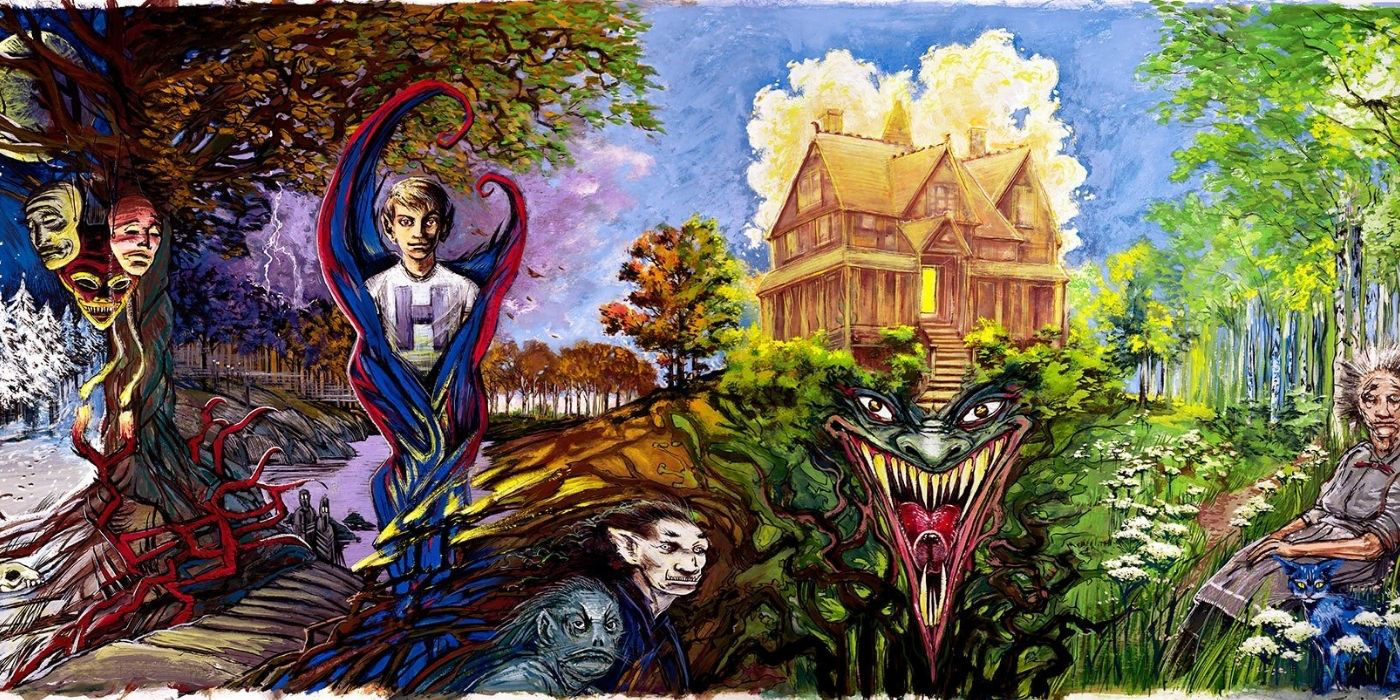
Full wraparound artwork by Clive Barker

The Thief of Always wasn’t Barker’s first foray into children’s literature. He’d actually made a couple of unpublished attempts before The Books of Blood (something called The Candle in the Cloud in 1971, and The Adventures of Mr Maximillian Bacchus and His Travelling Circus with some friends a few years later), and he’d written some plays for a youth theatre. Two of his inspirations were Peter Pan (which Barker has called “the book of my childhood”), and CS Lewis, but I was pleased to find that, unlike Lewis or, say, Roald Dahl, Barker doesn’t pick on one of his kids to be a moral lesson for the others, as with Edmund in The Lion, the Witch and the Wardrobe, or the many sticky ends met with in Charlie and the Chocolate Factory. Wendell, who is evidently a little more greedy, gullible and cowardly than Harvey—though all within acceptable child limits—seems the perfect set-up for this, but Harvey and he turn out to be genuine friends, and there was no feeling from Barker of an adult tut-tutting when Wendell couldn’t quite see things through in the ultimate confrontation with Hood.

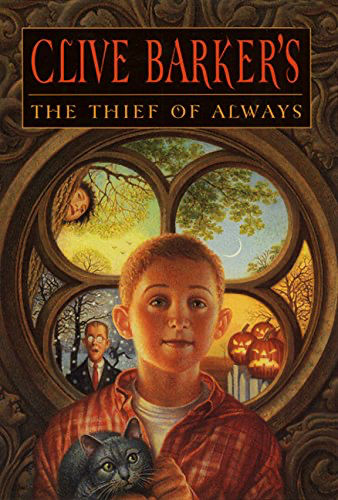
2002 edition, artwork by Dan Craig

The Barkerian touch, here, is that Harvey wins in the end thanks not to his moral goodness, but because he’s found a little of Hood’s darkness within himself, and learns how to turn it on this “Vampire Lord” and his deceptive House. There are echoes of other Barker works here too, such as the overall feeling of a Faustian pact; the quartet of Rictus, Jive, Marr and Carna feeling a little like the four Cenobites (both are sets of unnaturally altered humans with supernatural powers, both are three men and a woman, and both feature one member with a ridiculously fixed grin); Rictus, in addition, has the salesman-like patter of Shadwell from Weaveworld; and Mr Hood is first met in a dusty attic, giving it the feel of the lurking supernatural presence of the resurrected Frank in Hellraiser. Barker himself has said that The Thief of Always has some of the same themes as Imajica: “The concerns about the darkness, the secret self; the ideas about some ultimate enemy who is in fact quite close to one’s self.” There’s no sense at all that, in writing for children, Barker is being less Barker.

(He was often, at this time, saying in interviews from Weaveworld on that he’d moved on from horror to fantasy, but there’s a lot of darkness in The Thief of Always, and I have to say it’s in the darker fantastic that his power as an imaginative writer lies.)

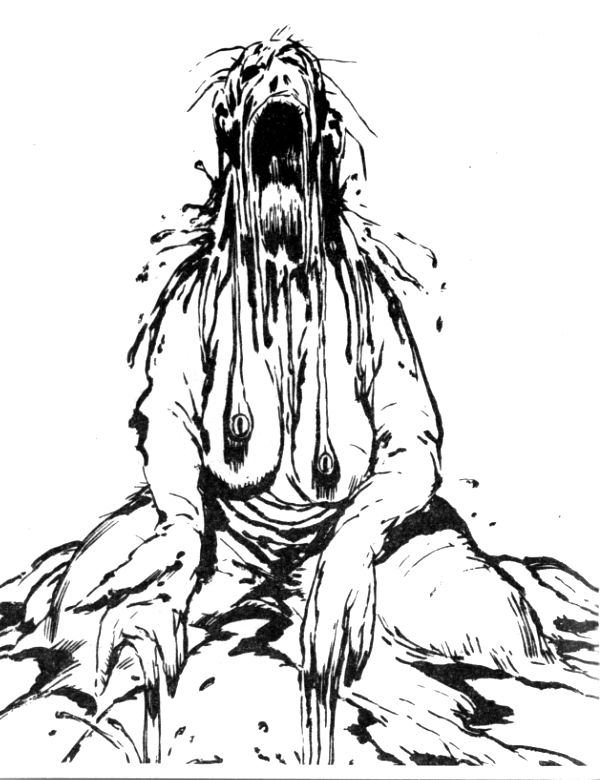
Barker not doing horror… and for kids, too. I particularly like how her nudity is tastefully covered by, uh, her melting eyeballs…

The risk with a children’s fantasy about the dangers of escapism is that it might turn into a critique of the genre it’s written in, but Barker, very much a pro-imagination writer—and also, as already said, not of the finger-wagging type—here presents a much more holistic view: “if we embrace Neverland too strongly, we are forever sucking our thumbs, but if we die without knowing Neverland, we’ve lost our power to dream…”, as he’s said in an interview. Harvey is an imaginative lad, and ultimately his imagination is part of the solution, not the problem. Being lured in by the apparent pleasures of the Holiday House is more like a refusal to grow up than a retreat into one’s inner world, and the best children’s literature is usually about learning to open up to the wider adult world. And Barker, a self-confessed “inclusionist” in all his writing, sees imagination, and darkness, as part of the wider, adult world, too.

^TOP

An Echo of Children by Ramsey Campbell

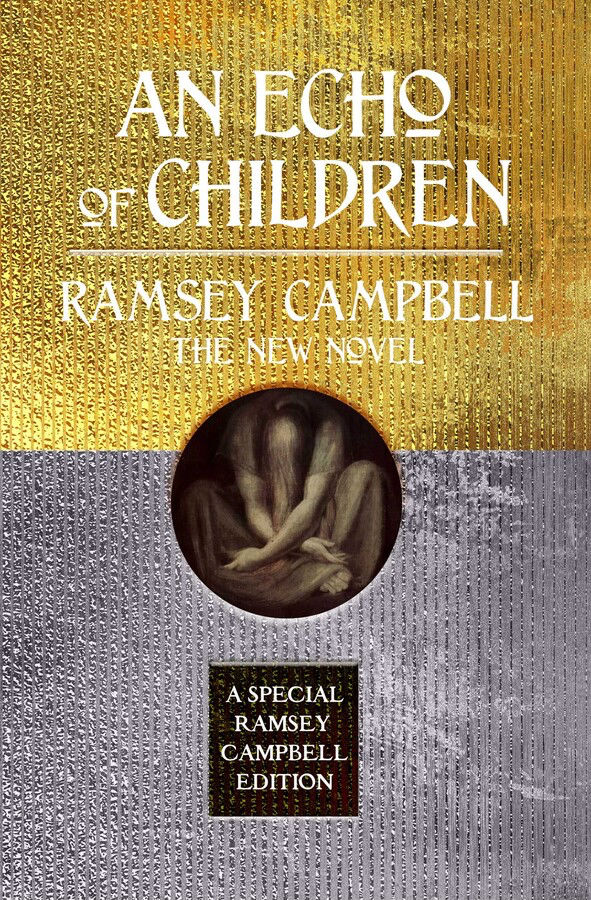
The (slightly over-glitzy, for my taste) Flame Tree Publishing hardback

Retired teachers Thom and Judith Clarendon are visiting their son Allan and his wife Coral at their new home in the seaside town of Barnwall (at number 14 Willow Grove—and you can’t help suspecting that 14 is probably a skipped 13). The real focus of their visit, though, is their six-year-old grandson Dean. Coral’s parents, Kendrick and Leigh, are also visiting, making for a crowded house. But it may have one more occupant still—Dean’s imaginary friend Heady, who “makes it go cold sometimes” and who can talk, but only “when he’s got a head”. Sleeping in Dean’s room, Thom wakes to see a child-sized shadow lingering near the bed, one that doesn’t seem to have anything above the shoulders. It disappears when he fully wakes up, but then Judith says to him “Don’t say you didn’t see.”

It all sounds like the set-up for a ghostly tale, and though it’s one Campbell would surely bring something entirely fresh to, it turns out that’s not the tale he’s telling in this, his latest novel, An Echo of Children. Because, once the grandparents are alone, Judith opens up about her concern that Dean’s imaginary friend may, in fact, be a ghost. And—everyone agrees. What’s more, even Allan and Coral agree, and a local priest, who believes them but for some reason is reluctant to arrange for an exorcism, nevertheless recommends the owner of a local New Age shop, who duly carries out a cleansing of the house. And it seems to be successful. Dean says Heady doesn’t like the smell in the house anymore and has gone. Which is sad, he says, because “He told me he wouldn’t let anyone hurt me… like someone hurt him.”

It’s from this point something changes in the household. Coral and Allan, already stricter than their own parents ever were, take Dean out of his new school because they don’t like the influence of his new classmates. As both work from home (Coral is a copyeditor, and perhaps being a corrector of other people’s mistakes has crept into her parenting style a little too much), they decide to home-school him, but their main intent seems to be to keep him away from anything that would make him question their increasingly strident religious views—and that even includes the local church.

Judith (now at her own home again, and having to work out what’s going on with Dean via video calls) starts to have new suspicions about the level of punishment involved in Dean’s home-schooling. She researches 14 Willow Drive and finds that the street changed its name after a horrendous local case in which a couple became so obsessed with correcting their wayward child, he “died by accident while they were attempting to purge him of wickedness” by attaching him to “a heavy child-sized cross”. And this is merely the latest in a long line of atrocities in a town whose very name, it turns out, commemorates a Viking massacre of a particularly nasty type: Barnwall, meaning bairn-field, or child-field, derives from the mass burials that were required once the Vikings had done their work.

An Echo of Children is a dialogue-driven novel, with something of the feel of Alan Garner’s The Owl Service (another tale of people caught in the tangles of a supernaturally-charged landscape). But the dialogue is characteristically Campbell’s own. Virtually every line spoken is fraught with unintended implications—accidental second-meanings instantly latched onto by the recipient, leaving the speaker scrabbling to correct themselves, or revise what they’d just said. It’s a novel in which even those who love one another seem to be constantly having to reassure their loved ones against the unintentionally bruising effects of language. For Campbell, dialogue is a minefield even before such a delicate subject as the possible abuse of a child gets introduced. The effect is a sort of hemmed-in isolation as the difficulties of communication lead to Judith’s constantly having to deal with others’ almost wilful misunderstandings, or is simply battered into helplessness by the kind of false reassurances people give when they see someone in distress.

The theme of this novel, as Campbell himself has said, is “the vulnerability of children, as well as how people are willing to embrace beliefs that rob them of the right to question.” And the vulnerability of children is by no means a new strand in his work. Right back in the early novels, The Nameless was about a parent’s fear of what the world can do to a vulnerable child (and this could well be seen as Allan and Coral’s motivation here), while The Influence dealt with the spectre of psychological abuse that hangs over a family through multiple generations. The abusive impulse arising from a location with a dark and supernaturally-charged past can be found in The House on Nazareth Hill, and there are of course numerous short stories in Campbell’s body of work that touch on the theme (for instance, in the collection I recently reviewed, Waking Nightmares). An Echo of Children comes closest to Claw, in that it’s about the potential parental abuse of a child, but here the focus is on the helplessness of grandparents who suspect what’s going on, but who, while they feel they must surely be able to do something about it, are too easily dismissed as interfering busybodies, or as simply having a different parenting style—or, even, as suffering from the first signs of dementia. (Thom’s living with a constant barrage of age-related aches and pains, bouts of blurred vision and so on, is a constant note throughout the book, which only adds to the tension of the concluding chapters.)

The mix of fundamentalist religious beliefs, and the smily, reassuring collusion of the local establishment figures who are also neighbours (and so, presumably, under the same influence of the land’s dark history) gives this novel a (sadly evergreen) relevance. Neighbours on Willow Drive include a police inspector, a social worker, and the owner of a local amusement arcade—all figures associated with the protection of children, or at least of places where they ought to be protected—and there’s almost a folk-horror-ish air in the way they pop up whenever Thom and Judith go out, offering their opinions on the right way to treat children, and how Dean is of course safest in his parents’ hands.

I might have preferred more in-depth background on the history of Barnwall, but perhaps that would have been a different sort of novel entirely. (I’d certainly have liked more characterisation of Allan and Coral. Surely the grandparents must have been wondering where this sudden religious impulse was coming from—though perhaps that’s part of the point: Allan and Coral’s behaviour is allowed to pass due to the usual British reticence in discussing peoples’ religious beliefs, even when those beliefs are a stepping stone to cultish behaviour.)

It’s an immensely readable novel (I polished off the last half in a single day, which is rare for me), not so much on the chilling edge of horror as the domestic end of a psychological thriller, though one with a definite supernatural edge. It continues Campbell’s run of fresh takes on the rich themes that have informed his body of work throughout, while showing him to be constantly seeking new angles and ideas.

^TOP