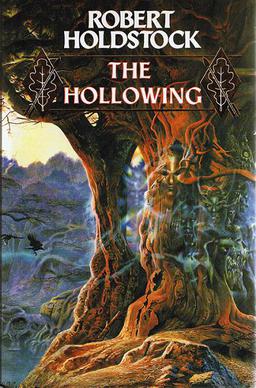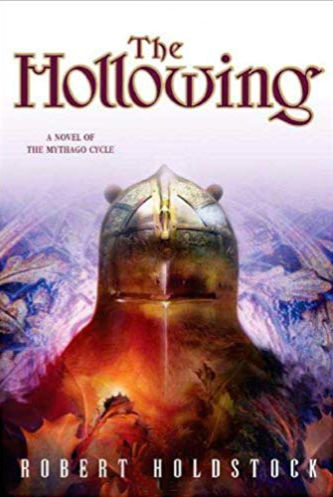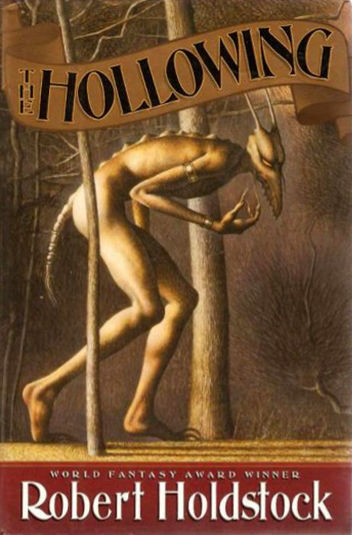
The Hollowing by Robert Holdstock

UK cover by Geoff Taylor

The Hollowing (first published in 1993) begins a year after the previous Ryhope Wood book, Lavondyss, and has a brief, baton-passing connection with that book’s characters. Early on, James Keeton, the father of Lavondyss’s protagonist Tallis Keeton, emerges from Ryhope Wood, ragged and wild-looking, a year and fifteen days since he disappeared in search of his still-missing daughter. Obviously broken by this loss (and, no doubt, by his time in the mythic depths of Ryhope), Keeton is taken to a sanatorium, where he’s visited by this book’s main character, Richard Bradley, and Richard’s son Alex, who had something of a connection with Tallis. But Keeton came back clutching one of Tallis’s masks, and when Alex picks it up and looks into it, he opens a “Hollowing” to the heart of Ryhope — a sort of wormhole shortcut by which you can leap from one distant location to another, even one world to another. Alex falls unconscious, and when he recovers, he’s not fully there, only capable of mumbling a few strange words, like “chapel” and “giggler”. Some time later, he disappears, and when his somewhat woody-seeming and highly decomposed body is found at the edge of the wood, Richard and his wife Alice can only mourn for his death. A few years later, though, Richard (now separated from Alice) receives a message from a group of scientists camped in Ryhope Wood, saying they’re in contact with his son and need his help to reach the boy. Alex is not dead, just lost deep in Mythago Wood.

Reluctantly but inevitably, Richard enters the wood, acclimatises to its peculiarities, and arrives at the scientists’ station at Old Stone Hollow to meet its bunch of investigators:

When the Station at Old Stone Hollow had been established, three years ago by the time-standard of the world outside of Ryhope Wood, there had been twenty assorted scientists and anthropologists, all gathered in by Alexander Lytton, all with a specialist field, all made privy to the secrets and oddities of the realm of the wildwood. They had been divided into ten teams of two, but only five of these duets remained extant. Three had disappeared more than two years ago and were presumed dead…

The backstory of the first Ryhope Wood book, Mythago Wood, has a pair of scientists, George Huxley and Edward Wynne-Jones, attempting to use early-20th century instruments to understand the wood’s mythogenic powers, but now we get a whole campful of them. These are not, though, quite the same as The Stone Tape’s band of experts trying to crack the secrets of a haunted room; they’re a bunch of jaded, irritable, and emotionally scarred men and women as far from understanding their object of study as ever, except that they’ve come to know, and be wary of, its many dangers. The station is surrounded by an electronic barrier that repels most mythagos, but also by more traditional warding methods: scarecrows, masks, shields and weapons hung from trees, totem poles. Anything that works. The scientists of Old Stone Hollow are prone to wander into the wood on their own private quests, driven as much by personal stories of loss or need (“Everybody’s looking. Everybody’s seeking. Everybody’s dreaming”) as the desire for scientific understanding. Many have had the experience of going “bosky” — entering so deep into the wood and its mythic world, they lose touch with their modern selves and start to behave like the very myths they’re living among. And they accept this as part of the deal.

One of the leaders of the expedition, a Scot named Alexander Lytton, has read George Huxley’s journal and has an obsessive need to somehow make contact with the man himself (even though he knows he’s long dead). He believes the wood was woken to its present active state by George Huxley, and is annoyed that Alex’s destabilising presence is overwriting Huxley’s traces. Alex, Lytton believes, was damaged mentally when he was snatched into the wood. The boy was stripped of the many inner aspects of himself, each becoming a separate mythago, many of them created from his enthusiasm for various myths and legends (he had a particular interest in the tale of Gawain and the Green Knight, but even his interest in dinosaurs has its effect on the wood). Somewhere, though, there’s what Lytton calls the boy’s “protogenomorph”, the “first form of the dreaming mind of the boy”, “the part of him that has waited for you, the part that has been fighting the battle”. Richard, then, has to find his son in the depths of Ryhope Wood and somehow bring him back to wholeness.

One of the new things Holdstock does in The Hollowing is show us the mythically-entangled stories of characters from other parts of the world. There’s Arnauld Lacan, whose entanglement with mythagos began in Brittany where, like the first book’s Stephen Huxley, he fell in love with, and lost, a woman who seems to have been a mythago. More interesting, though, is Helen Silverlock, a Lakota Sioux (Richard is reminded of “Cher from the pop duo Sonny and Cher” — one of the book’s few references to the pop music of its time, it mostly being set in 1967). Her family has been “regularly attacked, abused and destroyed by Coyote”, and she has come to Ryhope in the hope of meeting this particular form of trickster and sorting things out.

The most interesting section of the book, for me, was a longish chapter where Richard, living alone for a while in Old Stone Hollow, encounters a whole ship-load of mythagos, a grizzled crew of cynical Ancient-world warriors with a hold full of plundered wonders and treasures — some of which are living, including a pair of centaurs, a cyclops blacksmith, and the still-singing severed head of Orpheus. This is a gritty, aged version of Jason and his Argonauts, a Jason interested in nothing but gaining and owning treasures, pillaging them wherever his ship lands, and caring nothing for their value except as trophies. In a way, he could be the embodiment of the worst direction the scientists of Old Stone Hollow could go, if they thought of the wood simply as a thing to classify, dissect, and extract exploitable knowledge from. Jason, in this purely possessive aspect, can be seen as the worst possible attitude to take towards the “treasures” of the mythic and imaginative inner worlds. (In many ways, he and his band recall the dark, plundering “Outsider” Christian from the first book.)

US edition, cover by John Jude Palencar, from ISFDB.

In contrast to Jason is Sarin, a woman Jason keeps as one of his items of living plunder in the hold of his ship. She comes from a time when everyone could speak a single language, known as the “Tall Grass language”, as well as each having their own private language (“which they spoke alone, to the moon, or to hidden forces, or to God”). In her time, a great tower was built, stretching high into the sky, before being struck down by the gods as a warning against overreaching arrogance, after which people forgot the Tall Grass language, and could only speak a confusion of their own, secret tongues. Sarin, however, emerged from the fall of the Tower of Babel with her memory of the original language intact, and using it, she can understand and speak all languages, given a little time to work them out. She, in a way, provides a different way of seeing the inner worlds of myth and imagination: as ways to access the one “language” of myth and symbol we all, at some deep level, share, before it’s distorted by individuality and isolation. As Lytton later says of the many mythago-selves Alex was stripped of when he was brought into the wood:

“This is an encyclopaedia of what we have all inherited!”

It’s been a while since I reviewed Mythago Wood and Lavondyss, though I intended to read through the entire series at the time. Lavondyss was just too rich and harrowing an experience to leap straight into another book in the same vein. I’d say The Hollowing is no way near as powerful or focused as Lavondyss, though it’s hard to imagine any author producing another book as powerful as that one. In fact, I found it hard to imagine how Holdstock could ever follow that book, so having his next novel in the Ryhope Wood sequence feel somewhat half-powered is forgivable, even if I would have preferred a more focused story, to make the reading flow a bit better. (I was never drawn back to this book to see what happened next, only to get a bit more reading done.)

The Hollowing’s mythagos are much more fantastic, its world much more plastic, bending and warping far more than Mythago Wood’s did, and so it lacks the first book’s ability to make you feel you were being confronted by living, breathing, often stinking, emanations from a real historical past. It also feels much less connected than Lavondyss did to its main character’s personal darkness, much less singularly focused. Rather, The Hollowing feels like a slice of life in Ryhope Wood — eventful, certainly, but rather scattered and fragmentary. It’s not really clear what Richard Bradley has to do to bring his son back from being lost in the heart of the wood, so for most of the book it feels we’re just sitting around waiting for things to happen. And yes, things happen, but it all feels somewhat disconnected, until, finally, Richard too goes “bosky”, and has his period of living wild in the wood, casting off the shell of his daily self and accessing something more primal. And perhaps this was the necessary step he had to take in order to reach his son, but it still felt that it was something that just happened, rather than something he had any active part in initiating. Still, The Hollowing left me feeling Holdstock has more to say, so I’ll hopefully be reading the next book in the Ryhope Wood sequence soon.

^TOP

Heroes and Villains by Angela Carter

Penguin 1988 cover by James Marsh

A few Mewsings ago, I reviewed H M Hoover’s Morrow books, in the first of which a pair of children living in a semi-barbarous, post-apocalyptic society escape to the more technologically advanced society of Morrow. In Angela Carter’s (not YA) Heroes and Villains (1969), the opposite happens. Carter’s heroine Marianne (a young woman rather than a child) leaves her home community, a fenced-in remnant of the pre-“blast” civilisation dwelling in the buildings that survived this particular future’s apocalypse — mostly farmers and soldiers with the added “intellectual luxury of a few Professors who corresponded by the trading convoys” — for the wastelands, in the company of a barbarian man, Jewel. Whereas Hoover’s Tia and Rabbit leave because of their telepathic abilities and outsider status, Marianne goes because she’s bored with the possibilities offered to her by her society. She’s always been drawn to the barbarians — by their freedom, their vivacity, their bright colours. In Carter’s post-apocalyptic future, it’s the technological society that’s the most repressive (the soldiers are “developing an autonomous power of their own”, and look set to take over once the last few Professors die out). The barbarians can afford to be more free — in part because they live by raiding the farmers every so often — but are nevertheless beset by disease, physical ailments, and, crucially for Marianne, superstition. Hoover’s Tia left “the Base” because they thought she was a witch; arriving at Jewel’s people’s latest home, Marianne finds herself believed to be a witch, too, and doesn’t even have Tia’s witchy telepathic abilities to make up for it.

Carter, though, is less interested in the differences between the two types of communities, as to the dichotomy Marianne is caught by throughout the book, two poles she can’t escape because she carries them within herself, and often finds difficult to tell apart: desire and need.

Beardsleyesque Graham Percy cover

Jewel takes Marianne to his people, currently living in a large, semi-ruined house beyond the swamps and forests that surround her former home. There, she meets Mrs Green, the tribe’s matriarch, herself an escapee from the world of the Professors. Mrs Green is motherly, and treats everyone as though they were just big children, which, in a sense, they are. But these barbarians also have a dark father-figure in the shape of Doctor Donnelly, a former Professor who, “bored” and “ambitious”, went out into the world and, Kurtz-like, turned himself into a shaman and holy man for this tribe, frightening, guiding, and controlling them with his fits, his visions, and his stuffed snake. He feels like a character that’s appeared in the other Carter novels I’ve read (though quite some time ago), the puppeteer/shop-owner of The Magic Toyshop and the titular doctor from The Infernal Desire Machines of Doctor Hoffmann. Unpredictable, entirely self-serving, helping Marianne one moment, plotting to poison her the next, Donnelly is undoubtedly the book’s liveliest character, also its most dangerous. He instructs and warns Marianne through a series of slogans daubed above his door, most of which are nonsense, but one of which is:

“OUR NEEDS BEAR NO RELATION TO OUR DESIRES”

Pocket Books PB, cover by Gene Szafran

Marianne is obviously drawn to Jewel, but not quite enough to want to stay with him. When she attempts to escape (after Jewel’s brothers threaten to rape her) Jewel tracks her down and rapes her himself. She’s then brought back to the house and told she’s going to marry Jewel, even though his people are all convinced Marianne is a witch and ought to be burned. (Motherly Mrs Green’s sympathies are all with her boy, Jewel, who she felt had no choice but to do what he did.) Marianne and Jewel spend the rest of the novel alternately hating and needing one another, hurting and healing one another, breaking up and coming together, giving in to each other one moment, struggling and fighting the next. For most of its second half, Heroes and Villains is like being forced to witness the often verging-on-violence tussles of a quarrelsome couple who can’t live together but can’t live apart either. Morrowian telepathy might help, but I can’t help feeling, in Carter’s world, it would only make things worse, as the real battle is within each character, with their own human nature. Carter’s post-blast future is not, like The Death of Grass or Day of the Triffids, an exploration of how easily civilisation might give way to barbarism; it’s more about how the world changes when you grow up and leave the (here) boring world of childhood for the dangerous and never-satisfying world of adulthood, and meet with only frustration, pain, and more boredom:

“Boredom and exhaustion conspired to erode her formerly complacent idea of herself. She could find no logic to account for her presence nor for that of the people around her nor any familiar, sequential logic at all in this shifting world; for that consciousness of reason in which her own had ripened was now withering away and she might soon be prepared to accept, since it was coherent, whatever malign structure of the world with which the shaman who rode the donkey should one day choose to present her.”

And at the heart of it, that constant inner struggle between desire and need:

“Night came; that confusion between need and desire against which she had been warned consumed her. If it was only that she desired him, then it became a simple situation which she could perfectly resolve while continuing to despise him. But if he was necessary to her, that constituted a wholly other situation which raised a constellation of miserable possibilities each one indicating that, willy nilly, she would be changed.”

It’s evident Marianne will never decide one way or the other. She and Jewel sometimes fit each other’s desires, sometimes fit each other’s needs, but rarely for long or at the same time. It’s all rather despairing (“There’s nowhere to go, dear,” said the Doctor. “If there was, I would have found it.”) — and not because this is a post-apocalyptic, ruined version of our world, but because it’s an emotional picture of the world as it can be now, if you’re caught between incompatible desires and needs, and perhaps trapped in a marriage you sometimes want and sometimes hate. The post-apocalyptic wasteland just exists to add that note of hardly-necessary hopelessness to an already hopeless domestic situation. As Mrs Green says:

“It’d be hell with your Dr Donnelly running everything, real hell, no respect for the old or nothing. Only tortures, mutilations and displays of magic.”

I can’t help feeling, though, that Dr Donnelly is running the world in Heroes and Villains, or at least his approach is the only one that works. He’s given up all attempt at being rational and consistent, and has embraced a sort of wilful madness. As a child, Marianne lived in a world of carefully-protected reason; bored with that (and after the death of her father) she left it, to find that nothing would ever be the same again:

“When I was a little girl, we played at heroes and villains but now I don’t know which is which any more… Because nobody can teach me which is which or who is who because my father is dead.”

So, the comparison with H M Hoover’s Children of Morrow is less about the two authors’ ideas on technological as opposed to barbaric societies, and more about differing complexities in their characters’ inner worlds, the simplicity (or not) of their needs and desires, the difference, perhaps, between childhood’s easy answers and adulthood’s impossible questions.

^TOP

A Voyage to Arcturus as an allegory of life

Canongate 1992 PB, art by Sir Frank Brangwyn

The first half of Maskull’s journey on Tormance could be read as an allegory of human life — though with interruptions. Just think how David Lindsay’s protagonist first experiences this new world: rather than landing on the surface, astronaut-style, in the crystal torpedo in which he set out from Earth, he simply wakes to find himself already on Tormance, but in a helpless state. He’s lying naked on his back, too weak in this larger planet’s gravity to get up. He has new sensory organs that make this alien world seem even more new and different to him, among which is the whipcord-like magn growing out of his chest, like a baby’s umbilical cord. He is, in effect, a baby.

And along comes the most motherly creature on Tormance, Joiwind. Maskull immediately associates her with “love, warmth, kindness, tenderness, and intimacy”. She has an avowed philosophy of lovingkindness for all creatures, and at one point proclaims, “Is not the whole world full of lovely children?” She is, in effect, the most motherly mother Maskull could meet.

She clothes him, then feeds him from her own body, giving him an infusion of her “milky opalescent” blood, enabling him to stand Tormantic gravity. (A move that echoes and completes Krag’s method of enabling Maskull to stand the Tormantic gravity of the tower back at Starkness on Earth. Krag cuts Maskull’s arm and spits in the wound; Joiwind replaces the lost blood, thus providing the feminine completion to the masculine action: wounding, then healing.)

Soon, as they journey, Joiwind and Maskull are joined by Panawe, Joiwind’s husband. It’s as though baby Maskull has picked up a father in addition to a mother in this strange new world. At one point, the couple wait indulgently while Maskull runs off to investigate a nearby lake, like a toddler insisting on jumping into a particularly inviting puddle. That evening, Panawe tells Maskull the story of his own childhood, and the next day Maskull leaves to enter the next stage of his life-journey.

Ballantine PB, 1968, artwork by Bob Pepper

After a brief meeting with Surtur — who may not be the real Surtur — on the Lusion Plain, whose main purpose seems to be to issue a promise that Maskull has some sort of destiny ahead of him (just the sort of thing for an adolescent to feel as he heads off into the world), Maskull meets Oceaxe and receives a jolt. Oceaxe is no motherly woman. She’s “haughty, seductive and alluring”, and where Joiwind saw a world full of children, Oceaxe asks, “Isn’t the whole world the handiwork of innumerable pairs of lovers?” It’s obvious we’re in a different sort of world now, and Maskull, still wandering along like a child, has to be prodded into acting less like a child, more like a man. He’s told he dresses like a woman and even that his Tormantic sensory organs are more fit for a woman than a man, and he needs to change them. This, now, is a world where the perceived differences between the sexes matter, because it’s now a world where attraction between the sexes matters. Told how to change his organs, Maskull experiences an overnight adolescence. In the morning, he’s no longer Joiwind’s baby, he’s a would-be man. (Oceaxe still accuses him of being “boyish” at one point, but at least it’s an improvement, for Maskull, after being told he dresses like, and looks like, a woman.)

So now life on Tormance is no longer about Joiwind’s lovingkindness, it’s a battle of wills. It’s about proving oneself, exerting dominance, and winning sexual partners. There’s a thirst for dangerous thrills, and a sense of constant instability in the very ground itself. It’s all very adolescent, as it should be, because this is Maskull’s Tormantic adolescence. After the fatherly Panawe, the next male Maskull meets is the barely-adult but supercilious and cruel Crimtyphon, and he meets him not as an ally but as a rival. They fight like a pair of rutting stags.

French edition from 1975

The next stage in Maskull’s journey of life is characterised by another woman, Tydomin. Although she’s part of the Ifdawn Marest crowd, it’s made clear that, unlike them, she’s “no longer quite young”: compared to the adolescent Oceaxe and Crimtyphon, she’s middle-aged. She wins her battles in a different way, using subtlety and wile rather than outright violence, and though she does win, she’s by no means triumphant. This stage of life, for both Tydomin and Maskull, is marked by a feeling of tiredness, a sense of disillusionment and a need for a change or an end. The headlong momentum of adolescence has given way to adulthood, and the initial reaction to that loss of acceleration is to feel that life is less lively, less life-like, and so less worth living. Tydomin, fed up of life as she’s been living it, has decided she wants, from now on, to be a man; Maskull’s response to all he’s been through so far, typically male and still more adolescent than not, is to decide that life, which hasn’t worked out how he expected it to, and which has trampled on his childishly simple morals, isn’t worth living.

Here it starts to become clear how Lindsay’s allegory of life departs from the more conventional pattern. Instead of smooth transitions from one stage to the next, Maskull’s maturation is punctuated by breakdowns, as his disillusionment with the path set out for him makes him challenge it and find it wanting. Each time, it takes a revivifying confrontation with death to remind him why he’s alive. Having decided he’s willing to die, Maskull lies down to do so, only to find himself transported to his life back on Earth, to the séance where Krag grabs the apparition’s neck — Maskull’s neck — and twists it right round. This shocking vision reminds Maskull of the true reason he’s alive: it’s not to follow the conventional pattern, but to find his own. Revitalised, he sets out on the next stage of his quest — and once more falls back into the pattern of conventional life.

German PB

What follows adolescence? Work. Maskull and Tydomin meet Spadevil, a man who sees duty as the most important thing in life. It sounds like the philosophy of someone who has just entered the world of work and, finding a lifetime of it stretching in front of him, has to come up with some way of taming the still-uneasy turmoil of adolescence so it can fit a useful, socially-approved purpose. Spadevil, along with his two new disciples, takes this philosophy to Sant, which is an image of the world of work in Lindsay’s day, in that it is dour, dull, and male-only. (The firm Lindsay himself worked for, which became Price, Forbes and Company a couple of years after he joined in 1891, got its first female employee some time around 1909. Her job was to operate the firm’s one and only telephone. Her employers were so unsure how to fit this new commodity, a woman, into their working world that they built a special glass booth for her to work in, and, according to And At Lloyd’s: The Story of Price, Forbes and Company Limited, “the staff were forbidden, under threat of dismissal, to communicate with her except over the telephone”.)

Fitting in with Lindsay’s version of an allegory of life beset by breakdowns, this new enthusiasm for duty just doesn’t last. Maskull’s attachment to these new ideals, as embodied by Tydomin and Spadevil, ends in typically brutal Tormantic fashion, and Maskull, untethered from the usual path of life again, finds himself wandering in the wilderness of the Wombflash Forest, whose name perhaps promises a new birth, or perhaps expresses a craving, at this low point, to return to the certainties of childhood’s earliest stages, before all these murders, deaths and disillusionments. Again, it’s contact with death that moves Maskull on — he sees a vision of his own death, and a glimpse of Muspel-light, reminding him of why he’s on this quest. It’s not to follow the standard allegory-of-life path, it’s to discover his own answers. Revivified once more, he continues.

1975 German cover, art by Karl Stephan

The next figure he meets is Polecrab, a working man and a father of three. Polecrab has heard tales of the true nature of life in Crystalman’s universe, and even credits them with some truth, but has made no effort to find out more. He is, in effect, who the questioning Maskull would have become, had he stuck to the well-worn path of life and not had these moments of breakdown and disillusionment. It’s at this point, really, with this figure of Polecrab before him — the man who lived life as it’s supposed to be lived, satisfied in his way but ultimately still a small man before the universe’s deeper mysteries — that Maskull leaves the conventional path for good. He seeks an alternative, and from this point his journey on Tormance is no longer an allegory of life, but an investigation into a series of alternatives to see which might provide a better answer.

The first that Maskull tries — he visits Swaylone’s Island, where the musician Earthrid plays enchanting but murderous music — is the path Lindsay himself took when he left the world of work and became a writer: the path of art as a possible answer to life’s mysteries. When that fails (and all answers fail on Tormance), Maskull looks to science (Matterplay, with its vision of life as simply the wild and random sporting of the biological life-force), then religion (Leehallfae and Corpang, both of whom are devoted to their different gods, and both of whom are soon disillusioned), then sex (Haunte and Sullenbode’s world of pure-males and pure-females) for an answer. All of these fail. The ultimate answer awaits not for Maskull, but for Nightspore; and not on Tormance, but in Muspel.

Reading Lindsay’s A Voyage to Arcturus as if it were an allegory of life shows that the sort of life it’s allegorising isn’t an unquestioning one. Rather, it’s the pattern of a life beset by inner difficulties that, ultimately, make the conventional path impossible. It’s a life punctuated by breakdowns, by moral outrages, by disillusionments; but it’s also a life urged on by visions, revitalising contacts with a deeper idea that transcends the mundane path. It’s a painful, difficult path, but I suspect it perhaps represents Lindsay’s own in many ways. He had his own revivifying idea, his own vision of Muspel and the Sublime, and it was this, not the values of the interwar literary world, that he knew he had to be true to.

^TOP