Discussing Lord Dunsany’s style in his rather vituperative survey of fantasy literature, Wizardry and Wild Romance, Michael Moorcock quotes this passage from Thomas de Quincey as one of its possible sources:
“I was stared at, hooted at, grinned at, chattered at, by monkeys, by paroquets, by cockatoos. I ran into pagodas, and was fixed for centuries at the summit, or in secret rooms; I was the idol; I was the priest; I was sacrificed… I came suddenly upon Isis and Osiris: I had done a deed, they said, which the ibis and crocodile trembled at. I was buried, for a thousand years, in stone coffins, with mummies and sphinxes, in narrow chambers at the heart of eternal pyramids. I was kissed, with cancerous kisses, by crocodiles; and laid, confounded with all unutterable slimy things, amongst reeds and Nilotic mud.”
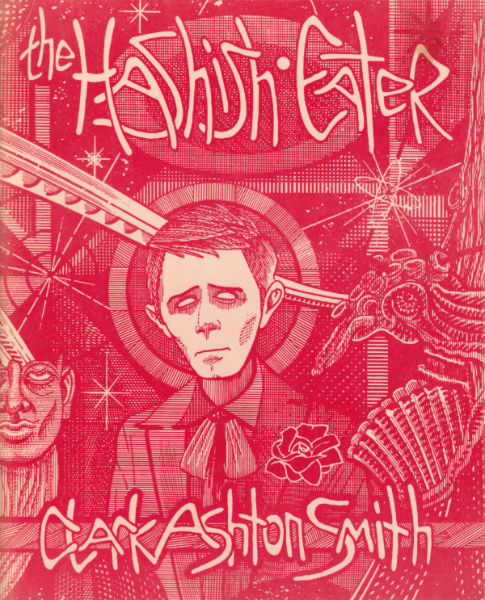
The Hashish-Eater, from Necronomicon Press. Cover by Robert H Knox.
Reading that little fever of opiate orientalism, I immediately wanted more, but, surprisingly, it’s about the only passage of its kind in Confessions of an English Opium Eater. Far more in this feverish-visionary vein is to be found in Fitz Huw Ludlow’s The Hasheesh Eater: Being Passages from the Life of a Pythagorean (first published in 1857, and avowedly in the tradition of de Quincey). But that sort of febrile fantastia finds it apotheosis, for me, in Clark Ashton Smith’s similarly-named mini-epic of cosmic consciousness gone wrong, “The Hashish-Eater: or The Apocalypse of Evil”, perhaps the greatest of all fantasy poems:
If I will,
I am at once the vision and the seer,
And mingle with my ever-streaming pomps,
And still abide their suzerain: I am
The neophyte who serves a nameless god,
Within whose fane the fanes of Hecatompylos
Were arks the Titan worshippers might bear,
Or flags to pave the threshold; or I am
The god himself, who calls the fleeing clouds
Into the nave where suns might congregate
And veils the darkling mountain of his face
With fold on solemn fold; for whom the priests
Amass their monthly hecatomb of gems—
Opals that are a camel-cumbering load,
And monstrous alabraundines, won from war
With realms of hostile serpents…
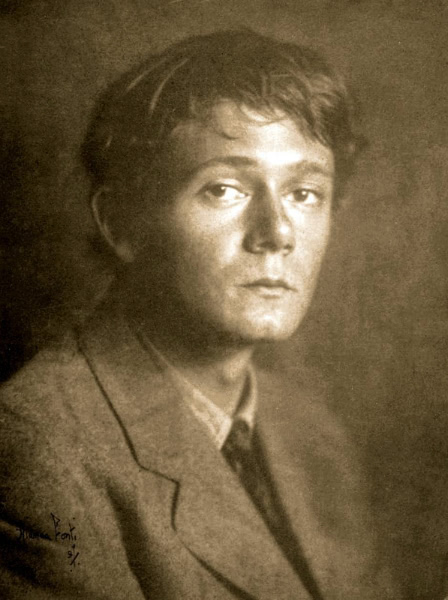 Smith mentions a number of inspirations, influences, and works that fed into the writing of “The Hashish-Eater” in his letters at the time. De Quincey and Ludlow are named in a 1923 letter to Frank Belknap Long (whom he warns against trying the drug itself, because Smith — who hadn’t — knew people who had, and “The reaction is terrible, especially in those of a nervous temperament.”). Writing to his poetic mentor, George Sterling, on March 29th 1920, Smith mentions two short poems, one by Thomas Bailey Aldrich (“Hascheesh”, 1861), one by Arthur Symons (“Haschisch”, 1899). The Aldrich poem compresses Smith’s near 600 lines to a bare 24, with a beautiful, fantastic vision (“A Palace shaped itself against the skies:/Great sapphire-studded portals suddenly/Opened upon vast Gothic galleries”) being swiftly followed by a horrible one (“Fanged, warty monsters, with their lips and eyes/Hung with slim leeches sucking hungrily”), while the Symons poem ends with a verse that particularly pleased the cosmicist Smith:
Who said the world is but a mood
In the eternal thought of God?
I know it, real though it seem,
The phantom of a haschisch dream
In that insomnia which is God.
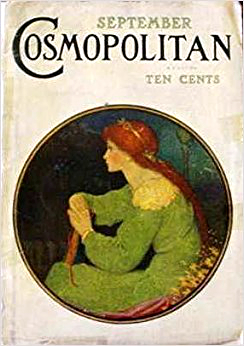 But if Smith’s poem has any progenitor beside his own unique imagination, it must be Sterling’s own “A Wine of Wizardry”. Like Smith’s, a long poem in blank verse, it strings together a series of red-hued fantastic visions, sparked into life by the glints and bubbles seen inside a glass of wine. It gained a certain notoriety when its publication (in the September 1907 issue of Cosmopolitan, of all places) was accompanied by an encomium by Ambrose Bierce, saying it ranked alongside the works of Keats, Coleridge and Rossetti. Indignation, rebuttal, and satires followed (as detailed in this article on the poem’s centenary).
In a letter to Sterling on the 10th July 1920 (the year “The Hashish-Eater” was written), Smith added the name of yet another influence:
“I’m sorry people think “The H. Eater” a mere extension of “A Wine of Wizardry”. That’s no mean compliment, however—The “Wine of Wizardry” has always seemed the ideal poem to me, as it did to Bierce. But the ground-plan of “The H.-E.” is really quite different. It owes nearly as much to The Temptation of Saint Anthony as to your poem.”
In Smith’s poem, the protagonist achieves his visions “By some explanation of cosmic consciousness, rather than a mere drug”. According to Gary Lachman’s A Secret History of Consciousness, “cosmic consciousness” was a term coined by R M Bucke for a paper he read in 1894 to the American Medico-Psychological Association, and later popularised in a book of the same name in 1901, based on an experience he himself had, in which:
“…the cosmos, which to the self conscious mind seems made up of dead matter, is in fact far otherwise—is in very truth a living presence… that the universe is so built and ordered that without any peradventure all things work together for the good of each and all…”
Smith’s version of “cosmic consciousness” has none of this all-pervading benevolence. It is — at first, at least — simply a means by which the titular Hashish-Eater can pry into all the wonders and secrets the universe contains, voyeuristically channel-hopping an endless series of fantastic worlds, and arrogating to himself the loftiest of titles:
Bow down: I am the emperor of dreams;
I crown me with the million-colored sun
Of secret worlds incredible, and take
Their trailing skies for vestment when I soar,
Throned on the mounting zenith, and illume
The spaceward-flown horizons infinite…
In this, he certainly resembles Ludlow:
“I began to be lifted into that tremendous pride which is so often a characteristic of the fantasia [of the drug]. My powers became superhuman; my knowledge covered the universe; my scope of sight was infinite. I was invested with a grand mission to humanity, and slowly it dawned upon me that I was the Christ, come in the power and radiance of his millennial descent…”
But Ludlow has a warning about over-indulgence in his chosen drug that applies equally to Smith’s protagonist:
“Hasheesh is indeed an accursed drug, and the soul at last pays a most bitter price for all its ecstasies; moreover, the use of it is not the proper means of gaining any insight, yet who shall say that at that season of exaltation I did not know things as they are more truly than ever in the ordinary state?”

cover by Bruce Pennington
So many of the wonders Smith’s Hasheesh-Eater glimpses involve kings, giants, even gods, being plotted against and overthrown, often by the smallest or least-powerful beings, from dwarves stabbing titans in the toes with pin-like poisoned blades, to a plague of lichens (somehow) bringing down an empire. The Hashish-Eater, though, refuses to take the warning, even when he hears a word “whispered in a tongue unknown,/In crypts of some impenetrable world”, a “dark, dethroning secrecy/I cannot share…” He runs away from the first of his visions to turn on him, but soon finds himself pursued by an entire “Sabaoth of retribution, drawn/From all dread spheres that knew my trespassing…”
Finally, chased to the edge of everything, Smith’s protagonist comes face to face with the ultimate secret, and the first genuine revelation of his heretofore entirely self-indulgent, hedonistic, and unenlightening use of the gift of “cosmic consciousness”. In his “Argument of ‘The Hashish-Eater’”, Smith explains that, at the end, his Hashish-Eater:
“…is driven at last to the verge of a gulf into which falls in cataracts the ruin and rubble of the universe; a gulf from which the face of infinity itself, in all its awful blankness, beyond stars and worlds, beyond created things, even fiends and monsters, rises up to confront him.”
This “face of infinity itself” is all the Hashish-Eater is not. Where he is crowned with “the million-colored sun/Of secret worlds incredible”, it is lit by a light “as of a million million moons”. Where he has eyes greedy to see and know everything, it is “a huge white eyeless Face”.
Its size, its whiteness, and its rising up from an abyss, all point to another possible influence on the poem, the ending of Poe’s Narrative of Arthur Gordon Pym of Nantucket:
“And now we rushed into the embraces of the cataract, where a chasm threw itself open to receive us. But there arose in our pathway a shrouded human figure, very far larger in its proportions than any dweller among men. And the hue of the skin of the figure was of the perfect whiteness of the snow…”
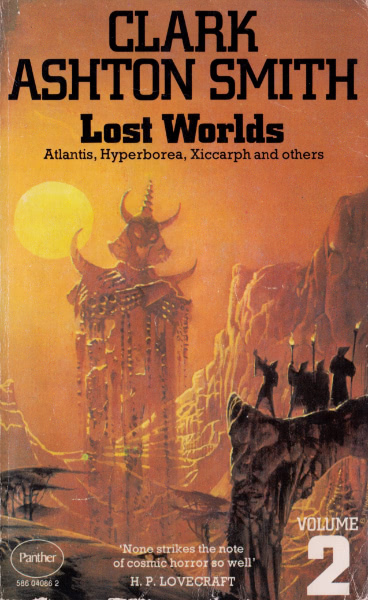
cover by Bruce Pennington
Is this “face of infinity itself” what gives Smith’s poem its subtitle, “The Apocalypse of Evil”? Certainly it seems evil to the Hashish-Eater, who is so horrified to find it rising in front of him as he flees the horde of mythological beasts intent on his destruction. But if it seems evil to him, perhaps that’s because it represents the one thing he’s been escaping from all this time. Without eyes, this is the face of a thing that looks within, and its “lips of flame” could well be the lips of a poet enflamed by a genuine inner vision, not a mere list of eye-candy wonders and darkly thrilling but spiritually empty occult secrets. Although it wears the face of cosmic horror, this “face of infinity” could, in fact, be the genuine “emperor of dreams” that the Hashish-Eater sought, so arrogantly, to depose at the start of the poem: it could be his own unacknowledged unconscious, rising to confront him with his unregarded inner life, his inner evils and his more painful insights, everything he’s been trying so desperately not to face within himself, with all his ecstatic indulging in external wonders and gaudy secrets.
As Ludlow says of his own visions:
“In the jubilance of hasheesh, we have only arrived by an improper pathway at the secret of that infinity of beauty which shall be beheld in heaven and earth when the veil of the corporeal drops off, and we know as we are known. Then from the muddy waters of our life, defiled by the centuries of degeneracy through which they have flowed, we shall ascend to the old-time original fount, and grow rapturous with its apocalyptic draught.”
Smith’s “Hashish-Eater” is a Faustian parable, a warning about the improper uses of the wonders of imagination. And I think that, to echo Bierce on Sterling’s “Wine of Wizardry”, it genuinely stands alongside the great long fantasy poems, such as Coleridge’s “Rime of the Ancient Mariner”, Browning’s “Childe Roland to the Dark Tower Came”, Christina Rossetti’s “Goblin Market”, and Wilde’s “The Sphinx”.