Obsession by Ramsey Campbell

Obsession_photoI first read Obsession in the late 1980s, as part of my initial burst of Ramsey Campbell-consumption (not literal — I didn’t eat him), when I worked through a local bookshop’s stock of his titles, including those with the horrible photo covers he was blessed with at the time. (Obsession, in fact, had the worst — a woman’s clenched but impeccably-manicured hands covered in what seemed to be soap suds, or perhaps dried potato juice. The book has yet to gain the cover it deserves, I think.)

Obsession was published in 1985, and re-reading it, I was struck by how it in part recalls another book from the same time, King’s IT (1986). Both are about a group of kids from the late 1950s, and a past that comes back to get them in the 1980s. Rather than alternating between the present and the past as King does, Campbell’s novel opens in 1958, then makes a one-way leap to the present. There’s no element of nostalgia, or that whole ‘wonderful world of being a kid’ thing, as with King’s book. Obsession is tightly plotted psychological, perhaps-supernatural, thriller. (It’s a book that proves Campbell is as much a page-turner as a wordsmith.) But the major difference between the two books is their version of evil that the protagonists face.

In 1958, we learn how each of a group of four kids — Peter, Steve, Jimmy and (as with IT, a single girl) Robin — have one thing in their lives they want to be rid of. With Peter, it’s his nagging, controlling grandmother, recently moved in with the family and making everyone’s life a misery; with Steve, it’s a bullying teacher; with Jimmy, it’s his father’s gambling debts; with Robin, it’s a man who’s bothering her unmarried mother. Then Peter gets an anonymous letter offering to help. Writing back, he gets four forms:

“Most of each sheet was blank, not even bearing the box number. WHAT I MOST NEED IS, a line of typescript said, and left several inches of space before the dotted line above the words Without a signature this form is invalid. There was one more sentence. Your price, it said, is something which you do not value and which you may regain.

The four kids fill out the forms, which are instantly snatched away by the same sort of wind that tears the cursed strip of runic paper from Professor Harrington’s grasp in Night of the Demon. Then Jimmy’s dad wins the pools; the teacher who’s been bothering Steve has a heart attack; the man who’s been bothering Robin’s mother gets run over; Peter’s gran falls down the stairs…

obsessiontor86In 1983, things start to go wrong. Policeman Jimmy’s wife is caught in a serious accident, an accident that occurred in an abandoned property supposedly looked after by Steve’s father’s estate agency (where Steve himself works), and as a result the agency gets a bad name and starts losing business; Robin (now a doctor) is accused of dealing in drugs, mostly by her very difficult-to-live-with mother; and Peter hears his dead grandmother, then actually sees her…

But, despite the dead grandmother, who gets a few fright-moments, there’s no equivalent of Pennywise the Clown. The real source of evil isn’t the supernatural, so much as each of the four characters being caught in vice-like situations where only desperate acts seem able to free them. It’s the old saw of being careful what you wish for, or of getting something “for free” when in fact there’s a price, only not one you’d ever have agreed to. It’s in Campbell’s four very human characters, and their very human reactions to the trying situations they find themselves in, that the evil is found.

obsession_02There’s a case for saying Obsession has no supernatural element at all, despite those glimpses of Peter’s dead and dusty-eyed gran. Peter, after all, sustained a head-injury as a kid and still has powerful headaches. Plus, there’s his guilt at what he did (signing the forms being his idea). Like The Turn of the Screw, Obsession could fit into Tzvetan Todorov’s very narrow definition of “the fantastic”, to be applied only to those narratives where you can’t tell one way or the other if the supernatural is real or a delusion. (The Turn of the Screw is, I think, a very Campbellian tale, all about someone coming unravelled under both psychological and pseudo-supernatural pressures, and, as with so many of Campbell’s books, it’s about how this can lead an at-first “normal” adult to endanger the children in their care — as in, for instance, The Claw, Midnight Sun, and The House on Nazareth Hill.) One of Campbell’s characters even says: “I think the supernatural is just something people invent as an excuse for what they do or want to do themselves.”

At the end — right at the end, and only through a now-crazed, or at least highly-disturbed Peter’s eyes — there’s a glimpse that there may be something larger behind it all, but something surprising, and very much unlike Stephen King’s evil alien spider-thing:

“He’d never put a name to the originator of the forms and of all that had happened since, perhaps because he was afraid to do so, afraid to think he had signed a pact with something so evil as it had seemed to him. Yet what kind of evil was it that had shown him that giving in to temptation led to greater and greater suffering? Perhaps it was precisely the opposite of what he had assumed.”

(At one point in the novel, another character says, “If fear is taking the place of religion, so be it.”)

Obsession_ebookIn his afterword to the latest edition, Campbell calls the book (originally titled For the Rest of Their Lives, but changed by the publisher) “one of my earliest comedies of paranoia”, thus tying it in with other such Campbell novels as The Count of Eleven or The Grin of the Dark, or, come to think of it, just about all of his work. But here, the comedy is utterly straight-faced, and more a non-comedy of helpless despair than the sort of twisted slapstick of The Count of Eleven or, say, the weird Innsmouth-like runaround of his recent novella (like Obsession, set in a seaside town), The Last Revelation of Gla’aki.

In contrast to the other King novel I reviewed recently, Mr Mercedes, Campbell never disappoints when rendering a truly human evil. King’s “Mr Mercedes” is almost as much a monster as Pennywise the Clown: both are, ultimately, evil because that’s what they are, they’re evil. If Campbell’s characters are evil, it’s for the opposite reason — it’s because they’re human: weak, fallible, and caught in an awful situation, stuck in a nightmare logic that squeezes them till they pop. Obsession could be the purest example of this in Campbell’s oeuvre, an entirely situation-driven descent into four personally-tailored nightmares. It’s not one of his major novels, though I say that only because he’s written such good ones. Obsession’s still a nice little read.

^TOP

Threshold by Ursula Le Guin

I think one of the reasons I may have gone away from fantasy literature after my initial love of it when I was a young teen reading and re-reading David Eddings’s The Belgariad, was it was so hard to find fantasy that matured as I did. After that early enthusiasm for fairy-tale-ish adventure, what came next, where were the works of deeper power, or greater complexity? There were some, but they seemed as rare as they were wonderful: Holdstock’s Mythago Wood and Lavondyss, Peake’s Gormenghast books, Ursula Le Guin’s Earthsea.

Threshold, Gollancz edition. Cover by Alan Cracknell

Threshold, Gollancz edition. Cover by Alan Cracknell

At my first reading, I found Le Guin’s 1980 novel Threshold (The Beginning Place in the US) a little dour, I think, but a recent re-read made me realise it was certainly one of those books that were taking existing fantasy ideas and adding much greater depth and weight, exploring the implications, adding complexity to the characters and ideas. Taking the Narnia-like premise of people from this world going into another, magical world, the difference with Threshold is that, unlike the children of The Lion, The Witch and the Wardrobe, who go to another world to essentially become fairy-tale versions of themselves (children in this world, adventurers then kings & queens in that world), the protagonists of Le Guin’s novel very much take the preoccupations and problems of their this-world lives with them. Initially using this other world as a refuge from difficult relationships and worldly hardships, the novel’s two protagonists (who, at first, are deeply resentful of each other’s presence in what they thought was their own personal hideaway) are drawn into the troubles of this other world in which they must play a key role.

Hugh Rogers (“Run-and-hide Rogers” as he calls himself) is twenty years old, working on the checkout of a local Thrift-E-Mart, and stifled by his over-controlling mother. Recently moved to the area, he discovers the very edge of the “twilight world” as he calls it (because its light is in a perpetual edge-of-day state) and finds in it the only real place where he can be himself. Irena Pannis, a little younger, has known the “ain country” (which she names after a line in a folk song she once heard) longer, having spent time in its mountain town of Tembreabrezi, where she has learned the language. For her it’s a refuge from a starkly unloving world, a world in which “Everybody I know just hurts each other. All the time”, and “Love is just a fancy word for how to hurt somebody worse.”

threshold_pbTembreabrezi is a way-station for travellers on the roads that pass through it, but recently something has changed: the town-dwellers themselves cannot walk the roads, cannot leave their town, and nobody is coming to them anymore. Something has to be done, something that was done, once, long before — a confrontation on a nearby mountain which left a previous lord of the town with a withered hand — something that Irena, with her basic grasp of the language, can’t quite translate or understand, something that the townspeople believe Hugh has come here to do.

A monster has to be faced. Like the worm in William Mayne’s A Game of Dark, it’s a pale, stinking, disgusting thing, almost too horrible to face, something that strips Irena and Hugh of all pretensions that they might, like the Narnia children, be in some way destined, blessed heroes in this realm — but also it’s a thing of pain and suffering, a thing that cries, “howling and sobbing”, an embodiment of something “horrible and desolate, enormous, craving”.

Quite what the monster is, why the roads are closed, and what the very palpable fear the townspeople feel is, is never stated, but I felt it was, in some way, tied deeply to Irena and Hugh’s own need for this escape-world that they find themselves in — as if, by leaving behind the fears and difficulties of the outside world when they come to the “ain country”, it in fact separates from them, into a sort of intensified, separate and monstrous form. The horror they face in this sad beast is real and loathsome and genuinely dangerous. But what happens changes Irena and Hugh, as though facing any fearful thing, if horrific and dangerous enough, can wash them clean of the lesser fears they deal with in their normal, daily lives.

Threshold is certainly a book worth not just reading but re-reading, one that feels it’s saying something new about the traditional ideas behind fantasy fiction, more than thirty years after its first publication.

^TOP

Wizardry and Wild Romance by Michael Moorcock

I’d like all the writers I like to like each other. But writers, self-centred and individualistic as cats, are often the worst at being objective about other writers. There’s too much stepping on each other’s toes, too much “You don’t want to do it like that!” and “I was going to do that, and do it better!” As a result, I’ve learned to take a cruel joy in finding out that the writers I like in fact hate each other. There’s M R James on Lovecraft (“whose style is of the most offensive. He uses the word cosmic about 24 times”), Machen on Blackwood (“Tennyson said ‘the cedars sigh for Lebanon’, and that is exquisite poetry; but Blackwood believes the cedars really do sigh for Lebanon and that… is damned nonsense”). Both Tolkien and C S Lewis met and liked E R Eddison, but hated his outlook (Tolkien: “I thought that, corrupted by an evil and indeed silly ‘philosophy’, he was coming to admire, more and more, arrogance and cruelty”); while Fritz Leiber wrote of Tolkien, “He’s not interested in women and he’s not really interested in the villains unless they’re just miserable sneaks, bullies and resentful cowards…”

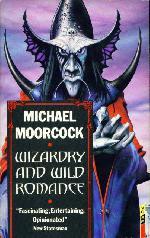
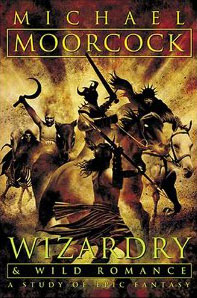
Wizardry & Wild Romance cover

Wizardry and Wild Romance, Gollancz (1987), cover by Les Edwards

Michael Moorcock’s Wizardry and Wild Romance is subtitled “A Study of Epic Fantasy”, but it’s no academic exercise in objectivity. I’ve read it many times, but reading it used to depress me, and it’s taken a good few years (and re-reads) to understand why. It is, of course, that Moorcock is a practitioner of the form he’s examining, and his “study” is more a cry than a critique. One of the reasons I’ve so often come back to reading it is that I wanted it to be like Lovecraft’s “Supernatural Horror in Literature”: a critical history of a genre by one of its major practitioners. But Lovecraft’s essay is, really, a critical history only by way of being a writer’s manifesto, a definition of what Lovecraft himself was trying to do. Because Moorcock shies away from explicit definitions (though he does offer one: “I am referring specifically to that body of prose fiction distinguished from myth, legend and folktale by its definite authorship and not genuinely purporting to be a true account of historical or religious events”), it leaves a sort of gap, the black hole of a definition which can only be inferred from the penumbra of praise and damnation that makes up the bulk of Wizardry and Wild Romance. And one of the problems is that Moorcock is so much better at damnation:

“…a new school is emerging of would-be Romantics, desperately striving to discover fresh sensibilities in the way repressed products of the middle-classes tried to loosen up with drugs and sentimental egalitarianism in the sixties. These people learned the school rules too well, however, and the main impression given by their fabulations is of red elbows and other miscellaneous bits of anatomy poking out through holes they have, with much effort and personal discomfort, rubbed in the straitjacket.”

And:

“Often the prose is little more than a mindless imitation of the euphonious aspects of the verse which, lacking the substance of the original, takes on the aspect of a mute attempting desperately to sing a Mozart song by mouthing an approximation of the sounds he has heard.”

And, most famously:

The Lord of the Rings is a pernicious confirmation of the values of a morally bankrupt middle-class. The Lord of the Rings is much more deep-rooted in its infantilism than a good many of the more obviously juvenile books it influenced. It is Winnie-the-Pooh posing as an epic.”

Like many an internet commentator, he brings the Nazis into the debate early on (mentioning Rudolph Hess in the Foreword). And he has a particular downer on HP Lovecraft:

“An aggressive, neurotic personality, though not without his loyalties and virtues, Lovecraft came under the influence of Poe, Dunsany and the imaginative writers of the Munsey pulp magazines and produced some of the most powerful infantile pathological imagery and some of the most astonishingly awful prose ever to gain popularity, yet his early work, written primarily in homage to Dunsany, from where he borrowed the idea of an invented pantheon of gods, is lighter in touch and almost completely lacking in the morbid imagery of his more successful horror stories in which death, idealism, lust and terror of sexual intercourse are constantly associated in prose which becomes increasingly confused as the author’s embattled psyche received wound after wound and he regressed into an attitude of permanent defensiveness.”

Whew.

That word, “aggressive”, occurs quite often in Moorcock’s little critiques, whether it’s of Lovecraft, John Norman, Tolkien or C S Lewis. But its use does itself come across as, well, quite aggressive:

“One should perhaps feel some sympathy for the nervousness occasionally revealed beneath their thick layers of stuffy self-satisfaction, typical of the second-rate schoolmaster, but sympathy is hard to sustain in the teeth of their hidden aggression which is so often accompanied by a deep-rooted hypocrisy.”

The thing I always failed to notice in my early readings and re-readings of Moorcock’s book (which usually left me feeling how much he must hate the genre, and wondering why he bothered to write a book about it) was his evident passion for it. He swipes so eloquently against the writers he hates precisely because he feels so strongly about what they’re doing — or, to his mind, mis-doing. He does praise writers, some not unequivocally — Clark Ashton Smith, Robert E Howard — others highly — Fritz Leiber, M John Harrison, Robert Holdstock, Mervyn Peake — though never, sadly, as eloquently as his criticisms. But he also presents, if you can spot it amidst the fusillade, evidence of having not only read a great deal of it, but a good deal about it.

Rodney Matthews cover

Rodney Matthews cover

And, of course, he has written a lot of it himself. But here, Moorcock doesn’t discuss his own work, which may account for the key gap I find in Wizardry and Wild Romance (whose title I always assumed was a quote from a genuine poem, till I tried to track it down, and found that the “Wheldrake” it’s attributed to is a Swinburne pseudonym (used, appropriately, to write bad reviews of his own work) as well as, later, a Moorcock character).

Wizardry and Wild Romance was the first book about fantasy I read, and it certainly taught me a lot:

“An intrinsic part of the epic fantasy is exotic landscape…. and no matter how well drawn their characters or good their language writers will appeal to the dedicated reader of romance according to the skill by which they evoke settings…”

And:

“Melodrama and irony work very well together; the best fantasies contain both elements, which maintain tonal equilibrium…”

Moorcock may bash the “morally bankrupt” middle-classes, and he may sometimes present a rather defensive maturismo somewhat reminiscent of Jackie Wullschläger’s in Inventing Wonderland, but you have to admit he does it with style. And if you can stand back far enough not to be splashed by the acid he spits, there’s a good deal of enjoyment to be had from the sheer wit of the book, even if you disagree with the points being made:

“If the bulk of American sf could be said to be written by robots, about robots, for robots, then the bulk of English fantasy seems to be written by rabbits, about rabbits and for rabbits.”

And, perhaps the most revealing statement about Moorcock’s own tastes in fiction:

“If we must be given stories about talking animals, let them at least be sceptical, sardonic and world-weary talking animals.”

While to me, it’s to find recourse from scepticism, cynicism and world-weariness that I turn to fantasy in the first place — that, to me, is what literary magic is all about, what Tolkien called “re-enchantment” — but that, of course, is my own bias.

cover

John Picacio cover

Although it was updated in 2004 for the Monkeybrain Books edition, Wizardry and Wild Romance is, really, a product of its time, and is best read that way. It came from a writer witnessing the commercialisation of what had been, to him and the writers he admired, a deeply individualistic, often revolutionary art form — but that’s a battle that has long been lost, the commercial element of heroic fantasy being here to stay. The updates to the book, to me, feel a bit tagged on and less part of the central, anguished cry that spawned the kernel essay, “Epic Pooh”, back in — when was it? According to the Foreword, parts of Wizardry and Wild Romance were published as early as 1963, and that’s over fifty years ago!

Wizardry and Wild Romance is a book I will come back to and re-read, as I have come back to it many times in the twenty seven years since I first read it. But it’s been a process of learning how to read it: not as objective criticism, more as the expression of a passion, and of an ideal, that Moorcock never clearly states, but certainly defends — in style.

^TOP