Neuromancer by William Gibson

Neuromancer first HBRe-reading Neuromancer, I still feel the excitement of the first time I read it — the whole surprising, new-thing-ness of it — though it always makes me wonder if someone coming to it for the first time might wonder what the fuss is about. Its major impact comes from ideas that have been so subsumed into the culture, they’re almost invisible as ideas — much in the way the artificial intelligence Wintermute ends the novel breaking free of its bonds as an AI to expand and in some way become one with the whole matrix of cyberspace itself, “the sum total of the works, the whole show.” Gibson’s conception of cyberspace came just in time both to prepare us, imaginatively and conceptually, for the rise into daily life of computers and (some time after) the internet, and to give us a constant reminder of how naff what we actually ended up with is, compared to what he imagined (by combining the way kids got totally immersed in the low-res graphics of arcade video games, and the way the then-new Sony Walkman provided an immersive, portable otherworld you could plug yourself into): the “consensual hallucination” and “graphic representation of data abstracted from banks of every computer in the human system” (full quote here), data and software you could experience sensually, directly. The strange thing is how much of Neuromancer is so rooted in old culture: how it’s basically a hard-boiled noir take on SF (just as is Blade Runner — seeing which while writing Neuromancer almost made Gibson give up on the novel), and a re-imagining of Faerie/the land of the dead as a TRON-like world of bright, primary-coloured geometric shapes: “Lines of light ranged in the nonspace of the mind, clusters and constellations of data. Like city lights, receding…” But then again, this seems to be true of all the great, game-changing works of imaginative fiction — the way they can be seen, on the one hand, as incredibly new, but on the other as “why didn’t I think of that?” recombinations of what went before.

Cyberspace, from 1995's Johnny Mnemonic

Cyberspace, from 1995’s Johnny Mnemonic

What always feels so life-affirming, to me, about Gibson’s works, even though (particularly with the Sprawl trilogy of Neuromancer, Count Zero and Mona Lisa Overdrive) they’re so mired in the relentlessly downbeat, rusted-with-cynicism worldview of noir, is how his human beings are always finding ways of asserting their individuality not just in the face of a highly technologised world, but thanks to it. Case, Neuromancer‘s protagonist, would arguably be a nobody at any date prior to the invention of the technologies that allow him to jack into cyberspace and manipulate what he finds there with a seat-of-the-pants, intuitive skill; and where would Molly Millions be without her surgically implanted mirror shades and razorgirl claws? New technology, in Gibson’s world, becomes one more way of expressing essential human individuality. He’s interested in how people take up a new thing and use it not for its intended purpose. (From Count Zero: “The street tries to find its own uses for things, Mr Turner.”) But his is also a very dark, very 1980s world with a huge divide between those who have and those who don’t — and in this case the “have” refers not so much to money as power, and a specific type of power at that: “Power, in Case’s world, meant corporate power.” It is power, not technology, that is the chief dehumanising factor in this world:

“Case had always taken it for granted that the real bosses, the kingpins in a given industry, would be both more and less than people… He’d always imagined it as a gradual and willing accommodation of the machine, the system, the parent organism…”

Or, from the followup novel, Count Zero:

“…she stared directly into those soft blue eyes and knew, with an instinctive mammalian certainty, that the exceedingly rich were no longer even remotely human.”

So here’s a theory. In the 1970s, technology was perceived as part of the structure of power. They had the cabinet-sized mainframes with their whirling, eye-like pairs of tape reels, just as they had the nuclear weapons. Look at all those wonderful seventies dystopias and you’ll find that, if technology isn’t implicitly inimical to humankind (as in Westworld and Futureworld and 1980’s Saturn 3), then it is certainly inseparable from the oppressive, controlling state (Logan’s Run, THX1138, Rollerball). In the 1980s, though, technology — the computer part of it, not the nuclear weapons — became cheaper, and suddenly everyone could have a home video recorder, an electronic calculator, a digital watch, even their very own computer. And so technology, available to everyone, became part of popular culture, where it was thoroughly explored for its use in entertainment and self-expression, and no longer seen as a symbol of oppression. (You could even say that 1983’s WarGames, which is for me the archetypal home-computer revolution movie, is the point at which everything turns, as we see our hero teach a computer not to start a nuclear war.) Neuromancer was part of the reclamation of technology for the masses. And to me, this aspect of the novel — that humankind can endlessly take on board new technologies and make them (sometimes literally) part of itself while expanding, not narrowing, the bounds of what it means to be human — still feels new.

Neuromancer PBThis isn’t to say Neuromancer denies the dangers of technological dehumanisation. Rather, it acknowledges dehumanisation as an ever-present threat — just one of those things people do to themselves — with technology merely one of its means. As the novel opens, Case is deadened to his own feelings, to the extent that he’s goading the lowlifes of Chiba City into completing his unconscious suicide. When he finally manages to feel, it’s at the crucial halfway point of the novel, and even the unpleasant feeling of rage is like a “new thing”, a “treasure” compared to the emotional paralysis that went before:

“He’d been numb a long time, years… But now he’d found this warm thing, this chip of murder. Meat, some part of him said. It’s the meat talking, ignore it.”

“Meat” is the cyber-cowboy’s disparaging term for the body, and technology is certainly one of the ways that the divorce of mind and body can occur. But so are, in the novel, drug addiction and cynicism. And this is exactly the thing that feels so old-school in Neuromancer — it’s the same atmosphere that pervades Raymond Chandler‘s fiction. (Though Gibson, apparently, dislikes Chandler, preferring Dashiell Hammett — see this excellent Paris Review interview, for instance.) The hero, whether Philip Marlowe or Henry Dorsett Case, is battered to numbness by an unfeeling, dehumanised world, but makes the breakthrough back to feeling, back to an ideal or a recovered morality. The return to full humanity is the first, vital step to becoming a hero.

In the end, it’s power that dehumanises the most. And the powerful can be dehumanised by power alone, without any need for technology. (Though it does, of course, help. I particularly like Gibson’s description of the Tessier-Ashpool clan’s approximation to immortality through cryogenics as “a series of warm blinks strung along a chain of winter.” Plus, they can afford their very own vat-grown ninja…)

Neuromancer PB2Gibson’s protagonists use tech with such style. This — so much more than its current use with “steam” — justifies the “punk” in cyberpunk. These really are people with the hi-tech equivalent of a safety pin stuck through their nose; crude conglomerations of tech and flesh, welded together with hi-end surgery and micopore tape, brushing up against the massive data structures of zaibatsu megacorporations then bedding down in a cheap, run-down coffin hotel.

Reading Neuromancer is all about dipping into a writer’s sensibility and pool of ideas, his way of looking at the world and thinking about how it might become. Our world still might become like this. And though I’m not sure I’d elect to live in Gibson’s world, I’d certainly be happy to do so if I could take Neuromancer with me, and use it as a how-to guide.

^TOP

IT by Stephen King

IT coverIT was one of the major reading events of my teens. As well as being the first Stephen King book I read as it came out (in paperback, anyway) right when I was in the grip of my first enthusiasm for horror, sheer page count meant IT couldn’t help being an event rather than a mere read. Plus, there was something about the basic idea that seemed so right: a bunch of loser kids face horror in small-town USA, then have to come back and face it again as adults. Nostalgia for the small-town life of 1950s USA seemed to pervade the 1980s, mostly thanks to George Lucas and Stephen Spielberg (Lucas’s American Graffiti sparked it off in 1973, 1978’s film of Grease made it more widespread, but the whole thing found its apotheosis in 1985’s Spielberg-produced Back to the Future), and as I was neither born in the 1950s nor in the USA, it formed for me a sort of fairy-tale fantasyland where stories of innocence and coming of age could be told, no more nor less real than the Germanic never-never land of the Grimms, or Clark Ashton Smith’s far-future Zothique. To read a horror story set in that fabled land of innocence and bobby-sox polka-dot lollypop rock’n’roll seemed just what I wanted — no, needed — as I hit the second half of my teens.

It’s become an occasional (though unplanned) theme in this blog to revisit things I was frightened of as a kid (the most recent one being another King effort, the TV mini-series of Salem’s Lot), and one of the things that made me put off re-reading IT was how certain scary scenes had lingered in my memory — particularly the one where Beverley Marsh hears the voices of dead kids coming up through the plug-hole of the bathroom sink. Back when I first read IT, that made me very nervous of our rather claustrophobic, spider-prone bathroom, and I wasn’t sure I wanted to reawaken the fear. (Pardon the pun, but fear of the bathroom is such an inconvenient fear.) The other thing that put me off re-reading IT was how disappointing I’d found the ending the first time around (combined with how disappointed I’d been by the endings of the last two King novels I read: Duma Key and — a while back — Bag of Bones). But then I read James Smythe’s article on IT, part of his comprehensive re-read of all Stephen King’s novels and story collections, and when he said IT was “a summer novel”, and I realised it was starting to be summer, I decided to dive in.

In the end, a sort of reversal occurred. I was no way near as scared of the horror scenes as when I’d first read the book — in fact, I was rather disappointed by them — but I found the ending a little less disappointing (only a little, mind, and perhaps because I was prepared for it). Nevertheless I still enjoyed IT immensely. So, why?

IT coverThe horror scenes, first. One I’d been particularly chilled by the first time I read IT was where grown-up Beverley returns to her former home, finds it occupied by what appears to be a sweet old foreign lady, and is invited in for tea. Once inside, the sweet old lady transforms into something undead and disgusting. (Her line, “My madder was my fadder”, was one of the novel’s many catchphrases that stuck in my mind as surreally horrific. Although, I discovered on this re-read, it’s not as much of a catchphrase as I recalled, only being repeated once, unlike “We all float down here”, or “Beep-beep, Richie.”) This time reading that scene, as the transformation began, I was at first a little creeped, but as King ladled on grisly detail after grisly detail, I started to find the whole thing overdone, and then too OTT to be scary. It was as though King was so over-sugaring his horror with whatever the horror equivalent of sugar is, that he’d numbed my readerly taste-buds. And I think every horror scene — or, I should say, every supernatural horror scene — in IT suffers the same way. What struck me as sensational and grisly when I first read the book, on this re-read seemed merely sensational.

It could be argued that this is the point. King himself spells it out:

It was like some comic-book villain. Because they saw it that way? Thought of it that way? Yes, perhaps so. It was kid’s stuff, but it seemed that was what this thing thrived on — kid’s stuff.

The creature in IT assumes the form of whatever frightens its victims the most, and kids being frightened by gloopy, gory, grisly details, that’s the approach it uses. The trouble is, this is also the fault I found with Bag of Bones and Duma Key — that the supernatural horror scenes were so un-disciplined, so full of detail after detail straining after effect at the expense of meaning, that the overall result was to detract from rather than strengthen the horror and the story. Because the creature in IT has no limits but King’s prodigious vocabulary of gloop, it loses its effectiveness as horror. Pennywise the Clown has the power to assume any form, to read its victim’s innermost thoughts, and to make its victims see whatever it wants them to see, and to even feel it as dangerously real — so why doesn’t Pennywise win hands down? Why hasn’t it wiped out the world? Why doesn’t it assail the kids with so much horror they go insane? Why doesn’t it simply jump out of the nearest drain and tear them to pieces? The truly frightening scenes, for me as an adult reader, were where Pennywise uses human beings to do its work. And although these humans are much less powerful than Pennywise, they’re more scary because I know they can’t be warded off with a childhood talisman (a book about birds, an asthma inhaler), and that they can do actual physical damage. Their lack of over-the-top-ness makes them more real, and so more scary.

IT cover 3IT has every potential of being a Lovecraftian horror — a horror story of ideas as much as grisly details — but it’s here where, for me as an adult reader, King really falls short. Pennywise is at once set up as a force of pure evil, pre-existing the universe itself, to the extent that we can only assume it to be King’s version of Satan (with the useless Turtle as demiurge, and the “Final Other” a sort of removed, indifferent, Gnostic True God); but at the same time, Pennywise is so limited — geographically, if nothing else (in all of the universe, it is bound to Derry, Maine) — and rather useless. It can only frighten kids. It’s as likely to kill the “bad” kids, that serve its purposes, as the good. It runs away from bird books and asthma inhalers. Unlike Lovecraft’s monsters, the meaning of the evil Pennywise represents is nowhere looked into any deeper than that it is evil. But what would a universe where such a creature as this exists, with the powers it has (telepathy, creation of solid hallucinations, a hunger for fear) mean for human beings? That is what Lovecraft’s fiction is all about — the meaning behind the horror, the implications for mankind if they’re taken as a universal laws. Of course, IT is far more about human than cosmic things — it’s basically a summation of the purest of childhood terrors (King called IT his “final exam on horror”) — and with that God-like “Final Other” providing an ultimate escape clause in any attempt to understand what stops the balance between good and evil from tipping over, there doesn’t seem to be any meaning to Pennywise’s horror, other than to represent pure, irrational horror itself. IT is a nightmare — as scary as that is, and as ultimately insubstantial.

This comes to a head in the ending. The thing about the ending of IT is that because Pennywise has no “rules” — no established weaknesses or limits — I had no idea how it could be defeated. The Ritual of Chüd — a folklorish tongue-wrestling match the kids read about in a library book — sounds like it might work, and might also be genuinely risky to attempt, but the actual ending doesn’t use it (though makes a fudging attempt at pretending it has), making me wonder why King bothered setting it up in the first place. The actual ending involves a lot of kids holding hands, shouting “You killed my brother!” and somehow driving back the creature through sheer force of — what? will? feeling? belief? solidarity? Then physically tearing it apart. In which case, the question is, why didn’t any of Pennywise’s other victims defeat it if it’s so easy to defeat? If the creature in IT had been set up with just one weakness, just one stated limitation, its demise, I can’t help feeling, would suddenly become much more meaningful, and the challenge to the kids much more interesting and real.

And then, with regards to the ending… there’s what Beverley does. I don’t want to break into a spoiler here, but if you’ve read IT, surely you know what I mean when I say I’m talking about what Beverley does after Pennywise is defeated for the first time, and the kids find themselves lost in the sewers. How she “brings them all back together”. I mean… why? It seems just weird. Weird in a wrong way. Demeaning and without meaning. Nothing in the novel prepares for it, and nothing in the novel calls for it. On this re-read, it seemed even more out of place than on my first read.

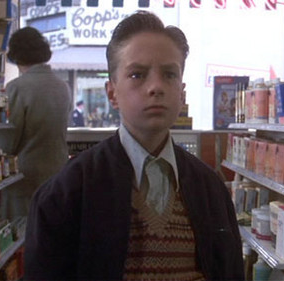
Adam Faraizl as Eddie Kaspbrak from the 1990 mini-series of IT

Adam Faraizl as Eddie Kaspbrak from the 1990 mini-series of IT

But despite all this, IT is such a readable book. And IT is readable because King is such a strong storyteller. He kept me going through this very long novel (and as I’ve said before, I don’t like overlong novels) through sheer storytelling power. King inhabits his story like no other writer, and you can just feel him, at times, hunkering down into the scene and simply wallowing in it (for some reason, the image that comes to mind is of a hog in mud, but this isn’t meant as a criticism!). For me, the essence of IT‘s good points all come out in chapter 16, “Eddie’s Bad Break”, which could almost be a short story on its own. Eddie, an over-cosseted kid whose mother controls him through fears about his health, learns first of all that the asthma medicine he relies on is a placebo, then experiences real life-threatening danger for the first time when bully Henry Bowers breaks his arm. King’s supernatural horrors are spooky, mostly superficial, and are all about the effect of grisly details — usually layered on so thickly they start to seem ridiculous rather than horrific — but his moments of character horror, of everyday horror, are subtle and much more effective. The scene where the druggist, Mr Keene, takes Eddie into the back room and explains what “placebo” means is far more tense than any of King’s supernatural horror scenes, because it is so intimately tied up with Eddie’s character, his personal fears, his relationship with his mother, his own identity. It threatens Eddie’s world in a way that the existence of a super-powered mega-clown from outer space somehow doesn’t. The scene where Eddie is cornered by Henry Bowers and his gang, and not helped by a previously-reliable adult is far more chilling, and far more meaningful, than any of the scenes where Pennywise the Clown appears. Pennywise’s most effective appearance in the entire novel is in this chapter, when, in a dream/semi-dream, Eddie imagines the clown’s face imposed on his own mother’s when she’s at her most protective/controlling. The idea that all adults have a little bit of IT in them would be a great idea for a novel… But it’s not in this novel.

I can’t help wondering, considering my reaction to this re-read of IT, whether King’s prodigious storytelling ability almost works against him. Because he can weave such a strong spell with writerly skill alone, he perhaps lets himself get lax in terms of the basic bones of his story. Thinking about it, and despite the fact that I much prefer fantastical elements in the stories I read, the more satisfying King stories and novels I’ve read have all been non-supernatural ones — “Rita Hayworth and the Shawshank Redemption”, “Apt Pupil”, Misery — where King has been forced to take on more disciplined bounds to his boundless skill in storytelling. I want to read more King, but am put off by the suspicion that while the reading experience itself will be enjoyable, the ultimate aftertaste that comes from the end of the story will be that of a little too much of something a little too (horrifically) sweet.

But, having said this, King is of course immensely successful, so what do I know?

^TOP

The Earliest English Poems, translated & edited by Michael Alexander

The Earliest English Poems, Michael AlexanderThere’s a vitality to these poems, written as they were at a time when life was so much more embattled, more desperate and fragile, when spear-wielding enemies arrived by the seasonal boat-load demanding ransom or death, when every venture forth from home was to risk not coming back, and when every day was rounded by off by darkness laying siege to the little island of light and warmth that was the mead-hall, in which people gathered together to eat, drink, give gifts (gold rings and swords with heroic pedigrees), and listen to stories chanted in a primitive but vital meter. The values of these thousand-year-old societies were simple but profound: loyalty to one’s lord (and, crucially, his to you), kinship, companionship, bravery in battle, and reverence for “Wierd” (as Michael Alexander chooses to spell it, to separate the word from its current usage): that essence of Dark Ages fatalism, a pagan dourness lingering amidst the new hope of Christianity, encompassing both the way things work in the world, and the doom all men inevitably move towards:

“either illness or age or the edge of vengeance
shall draw out the breath from the doom-shadowed.”

These Beowulf-era poems are perhaps most well-known for their use of kennings, poetic prevarications like “welkin-wanderer” for “moon” and “whale’s riding” for “sea” — standard devices used by oral poets to fill out the meter as they think up the next line. But there’s a vitality in their use of language — even in translation — that brings out the sheer facts of living and dying in that era: “grave’s grasp” is death, an old man is “winter-wearied” and “heavy with friend-loss”, battle is “hard wood-talk” and “shield’s answer to shaft”.

Indeed, this thumping, thudding, drum-beat alliteration is particularly good for describing battles. For instance this, from “The Battle of Maldon”, the longest poem in the book, which Michael Alexander calls “without doubt the finest battle-poem in English” (inevitably, it’s one of defeat):

“Then was a splintering of shields, the sea-wolves coming on
in war-whetted anger. Again the spears
burst breast-lock, breached life-wall
of Wierd-singled men.”

The battle-poems are tales of men together. The poems of men and women as individuals are inevitably ones of exile and separation. Of all the poems in this book, it’s “The Wanderer” I re-read the most. It begins:

“Who liveth alone longeth for mercy,
Maker’s mercy. Though he must traverse
tracts of sea, sick at heart
—trouble with oars ice-cold waters,
the ways of exile — Wierd is set fast.”

Another such exile appears in “The Seafarer”:

“No man blessed
with a happy land-life is like to guess
how I, aching-hearted, on ice-cold seas
have wasted whole winters…”

The kennings I mentioned above are usually seen as circumlocutions for things like the sea (“swan’s riding”), or a ship (“sea-steed”), but the Seafarer talks of “breast-drought I have borne, and bitternesses too” — and that “breast-drought” is a kenning, but one that can’t be replaced by any single modern English word, yet still manages to go straight to a still-living meaning, and make it vividly alive.

Although there is Christian belief in these poems (one of the longer ones is “The Dream of the Rood”, a monologue spoken by the cross on which Christ was crucified), the main mood is a dark one of the inevitability of death, separation, and ruin:

“A wise man may grasp how ghastly it shall be
when all this world’s wealth standeth waste,
even as now, in many places, over the earth
walls stand, wind-beaten,
hung with hoar-frost: ruined habitations.”

But in the face of this there’s a defiance, a decision to hold fast to the code by which the people of that time lived, and to burn all the brighter for the briefness of their flame:

“Thought shall be the harder, heart the keener,
mood the more, as our might lessens.”

(Which Michael Alexander calls “the classic declaration of the heroic faith”.) This is the essence of what I like in the best sword & sorcery fiction, and here it is, straight from the source.

Fittingly, most of the poems translated here are fragments, ruins, victims of the ravening “Wierd” of history itself. But still the heroic voices come through — the old wanderer bereft of lord and hearth, the woman separated from her lover because of a feud (“If he comes to the camp they will kill him for sure”), the exiled poet eking out comfort from a sad refrain (“That went by; this may too”), the brave few battling to the end through loyalty to their dead lord.

What it says in “The Wanderer” could apply to them all:

“Their Wierd is glorious.”

^TOP