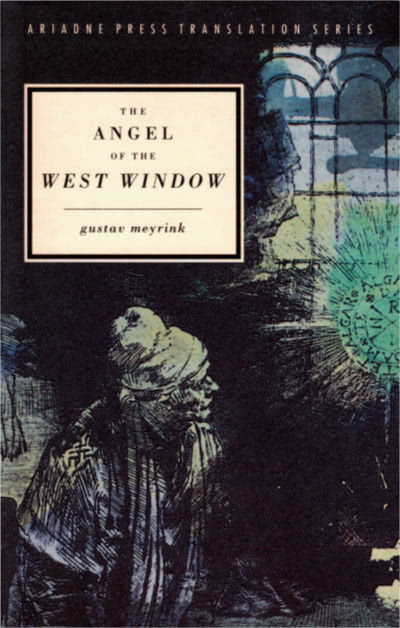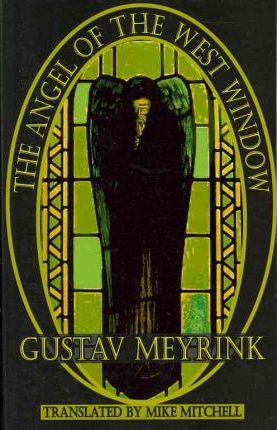
The Angel of the West Window by Gustav Meyrink

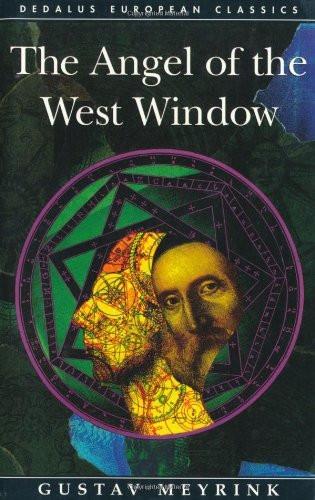
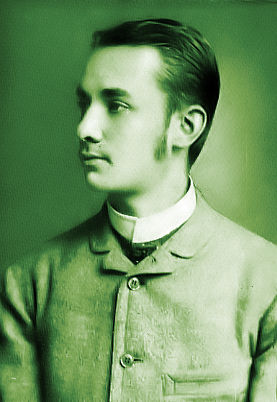
At one time I worked my way through all of Gustav Meyrink’s novels (in Mike Mitchell’s translations, published by Dedalus), and although his first, The Golem (1914), is his most famous, it was his last, and least successful in terms of sales (selling less than 3,000 copies, compared to 220,000 of The Golem, according to this article), that stuck with me.

Published in 1927, The Angel of the West Window tells a dual story. The narrator — unnamed till virtually the last page, when he’s revealed to be one Baron Müller — learns that he is the only surviving descendent of the Elizabethan mathematician, astronomer, astrologer, alchemist and occultist John Dee, when he inherits a sizeable packet of the man’s journals and private papers. Embarking on the task of ordering these papers into some sort of narrative, Müller finds occult elements starting to invade his own life. Dee’s papers describe how, early on in life, he looked into a mirror and found his reflection talking back to him, promising what sounded to be a great future, in which he:

“…shall know neither rest nor repose till the coasts of Greenland, where the Northern Lights glow, shall be conquered… He who holds the Green Land in fief, to him shall the Empire beyond the sea be given, to him shall be given the crown of England!”

Dee immediately makes plans — which include finding a way of making sure the then-Princess Elizabeth would drink a potion to make her fall in love with him, and thus ensure his kingship of England — but finds himself frustrated at every step. Elizabeth, once she is queen, toys with him, agreeing to his plans for an expedition to Greenland only to cancel them a moment later. And though she drops hints that she knows the nature of the potion Dee contrived to have her drink, and occasionally implies that the two of them have some sort of special relationship, she makes no move towards marrying him — in fact, she orders him to wed one of her ladies-in-waiting who clearly hates him.

Meanwhile, a number of peculiar characters enter the narrator’s modern-day (i.e., 1920s) life. Lipotin, a trader in antiquities — whose nickname, Mascee, is oddly the same as that of an antiques pedlar known to John Dee — provides him with a number of occultly significant objects, including a locked Tula-ware puzzle-box and a green-glass mirror, while the Russian Princess Assja Shotokalungin drops by, wanting to buy from him a certain antique spearhead, which she seems sure he owns, even though he doesn’t.

For me, the Dee part of the novel works so much better than the narrator’s. Dee’s story is all about how his promised glories are constantly denied him, and how he turns more and more desperately to the occult, only to meet with a constant cycle of repeated promises, delays, more promises, and ultimate frustration. He enters into a partnership with Edward Kelley, an ex-criminal (his ears have been cut off as punishment for forgery) who provides Dee with a small amount of powder that can turn lead into gold, along with a book that describes how this powder might be used to make the Philosopher’s Stone. But the book is in code, and the pair soon use up their small stock of powder in making the gold they need to continue their studies (and to fund Kelley’s dissolute lifestyle). Kelley, though, can summon the Angel of the West Window, an awesome, otherworldly presence (with something of a demonic air: “the thumb on the right hand pointed downwards, it was the left hand thumb”) that promises to teach Dee the key to the book’s cipher, though always tomorrow, or the day after tomorrow, never today. (It does, when their need is at its most dire, replenish their stock of powder, so they can make more gold, and continue their desperate studies.) Along with Dee’s second wife Jane, the pair leave England for Prague, where Dee wants to see what the Emperor Rudolf II, who claims to be an alchemical adept, can teach him, but Rudolf is paranoid, controlling, and on the edge of madness. Then the Angel of the West Window declares that Dee must share his beloved wife with the lecherous Kelley.

In between reading of Dee’s troubles, the narrator finds himself at the centre of an occult battle for his soul, fought between forces he only gradually comes to understand. On the one hand, there are the Gardeners, a group of enlightened beings who provide the occasional prod on his path to illumination; on the other, there’s the Goddess Black Iaïs, who “rules the realm of anti-Eros, whose power and extent no-one suspects who has not himself been initiated into the mysteries of hate”, and who wants the antique Spearhead of Hywel Dda, once in the possession of John Dee. Despite all this being a clear parallel to Dee’s story, the narrator comes across (to me, anyway) as almost wilfully stupid in being unable to tell what’s happening to him, and as a result, his part of the story seems mostly about him being shunted from one incomprehensible event to another. There’s a lot of occult talk and mysteriously significant events, but no real human-level drama, as there is with the Dee tale, and all of the narrator’s gains feel like something given to him, rather than something he’s earned.

It eventually emerges that the narrator is to experience the fulfilment of what was promised, centuries ago, to his ancestor John Dee. Dee got the nature of that initial promise wrong, interpreting it wholly in terms of worldly gains, when it was meant only in spiritual terms. (“Green Land” is used, in the novel, to refer to the land of the dead, and of the spiritually enlightened, and it was this land that was promised to Dee, not the land of the same name that exists in the material world.) By the end of the book, I found it difficult to accept that the narrator had done anything to earn his spiritual elevation — he’d seemed to learn no lesson, having merely been batted about between occult forces like a spiritual tennis ball that just happened to end up on the right side of the net.

Reviewing The Angel of the West Window in 1936, Jorge Luis Borges called the book “a chronicle of confused miracles, barely salvaged, from time to time, by its poetic ambience”. (Of Meyrink’s literary career as a whole, Borges says: “His books became acts of faith, and then of propaganda.”)

It didn’t, to me, feel that Meyrink was merely peddling some occult system. At times, the supernatural events that happen to either Dee or the narrator felt genuinely weird and shocking (in particular, the pronouncements of Bartlett Greene, with whom Dee shares a prison cell near the start of the novel) rather than being contrived. The best parts — the Dee parts — actually seemed to be all about how, the more enticing the promises of the occult are, the more empty, frustrating, and soul-destroying is their effect. It might have been better simply as Dee’s story, with no modern counterpart, but by the end, despite often tedious passages in which many supposedly significant things were happening but no real meaning emerging, The Angel of the West Window does, nevertheless, work a little literary magic.

^TOP

From Ritual to Romance by Jessie L Weston

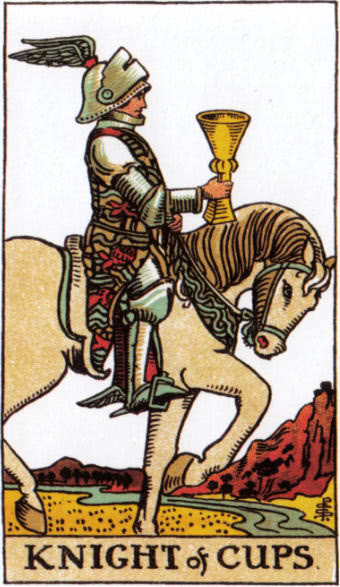
From Ritual to Romance, published in 1920, is perhaps most well known today for being the first work T S Eliot lists in his “Notes on The Waste Land”, where he says that Weston’s book suggested “Not only the title, but the plan and a good deal of the incidental symbolism” of his poem. Eliot, of course, later said these notes were a publisher’s requirement to bulk out the book publication of The Waste Land, which has led some to dismiss them entirely, or to see them as one more layer of obfuscation around the poem, and Eliot himself later said he regretted sending so many readers “on a wild goose chase after Tarot cards and the Holy Grail”. But From Ritual to Romance, which aims to trace a link between medieval Holy Grail romances and the earliest fertility rituals, certainly had its influence on what the poem says and how it says it. As Eliot wrote in 1957 (quoted here):

“I was certainly not concerned with the validity of her thesis, but with the value of the imagery as a spring-board!”

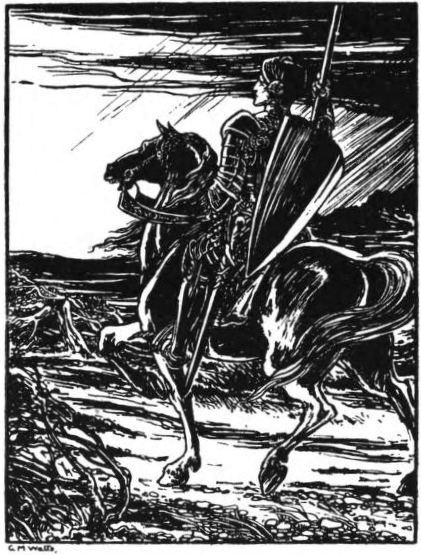
Sir Gawain approaching the Grail Castle, illustration by Caroline Watts

Weston’s book makes no bones about its own debts. It’s firmly in the tradition of Frazer’s The Golden Bough, a work of syncretist anthropology that first came out in 2 volumes in 1890 (and had expanded to 12 volumes by 1915), causing both scandal (for its treatment of Christ’s story as just another myth) and literary influence. Both Weston’s and Frazer’s books have their basis in the idea that “vegetation rituals” — “a symbolic representation of the death and re-birth of the year” — by which ancient peoples sought to ensure the fertility of their crop lands, are the foundation for later religious practices — though it becomes clear from Weston’s book that for her, at least, the fertility sought through such “vegetation rituals” extends not only to the fertility of the soil but human fertility and, later, a sort of spiritual fertility through union with “the supreme Spiritual Source of Life”.

Central to the Grail quest is the idea of a king and a land that are ailing. The king and his land are one. As one sickens, so does the other; to heal one is to heal the other. Weston traces this idea back to “the prehistoric heroes of the Aryan race” (a phrase which immediately highlights a huge cultural gap between Weston and the reader of today), from the Rig-Veda and Babylonian Ritual to the Ancient Greek cult of Adonis. At this point, she says, the belief surrounding such “vegetation rituals” can be seen as having two sides, the exoteric and the esoteric, the public ritual and the secret Mystery cult:

“…and with this change the role of the principal actors became of heightened significance. That of the Healer could no longer be adequately fulfilled by the administration of a medicinal remedy; the relation of Body and Soul became of cardinal importance for the Drama, the Medicine Man gave place to the Redeemer…”

Weston says: “the original use of the ‘Tarot’ would seem to have been, not to foretell the Future in general, but to predict the rise and fall of the waters which brought fertility to the land…”

Ultimately, she sees in the Grail story a continuity between Ancient Attis-Adonis & Mithraic cults and early Christianity, an “essential harmony… between the Old Faith and the New”, which somehow survived the point at which Christianity, on becoming dominant in the West, sought to distance itself from past beliefs by declaring any similarities to be the mockeries and snares of the Devil. This essence of ancient-to-medieval continuity “lingered on; openly, in Folk practice, in Fast and Feast, whereby the well-being of the land might be assured; secretly, in cave or mountain-fastness, or island isolation, where those who craved for a more sensible (not necessarily sensuous) contact with the unseen Spiritual forces of Life than the orthodox development of Christianity afforded, might, and did, find satisfaction.” Weston sees, in the essence of the Grail romances, a “Christianized Mystery” — an esoteric heart to what is, to most, a purely exoteric religion.

Weston sees surviving Grail romances, though, as being mostly written by people ignorant of their deeper meaning. To Chrétien de Troyes (who died in 1185), for instance, she says, “the story was romance, pure and simple. There was still a certain element of awe connected with Grail, and Grail Feast, but of the real meaning and origin of the incidents he had, I am convinced, no idea whatever.” Traditional folk-tale themes get thrown in with the relics of ancient rituals, and “We have here passed completely and entirely into the land of romance, the doors of the Temple are closed behind us.” Weston even suggests the severance might have been deliberate:

“The remodelling is so radical that it seems most reasonable to conclude that it was purposeful, that the original author of the Queste had a very clear idea of the real nature of the Grail, and was bent upon a complete restatement in terms of current orthodoxy.”

In speculating on how these ancient rituals passed into medieval romances, Weston suggests an intriguing possibility, worthy of a modern-day weird tale, which might have occurred in a Christian land where remnants of the pagan past could still be found in crumbling mountain temples or island retreats, and which might be chanced upon by some lone, wandering knight:

“The earliest version of the Grail story… relates the visit of a wandering knight to one of these hidden temples; his successful passing of the test into the lower grade of Life initiation, his failure to attain to the highest degree.”

There’s an obvious similarity between Eliot’s Waste Land and Weston’s book. Both are reacting to how new ideas had undermined religious belief and, along with that, the sense of a deeper meaning in life. But whereas Eliot’s poem is all about the loss of faith, and takes on a highly fragmented form, Weston seems assured of renewing the sense of meaning in modern life by deepening the roots of her culture’s religious life beyond Christianity and further into the ancient past. Her approach is all about seeing the whole, rather than the parts. (She criticises earlier commenters on the Grail stories for concentrating on the meaning of only one particular element at a time — the Cup, or the Lance, for instance — without seeing each as part of a necessary whole.) Towards the end of her book, Weston breaks out in what sounds like a moment of passionate and genuine belief:

“…the Grail is a living force, it will never die; it may indeed sink out of sight, and, for centuries even, disappear from the field of literature, but it will rise to the surface again, and become once more a theme of vital inspiration even as, after slumbering from the days of Malory, it woke to new life in the nineteenth century, making its fresh appeal through the genius of Tennyson and Wagner.”

I’m sure Weston’s methods don’t stand up to modern academic standards but, like the seed of ancient ritual she herself finds in medieval Grail romances, there remains in her book the kernel of a poetic ideal, a link between ancient human beliefs and modern needs. And, while we may think it’s nothing but magical thinking that led previous cultures to think that, by performing their “vegetation rituals”, they could take an active part in renewing the land’s fertility, today it’s become essential that we take part in what was, before, a natural process, if only to undo the damage we’ve done to the Earth’s ability to support life. Perhaps the Grail is needed today more than ever.

^TOP

A Voyage to Arcturus — the Séance

The first chapter of David Lindsay’s A Voyage to Arcturus can seem a bit of an anomaly. It introduces eleven characters, all but three of whom (and they’re the last three to be introduced) are forgotten as soon as the chapter ends. What’s more, we get enticing hints about these soon-to-be-forgotten characters, making it seem Lindsay might have had some sort of a plan for them. Montague Faull, for instance, the South American merchant at whose Hampstead home, Prolands, the séance is to take place, obviously has the hots for another character, Mrs Trent. (Backhouse notices “the concealed barbarian in the complacent gleam of his eye” when Faull looks at her). There’s plot material there, but it never gets used.

As more people arrive for the séance, it almost seems as though Lindsay were bringing characters on stage for the purpose of auditioning them to be his novel’s protagonist. After Backhouse — who’d certainly make the subject of an interesting, if depressing, novel (Lindsay tells us something of his fate) — and the rascally Faull, we get Lang, “the stockjobber, well known in his own circle as an amateur prestidigitator” — surely set to be the hero of his own series of Raffles-like adventures, in which he beats cat burglars at their own game on the tiled roofs of interwar London. Then we get Professor Halbart:

“He was the eminent psychologist, the author and lecturer on crime, insanity, genius, etc., considered in their mental aspects. His presence at such a gathering somewhat mystified the other guests, but all felt as if the object of their meeting had immediately acquired additional solemnity.”

Ballantine cover, art by Bob Pepper

Surely Halbart is to be our hero, the man who, perhaps by teaming up with Backhouse to gain a clue or two from the netherworld, will prove Montague Faull to be the murderer of Mrs Trent’s husband at the exact same moment Faull was hosting the séance! Or perhaps, working alone, he’ll discover Backhouse to be a criminal mastermind using his weirdly tangible apparitions to commit a series of daring robberies or anarchistic assassinations.

But no, it’s none of them. At what seems the last moment, Lindsay brings on the peculiar double act of Maskull and Nightspore, one the evident man of action, the other “consumed by an intense spiritual hunger”. What sort of adventure would require such a pairing? This Voyage to Arcturus novel is growing stranger and stranger by the moment…

But still Lindsay isn’t done. As though daring himself to go one step further still, in leaps Krag, who’s another order of being altogether. His first act, after loudly greeting his astonished host, is to murder Backhouse’s apparition by twisting its neck in two precise movements.

Part of me loves the possibility that Lindsay sat down to write a novel set entirely in Hampstead, and got shanghaied by some wild strain of his own imagination. This quote from a letter to E H Visiak makes it almost seem possible:

“I do not know how it is with you, but my books up to the present have turned out quite other than I have originally intended, so that it is almost fascinating to watch them developing themselves on their own lines.” — Letter to Visiak, 21st October 1921, printed in Adam International Review Vol XXXV.

David Lindsay, grainy newspaper photo, from the time of the publication of Devil’s Tor

But I can’t believe he simply busked the rest of the book, particularly as there’s the weird way that moments of Maskull’s journey tie in with incidents on Earth, as though the two were happening both subsequently and simultaneously — or perhaps, on some mythic plane, perpetually — most evident of which is Maskull’s at one point lying down on Tormance to die, only to find himself waking up, briefly, as the very apparition whose hand he shook, at the séance he attended several days previously!

So here are a few other ideas. I’m not presenting any of them as convincing arguments. I’ve come to enjoy re-reading A Voyage to Arcturus as a way of opening up its possibilities rather than trying to solve it as though it were a crossword puzzle, and I think the more I do that, the richer, as a novel, it becomes.

The most obvious interpretation sees the séance chapter as part of the general pattern of all of Maskull’s later adventures, in which a new region of Tormance is introduced, along with its inhabitants and their world-view or philosophy, only to have it all proved to be another of Crystalman’s ploys, by having the “vulgar, sordid, bestial” grin appear on yet another corpse, like the rubber stamp of Lindsay’s disapproval. In this context, the Hampstead séance is just one more rejection — the primal rejection, you could say, as it rejects the writer’s own world and culture wholesale. Exactly what the rejection is of is difficult to say, as it seems to be rejecting so much, though the ennui that leads these successful Hampstead residents to indulge in a little light séance-ing is perhaps best summed up by Joiwind’s later comment:

“That’s a strange word. It means, does it not, craving for excitement?”
“Something of the kind,” said Maskull.
“That must be a disease brought on by rich food.”

At this time, most works of imaginative fiction used a framing device — as in, for instance, The Turn of the Screw, where everyone stands around a fireplace, taking turns telling ghost stories — and it could be that Lindsay simply included the Hampstead chapter as a convention, as the accepted way to tell a fantastic tale. In this interpretation, the trip to Tormance doesn’t actually take place, but is played out before us as part of the séance. After all, the voyagers-to-be, Maskull and Nightspore, make their first appearance the moment after Backhouse has announced the séance has started — so is Maskull and Nightspore’s entrance its first manifestation? And is all that follows in fact a vision channelled through Backhouse for Montague Faull and his guests’ amusement and/or instruction? (But if so, we ought to get their reactions at the end. I can imagine Faull applauding politely while throwing a glance at Mrs Trent to see if he might get her alone later in the evening, while Professor Halbart jots a line or two in a pocket notebook.)

Turkish edition, from İthaki Yayınları, 2016

Another take on the séance chapter is that Lindsay is setting up a contrast. Maskull will set out on a journey of spiritual enlightenment, guided by the mysterious “Muspel Light”, whose name refers to the realm of fire, Muspelheim, in Norse myth. Meanwhile, the inhabitants of Hampstead are, at the start of the book, “illuminated only by the light of a blazing fire”, a hearth-fire that in no way compares to the mystical and otherworldly blaze coming from Muspel. It could be that, in this way, this séance in a Hampstead drawing room sets up a very Lindsay-esque comparison, as though he were saying that Maskull’s trip to Tormance stands in the same relation to a drawing-room séance as a séance stands to an average evening social gathering in a Hampstead drawing room. Just as the séance is a breaking through of the wondrous and sublime into Hampstead normality, so the trip to Tormance outdoes the séance by multiplying its wonders and sublimity exponentially.

It could be, though, that Lindsay was doing something necessary to his own creative process in the séance chapter, because it has echoes with the set-ups in his later novels, as though he had certain alchemical preconditions necessary to begin working his literary magic. These preconditions involve the coming together of two opposing but complimentary elements, most often embodied, in Lindsay’s fiction, as a man and a woman. As he says, in another letter to E H Visiak:

“You remark — ‘Poetry is generated by the clash of the male and female elements in the personality.’ I go further and say that all the works of creative genius are the children of the union of the male and female elements, and that it is the female that produces them.” — Letter to E H Visiak, 9th Feb 1922; printed in Adam International Review 346-348

The first of these elements at the séance is Backhouse the medium. Backhouse is presented as an aloof, disciplined man, who, despite the fact he hires himself out as the entertainment at soirées such as this, takes his work very seriously. Of what he does, he says: “I dream with open eyes… and others see my dreams. That is all.” He makes no attempt to explain or understand what he does — which makes it so fitting when Krag calls him a “spirit-usher” — nor to embellish or mystify it in any way. In this, he’s a bit like Lindsay himself, whose prose style has wrong-footed some readers into thinking it no style at all, or a bad style, simply because it does none of the usual things that a fantasy prose style of the time (Dunsany’s, for instance) was expected to do. It works none of what Clark Ashton Smith calls “verbal black magic”, but instead seems intent on cutting all the magic out, so as to present its wonders in a plain, straightforward, take-it-or-leave-it style, with no rhetoric and no poetry. The facts are left to speak for themselves, thus making them seem all the more like facts. What Backhouse says of himself might count for Lindsay, too:

“I am a simple man, and always prefer to reduce things to elemental simplicity… Nature is one thing, and art is another.”

In this, he’s like another Lindsay protagonist, Nicholas Cabot in Sphinx. In that novel, Nicholas is working on a machine to record the deep-sleep dreams we can never remember upon waking. He, too, is seeking to “dream with open eyes” — conscious, rational, waking eyes — and his approach is as scientific and inartistic as Backhouse’s.

Which is why the medium is so discombobulated when he turns up at Prolands to find he’s to work on what is, effectively, a theatrical stage. It’s all down to our second alchemical element, Mrs. Trent — of whom Lindsay says, “It was evident that aesthetically she was by far the most important person present.” She represents the creative element Backhouse represses, denies or lacks. And though her contribution is, on the face of it, simply to have the séance room done up with theatrical scenery and a hidden orchestra, what she’s also doing is bringing the power of Mozart, and the Temple scene from The Magic Flute specifically, to magnify Backhouse’s powers as a medium. In a way, it could be this — mediumship plus Mozart — that takes Backhouse’s normally dry but impressive séances to the next level, turning this one into the start of a journey to another world. (Also, of course, Mrs Trent is the one who invites Maskull and Nightspore to the séance — her apparitions, ready to mix with Backhouse’s.)

Lindsay was obviously deeply affected by Mozart, particularly this one scene from The Magic Flute. And in his description of the séance room, it’s evident he’s thinking of one specific production of the opera:

“Having settled his guests in their seats, Faull stepped up to the curtain and flung it aside. A replica, or nearly so, of the Drury Lane presentation of the temple scene in the ‘Magic Flute’ was then exposed to view: the gloomy, massive architecture of the interior, the glowing sky above it in the background, and, silhouetted against the latter, the gigantic seated statue of the Pharaoh…”

In England, The Magic Flute received its first performance at the Theatre Royal, Drury Lane in March 1838. Obviously, Lindsay didn’t see this one. It was revived, though, in 1914 by Sir Thomas Beecham, as part of the repertoire of his Beecham Opera Company, which was formed after the Covent Garden Opera Company shut down during the First World War. Beecham toured his company around England, but settled at Drury Lane in 1917, putting on performances between May and July, and September and November, of that year, which is when I guess Lindsay (still in his first year of married life, at the time) might have seen it. Karl Friedrich Schinkel’s stage designs for an 1815 production are the images most associated with The Magic Flute:

But Beecham’s company employed Hugo Rumbold as designer, and in the 30th May 1914 issue of The Sphere, there are some drawings of Rumbold’s stage set-ups in an article about the opening of Beecham’s new opera season. They don’t seem as impressive as Schinkel’s designs, but perhaps this is what Lindsay was thinking of as the setting for his séance:

“A Fanfare of Trumpets in the Temple. Act II, Scene I”. Drawing by D. Macpherson, of Hugo Rumbold’s stage design for The Magic Flute. Source: the British Newspaper Archive; The British Library Board. © Illustrated London News Group

So, the séance chapter may have been all about setting up a sort of chemical reaction: Backhouse’s link to the netherworld combined with Mrs Trent’s link to “the beautiful and solemn strains of Mozart’s ‘temple’ music”. Result: Maskull on Tormance.

Perhaps, though, it’s easier simply to think about the effect the séance chapter has on the rest of A Voyage to Arcturus. If Lindsay had started with Maskull, Nightspore and Krag setting off for Tormance — or even if he’d started with the second chapter, where Krag, in the street outside, convinces Maskull to accompany him and Nightspore — it would be all too easy for the reader to see the rest of the book as a fable or a flight of fancy. By beginning it in a realistic setting, with realistic-seeming characters, Lindsay sets his reader up for something realistic. This makes the shift to the fantastic setting both more bizarre and shocking and, in a way, more meaningful. Also, that shift from the realistic to the fantastic is a deliberately destabilising move in a book that’s all about destabilising moves. (In an era when other modernistic works, such as The Waste Land, were taking the jarring displacement to a new level.)

I think the reaction the séance chapter often gets is down to that feeling of displacement. The effect is deliberate and meaningful, but it can leave readers who are used to having their science fiction and fantasy provide them with rigorously self-consistent worlds dismissing Lindsay’s effect as a mistake — or, considering the book was published in 1920, dismissing it as ingenuous, when it is, in my opinion, ingenious.

A Voyage to Arcturus is a rich book, one that repays many close re-reads and re-interpretations. I’ll hopefully write some more about other aspects of it, and Lindsay’s work in general, soon.

^TOP