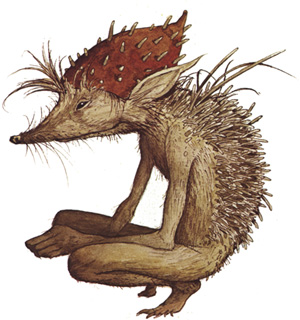
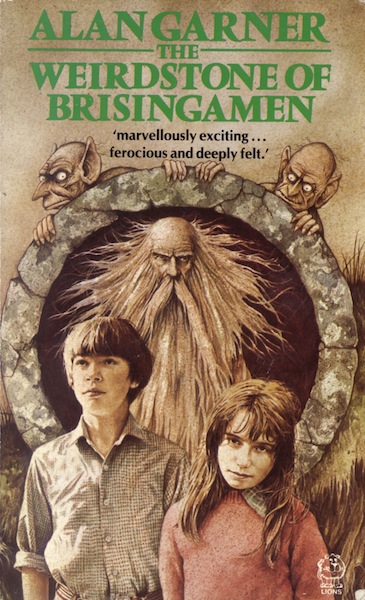
Alan Garner’s latest novel, Boneland, is a conclusion to the Alderley Edge sequence that kicked off his writing career back in 1960. But it’s no ordinary sequel. As Ursula Le Guin points out in her Guardian review, the protagonist of Boneland, the male half of the brother-sister duo of The Weirdstone of Brisingamen and The Moon of Gomrath, “has aged some 30 or 40 years, and their author nearly 50.” Which is why, when I first heard about Boneland, not only did I know I had to read it, but I also decided (as I’d always intended, but needed something like this to actually make me do it) to get round to reading all of Alan Garner’s novels in preparation.
No doubt as a result of this, reading Boneland left me heady with connections to Garner’s earlier works, both minor (the image of a hand outlined in red on a cave wall; a character seeing how far he can freewheel across a landscape; puns on the fact that M6 or M45 could be referring to a motorway or a distant galaxy; the flash of blue-silver as the trigger for trauma; “Who-whoop! wo-whoop! wo-o-o-o!”; stone axeheads; graffiti; nonsensical rhymes and folk-songs; being “badly”) and major (the sensitive, imaginative, troubled hero-with-visions; the connections and resonances between two worlds, or two times; two narratives linked by a single geographical location; sacred promises and love promises abused or betrayed then (sometimes) healed).

In Boneland, Colin of the first two Alderley Edge books is now Professor Colin Whisterfield, a brilliant academic and a deeply troubled human being. Highly intellectual, possessed of “an IQ off the clock” and an almost completely retentive memory (“I don’t delete. Anything. Ever”), he lives alone, in a cabin in a quarry near Alderley Edge, pursuing his world-renown astronomical studies using the nearby Jodrell Bank Observatory, but unable to remember anything of what happened in Weirdstone or Gomrath (“I can’t access anything, anything, before I was thirteen”), only that he once had a sister, but now has a desperate, crippling sense of loss, and a belief that, by studying the distant Pleiades, he might somehow find her. His fragile mental state leads him to begin psychiatric treatment with the earthy, motorbike-riding Meg. (An essay, “Inner Time”, collected in The Voice that Thunders, detailing Garner’s own experience with psychiatric trauma and treatment, makes good accompaniment reading to Boneland.) But is Meg what she seems? The voice of Colin’s sister comes to him as he stands between a pair of “whisper dishes” at the Observatory, hinting that Meg might in fact be the evil Morrigan from their childhood adventures. Meg, meanwhile, starts questioning whether this sister that Colin claims to have lost was ever real.
Alongside the main narrative, as so often with Alan Garner, is a parallel strand, this time set in the very distant past, as an unnamed shaman, last of his tribe, perhaps of his race, goes through his ritual activities and wonders, bereft, who will dance the dances to move the sun across the sky and return the spirits of beasts to the land once he’s gone? And, once more, this parallel narrative is connected to the modern-day strand by a physical object, a “black stone paperweight” which Colin realises is “five ice ages and half a million years old!” Like so many sacred objects in Garner’s fiction, it’s easily overlooked or undervalued: “This stone is poor, and cheap in price; spurned by fools, loved more by the wise.”
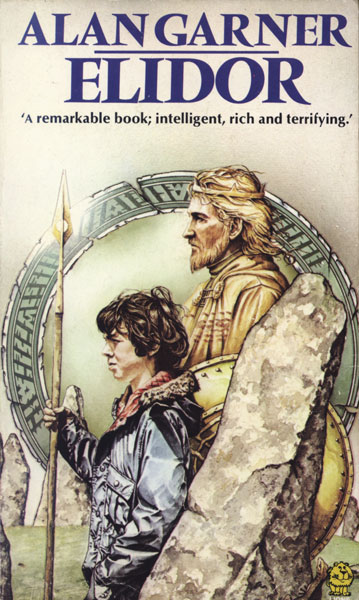
Elidor, cover by Stephen Lavis
At the heart of Boneland is a theme that runs deep through all of Garner’s novels from Elidor onwards, and which is, I’d say, one of the key themes to a lot of 20th and 21st century culture — the incommensurability of the extremes of intellect and emotion. Troubled genius Colin, highly successful as an intellectual but deeply flawed as a human being, beset by bouts of trip-switch irrationality, is Garner’s ultimate test case in this arena (and yet another of many troubled male heroes-with-visions, fits and flashbacks), with both sides of his intellect/emotional-damage equation hiked to the max. In my Mewsings on The Moon of Gomrath, I quoted a passage as indicating what I thought was the first stirring of Garner’s authentic imagination, the point his early writing really caught fire, as he describes Susan’s encounter with a being straight from the “Old Magic”:
Susan looked at him, and was not afraid. Her mind could not accept him, but something deeper could. She knew what made the horses kneel. Here was the heart of all wild things. Here were thunder, lightning, storm; the slow beat of tides and seasons, birth and death, the need to kill and the need to make…
“Her mind could not accept him, but something deeper could” — and it is making that connection, between the intellect (“the mind”) and emotion (“something deeper”) that Colin is failing to do. Perhaps that’s why he needs his sister. His world is full of the mythical and the scientific overwriting one another. His main astronomical work, for instance, is with “MERLIN” — not the Gandalf-like Cadellin of the first two books, but a “Multi-element-radio-linked-interferometer-network”, whose chief computer is called “Arthur”, and Arthur is, of course, one of the names of the Sleeper Under the Hill in Alderley Edge, whose sacredness Colin has abused by trying to get him to wake to rescue his sister. But Colin has at least a sense of the answer to this inability of reductive, analytic intellect to accept myth, imagination, and emotion:
“There can be more than one answer. There could be an infinity of answers. Truth isn’t fixed… Both systems can be real, but both are models. You can’t, or shouldn’t, confuse them. I did.”
“Hey now, kiddo,” said Meg. “Are you, an astrophysicist, saying that mythology and science have equal validity?”
“I’m saying they could have. There may be truth in fairy tales. My mistake was to mix them.”
And, later:
“…you could argue that for a thing to have a multitude of possible meanings is tantamount to its having no meaning at all. But perhaps the opposite could once have applied. Perhaps a thing that could be thought to have a multitude of meanings, then, gained strength and importance from the ambiguities.”
Red Shift, the primal Garner text, starts with a conversation:
“Shall I tell you?”
“What?”
“Shall I?”
“Tell me what?” said Jan.
There, we have someone (the writer?) trying to find a way into telling his story, but meeting only with misunderstanding and obfuscation, a block that ultimately becomes the book’s tragedy. Boneland starts in a similar, but subtly different, way:
“Listen. I’ll tell you. I’ve got to tell you.”
“A scratch, Colin.”
“I must tell you.”
“Just a scratch.”
“I will.”
“There.”
“I shall.”
“Done.”
 Here, while one voice says it’s going to tell a story, the other tends a wound. Which could be said to have been Garner’s work, from The Weirdstone of Brisingamen to Boneland — telling stories to heal a wound, to reconcile the irreconcilable, to breach the divide. As the grown-up Colin says, “Someone has to look after the Edge. There always is someone; always has been.” And of course he means Alderley Edge, but “the Edge” could also be the dream/reality boundary the shaman Strandloper walks, and the “Wasteland and boundaries” that are the “gates of Elidor”, or the corpus callosum that links the left and right hemispheres of the brain, the point at which intellect and emotion must meet to make a whole, healed, human being.
Boneland is by no means a traditional sequel to the Alderley Edge books, but neither is it (as I feared it might be) an ironic rewriting of them, or an attempt to dismiss them. (Garner did once make mid-career disparaging remarks about his first two books, but has apparently warmed to them again.) And I, for one, am thoroughly satisfied with it, both as a continuation of those first two novels, and a continuation of Garner’s body of work as a whole.

 that’s as