Giovanni Battista Piranesi and the Three-Dimensional Labyrinth

Surely the “Dungeons” part of Dungeons & Dragons owes a substantial debt to the fevered mind of Giovanni Battista Piranesi, who stands as a sort of dark fountainhead of one obscure aspect of fantasy art — the multi-levelled subterranean labyrinth.

Born in 1720, Piranesi wanted nothing more than to be an architect, but despite publishing several books on the theory of architecture and architectural renovation (a hot topic in crumbling late-Renaissance Rome), during his lifetime he only received one actual commission that was actually put into effect — and that was a renovation, not a new building. Piranesi made his living in various ways, one of which was producing etchings. His most popular was a series of views of Rome to sell to tourists, but he also indulged in a set of “architectural fantasies” published under the title Carceri D’Invenzione — or, the Invented Prisons.

What a febrile, tortured imagination Piranesi had! This, looking like the nightmare child of Gary Gygax and M C Escher, is one of his more labyrinthine efforts, a three-dimensional maze of stairways and walkways, complete with gibbet-like struts, barred windows and darkly suggestive ropes. The figures, if you can spot them, are dwarfed by their surroundings:

I’ve been collecting examples of the Piranesian influence as I find it popping up, so here are a few. The first is from one of my favourite films (and novels), The Name of the Rose (1986). Not a prison this time, but a monastery library, though this fact hardly makes it any less oppressive (here, forbidden books are imprisoned):

And this, from Guillermo del Toro’s first Hellboy film (2004) — del Toro’s obsession with clockwork replacing Piranesi’s spiked wheels and shadowy torture devices:

Hayao Miyazaki provides this example, from the villain’s castle in Tales From Earthsea (2006), complete with Piranesian winch:

The latest addition to my collection is this panel from Starblazer #190, “The Power of the Warlocks” (1987), drawn by Ian Kennedy (not credited in the comic, but artist info courtesy of the Starblazer Issue Guide). More oppressive religious architecture, this time with appropriate minotaur figures as pillars (and is the one on the lower left flipping the bird?):

But my love of the dark, subterranean, multi-levelled maze began way before I came across Piranesi. It probably started around the time I came across this picture, in The Best of White Dwarf Articles III, drawn by (I think) Bob McWilliams (…or has it always been there, in dreams?):

What would the world have been like had a Piranesi design actually been realised in stone? And what sort of demon patron would commission such a nightmare anyway? For the answer to that, see this story of mine, elsewhere on this site

2020 update

Some more Piranesian moments I’ve come across:

A man-meets-giant-cog moment from Ridley Scott’s Legend (1985)

The backdrop in this scene from Supergirl (1984) is actually by Piranesi

^TOP

What adventures they’ll have…

paddington_and_the_doctor

^TOP

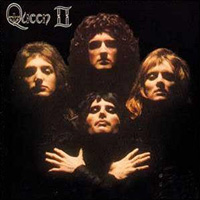
Queen’s Queen II

Fantasy worlds created in childhood sometimes spill over into adulthood. Thus we have E R Eddison’s peculiarly childish naming scheme for the races in his otherwise sublime novel The Worm Orobouros (with Witches, Demons, and even Pixies being his warring nations of basically human warriors). Thus we also have Emily Brontë continuing to write poems about the invented lands of Angria and Gondal (which she and her siblings had worked on intensely as children) right through to the end of her life. And thus we also have the world of Rhye — or hints of it — a childhood fantasy world created by Freddie Bulsara and his sister, which crept into reality when Bulsara became Mercury, and Queen recorded their first two albums.

queen_ii

I’m picking Queen II (from 1974) as the fifth of my top five fantasy concept albums, but really I’m picking the fantasy concept album that might have been, had Freddie Mercury taken over the whole thing and expanded the handful of fantasy-themed songs on the group’s first two releases into a complete concept album. My fantasy fantasy concept album, you could say.

And what an album it would have been! Early Queen manage a misty-morning never-never sound that tints many of their non-fantasy songs with the fantastic (“Nevermore”, “White Queen”); they also manage an almost religious grandiosity with equal conviction (the epic “Prophet’s Song”, “Jesus”) — both essential elements in a full-fleshed fantasy. When actual make-believe enters into it, we get something as baroque and filigree as the Art Nouveau-esque “My Fairy King”, as operatic as “The March of the Black Queen”, or something in the straight-ahead rock leagues like “Ogre Battle”. There’s humour, (“she boils and she bakes and she never dots her i’s” from “Black Queen”) — something which can puncture the make-believe bubble unless handled properly (in this case, with sufficient bombast) — there’s lyricism, and there’s even something that sounds like it was inspired by Dungeons & Dragons (“Can’t go east cos you gotta go south” from “Ogre Battle”), though of course D&D wasn’t released till 1974 (and I doubt it reached England immediately), while Queen II was recorded in 1973.

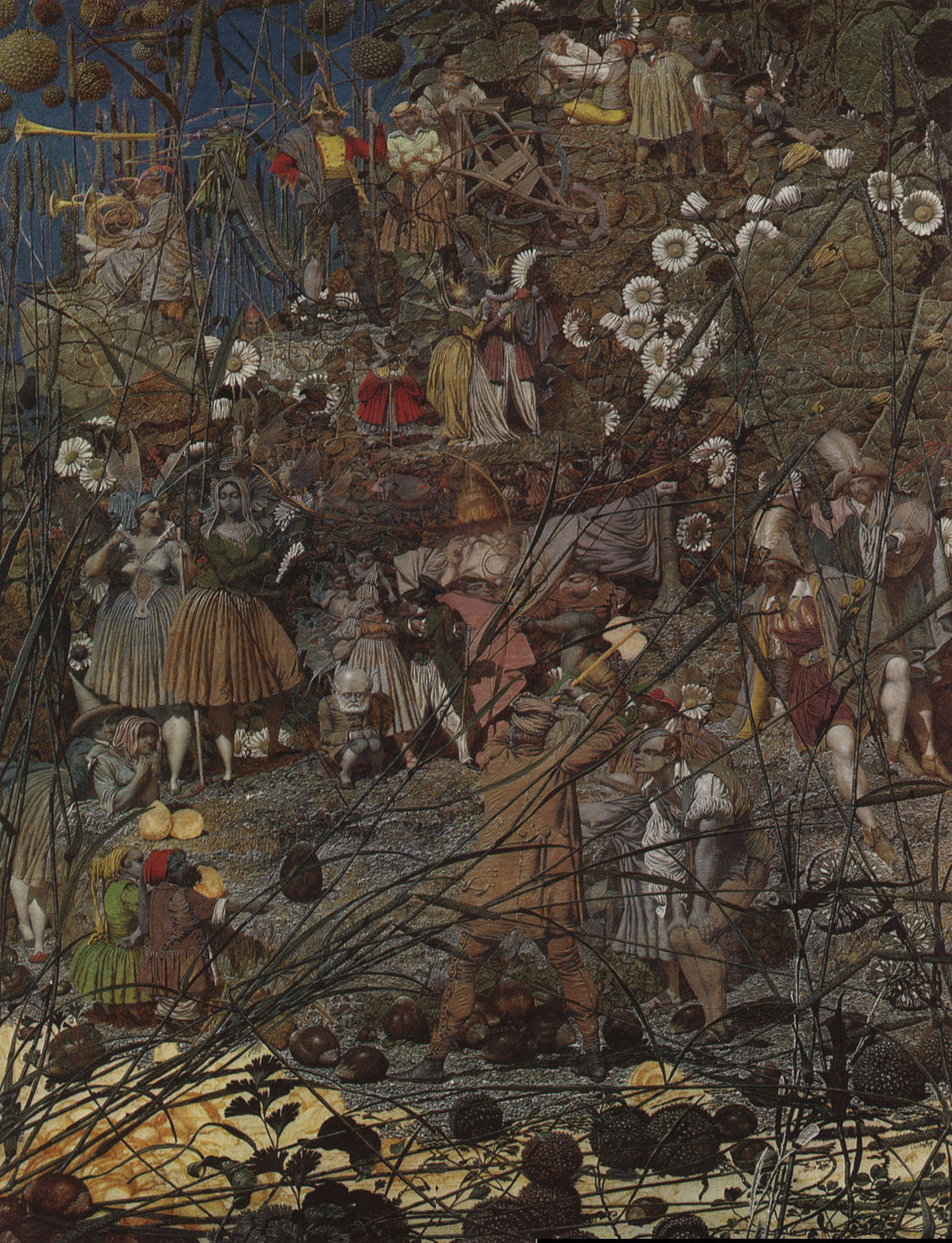
Centrepiece of the whole thing must be “The Fairy Feller’s Masterstroke”, a rendering in music of Richard Dadd’s intensely-detailed painting (and quoting from the peculiar poem Dadd wrote to accompany the picture, apparently in an attempt to prove it was a rationally reasoned-out subject, and not entirely produced by madness). At a mere 2 minutes 41 seconds, the song contains almost as many textures and details as the painting, and is one of the few examples of one work of art inspiring another of equal value.

Speaking of works of art inspiring others, there have been (I think) two fantasy novels written using Queen’s fantasy songs for inspiration. I read one, in the late eighties (I think), and can’t remember what it was called or who wrote it. And I don’t really want to. The secret of a successful adaptation from music to literature is, I suspect, not to be too literal. When I realised the plot of the novel was building up to a battle between two ogres, my heart sank. I remember glancing at another fantasy novel more recently which was inspired by Queen’s fantasy songs, but can’t remember the details, and the internet (in a brief search, I have to admit), seems equally disinclined. (I did uncover a video game, Ogre Battle: The March of the Black Queen, from 1995, though).

Well, that’s it for my top five fantasy-themed concept albums. I’m sure there are others, perhaps even betters. If I discover one, you’ll find it in a future Mewsings. Here’s the full five, which have been presented in no particular order:

^TOP