The Wicker Man

I spent most of my first viewing of The Wicker Man (the 1973 film, not the remake) in a state of bewildered readjustment. Before watching it, I’d heard only enough about it to know it was generally regarded as one of the great British horror films, and this had of course primed me with a number of preconceptions, all of which were thoroughly dashed the moment the folk of Summerisle started singing their cheery, bawdy ditty, “The Landlord’s Daughter”. By the end, I really wasn’t sure what sort of film I’d been watching. I knew it had a powerful ending, but as to the film that preceded it, I didn’t know if I liked it.

The Wicker Man: The Summerislanders sing “The Landlord’s Daughter”

But I kept thinking about it. Perhaps this is true of all the best works of art; they’re like problems you’re compelled to solve, sometimes long after they’re over. They haunt you, and require you to watch or read or listen to them again, and again, and perhaps again, always learning something new, but never all there is. So I found myself watching The Wicker Man again (and again, and again), trying to work out what it was, what had drawn me back to it, and why I was coming round to thinking of it as a truly great film.

I suppose, when it comes down to it, I was wrong-footed from the start because I can’t quite think of The Wicker Man as horror. It doesn’t fit my own (no doubt rather quirky, and never put into words) internal definition, though it certainly has one of the most shocking endings of any film I’ve seen. (Though not the usual horror-film version of shocking, in the way that, say, the hand shooting out of the ground at the end of Carrie is shocking. That’s shocking because it’s unexpected. If anything, the ending of The Wicker Man is shocking despite being so very expected, which is all the more a feat.) Anyway, I watched it again a few days ago, and I think I might have finally worked out why I don’t think of it as a horror film. It all comes down to a bit of a confession.
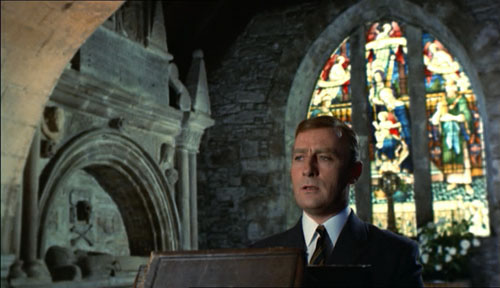
Police Sergeant Howie, in the world he’s comfortable with

Throughout, I find myself identifying with both sides of the story — both Police Sergeant Howie and the Summerislanders — but in different ways. Howie, you can’t help identifying with because he’s your point of view; you start from his position of knowing nothing about Summerisle, and learn about Summerisle as he does. The only thing is, you don’t get to like him, however much time you spend with him. In fact, you get to like the Summerislanders a lot more. They’re such a down-to-earth, happy bunch. They’re so refreshingly uninhibited. They sing, they dance, they have a good time. What’s more, they work as a community (whereas Howie isn’t even liked by his fellow policemen). And they have the wild-haired but dashing Lord Summerisle as their leader, who, as he’s played by Christopher Lee at his most charming, can only be a plus point.

This does tend to blind you to just how nasty what they do to poor Sergeant Howie is. It was only when I stopped and thought about it, after watching the film for a fourth or fifth time, that I realised how wrong it is to accept what the islanders do to Sergeant Howie, and even to feel he deserves it. (And I don’t even have the islanders’ excuse that they think it’ll improve their crops. I’ve no doubt that, as Sergeant Howie says, doing the wicked wicker thing to him won’t make the slightest difference, and next year it’ll be Lord Summerisle’s turn. So in a way, I’m even worse than the islanders. I’m happy to see Howie die simply because he’s a prig.)
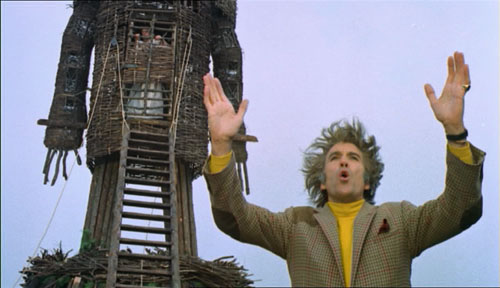
Lord Summerisle and the Wicker Man

Perhaps this is because, rather like Lord Summerisle himself, The Wicker Man has such an open sort of charm. It’s not as suave as Christopher Lee, but it has the same earthy honesty and pagan vitality. The central conflict of the film is repression (in the form of uptight Sergeant Howie) versus folky-bawdy disinhibition. Howie, in his starch-stiff uniform and starch-stiff face, his clipped, disapproving accent, his devotion to the law, hasn’t the flexibility of mind to even comprehend that there might be other ways of life than his own, and is horrified to find there are. (And then is so affronted by the forms they take, he’s incapable of appreciating how many underlying similarities there are; for instance — as Lord Summerisle points out — the belief in parthenogenesis, and the redeeming power of sacrifice.) Howie is identified with modern civilisation, through his constricting uniform, his aeroplane, his robotic-voiced loudhailer. The Summerislanders on the other hand wear loose clothes, sway their hips, speak in a free folky lilt, sing, drink, frolic in graveyards, jump naked through fires, and generally enjoy themselves. They’re not hung up on sex and death, but have quite come to terms with them, and with their own bodies; Howie, on the other hand, has holy-fied sex and death into something remote, codified and unliving — into something quite literally disembodied. Compared to Sergeant Howie — even though we spend almost the entire film in his company — the Summerislanders are just so likeable.
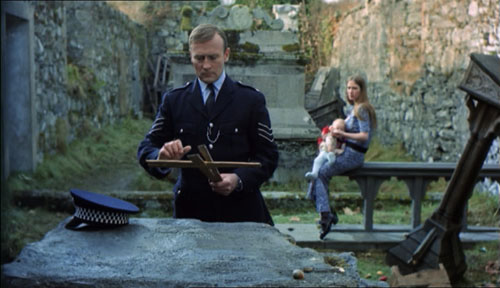
The Wicker Man: Howie concentrates on disembodied death; the Summerislanders celebrate embodied new life.

If only they weren’t a bunch of murderers!

That’s the thing. By the end of the film, I’m so much on the islanders’ side, it takes an effort to appreciate what an awful thing it is they do. And, when it comes down to it, I guess I don’t think of The Wicker Man as a horror film simply because I’m too much on the side of what I really ought to be calling the monsters.
^TOP

Michael Powell’s Wizard of Earthsea

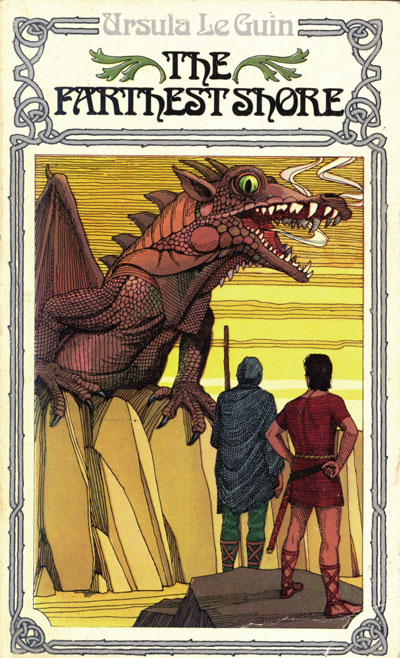
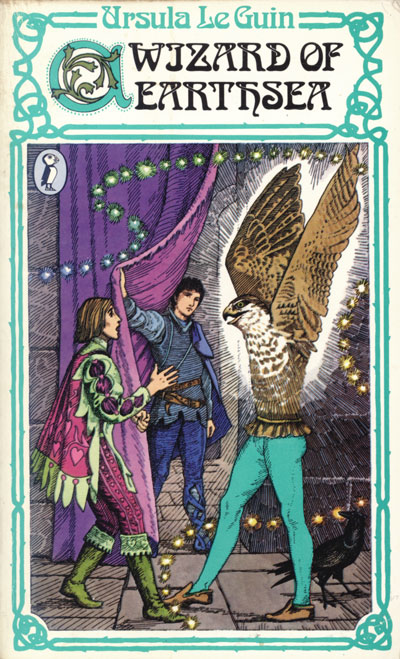
Ursula Le Guin’s Earthsea books have been adapted for the screen twice, once as a TV mini-series in 2004 (which Le Guin didn’t like), and once as an animated film from Studio Ghibli in 2006 (which fared a smidgen better with Le Guin, though she originally sold the rights on the understanding it would be Hayao Miyakazi making the film; in the end it was his son), but there was another, earlier, attempt at adapting the first two Earthsea books, a live action feature film written and directed by Michael Powell, he of Powell & Pressburger (The Life & Death of Colonel Blimp, A Matter of Life and Death, Black Narcissus, The Red Shoes, Tales of Hoffmann), and, on his own, the notorious Peeping Tom (1960). Apparently, Powell wrote to Le Guin to tell her how much he’d enjoyed the books, a correspondence ensued, and that led to their collaborating on the script by mail. (There’s a good account of how the two got started in a comment over at Tor.com.)

Powell had grand plans for the film, including bringing in David Hockney as designer (because of some illustrations he’d done for an edition of Grimms’ Fairy Tales — you can see some of them here, and, if you’re like me, wonder what he saw in them); Francis Ford Coppola was to have provided financial backing. The whole project never got further than the script, though — one account says it was due to Coppola going bankrupt, another that it was down to the ageing Powell not being able to get insurance — but the script is available to read over at Scribd.com. As the first two Earthsea books are perhaps the earliest-read books I still own, and occasionally re-read, I was curious to see what such a reputable filmmaker, with a definite artistic talent of his own, would have made of them.

Although it’s titled A Wizard of Earthsea, the script actually adapts the first two Earthsea books, A Wizard of Earthsea (which makes up the bulk of the film) and The Tombs of Atuan (which is mostly a subplot till the two come together at the end). And, apart from some jiggery-pokery needed to squeeze that pair into a two-hour film and bring it all to a satisfying conclusion, it generally remains very faithful to the books. The ending of Wizard (where Ged sails beyond the Archipelago in order to face the shadow he’s brought into the world alone) is lost, that final confrontation being merged with his and Tenar’s escape from the subterranean labyrinth of Atuan. For a long time, I preferred The Tombs of Atuan to its predecessor, and I couldn’t help being disappointed at how abbreviated Tenar’s story ends up in the script — her rejection of the gods she was brought up to serve is pretty much over in a line (“Oh Nameless Ones! My name is Tenar — Tenar — TENAR! I am not your servant any more!”), whereas, of course, she had a whole book to build up to that point in Atuan. But, allowing for the necessary abridgement, the feel of the stories is still very much intact in the script.

One question, though, is would it have remained that way? It’s notable that one of the scenes from A Wizard of Earthsea that didn’t make it into Powell and Le Guin’s script is probably the very one that would have sold it to a modern-day producer: the bit where Ged goes head-to-head with a dragon. Dragons appear in the script’s prologue, which ranges over the lands of Earthsea, introducing the Archipelago to the viewer, but aren’t seen again. Perhaps that was due to FX concerns, but it seems more to be because they were deemed extraneous to the story Powell and Le Guin were telling. Still, a dragon at the beginning (rather like a gun on the wall in the first act of a play) implies a promise of further dragonry to come, and in this case, the audience would have been disappointed.

There are some FX sequences left in. There’s a lot of illusion-weaving in the School for Wizards, for instance, and one intriguing scene where we first see the Archmage:

173. THE TALL WHITE FIGURE OF ARCHMAGE NEMMERLE materialises out of the shape and the spray of the falling water. A great black BIRD, a RAVEN of OSKILL, walks across the COURT to the Archmage and pecks at his STAFF.

Most of Le Guin’s magic, though, is understated and probably not as cinematic as a modern audience would expect — no flinging of fireballs or bolts of magical energy, for instance. If the film were to be made today, in this post-Peter Jackson age, that would almost surely be changed, or certainly cause the filmmakers to come under pressure from their more commercially-minded backers.

Another interesting point was that Powell obviously wasn’t thinking of this as a children’s film. His reaction to the books was, apparently, surprise that they were being published by Puffin, a children’s publisher, because he thought they were for everyone, adults included. I agree, but they certainly start off as being accessible by children. Powell, though, seems to have put his foot firmly down on the “for adults” camp, with a section of the script that details Ged’s stay with the people of the Terranon. Having just made it into their stronghold after being chased by the shadow-creature he loosed upon the world as a student mage, Ged collapses; there follows a slightly feverish sequence as he recovers, which starts with this scene:

486. HOT SPRINGS. Colors — weird rocks — old dwarf trees — NAKED WOMEN IN THE STEAM — THEIR VOICES. MUSIC AND SINGING. MUSCULAR MEN. EROTICA.

…and that mood continues with the appearance of Serret, a woman who “is elaborately dressed, she gleams with jewels, rings, earrings, toerings: her body, which can be glimpsed through the diaphanous gown she wears, shines with jewels. The nipples of her breasts are ornamented with rubies, her navel is set with diamonds. She is definitely a Princess.”

Definitely a Princess; definitely not for children, either.

Having read the script, I’d love to have seen the resulting film. If it had managed to stay true to what they’d put down on the page, and not be changed by producers wanting something more commercial, I think it would have been one of the better fantasy films of the eighties — or even the current decade.

Pity it wasn’t to be.

^TOP

Tom Baker’s other doctor

Between Rasputin in Nicholas and Alexandra (covered in a previous mewsings) and the evil Prince Koura in The Golden Voyage of Sinbad, Tom Baker played the part of the Egyptian Doctor in George Bernard Shaw’s The Millionairess, which was put on as a Play of the Month by the BBC in 1972, and is available as part of a George Bernard Shaw BBC box-set. (Which, fortunately, can be rented as individual disks from LoveFilm.)

It’s another example of Baker’s career following a train of thought, as he’s cast, once more, in the role of a fascinating foreigner; but, in a departure from the two film roles that bracket this TV performance, the Egyptian Doctor is not a villain. He even manages to have a touch of Doctor Who about him, being a benevolent scientist with absolutely no interest in, or knack for, money, but a strong desire to do good for the needy.

There’s little room in Shaw’s wordy play for much in the way of character development on the part of the actor, though — and certainly none for the sort of improvisation that brought life to Baker’s Doctor Who. Despite Shaw’s claim that The Millionairess “does not pretend to be anything more than a comedy of humorous and curious contemporary characters such as Ben Jonson might write were he alive now”, it is, as always with Shaw, far more a political argument than a play about people. I always find Shaw’s plays to be made up of wit and tedium and very little in between, with only the few, better, plays having enough of the former to really make up for the latter. (Heartbreak House and Saint Joan are my favourites.) At his best, Shaw can be very engaging in an argument — never failing to bring in an arresting paradox or two to really strike home his point — but after a while, in a drama at least, the constant paradoxes and cross-arguments leave me completely confused as to what point he’s trying to make. (The prefaces to the plays are far more informative, and entertaining, on that score.) If a Shaw play works at all, it’s because interesting characters emerge from the points he’s trying to make, rather than the other way round. And The Millionairess is not really one of his successes.

Still, there’s something a little Shavian about Tom Baker’s later interpretation of Doctor Who, some of the seeds of which can be found in his Egyptian Doctor — the grandiloquence, the generosity, the constant sprinkling of humour. And, of course, as always, that bulbous-eyed under-the-brow stare:

^TOP