English Gothic by Jonathan Rigby

At the end of this exhaustive (and occasionally exhausting) film-by-film history of English horror cinema, Jonathan Rigby quotes Anne Billson on the special place Gothic has for the English:

‘Horror thrives best when emotions are bottled up, and no one bottles them up quite like us.’

I’m not sure this is true of all horror. I’d say the US horror films, like Night of the Living Dead, The Texas Chainsaw Massacre, Rosemary’s Baby and The Exorcist, which put an end to the 20th century’s main British horror boom, are more about political than emotional repression — when they’re not simply about pure, primal terror, that is. Certainly, they don’t work in that stiff-upper lip way Hammer’s fairy-tale Gothics do. Perhaps that’s why the term ‘Gothic’ seems so much more appropriate to English horror cinema. (Though Rigby has also written books on European Gothic and American Gothic.)

Although Rigby mentions a welter of early horror films in his first chapter (covering 1897 to 1953), things (as well as Things) really kick off in 1954, with Hammer’s The Quatermass Xperiment, which made a marketing virtue of its ‘X’ certificate (brought in by the BBFC in 1951, to exclude under-16s). That film’s success led to the ‘First Flood’ of British horror (as Rigby titles the chapter), most of which were science fiction horrors, or the sort of costume-drama Gothics that Hammer were to make so much their own.

Right from the start, British critics and censors did their best to act as the repressing super-ego to these horror films’ blasts of unleashed id, complaining of a surging tide of boundaries-testing ‘sex and sadism’ (that nowadays seems merely quaint), which led to a slow choking-off of this initial horror boom in the first half of the 1960s, when horror filmmaking in Britain seems to have been dominated by costume Gothics (not just Hammer, but Roger Corman’s Poe films, too), alongside some respectable one-offs like The Innocents, The Haunting, and Repulsion. (Michael Powell, with his 1960 film Peeping Tom, became the sacrificial lamb to the repressive critics’ slaughter.) With the social changes of the 1960s, that critical repression flipped into outright prurience by the early 1970s, when a glut of US investment led to the films Rigby covers in a chapter called ‘Market Saturation’. After Hammer finally went to the Devil (literally — their last film being 1975’s To the Devil a Daughter), Rigby lumps the rest of the 20th century into a single chapter titled ‘British Horror in Retreat’.

Jonathan Rigby

That’s where the first edition of English Gothic ended. In this new (2015) edition, there’s a new chapter, ‘Risen from the Grave: 2000–2015’, covering the period which contains, among other things, Hammer’s own resurrection, its most characteristic film being (again) in period costume (The Lady in Black).

Perhaps it’s notable that Hammer had their success at the same time as the Carry On films. Both relied for their character on British prudishness, and both failed to adapt to the changing mores of the latter half of the 1960s (trying and failing in, for instance, Carry on Loving on the one hand and Dracula 1972 A.D. on the other), finally giving way to pulpier home-grown product which was far less repressed, and less finessed (Prey, Frightmare) — which themselves failed in the face of the fully explicit, overseas-made films of the video-driven 1980s.

I wonder if perhaps the horror genre will always have two opposing strands to it: the shocking, gory, explicitly violent side and the more dreamy, surreal, Gothic side. As people get tired of the excesses — or used to the shocks — of one (too much blood, or too little), the other has a breakout success. Hence, for instance, the boom of ghostly and surreal Asian horror films at the turn of the millennium, which then gave way to the excessively physical terrors of the Saw franchise five years later.

Some of my favourite British horror films have their feet in both camps — Clive Barker’s Hellraiser, or Ken Russell’s Lair of the White Worm, for instance — but I much prefer the dreamy, supernatural, Gothic side: chills rather than shocks, and spooks rather than psychopaths.

^TOP

Blow-Up and Performance

The two films I most associate with the swinging 60s are Blow-Up (1966) and Performance (made in 1968, but not released until 1970). I didn’t realise, till I watched them again recently, how much, while being very different in feel, they had in common. While one is set at the height of London’s cultural moment, and the other feels very much in its aftermath, both feature an artist (a photographer in Blow-Up, a musician in Performance) experiencing a revitalisation of their art through contact with violence and crime.

Blow-Up starts with its unnamed photographer (played by David Hemmings) emerging from a doss house, having just spent the night as one of the homeless while secretly taking snapshots. This might be taken as showing dedication to his art and a worthy social responsibility, but soon feels like just one more stunt in a day full of quick photoshoots, impulse buys and throwaway ideas. The dismissive way he orders the clothes he wore in the doss house burned, and the way he skims the proofs of the photos, interested only in the superficial impact of the images, seems to imply how little he’s been touched by the experience. His one contact with a deeper relationship to art seems to be his painter neighbour, who’s at the opposite end of the impulsiveness scale, being quite capable of leaving a painting incomplete for years till he’s sure he knows how to finish it.

One of his many impulses leads the photographer to follow a couple into a park, taking surreptitious snaps. He’s spotted, and the girl of the couple tries to get the photos off him. Something about the situation — its apparent peacefulness compared to the rush of his creative life, the desperation of the girl, an intuition that there’s more to it than meets the eye — catches his imagination and he starts studying the photos, blowing up sections till he realises he may have been present at a murder attempt. For a moment, he’s elated, thinking his art has had a genuine effect on the world — it’s saved someone’s life! Then comes the realisation: he didn’t save a life at all. Instead, he failed to notice a successful murder taking place right before his eyes.

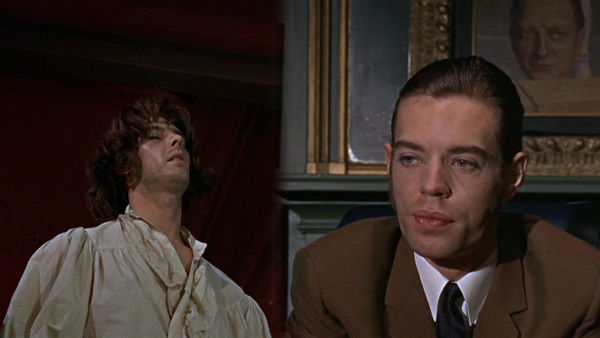
Performance is more ambiguous. It brings together two characters, both in need of a new sort of energy in their lives. One is Chas (played by James Fox), an East End gangster’s ‘Front Man’ who oversteps his bounds and has to go on the run; the other is Turner (Mick Jagger), a burned-out rock star hiding away in dishevelled Bohemian digs in Powis Square. It’s the meeting of these representatives of two very different undergrounds (the criminal and the countercultural) that revitalises both. Turner absorbs Chas’s gangster persona, and uses it to make contact with his musical ‘daemon’ once more; meanwhile, Chas has his ultra-macho self-image broken down to free his more feminine side.

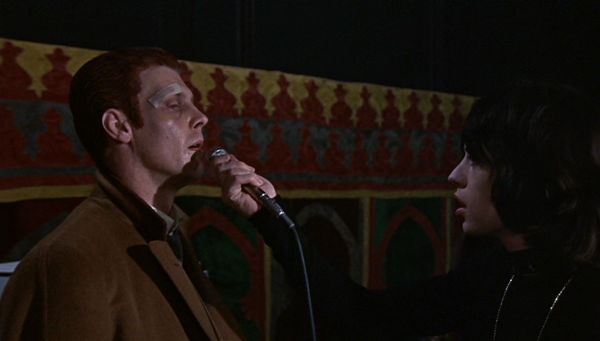
In both films, a musical performance captures the mix of art and violence they’re heading towards: the Yardbirds playing ‘Train Kept A-Rolling’ in Blow-Up (with Jeff Beck rather self-consciously destroying a guitar and throwing its neck into the audience, waking them from catatonia into a scramble of violence), Mick Jagger singing the rather Dylanesque “Memo From Turner”, surrounded by naked gangsters, in Performance.

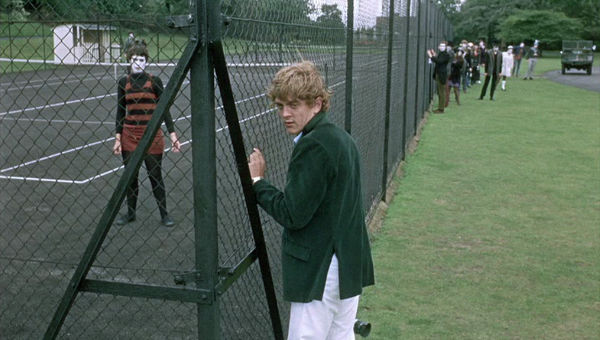
Both films end ambiguously. In Blow-Up, after realising he didn’t save anyone’s life at all, Hemmings’s character wanders in the park till he falls in with a group of feral street-performers, who set about an impromptu game of mimed tennis. Joining in — throwing back their non-existent ball when it’s knocked out of court — seems, somehow, to provide some sort of resolution to his story. In Performance things are even stranger, with Chas (either more in touch with his feminine side and a fuller human being, or simply stoned out on mushrooms) shooting Turner, then being taken outside by his gangster friends to meet a similar fate, where he reveals himself, in a brief glimpse, to in fact be Turner, or perhaps the both of them, melded into a Chas-Turner hybrid.

Both endings seem not so much to be interested in explaining or resolving the change that’s taken place in their characters, as wilfully defying any sort of interpretation at all. But the feeling, in both cases, is of a sort of rising above the action into an entirely new plane of meaning, an alchemical synthesis of the two worlds (art and violence) that have been polarised in each film’s preceding action. These endings defy rational explanation because that change, that revitalisation, can perhaps only come about through giving way to a wholly new logic.

^TOP

Pan’s Labyrinth

I’ve been wanting to write about Pan’s Labyrinth, one of my favourite films, for some time, but whenever I sit down to watch it, I find myself wondering what there is to say. Aside from how much I love the way it mixes wonderfully dark fantasy with convincing real-world drama, the sheer artistry of the film is sort of overwhelming — not just the quality of the filmmaking, the acting, and the storytelling, but the way so many of the strands of the story echo and resonate, so every character, every event, every location, acquires a deeper significance from the way it counterpoints other parts of the film. The whole thing works like a perfect piece of clockwork (an apt metaphor for the clockwork-loving Guillermo del Toro) — wonderful to watch, but difficult to write about without simply gushing.

Then I realised I had to write about not what I like most about the film, but what troubles me most about it.

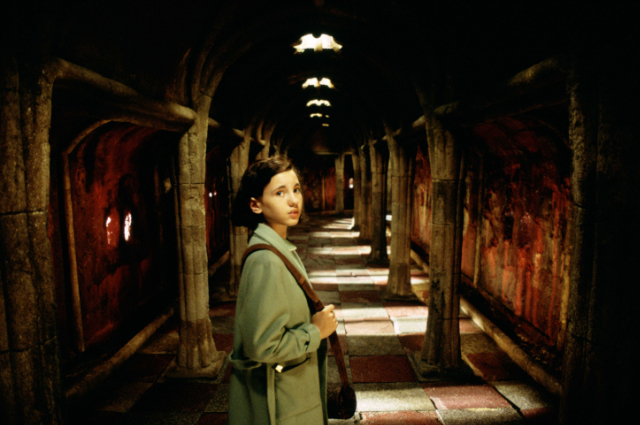
I saw Pan’s Labyrinth at the cinema, and bought it as soon as it came out on DVD. (And, yes, once again on Blu-ray.) When I sat down to watch the DVD for the first time, I was shocked all over again by the opening scene, in which the young Ofelia lies dying at the centre of the Faun’s labyrinth. I’d somehow managed to forget this most troubling fact, that the film’s heroine dies, even though it’s underlined by happening at both the start and the end of the film, so it really ought to be unforgettable. In her BFI Film Classics book on Pan’s Labyrinth, Mar Diestro-Dópido says of this moment:

‘The shocking impact of this scene lies precisely in the sudden absence of magic; we see Ofelia as she really is, vulnerable and defenceless, a thirteen-year-old child incapable of inflicting harm — and a stark reminder of the hundreds of thousands of children who fall victim to adult wrongdoing, particularly during war.’

Every time I watch Pan’s Labyrinth, Ofelia’s death seems so monstrously unfair. Having passed through three fairy-tale trials, facing genuinely disturbing horrors with real courage and an ultimate fidelity to her conscience — trials which, in most fairy tales, would have granted her the right to the happily-ever-after rewards of selfhood and adulthood — everything’s taken away from her. One way of reading the fantastic elements of the film is as the dying Ofelia’s hasty weaving of a story around the bare few mundane facts of her too-short life, to try to make them meaningful, to make them all point, in a final, desperate act of imagination, to, yes, her really being a princess after all, and this not being a horrible and pointless death but some sort of wonderful fulfilment. Yet, the vision of herself being received by her father, mother, and (somehow, because he’s still alive in the real world) her baby brother, in this magical underworld kingdom, occurs in the moments before she dies, not after, so perhaps this is nothing more than the dying dream of a young girl, one more victim of a brutal, fascistic reality, where death and suffering are handed out as freely as Franco’s daily rations of bread.

But even if it is just a dying girl’s fantasy, there’s another way to look at the story told by Pan’s Labyrinth. The film is about staying true to one’s conscience in the face of a fascist brutality that demands instant, unquestioning obedience at all times. And it’s a wonderfully disobedient act to rework such a harsh reality into your own private narrative, weaving the spaces between the facts with a fairy tale of your own devising.

How else can so helpless an individual as Ofelia triumph in such a brutal world, except through an act of imagination? It’s a world that does its best to deny stories. Captain Vidal — like fascism itself — denies everyone their ability to tell, or enjoy, any stories but those the ruling party tell, criticising Ofelia’s mother for letting her daughter read fairytales, and, in the banquet scene, for telling the story of how she and Vidal came to be married. But Captain Vidal is in the grip of his own story. His father supposedly smashed his pocket-watch the moment before his death, so his son would know how a truly brave man dies, and though Vidal is constantly looking at that cracked watch, and tending its clockwork alone in his office, he denies his father ever had a watch — a denial which only goes to show the power the story has over him. Fittingly, at the end, when he tries to control the story his own baby son will be told about him, his quietly resistant housekeeper Mercedes tells him his son will never even know his name. This, in such a harsh, unfantastic world, is how victories are won: through acts of imagination. History may be written by the victor, but fairy tales can be acts of rebellion.

Near the beginning of the film, Ofelia tells her as-yet-unborn brother the story of a flower that confers immortality, but which nobody goes near because its thorns are poisonous. Her own fairy-tale tasks are designed to test whether she, Ofelia, has been in the mortal world too long and lost touch with her immortal self, the Princess Moanna. But ‘immortality’ in Pan’s Labyrinth isn’t of the literal, Woody Allen kind (‘I don’t want to achieve immortality through my work, I want to achieve it through not dying’). It’s closer to the pagan idea of living so heroic a life your name will be remembered, and your story told, even after your death.

Dying alone at the centre of a ruined labyrinth, Ofelia confers on herself a very deserved immortality, by telling herself her own story, with herself as the heroine. Whether the fantasy elements of the film really happened or not (and only Ofelia’s escape from the locked attic using the Faun’s chalk-doorway method seems to imply they did), the story she tells herself is true — a true image of her conscience and inner life, that is — and it’s this, her being true to herself despite the threat of death, that confers on her the Pan’s Labyrinth version of ‘immortality’ in the end.

After all, she gets a film made about her.

(And a very good one, too.)

^TOP