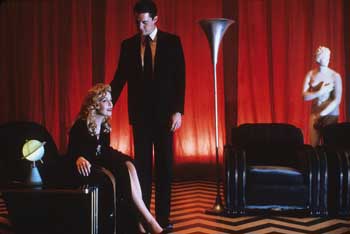
Pinhead & The Scarlet Gospels

scarlet-gospels-uk-coverClive Barker’s new novel may open with the resurrection of a magician, but its primary purpose is not to revive the magical past, it’s to lay a ghost. Or, rather, exorcise a demon. For here, in a literary kill-off move that’s surely been played out too many times for anyone to believe it’ll work, Barker does a Reichenbach Falls on his most famous creation: the Hell Priest.

Who?

That’s Pinhead, to you and me — or the Lead Cenobite, if you’re a purist, as that was how he was credited in the first Hellraiser film (while in The Hellbound Heart, he wasn’t even the lead) — but apparently the entity in question prefers to be addressed as the Hell Priest. At least, until he slaughters the rest of his order and embarks on a new career as would-be King of Hell. (The Devil, in this version of Hell, having been absent for some time.)

It’s here, I think, Barker’s trouble begins. If you’re going to kill someone off, you’ve got to at least get their name right. I don’t even think he gets the location right. The Hell Priest is to be killed off in Hell, right? But Pinhead — the creature who, to me, made his one and only definitive appearance in Hellraiser, and whose name ought to be Pinhead, because it shows the proper degree of fear-hiding-behind-irreverence that such truly terrible monsters are often treated with — doesn’t belong in Hell. The ‘Hell’ in Hellraiser is figurative, not literal. ‘Hell’ is a state you go through — toils and torments raised to religious levels — not a place. (Certainly not as quotidian a place as Barker presents in The Scarlet Gospels: a Hell with uniformed police, bicycles, money, and other much-too-mundane details, far more reminiscent of the Hell of Barker’s mostly disappointing previous novel, Mister B Gone. It does have some glorious architecture, though.)

To me, Pinhead is a far different creature to this troublesome Hell Priest. His origins — along with those of Barker’s first (and best) feature film — lie in an experimental short film, The Forbidden, first glimpsed on The South Bank Show in 1994. Here, Barker presents us with a variant on the Faust myth, in which a lone magician in search of ‘the further reaches of experience’ summons a ghostly lover, then passes onto more esoteric pleasures, culminating in his being skinned alive. The Forbidden is scattered with abstract, purely cinematic sequences (which can be seen sneaking their way into Hellraiser, too — as in the shot of an unfurling, blood-red flower that precedes Kirsty’s waking up in hospital), some of which are of Barker’s ‘nail-board’: a square wooden base, criss-crossed with regular score marks, six-inch nails hammered into each juncture. Moving a light around it, Barker explores this for its abstract visual qualities (as he does the lights-through-slats that precede the appearance of the Cenobites in Hellraiser), but it’s unmistakably the origin of Pinhead:

‘Every inch of its head had been tattooed with an intricate grid, and at every intersection of horizontal and vertical axes a jewelled pin driven through the bone.’ — The Hellbound Heart

Contrasted with the Faust character’s visions and torments, the image of the nail-board contains, I think, a sort of boiled-down abstraction of crucifixion: nails (significantly, these aren’t points-upwards, as you’d expect from an image of torture), crosses and wood, simplified and multiplied, as though transcendence were being sold by the yard, and made available to anyone with a DIY temperament.
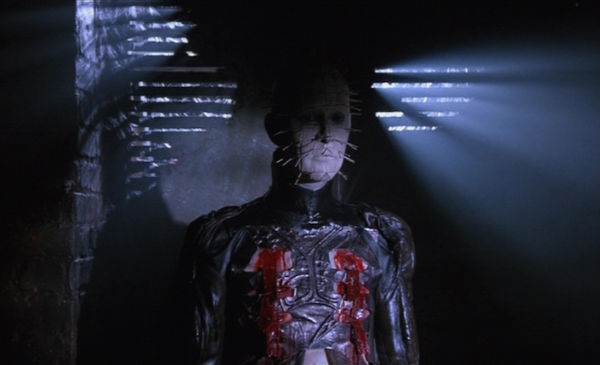
Moving from the nail-board to Pinhead, you see a man (or creature) who is in his own, permanent, self-crucified state, the very image of pain and transcendence unified. Summoned by Uncle Frank — who’s more interested in a far different meaning of the phrase ‘getting nailed’ — the Cenobites are ‘Angels to some. Demons to others.’ So they are, in Hellraiser, not evil, and do not belong to Hell. Instead, they’re a gateway to extreme experience that transcends the idea of pain being opposite to pleasure, or of evil being opposed to good. Heaven is their Hell, and vice versa; one is reached through the other. Their whole point is that they do not belong in a duality. Which means that, by putting its ‘Hell Priest’ in a very traditional Hell, The Scarlet Gospels, to me, strikes a false note. The Hell Priest that Barker is killing off isn’t the Cenobite known to the rest of us as Pinhead; he’s an imposter.

(Mind you, the Hellraiser movies have been doing just as convincing a job of removing Pinhead from his original ‘beyond good and evil’ meaning and turning him into a standard movie monster since the second film. And this, no doubt, is the version of the creature Barker wants to kill off.)

Scarlet Gospels (US cover)I’ve said before that Barker’s work is all about unifying the divides between, for instance, imagination and mundanity, between day-to-day experience and the transcendent extremes. For much of it, The Scarlet Gospels is too concerned, I think, with a storyline that doesn’t allow any of this deeper theme to come through. It reads like a checklist of what a Clive Barker novel ought to be: a very gruesome beginning, and then a lot of excessive, perverse, blood-soaked demonic goings on after that, but very little of the higher themes like transcendence.

Which isn’t to say there’s no transcendence. As well as being about the Hell Priest, The Scarlet Gospels is about two other characters with a literary pedigree: Harry D’Amour, Barker’s longstanding supernatural PI, and Lucifer. Both of these are transformed by the events of The Scarlet Gospels, in far different (and more convincing) ways than the demise of Pinhead (which can’t help being unconvincing — he’s been offed too many times in the movies).

The Scarlet Gospels isn’t the best of Barker, but that’s not to say it’s not worth reading. If at times it feels a little dated in its constant excess, it also feels like a reminder of the days when major publishers put out stuff that actually seemed dangerous and transgressive but which also had artistic intent. Barker is an artist, and I’d certainly like to read more of him — but moved on, not dwelling on the same old stuff in the same old way. And I wonder if there aren’t signs Barker might want this too:

Now Harry realized with terrifying clarity that he no longer wished to be the witness of such sights. This was not the world in which he belonged.

And:

“I have heard this story. I have seen you. I have seen all of you! In countless incarnations!” the Devil shouted to the crowd who attentively watched his every move. When he spoke again, it was slow and deliberate. “I do not want this anymore.”

^TOP

Twin Peaks

Twin_Peaks_BluRayIf you plotted the quality of Twin Peaks, you’d come up with a twin-peaked graph: it started brilliantly, and ended well, but dipped somewhat in between. In an ideal world, it wouldn’t have been a parody soap opera about the town in which Laura Palmer was murdered, it would have been a weird crime series, following the adventures of David Lynch’s FBI, a bunch of borderline-shamanic all-American good boys investigating the dark forces behind the most terrible crimes. (Which sounds like a cue for The X-Files, a couple of years later.) Certainly, what drives the pilot and early episodes is following Special Agent Dale Cooper (who I like to imagine as Kyle McLachlan’s character from Blue Velvet, grown up) as he uses a combination of acute observation, sharp deduction, dream-clues, intuition and sortilege (naming possible suspects then throwing stones at a bottle, seeing which one hits) to solve the mystery of Laura Palmer’s murder. Most of the parallel plots that were unrelated to the murder — the whole tangle of insurance & blackmail surrounding the burning of the Packard Mill, the mostly unfunny comedy of super-strength Nadine’s regression to her teenage-years — I could have done without.

David-Lynch_MJEBut, I’m a David Lynch fan (though a rare one, in that I like Dune but don’t like Eraserhead), and what made me re-watch the show for the first time since it was on TV wasn’t a desire to revisit the characters or world of Twin Peaks, but a desire to revisit David Lynch and his world. For me, creative as the others can be, the episodes Lynch directed stand out. The question is why. There’s a scene in the final episode (directed by Lynch) that’s nothing but a slow advance down an empty corridor, yet somehow it’s full of brooding tension. Or take another scene, this time at the end of the pilot episode, when Laura’s mother has a vision of a hand retrieving a necklace that’s been buried in the woods. Her sudden panicked reaction makes it seem like some sort of horrendous psychic violation is taking place. What Lynch brings to these scenes isn’t just in the scenes themselves, but the world he creates around them, one in which there’s a constant potential for reality to rip open and reveal something behind it, something full of irrational terror. His world is beset by a constant note of anxiety that adds meaning, or the threat of it, to the most mundane moments. It’s one of Twin Peaks’ most notable characteristics that, though it’s mostly played as a quirky comedy, it contains moments of genuine horror. But it isn’t a horror-comedy as, say, Shaun of the Dead is. Rather, the horror is made all the more horrific by being couched in such light comedy. And what’s different in Lynch’s episodes is that, while others might contain the same quirkiness (Dale Cooper coming face to face with a llama) or directorial inventiveness (a long, slow zoom out of a hole in a wall-tile), none of them catch the uppermost peaks of outright terror or downright strangeness that Lynch does.

twin_peaks_audrey

Throughout Lynch’s work, innocence is always coming face-to-face with horror — and, in his best work, not just coming face-to-face with it, but being corrupted by it, and then, crucially, coming through that corruption to a new, more profound and hard-won innocence, a redemption or a rebirth. This type of story is only ever played out lightly, if at all, in the TV series (whose characters, in line with most comedy, don’t really change), but it’s the core of the 1992 film, Twin Peaks: Fire Walk With Me. In my view, the TV series is utterly blown away by the film, which is one my favourites, along with Blue Velvet, Lost Highway, and Mulholland Drive. (Having just watched it again, after watching the whole run of the TV show, I found I’d enjoyed it more when I watched it standalone, away from the TV series.)

twin_peaks_ring

Lynch’s own view of the relationship between the TV series and the film is perhaps best expressed by the very first shot of Fire Walk With Me, in which a TV set, showing only static, is smashed by a baseball bat. Fire Walk With Me is Twin Peaks freed of its TV fetters. The opening half-hour — a further episode in the adventures of Lynch’s FBI boys, this time Chris Isaak as Special Agent Chester Desmond — is set in an out-of-the-way nowhere-place that’s all the town of Twin Peaks isn’t: its sheriff, unlike donut-noshing Harry S Truman, is utterly unhelpful and actively obstructive to the FBI (a deleted scene shows a fist-fight between him & Chester Desmond), the diner is manned not by former Miss Twin Peaks Norma Jennings, but fag-in-the-mouth cynic Irene, and the main residential area isn’t Twin Peaks’ upper middle-class suburbia but a rundown trailer park. The film still has the TV series’ surrealness and some moments of quirky comedy, but it has darkness in oodles — in nerve-jangling, nail-baiting, razor-laden dollops, until it’s almost too much to take. Twin Peaks: Fire Walk With Me is one of the most harrowing films I’ve ever seen, but one that nevertheless keeps me watching, and leaves me, at the end, feeling I’ve been through a genuine catharsis.

twinpeaks_fwwm

In it, Lynch raises Laura Palmer from being the clichéd beautiful murder victim of a serial killer to sort of a scapegoat, a victim of the disconnect between the town of Twin Peaks’ cosy surface and its dark underside. Caught between having to play the homecoming queen and dealing with the horror of abuse by the demonic Bob (whose supernatural nature can be taken as her own refusal to see who’s really abusing her — though this is a position undermined by the less ambiguous TV series), what sense of self she has grows thinner and thinner, till she has to say to her best friend: ‘Your Laura has disappeared. It’s just me now.’ It’s a drama that can only be resolved by switching from the normal reality of Twin Peaks (all cherry pie and damned fine coffee) to the weird, dreamlike otherworld of the Red Room, where the White Lodge and the Black Lodge are battling for her soul. Or are they working together for her redemption? It’s characteristic that Fire Walk With Me has less of the good-versus-evil, White Lodge-versus-Black Lodge feel to it: Red Room, White Lodge, Black Lodge — the alchemical significance of the colours Laura passes through is perhaps the key here, not the sort of duality the TV show was setting up.

^TOP

Neither the Sea nor the Sand by Gordon Honeycombe

Honeycombe_NTSNTSAnnie Robins, in her first venture away from an unloving mother and stroke-disabled father, travels on a whim to St Helier, Jersey, and there, despite her ‘unsociable, solitary nature’, falls deeply in love with Hugh Dabernon, seven years older but of a similarly solitary nature. They move in together, first into the house Hugh shares with his disapproving brother George, then into their own, more solitary home, above the island’s coast near the lighthouse at Corbière. Wanting, somehow, to get even further from human society, they take an unseasonal holiday in the far northwest of Scotland, and there, on a beach, Hugh drops dead. He gets up again some time later, but he’s still dead. Dumb (because breathless), blind to all but Annie (his gaze follows her even when she’s in another room), he does his limited best to obey the commands of the one and only love of his short life, though he can barely climb stairs. It’s all that Annie, in her distress, can do to get him home to Jersey, thinking there everything will be alright. When it isn’t, she calls George Dabernon, hoping he’ll know what to do with this dead-yet-not-dead brother, but she doesn’t get the response she hoped for:

‘It was the worst moment of George’s life, for it was unexpected, inexplicable, and tinged with blasphemy. Appalled at this resurrection, he gaped at the two of them…’

GordonHoneycombe

Gordon Honeycombe

This is a strange book, of just the sort of strangeness I like. It’s one, I can’t help feeling, that could only have been published before the Stephen King-led horror boom of the 1970s (Neither the Sea nor the Sand first came out in 1969), after which, commercial pressures would have skewed it more to outright horror than the ambiguous weird it is. Though it does feature a walking corpse, it’s not really horror; nor is it properly a love story, though love is the driving force. Whatever it is that binds Annie and Hugh together, the novel is more about Annie’s attempt to catch up with her always-just-out-of-reach Hugh, who is older, taller, more knowledgeable, more adventurous, and more robustly solitary than she is. The book opens with her trailing behind as he clambers up a steep hill in the Scottish wilds and she can barely keep up. Later, even when it’s he (now dead) who’s following her, the feeling is that he’s gone ahead, this time into death, though there’s a lingering part of him drawn back to her, as though she, or her love for him, were a lighthouse shining into the dark realm where he’s fallen. (The image of a lighthouse haunts the book, as does the sea.) The book is full of sequences of Annie following Hugh or Hugh following Annie, with one trailing behind, trying to catch up — right to the end, when we, as readers, follow a policeman, a doctor, a boy and a dog, who are following Annie, who’s following Hugh…

When we’re not following Annie or Hugh, we’re usually in the presence of some other character or (more often) pair of characters — a farmer and his wife, a GP and a neurologist, a policeman and his son — trying to understand what’s going on. They make no headway, whether they use common sense (the farmer and his wife), religious dogma (brother George), medical knowledge (the GP and the neurologist) or logical deduction (the policeman and his son). Annie, on the other hand, accepts Hugh’s return without the need to understand it, and it’s only when she has a moment of rational clarity, and sees him for what he is — a corpse, still walking — that she reacts with horror, and falls her furthest behind. Love, for these two, has to remain a shared irrationality, a thing that exists on the border between life and death, not at all a clearly-defined or explicable thing, which is perhaps why the pair need such solitude, as then there’s no need to explain. Annie comes through — after falling into her own death-like state, as though to experience this new way of being that Hugh has discovered — and finally finds a way of catching up with the man she loves.

NTSNTS_film02

Neither the Sea nor the Sand was the first novel of Gordon Honeycombe, best known as a newsreader for ITN in the 1970s, and for TV-AM in the 1980s, though a quick glance at his site’s biography reveals him to be a man of many accomplishments: an actor on stage (including with the RSC) and screen, a theatre director, adapter, writer, a TV and radio presenter. I can’t remember what brought me to this novel, but I was prompted into re-reading it when I recently found it had been filmed, in 1972. Honeycombe is credited with the screenplay (additional dialogue by Rosemary Davies). The main change is that Anna, played by Susan Hampshire, isn’t fleeing loveless parents but a collapsed marriage. This, for me, strikes the wrong note, as part of the reason the book works is that Anna is so young, vulnerable, innocent, and wilfully self-blinded to anything but the desperate fact of her one true experience of love, you can believe her unwillingness to accept Hugh’s death because she so needs it not to be true. The film’s Anna seems more down-to-earth, and the uniqueness of the bond between the two becomes that much less charged with whatever anguished power it is that draws Hugh back from the dead. Still, it’s an interesting film, part 60s in style, part 70s. Ex-Doctor Who companion Michael Craze is in it. It was retitled The Exorcism of Hugh in the US.

NTSNTS_film01

^TOP