The Walking Dead

Earlier this year I started working my way through The Walking Dead, after only being vaguely aware of the show up to that point. I’m now a little over the halfway point of its entire eleven season run. It has obvious affinities with some of the post-apocalyptic fiction I’ve covered on this blog, such as Day of the Triffids and The Death of Grass — the opening, with Rick Grimes waking up in hospital to find the world has ended being straight from Wyndham, while the brutality and descent into ruthless survivalism is John Christopher cubed — even though neither of those is about zombies. It also has a lot in common with Game of Thrones: both shows started in 2010; both had some pretty addictive storytelling, with ensemble casts and multi-episode subplots; and both had a penchant for killing off major characters with little or no warning. At its height, The Walking Dead attracted an audience of 17 million. Downtown Abbey, another massively popular show that also started in 2010 and which seems (though I’ve never seen it) the opposite to The Walking Dead in every respect, only got 13 million. There’s probably some sociological lesson to be drawn from that, but I’m not going to attempt it.

For the first season and a half, I wasn’t really gripped. The characters — who you need to care about in this sort of story — were mostly dominated by a group of emotionally inarticulate and self-destructive men, shouty and confrontational one moment, lacerating themselves with self-blame the next, while the women in the main did the cooking and cleaning and reminded each other that things like guard duty, expeditions, and making decisions were best left to the men. Then a plot twist arrived midway through season 2 that — perhaps because I wasn’t 100% engaged by this point — was so unexpected, and so brutal, I was suddenly and totally hooked. (It involved zombies in a barn, if you’ve seen the show.)

It still took till about season 4 before I began to feel interested in any of the characters, as they’d finally developed beyond the soap opera level of emotional immaturity (self-blame alternating with self-righteousness, in constant rotation), but the show has been pretty consistently gripping ever since.

I don’t binge watch it, though. However moreish the plot, or cliffhanging an ending, to watch more than one episode a day — or even one a day for an entire week — just feels too much. The show is almost constantly brutal and gruelling. (And gruesome. Every episode or two there’s a reminder of just how disgusting it must be to deal with the half-rotten dead on a day-to-day basis.) Which left me asking, at its worst moments, why do I keep watching it? Game of Thrones at least balanced its brutality with a sort of Sword & Sorcery joie de vivre and a dark sense of humour. The Walking Dead, on the other hand, has virtually no sense of humour, and the closest its characters get to the joy of being alive is a sense of relief they’re not yet dead.

One thing the show has, though, is an engagement with the idea of what it means to be “good people”. People keep telling Rick & co.’s group of survivors they’re “good people” — certainly they are, compared to some of the other groups we meet, who are militaristic, fascistic, opportunistic, or even cannibalistic. But each time someone says this, the latest story arc would end with a moment that seemed to say, “Do you still think they’re good people?”

A formula began to emerge. Rick’s group would encounter another group, and that group would either be actively hostile (one group, for instance, had commandeered a tank, and used it) or apparently friendly but secretly up to some serious nastiness (the aforementioned cannibals). Rick & co. would fight their way back to freedom, and (mostly) survive, but only at the cost of having to sink to new levels of brutality. At one point, Rick — having pointed out that as long as they’re not like the “walkers”, the zombies, they’re not entirely a lost cause — finds himself having to bite a chunk out of his opponents’ neck to win a desperate fight. Just like the zombies do. By the end of a storyline, the group are often so covered in blood — mostly other people’s — that they’re barely distinguishable from zombies anyway. Finally, Rick says: “This is how we survive… We tell ourselves that we are the walking dead…”

With the fifth season, the group arrive at a community that has managed to stave off the worst of this sorely-changed world’s ravages, and suddenly they find themselves in something like the civilised world they used to inhabit — but so battle-scarred and toughened by a series of utterly traumatising and degrading backs-to-the-wall experiences that they’re like homecoming veterans, totally incapable of sleeping because the quiet is too quiet, the calm too calm. At the same time, they don’t see this as an invitation to relax. Rather, they fear losing the edge the constant fight to survive has given them… But don’t worry, Rick & co., something terrible is bound to happen soon to bring those survival skills to the fore once more!

Another thing I like about the show — if like is the right word — is a quality it shares with a lot of the darker types of fiction and film I like, and which I’ve come to think of as bleakness. Bleakness is there, quietly, in the opening scenes of Alien, in the cold whiteness of the Nostromo’s interior and the getting-up-too-early feel of the crew waking from hypersleep, just as it’s there in the round-the-dining-table discussions about how they’re going to survive this killer alien out here in space; it’s there in the unforgiving landscapes of Walkabout, Picnic at Hanging Rock, and The Thing; it’s there in the all-encompassing labyrinth of love, lies and deception in Vertigo; it’s there in the disconnection between even the closest of people in The Silence; it’s there in the harshness of a fascist regime in Pan’s Labyrinth and the helplessness of children in The Institute; it’s there in the fragmented psyches of Ballard’s Atrocity Exhibition stories; it’s there in the cosmicism of Lovecraft. It’s pretty fair to say, where this blog is concerned, it’s never far away.

This bleakness is perhaps best summed up as a disjunction between the humanity of the characters and the hostile, or simply uncaring world they inhabit. The Walking Dead has it to a particularly harsh degree, and the question, for me, is always: can they, these characters, hang on to their humanity in the face of such a dehumanising world?

With The Walking Dead, it’s a constantly uphill struggle. There’s no rest, no respite, otherwise there’s no show, and the characters will only be worn down by each loss, each set-back, each moral compromise. (Unless the final episode of season 11 has a happy ending!) And that’s perhaps the thing that has led to me slowing down my watching of the show: it’s just too relentless, at times, in its bleakness. (I confess, I’ve recently started to check Wikipedia to see when long-standing characters meet their inevitable demise, just so I’ve got some warning.) In a world where everyone is forced to be at least a little bit wicked, there’s never going to be any rest…

^TOP

Silver Nitrate by Silvia Moreno-Garcia

Ever since reading Theodore Roszack’s Flicker (which I reviewed back in 2007), stories about supernaturally-charged/cursed films have been a favourite sub-genre of mine. Ramsey Campbell produced two very different takes on the idea, the folk horror Ancient Images and the cosmic-absurd Grin of the Dark. I like it tackled in film, too, with John Carpenter’s Cigarette Burns another early review on this blog (in fact the earliest, from 2006), and the Japanese Ring one of my all-time favourite films. So, I knew I had to read Silvia Moreno-Garcia’s new novel Silver Nitrate.

Set in Mexico City in 1993, the story follows film-editor Montserrat and her childhood friend (and somewhat faded TV star) Tristán Abascal’s investigation into the now forgotten director Abel Urueta’s last, unfinished horror film, Beyond the Yellow Door. Although a conventional enough shocker for its day (the mid-1960s), this movie was intended by its makers to be secretly turned into a publicly-enacted magical ritual by the insertion of three occultly-charged scenes, created by one Wilhelm Friedrich Ewers (named, in part, after the author of one of Lovecraft’s favourite stories, “The Spider”, Hans Heinz Ewers). Ewers, in the novel, fled wartime Germany when he realised he and his fellow dabblers in the occult were going to fail the Nazis’ test of their abilities to divine the location of enemy ships (most of them, including himself, being charlatans), and so were likely to be executed. Doing so, he discovers that the blood spilled in his escape has actually given him real magical power. By the time he arrives in Mexico he has honed his abilities, and intends to use them, alongside what he believes to be the magnifying effect of film (“A movie is a spectacle, but so is a sacrifice atop a pyramid”) to gain the sort of immortality even the greatest movie star can only dream of — the immortality that, in Woody Allen’s words, involves “not dying”. Or at least coming back from the dead.

The thing that makes this sort of book fun, for me, is the way the supernatural gets woven in with the actual history of film. Ancient Images, for instance, has Boris Karloff and Bela Lugosi appearing in their only British-made collaboration, and uses this to comment on the censorship of horrific material, both in the 1930s when the film was made, and the 1980s when the novel was written; Flicker weaves all sorts of Hollywood lore into its tale of how the darkness between movie frames can be used to unleash a more metaphysical kind of darkness on the world, including, for instance, Orson Welles’s attempt to film Heart of Darkness. I don’t have the knowledge of Mexican horror — or Mexican film generally — to know how much of this meshing-with-reality Moreno-Garcia is doing in her narrative, but a telling point, perhaps, is that I didn’t come away (as I usually do with this kind of book) with a list of films to seek out. (The one I remember her mentioning, the Spanish-language version of Universal’s Dracula which was filmed in parallel with the English-language version, is certainly worth a watch.)

Another trouble with approaching Silver Nitrate from the point of view of a connoisseur of this particular sub-genre is that I was wondering what new thing Moreno-Garcia would do with the idea of the supernaturally-charged film. But there isn’t a twist on the genre, here. Instead, the villain of the piece is, in the end, something of a stock baddie: an evil occultist and leader of a rather generic cult, a racist and would-be Übermensch whose philosophy (“Seize the world, squeeze it for every drop of power, smite your enemies”! ) is rather too off-the-shelf to develop any interesting angles. The supernatural, here, has no cosmic implications, it’s just imposing your will and making things happen, with no lasting cost.

I didn’t really care about the main characters, either. Perhaps one of the things that characterises the other narratives I’ve mentioned is the way their protagonists tend to get more and more isolated as they’re drawn further into their labyrinthine researches, until, when they finally realise they’re up against the supernatural, they’re so far gone that no one will believe them. Here — though they have their isolated moments — Montserrat and Tristán aren’t, ultimately, alone with the supernatural, and when the occult powers start flying, they’re just as capable of wielding them as their enemies, so there’s no sense of being up against something inherently weird. It’s a “superpowers” style of magic rather than the metaphysically frightening darkness that haunts the likes of Cigarette Burns (tortured angels!), Ancient Images (ancient rites!) or The Grin of the Dark (the, um, grin of the dark).

I don’t usually review books I found to be simply okay on this blog, but I wanted to include Silver Nitrate as it’s part of this sub-genre I so like, and it felt worth looking into the reasons it doesn’t work as well for me, to help me to see what does work. Silver Nitrate was okay, but didn’t hit the depths of weirdness like those other titles. (In that sense, I can more easily imagine it being made into a film.) There’s not the sense, as with those other works, that once the real horror of the weird has been seen it can never be unseen. I’m reminded of a lesson from another darkly labyrinthine quest-for-a-movie narrative which I’ve only just realised belongs on the list: Videodrome. The point about the Videodrome signal — as Max Renn must learn — is that it has “a philosophy”, and one that is both fascinating and dangerous. The occultist Ewers’ idea — “Seize the world, squeeze it for every drop of power, smite your enemies” — is dangerous, but doesn’t need the supernatural to make it so.

^TOP

The Books of Blood IV-VI by Clive Barker

The Books of Blood IV, art by Clive Barker

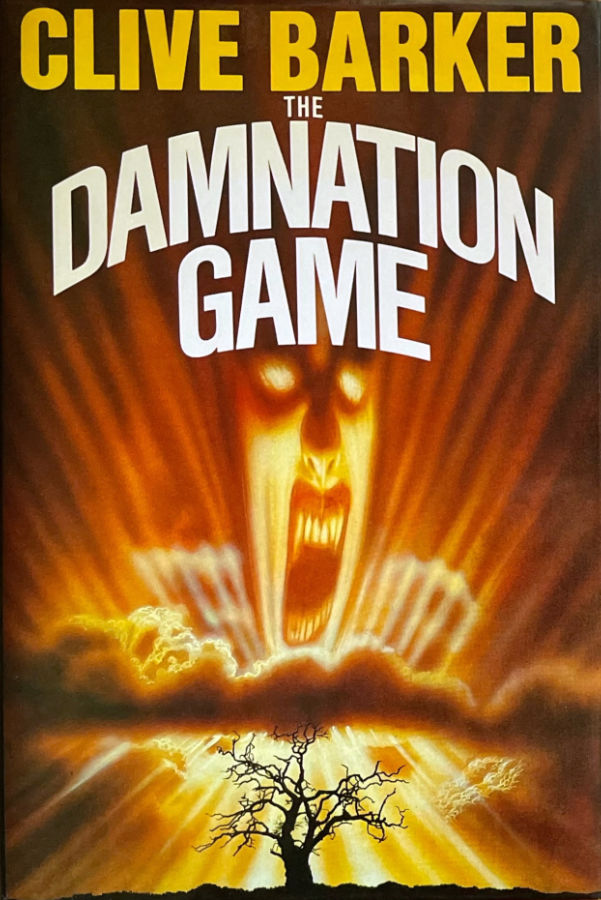
Unlike the stories in the first three Books of Blood, those collected in volumes IV to VI weren’t started as personal pieces for the delectation of Barker and his friends, but were part of a now burgeoning career as a writer — in fact, they were mostly written, according to Douglas E Winter in his 2002 biography of Barker, The Dark Fantastic, whilst Barker was also writing his first novel, The Damnation Game. All three of this second set of The Books of Blood (as well as The Damnation Game) came out in 1985. (In the UK, anyway. In the US, they were published later, in individually-titled volumes: The Inhuman Condition in 1986, In the Flesh in 1987, and, packaged with a new novella, Cabal in 1988.)

To me it feels — certainly in volumes V and VI — that Barker’s style is a lot more assured, perhaps less wild and experimental, but always peppered with moments of his particular storytelling voice. The tales are, sometimes, less bombastically fantastic than those in the first three volumes, as though Barker were deliberately concentrating on the more traditional literary elements in his arsenal: character, setting, and realism. Barker himself felt the stories were “Much denser, much richer, much more confident, much more paradoxical, and on one level, much, much more vicious.” (This quote from a 1986 interview, reproduced at CliveBarker.info.)

The Books of Blood V, art by Clive Barker

There are still some experimental-feeling stories, though unlike with the first three Books of Blood, here they’re the less successful stories, to my mind. “The Body Politic”, for instance, has the premise of a revolution in which human hands begin to seek independence from their (to them, parasitic) hosts. For a moment it feels it’s going to be a political allegory/satire, particularly when the left hand is the first to achieve this revolutionary freedom, but the right is generally acknowledged as the leader. But instead it devolves into a series of kill-scenes involving hordes of human hands skittering about like James Herbert’s Rats. I suspect Barker just isn’t a political writer. His most overtly political tale in these three books, “Babel’s Children”, is really just a joke/cynical statement about the arbitrariness and superficiality of the people who are in charge of the world, whatever their political persuasions.

Elsewhere, Barker is still trying out genres, as in the spy story “Twilight at the Towers” (which is also a werewolf story, and ends with a touch of the “tribe of monsters” theme found throughout Barker’s work, most notably in Cabal), and the hard-boiled detective yarn of “The Last Illusion” (which is also a Faustian pact tale — another Barker mainstay — with plenty of demons). Neither’s among the better stories here.

The standout, for me, is “The Forbidden”, which, like “In the Hills, the Cities” works in a sort of dreamlike way. Its story doesn’t make complete sense, but exists just to lead us closer and closer to the moment we’re presented with one of Barker’s eloquent monsters, whose eloquence encapsulates something that transcends the story’s logic.

Books of Blood VI, art by Clive Barker

“The Forbidden”’s protagonist, Helen Buchanan, is a young academic who wants to apply anthropological methods to the graffiti she finds in a rundown Liverpool estate. (Maybe the same one, Cantril Farm, as Ramsey Campbell used in The Face That Must Die?) Finding a particularly striking, almost shrine-like graffiti’d artwork, and an intriguing slogan (“Sweets to the Sweet”) that’s never particularly explained, she gets caught up with trying to trace the source of vague rumours of a violent killing, and so comes to meet the Candyman, a Barkerian figure that occupies the twilight zone between actuality and urban legend:

“I am rumour,” he sang in her ear. “It’s a blessed condition, believe me. To live in people’s dreams; to be whispered at street-corners; but not have to be.”

Did Candyman commit the killings Helen heard about? Yet the story presents these not as actual killings, but urban legends, rumours, always heard from the friend of a friend, and occurring in the next block. The implication is, then, that they didn’t occur, but instead express some potential for such things, a reaction against the extreme social breakdown of the estate where they’re supposed to have occurred. So why does Candyman then manifest and actualise them with a genuine killing (and through someone else, not by his own hooked hand), if his nature is rumour? But none of this matters once the Candyman’s there, whispering his Barkerish aphorisms in Helen’s ear. It’s a woozy, dreamlike tale, with a mood perfectly suited to the more dreamlike direction cinematic horror took in the 80s, making its 1992 adaptation Candyman perhaps the most artistically successful film based on Barker’s writing (though Hellraiser remains my favourite).

Scenes from the 1992 version of Candyman

“The Madonna” is another glimpse-of-a-monster tale, and one of the better ones in these three volumes. Here, the monster isn’t verbally eloquent, but is nevertheless pregnant with meaning — literally. Taking up the theme of monstrous births and the balance between masculine and feminine from the first three Books’ “Skins of the Fathers” and “Rawhead Rex”, here we have two men, whose relationship with the females in their lives is exploitative or at least dismissive, encountering something of a more primal female nature. Again, the tale is about the encounter, the revelation of the thing at the centre of the story’s spiral — the inward spiral towards revelation perhaps being the classic Barker story-shape — rather than the whys and what-happens-nexts.

If there’s one more tale I’d single out, it’s “The Life of Death”, and for a quite different reason. Barker had already written at least one entirely non-supernatural tale (“Dread”), but here we have a far less sensationalistic story, almost a character-piece, as we follow the never-quite-stated mood of a young woman in the days after a hysterectomy. Entering a previously-sealed crypt beneath a church that’s in the process of demolition, she comes into an entirely new relationship with death. It touches on the supernatural, but those supernatural elements can also be read as entirely metaphorical or poetic, and it’s the overall (dark) poetry of the piece that makes it such a standout.

US edition of The Books of Blood IV, released as The Inhuman Condition, art by Fred Marcellino

It was while reading this and the other less wildly fantastic pieces that I found myself wondering what made Barker’s most characteristic writing still so indubitably his. I keep wanting to call it “theatricality”, but that’s probably more down to his being a playwright, actor, and director. One part of it, though, is theatrical, or certainly showy, in its preoccupation with the idea of glitzy appearance as opposed to substance. On the one hand, Barker’s apt to underline the superficiality of something we’d initially value, as in this:

“Sunlight was a showman. It threw its brightness down with such flamboyance, eager as any tinsel-merchant to dazzle and distract. But beneath the gleaming surface it illuminated was another state; one that sunlight – ever the crowd-pleaser – conspired to conceal. It was vile and desperate, that condition.”

Or, even more direct:

“Miracles are useless. Magic is a distraction from the real concerns. It’s rhetoric. Melodrama.”

But on the other hand, with Barker, there is real magic, and real miracles, but they’re often to be found far away from the glitz and glamour, among the tawdry, the downtrodden, the grubby. (And the criminal — Barker evidently likes the air of forbiddenness and freedom that surrounds his less salubrious characters.) In “The Inhuman Condition”, for instance, a young thug called Karney takes a curiously knotted string from the pocket of a tramp he and his friends have beaten up and, fascinated by its complex knots, finds himself releasing monsters as he unpicks them — much as the puzzle-box of the Lament Configuration releases demons in Hellraiser.

In the Flesh (the US edition of The Books of Blood V), art by Fred Marcellino

The essence of Barker’s most characteristic style, though, is the way he’ll take a step back from the narrative to highlight some story moment, to bring out the archetypal nature of some character, or the elemental nature of some conflict, to recast an otherwise realistic narrative in terms of masks worn by actors and timeworn styles of drama (the love story, the longed-for tragedy, the sad comedy, the melodrama). For instance, he’ll describe a character as “a common killer, a street-corner Cain”, in a way that both disparages them and elevates them with a Biblical pedigree. And perhaps that’s where the likes of the Candyman get their story-power: they speak, knowingly, of their own roles, and they see and live in the story-world that interpenetrates the real. If this is “theatricality”, it’s the theatricality of archetypal theatre — of morality plays, Greek tragedies, Renaissance dramas, and pantomimes. It’s the bones of story, showing through.

The Dark Fantastic, by Douglas E Winter

In The Dark Fantastic, Douglas E Winter says that “Flesh is a trap” for Barker “here [in The Books of Blood] and throughout his career” — but, to me, the body is Barker’s main theme, and it’s only the untransformed flesh that’s a trap. Escape, for Barker, isn’t escape from the body, but escape into new fleshly forms and shapes. For all his talk of revelations and transcendence, for Barker, there’s nothing but the body — the transcendence he demands is fleshly transcendence, the revelations he seeks are ones of blood and nerves and muscle, not spirit and soul.

In “The Last Illusion”, for instance, when the illusionist/magician Swann dies, it’s his body — not, as in a more traditional version of the tale, his soul — that has to be protected to stop Hell from claiming it. And the ghosts in “Revelations” are, aside from being unseen by most people, just of a different degree of physicality than the rest of us. They still bear the wounds that killed them, and their interests are still interests of the flesh (i.e., physical pleasures). Hell in “In the Flesh” is a Hell of murderers being trapped in the physical locations where they performed their murders, while freedom is a return to the physical world of the living.

Which raises the question of what realms Barker is hinting at when he talks of enlightenment, transcendence, Hell and so on. It seems to me that, in these books at least, he avoids any sort of theology or system of higher worlds, invented or otherwise. (What, for instance, forces the murderers in “In the Flesh” to haunt the scenes of their crimes? If it’s a judgemental God, He’s not referred to.) It seems, rather, that Barker just wants the elbow room provided by talk of transcendence, enlightenment, Heaven and Hell, angels and demons — without having to commit to anything but the potential for these things, for a wider realm of experience than the mundane world allows.

^TOP