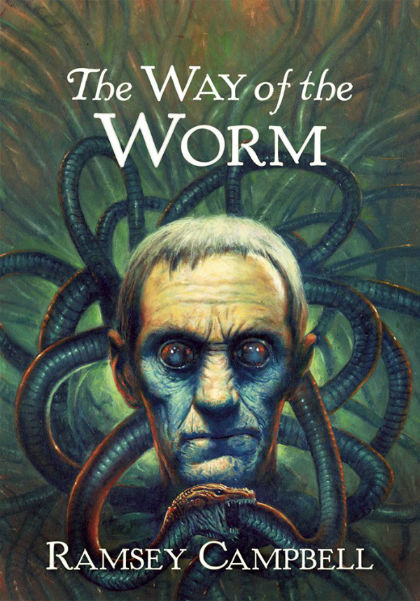
Barker began writing his Books of Blood stories at the start of the 1980s — bizarrely enough as a relief from the intense work of playwriting (his initial career being as a playwright, actor, and director of the Dog Theatre Company). They were, at first, intended only for himself and his friends, and for the sheer joy of doing something new. But later, realising he might be able to make a go of these things, he had them typed up as a 600-page manuscript and handed it to his theatrical agent, who tried Gollancz (who turned it down), then paperback publisher Sphere Books, under the misapprehension they published Stephen King. Sphere accepted, and took the unusual approach of releasing them in three volumes simultaneously (Barker had thought of the stories as one book, The Book of Blood), and putting this then-unknown author’s name as part of the title. They even used his art for the covers. Clive Barker’s Books of Blood volumes I to III came out in March 1984.
They were something different in the then-booming horror market, very much unlike its leading author, Stephen King. As Douglas Winter puts it in his biography of Barker, The Dark Fantastic:
“His stories exercised an unbridled enthusiasm for the lush and the lurid, pushing at taboos of sex and violence, yet confirmed an unparalleled ambition and audacity.”
King, though, certainly does excess — perhaps more self-consciously than Barker, in whom it feels like a natural mode — but anyway that’s not the real core of what Barker brought to the genre. As well as being explicit in terms of blood, gore, and bodies, Barker was explicit with the more philosophically religious elements in horror fiction: he wasn’t just out to shock, he was after revelation, transformation and transcendence, even if it was of a dark kind. As he’s quoted in Winter’s biography:
“The kind of horror I like drags things into daylight and says, Right. Let’s have a really good look. Does it still scare you? Does it maybe do something different to you now that you can see it more plainly — something that isn’t quite like being scared?”
 There’s a strong feeling in these stories of a highly creative talent let loose on an unexplored domain, rushing around and trying all sorts of ideas, approaches, modes and genres, squeezing them to see what juice they’ll produce in his particular hands. There are ensemble pieces and narratives focused on just the one character (even a rare first-person story), there’s realism (the non-supernatural “Dread”, about its protagonist’s philosophical education thanks to a man who believes that the only subject of any “worthwhile philosophy” is “the things we fear, because we don’t understand them”, and goes on to give practical, personalised lessons), there’s fable (“Hell’s Event”, about a once-a-century race that decides who will rule the next hundred years: Heaven or Hell), there’s something close to comedy (“The Yattering and Jack”, about a minor demon’s attempts to break the mind of a stubbornly disbelieving gherkin-importer), and something close to a love story (“Jacqueline Ess—Her Will and Testament”, in which a woman gains the ability to reshape flesh with her mind, but her attempts to learn how to use this new power from the powerful men in her life only show how shallow power is compared to passion, which is so much harder to find).
Some, for me, don’t work so well and perhaps betray the fact that Barker, though highly creative and an obviously gifted writer, was still learning his craft. “Pig Blood Blues”, about an ex-policeman newly hired to teach woodwork at a Remand Centre for Adolescent Offenders, who discovers the whole facility has taken to worshipping a seemingly possessed pig in the centre’s farm, felt to me as though it could have done with a slower pace, a longer build-up. It’s as though Barker, impatient to see where this idea would end (it’s a rare case of one his tales leaving its revelations till the end), hurried through the elements that might have turned this into a novel: character build-up, growing hints about what was happening, and so on.
 I wouldn’t be surprised to learn that “Skins of the Fathers” and “Rawhead Rex” were among the first to be written, as they’re both less satisfying in their overall story structure, while also having some of the rawest laying out of themes that I can imagine were bubbling around in this young male creator’s psyche: themes of monstrous fathers and victimised sons. In Barker’s fiction, though, that word “monstrous” can have a far different meaning to its normal, daylight, usage. In “Skins of the Fathers”, for instance, we have two types of monstrous father. There’s Eugene, who considers it his absolute right to have everything his own way, and to abuse his wife Lucy and son Aaron as much as he likes. He’s clearly monstrous, but in Barker’s world, calling him that would be an abuse of the term, because there are also, in this tale, actual monsters, and these are, it turns out, Aaron’s real fathers: ancient creatures of the desert, a varied mix of weirdly beautiful or downright incomprehensible beings who have come at last to reclaim their son and awaken him to the powers that are his birthright. I can’t help reading this story as, in some ways, a creator’s self-remaking fable, in which he disowns the traditional ideas of (as it’s put in the story) “hand-me-down machismo” (something that might have been especially important to a gay writer like Barker), in favour of something weird, marginalised, secretive and perhaps forbidden, but also magical, transformative and creative.

The 1986 film of Rawhead Rex, a zero-subtlety folk horror… But nothing says 80s fantasy like hand-animated glowing energies.
“Rawhead Rex”, on the other hand, presents us with an outright monstrous father in both meanings of the word: a child-eating monster whose only purpose is to eat, kill, destroy, and dominate, but whose one weakness is the equally archetypal image of the female as source of life. What Rawhead Rex and the monsters in “Skins of the Fathers” have in common is they’re presented as ancient creatures who father children on human mothers. In “Rawhead Rex” the subsequent pregnancies kill the mothers, but in “Skins of the Fathers” the monsters, rather than men, are women’s natural partners for generating offspring:
“Women had always existed: they had lived, a species to themselves, with the demons. But they had wanted playmates: and together they had made men… What an error, what a cataclysmic miscalculation. Within mere eons, the worst rooted out the best; the women were made slaves, the demons killed or driven underground, leaving only a few pockets of survivors.”
“Midnight Meat Train” is another story to feature a root race of non-human (or once-human) fathers. Here, the protagonist escapes becoming a victim of what seems to be one more New York City serial killer, only to find this killer had in fact been working for the city — not the government, but for the “City Fathers”, a race of ancient and perhaps once-human elders who have among them the “Father of Fathers”, the “original American”, who is most certainly not human:
“If it was like anything, it was like a shoal of fish. A thousand snouts all moving in union, budding, blossoming and withering rhythmically. It was iridescent, like mother of pearl…”
But the most general theme that links these stories — and the books Barker would go on to write, too — is the transformative effect of contact with the darkness. That contact, for Barker, is never an end-point, as it so often is in horror; it’s always a door to be opened, a curtain to be lifted, a secret to be brought into the light. From “Midnight Meat Train”:
“You shouldn’t have seen this: it’s not for the likes of you,” he said, taking another step towards Kaufman. “It’s secret.”
Which recalls my favourite line from Barker’s 1987 film Hellraiser, and one I’m sure recurs throughout his work, in many forms: “This is not for your eyes.” It’s not for your eyes, but Barker’s going to show you anyway.
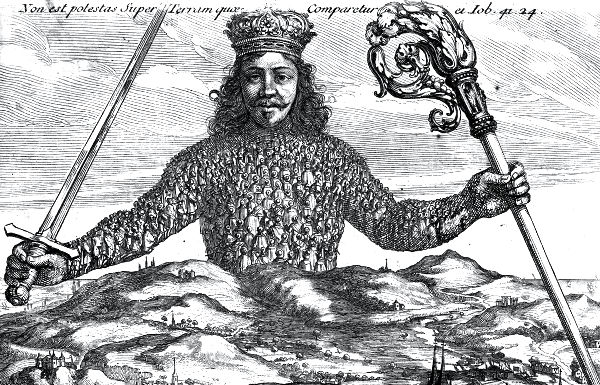
from the cover of Hobbes’ 1651 treatise, Leviathan
The one story I’ve heard most often singled out in these early Barker stories is “In the Hills, the Cities”, a weird mix of transcendent vision and tragic horror that pretty much defies categorisation. A couple of lovers, Mick and Judd, are on their first — and, they soon realise, last, because they’re just not getting on — holiday together, somewhere in Yugoslavia. Mick, it turns out, is (to Judd) a “political bore”, while Judd keeps wanting to take side-trips to obscure local churches to see their paintings. He’s not religious, he’s only interested in the paintings’ aesthetics, leading Mick to think that the “complexities, the contradictions, even the agonies that made those cultures blossom and wither were just tiresome” to Judd. Then, cutting through their petty squabbles, comes a vision straight off the cover of Hobbes’ Leviathan to not only transcend their politics-versus-aesthetics debate, but blow it out of the water.
Two towns they pass close to have a tradition. Once a year each makes itself into a single, walking giant, a carefully strapped-and-bound-together ambulant city made of people. Some people are the eyes, some are the teeth, some are the fingers, others are the muscles, the heart, the stomach. These two “cities” then do battle. It is a thing that seems to capture a sort of nobility, as one character says:
“It is the body of the state,” said Vaslav, so softly his voice was barely above a whisper, “it is the shape of our lives.”
But it is also rooted in the madness of the mob:
“Mick saw the leg raised; saw the faces of the people in the shin and ankle and foot – they were as big as he was now – all huge men chosen to take the full weight of this great creation. Many were dead. The bottom of the foot, he could see, was a jigsaw of crushed and bloody bodies, pressed to death under the weight of their fellow citizens.”
It — quite literally — embodies politics and aesthetics, transcending both into something incomprehensible, awe-inspiring, deranged and monstrous. It’s a seemingly allegorical image (as the cover of Leviathan was) but it goes so far beyond any allegorical meaning. (It’s surprising to realise that this, perhaps the most powerful image in Barker’s first three Books of Blood is not supernatural.)
I actually think that “In the Hills, the Cities” is perhaps the only example, here, of something that works despite Barker’s philosophy of “having a really good look”. Although nothing, in the end, is hidden, the reason behind all this remains obscure. Is this an image of transcendence, or of derangement? Had Barker included this image in his later fiction — and he’d soon go on to find his natural medium in doorstop-sized novels like Weaveworld — he’d have to explore its meaning, lay it bare somehow. But I think its power here lies in the way it absorbs and transcends both Mick’s politics and Judd’s aesthetics to become so much more than both, while still remaining almost screamingly incomprehensible. It reaches beyond Barker’s images of transcendence — however dark and magical — to the sublime, in all its terror and mystery, insanity and imagination.