
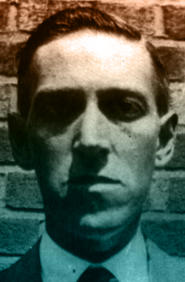
 What happens when a fantasy writer encounters one of their own creations? In a sense, this is what happened to H P Lovecraft when, in 1924, he set out for a two-year stay in New York. As related in his 1925 story “He”, his first view of the city was close to a poetic, fantastic vision, more fitting to one of his Dunsanian fantasies:
“Coming for the first time upon the town, I had seen it in the sunset from a bridge, majestic above its waters, its incredible peaks and pyramids rising flower-like and delicate from pools of violet mist to play with the flaming golden clouds and the first stars of evening. Then it had lighted up window by window above the shimmering tides where lanterns nodded and glided and deep horns bayed weird harmonies, and itself become a starry firmament of dream, redolent of faery music, and one with the marvels of Carcassonne and Samarcand and El Dorado and all glorious and half-fabulous cities.”
Lovecraft felt he was not only seeing, at last, the dream-city of so many of his own early fantasy tales, but the very muse from which they were born:
“Shortly afterward I was taken through those antique ways so dear to my fancy—narrow, curving alleys and passages where rows of red Georgian brick blinked with small-paned dormers above pillared doorways that had looked on gilded sedans and panelled coaches—and in the first flush of realisation of these long-wished things I thought I had indeed achieved such treasures as would make me in time a poet.”
He should have known what would happen next. He’d written the tale himself. In “The Quest of Iranon” (written 1921), a seemingly ageless poet quests for Aira, a never-to-be-found dream-city of endless beauty, luxury and poetry (which, like the above description of New-York-from-afar, seems made up of light and sound more than bricks and mortar):
“I remember the twilight, the moon, and soft songs, and the window where I was rocked to sleep. And through the window was the street where the golden lights came, and where the shadows danced on houses of marble. I remember the square of moonlight on the floor, that was not like any other light, and the visions that danced in the moonbeams when my mother sang to me.”
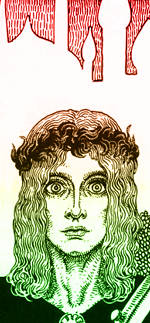
from Virgil Finlay’s illustration to “The Quest of Iranon”
But Iranon is recalling a poetic, idealised memory of his earliest life. And, just as Iranon finds a city almost but not quite matching his ideal (Oonai, whose “lights were not like those of Aira; for they were harsh and glaring”, which honours poets, though only for a time, and which also has to deal with such post-poetic realities as drunkenness, hangovers, and death), and rejects it to continue his impossible quest, Lovecraft’s narrator in “He” finds New York at first wanting, then increasingly a thing of horror — a reaction that can only be fully understood when one realises Lovecraft was not just rejecting his new home, but was being betrayed by what he’d thought of as his poetic muse. Lovecraft, perhaps, had not, deep-down, expected to interact with a physical city inhabited by fellow human beings (“I found the poets and artists to be loud-voiced pretenders whose quaintness is tinsel and whose lives are a denial of all that pure beauty which is poetry and art”), but directly with the historical and architectural beauty of the city itself, as a living, single entity, an embodiment of all his cultural ideals, not a plurality of peoples and cultures. In the end, he declares New York to be not living but dead:
“…the fact that this city of stone and stridor is not a sentient perpetuation of Old New York as London is of Old London and Paris of Old Paris, but that it is in fact quite dead, its sprawling body imperfectly embalmed and infested with queer animate things which have nothing to do with it as it was in life.”
And in a twisted nightmare vision of New York’s future, Lovecraft sees a thing of (to him) utter horror that is not only dead, but gone beyond death:
“For full three seconds I could glimpse that pandaemoniac sight, and in those seconds I saw a vista which will ever afterward torment me in dreams. I saw the heavens verminous with strange flying things, and beneath them a hellish black city of giant stone terraces with impious pyramids flung savagely to the moon, and devil-lights burning from unnumbered windows. And swarming loathsomely on aërial galleries I saw the yellow, squint-eyed people of that city, robed horribly in orange and red, and dancing insanely to the pounding of fevered kettle-drums, the clatter of obscene crotala, and the maniacal moaning of muted horns whose ceaseless dirges rose and fell undulantly like the waves of an unhallowed ocean of bitumen.
“I saw this vista, I say, and heard as with the mind’s ear the blasphemous domdaniel of cacophony which companioned it. It was the shrieking fulfilment of all the horror which that corpse-city had ever stirred in my soul, and forgetting every injunction to silence I screamed and screamed and screamed as my nerves gave way and the walls quivered about me.”
(Though, if you take the adjectives out of that future vision of New York, you find an impressive-looking city of people clearly having a good time.)
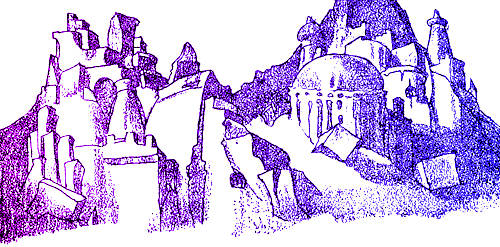
from Howard V Brown’s illustrations to At the Mountains of Madness
The symbol of the city first appears in Lovecraft’s writing around 1918, after a dream, related in a letter to Maurice W Moe, in which he saw:
“…a city of many palaces and gilded domes, lying in a hollow betwixt ranges of grey, horrible hills. There was not a soul in this vast region of stone-paved streets and marble walls and columns, and the numerous statues in the public places were of strange bearded men in robes…”
This becomes the city of Olathoë in the story “Polaris”, whose narrator enters a dream trance and travels back to a former life, 26,000 years past, where a lapse into sleep while on guard duty allows hordes of barbarians to overrun this far-north city. The main human impulse behind the story is the guilt the narrator still feels at this lapse, even though Olathoë has been lying under polar ice for millennia, and has long become like the nameless ruined city of Lovecraft’s prose-poem “Memory” (from 1919), whose name and inhabitants are all but forgotten (“These beings of yesterday were called Man.”). In a 1919 poem called simply “The City”, Lovecraft spells out exactly what the dream-symbol of the city meant to him:
It was golden and splendid,
That City of light;
A vision suspended
In deeps of the night;
A region of wonder and glory, whose temples were marble and white.
The city, then, is an island of light (culture, civilisation, and rational enlightenment) amidst cosmic darkness. Crucially, this poetic city appears to its poet in — and as a balm to — a “mad time of unreason”.
But there’s another city, an ab-city or anti-city, that appears in Lovecraft’s fiction alongside this ideal. And if the dream-city is a sunlit, living thing, a bastion of civilisation, the anti-city is a moonlit, undead thing, home to aliens, inhumans or subhumans: it’s “The Nameless City” (“I was travelling in a parched and terrible valley under the moon, and afar I saw it protruding uncannily above the sands as parts of a corpse may protrude from an ill-made grave…”), the ruined city populated by white apes in “Facts Concerning the Late Arthur Jermyn and His Family”, the undersea city of “The Temple”, and the ghost-city of “The Moon-Bog”.
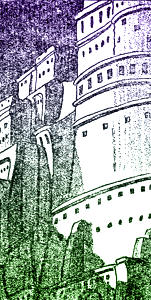
Henry Brown, At the Mountains of Madness
Perhaps the most explicit clash between these two types of city is in the 1919 story “The Doom that Came to Sarnath”, where Sarnath (the “wonder of the world and the pride of all mankind”) is contrasted with Ib (populated by inhuman creatures from the moon, and “terrible with great antiquity”). The people of Sarnath destroy Ib simply through disgust at its inhuman inhabitants. The one thing they save is a stone idol of Bokrug, the water-lizard, “as a symbol of conquest over the old gods and beings of Ib” — a symbol of the triumph of the human over the inhuman, the rational over the irrational. The people of Sarnath practice a “very ancient and secret rite in detestation of Bokrug”, as though part of their very identity is this conquest of the inhuman creatures and their ancient culture. But that ancient culture is not dead; it rises again to destroy what once destroyed it, leaving desolation in its wake. So the two cities’ roles are defined: the ideal dream-city represents civilisation and the conquest of the anti-city, with its inhuman or barbarous inhabitants; but the dream-city can’t help but wonder at the weirdness of the anti-city’s idols and artwork (studying the artwork of an anti-city is a key part of Lovecraft’s stories, from “The Nameless City” to At the Mountains of Madness), and defines itself thereafter by its difference from, and conquest of, the inhuman, all the time failing to realise that without that repressed, supposedly inhuman shadow side, it is doomed. (Even, “DOOMED”.)
In the real world, though, cities aren’t embodied ideals, but meeting places, characterised by the clash and coexistence of cultures, not Lovecraft’s ideal of cultural purity. Upon leaving New York, his poetic reaction became even more polarised. On the one hand, he exaggerated his vision of the “corpse-city” of future New York into the “nightmare corpse-city” of R’lyeh, a slimy, sea-risen, non-Euclidean muse of horror, its populace reduced from “swarming loathsomely… yellow, squint-eyed people” to a single, ultra-terrestrial, tentacled entity with a deliberately unpronounceable name. And on the other hand, there’s the long retreat into the self-comforting Dream-Quest of Unknown Kadath, a narrative whose very length seems driven by a desire to linger in the regions of the unreal, to heal the poetic soul in quest of a type of city Lovecraft (like Iranon) desperately needed to believe in once more. And he finds it, with an emotional reaction more fitting to the welcome of a long-lost love:
“…as Carter stood breathless and expectant on that balustraded parapet there swept up to him the poignancy and suspense of almost-vanished memory, the pain of lost things, and the maddening need to place again what once had been an awesome and momentous place.”
Lovecraft has, at last, found a safe haven to lodge his dream-city. Not in far, ancient climes where barbarous forces can get at it, nor in the present day, where reality’s grubby, verminous hands will sully it, but in the near-but-untouchable past of his own childhood memory, accessible only to him, by going inwards to regions the real world can’t touch:
“…your gold and marble city of wonder is only the sum of what you have seen and loved in youth. It is the glory of Boston’s hillside roofs and western windows aflame with sunset; of the flower-fragrant Common and the great dome on the hill and the tangle of gables and chimneys in the violet valley where the many-bridged Charles flows drowsily.”
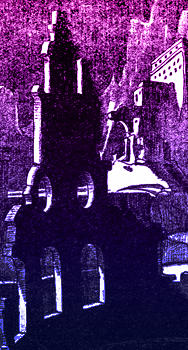
Henry Brown, At the Mountains of Madness
Lovecraft set his next major piece of fiction, The Case of Charles Dexter Ward, in his own equivalent of Randolph Carter’s Boston, Providence, liberally peppering the narrative with the actual history of this real city, to make the fantastic that much more convincing, and also perhaps to dwell in the healing balms of a home deep-rooted in familiar architecture and real history. After this, Lovecraft left cities for a while, his next few stories being set in wild, rural regions (“The Colour Out of Space”, “The Dunwich Horror”, “The Whisperer in Darkness”). But in At the Mountains of Madness and “The Shadow Out of Time”, Lovecraft’s dream-cities and anti-cities make an interesting return. Now Lovecraft’s vision has matured, and he’s ready (bolstered, perhaps, by not having to face the harsh truths of New York anymore) to reassess that moment of vertiginous, dark-poetic horror that was the vision of a real human city. Now, he has his narrators visit ancient, inhuman, but nevertheless highly rational cities, as though he were trying to reconcile his polarised poetic symbol into a new, single entity. The length of the stories means his narrators have time to overcome their initial horror at the alienness of the inhabitants, to look at the wall-decorations and learn something of the history of these inhuman creatures till they can find value in their culture and ideals (“Radiates, vegetables, monstrosities, star-spawn—whatever they had been, they were men!”).
But there’s still horror. Beyond the “Radiates, vegetables, monstrosities, star-spawn” are the protoplasmic Shoggoths, and, in “The Shadow Out of Time”, “a horrible elder race of half-polypous, utterly alien entities”. These horrors-beyond-the-horrors dwell beneath their respective cities, in the darkness of abyssal un-cities, full of eerie sounds, screaming winds and gelatinous mutability. This has always been Lovecraft’s ultimate vision of horror — not things which can be identified, but things which have no identity, things which change identity, things which don’t belong to the universe of “identity” at all, but which obey other, non-materialistic laws. Crucially, they are also things which can infect and degrade one’s own identity, threatening not just Lovecraft’s heroes’ physical existence, but their psychology and humanity:
“Sense of distance gone—far is near and near is far. No light—no glass—see that steeple—that tower—window—can hear—Roderick Usher—am mad or going mad—the thing is stirring and fumbling in the tower—I am it and it is I—I want to get out . . . must get out and unify the forces. . . . It knows where I am. . .” (from “The Haunter of the Dark”)
Lovecraft’s career as a writer is marked by two factors: a harshly polarising filter that split his world into regions of what is acceptable and what is horrific; and an endless, needling quest to dive into the borderland between those two vastly separated regions, to better define exactly what it is he’s so afraid of. Lovecraft’s fiction is all about the combined need to know, and the horror of what will be known. If he’d lived longer, and continued to write, I think he’d have continued to progress in this direction, refining his dark poetry, and breaking down the barriers between what he feared and what he, in the real world, was forced to experience. But we can’t know. One thing for sure, though, is that New York did live up to its promise: it made H P Lovecraft a poet, just not the sort he expected to be.


![the-last-revelation-of-gla-aki-jhc-by-ramsey-campbell-out-of-print--[3]-2057-p](https://www.murrayewing.co.uk/mewsings/wp-content/uploads/2015/12/the-last-revelation-of-gla-aki-jhc-by-ramsey-campbell-out-of-print-3-2057-p-1.jpg)


