The Insanity of Jones and other tales by Algernon Blackwood

Algernon Blackwood, photo by Douglas

Algernon Blackwood, photo by Douglas

Of all those early-20th century weird writers (Arthur Machen, M R James, Lord Dunsany, H P Lovecraft, Clark Ashton Smith), Algernon Blackwood seems the most difficult to really know. Reading Lovecraft — the very type of the weird writer — you can’t help being aware that HPL has a definite idea of what a weird tale should be, and that he’s doing his best to capture it in form, content, style and idea, honing his approach tale by tale, in theory and in practice. Blackwood doesn’t seem to have an aesthetic ideal; his fiction is an outpouring of all sorts of stories and styles, ghostly, adventurous, romantic, comedic. (Lovecraft himself calls Blackwood’s work “voluminous and uneven”, though says it contains “some of the finest spectral literature of this or any age”.) He does though, like Lovecraft, have a central belief that acts as the DNA that shapes and unites all his fiction — “an interest in the Extension of Human Faculty”, as he puts it — but it seems to me that, in contrast to Lovecraft’s fiction, where the best tales are usually those that most embody Lovecraft’s stated ideals, those where Blackwood most explicitly captures his views on “extended or expanded consciousness” are usually the least successful as fiction. Fortunately, Blackwood has another force driving the production of his stories, and it’s where this is most evident that he’s at his best.

In his introduction to The Insanity of Jones and other tales — a selection of his fiction written between 1906 and 1910 —  Blackwood says:

“I recall, anyhow, that these tales poured from me spontaneously, as though a tap were turned on, and I have often since leaned to the suggestion that many of them derived from buried, unresolved shocks… These ‘shocks’ had come to an exceptionally ignorant youth of twenty who had drifted into the life of a newspaper reporter in New York after a disastrous cattle-farm and a hotel in Canada, and the drifting had included the stress of extreme poverty and starvation… the New York experiences in a world of crime and vice had bruised and bludgeoned a sensitive nature that swallowed the horrors without being able to digest them, and… the seeds thus sown, dormant and unresolved in the subconscious, possibly emerged later — and, since the subconscious always dramatises, emerged in story form.”

The best of the tales in this book are those most obviously rooted in real experience and vividly-created, authentic-feeling settings. The weird desolation of the wilds of the Danube in “The Willows”, and the truly vast and primal wilderness of Canada in “The Wendigo” are two obvious ones, but Blackwood isn’t only a wilderness man. The Insanity of Jones and other tales by Algernon BlackwoodThe New York of “Max Hensig”, with its evocation of the alcohol-sodden, sleep-deprived world of city reporters is just as convincing — and gripping — an environment. Elsewhere, although Blackwood can be poetic (as in, say, “The Dance of Death”, or “The Old Man of Dreams”, which mostly work because they’re short), the difference begins to tell in those stories written purely as stories rather than outpourings of genuine experience (“Miss Slumbubble”, in which an overly-anxious woman finds herself trapped in a haunted train carriage, or “The Insanity of Jones”, where a young clerk is given the chance to enact a karma-free revenge on a man who tortured him to death in a previous life) are the least substantial, and least convincing.

The key (with all weird writers, I suspect, particularly those who have a philosophy to expound) is mystery. Whatever a writer’s beliefs, while they’re conjuring the mystery — the awe, the fear, the terror, the wonder — they include us all, but as soon as the explanation arrives, the portcullis clangs down. The perfect example is Blackwood’s “May Day Eye”, which starts as a vivid evocation of the borderline panic of being lost in a mile or two of English countryside as dark descends — then, suddenly it’s all technical talk of “elementals”, and it’s not convincing. The point at which this tale changes is where the narrator meets with an expert on folklore who has all the necessary explanations. Such a mouthpiece character doesn’t always appear in Blackwood’s fiction, but when he does, he usually spoils it, for me. The most obvious example is the “psychic detective” John Silence (if only he would be silent), one of whose tales, “The Camp of the Dog” is in this book. John Silence is absent for much of the tale, and before he comes we get — again — a great evocation of an environment, in this case a vast collection of tiny islands north of Stockholm, and a growing tension between the small group of campers holidaying there, a tension taking a dangerously lycanthropic turn. Then John Silence arrives and talks all about “vital forces”, “the Subtle Body” and all things “fluidic”, and puts a dampener on what was building up to be a rather hothouse tale of teenage lust at odds with civilised values.

But when Blackwood’s good, he can be very good, and he’s good when his tales are backed up by a solid grounding in real places and situations. In “Max Hensig”, the New York reporter, Williams, gets to interview a psychopathic doctor on trial for the poisoning of his second wife. defagoWilliams is convinced Hensig is dangerous, and writes so in the papers, but Hensig — who is clearly a psychopath, and is openly contemptuous of so unimaginative a way of killing someone as poison — is released, and then Williams knows Hensig is after him. The interviews, with Williams one side of the prison bars and Hensig the other, feel like Hannibal Lecter territory, and when we know Hensig is on the loose once more, hard-drinking Williams’ descent into near-nervous collapse is as thick and sticky as an alcoholic sweat.
But the best tale in the book, for me, is “The Wendigo”. (“The Willows” is here, too, but I think that, despite Lovecraft’s endorsement, it has to take third place after “The Wendigo” and “Max Hensig”.) For a start, the environment is wonderfully realised:

“In front… lay the stretch of Fifty Island Water, a crescent-shaped lake some fifteen miles across from tip to tip, and perhaps five miles across where they were camped. A sky of rose and saffron, more clear than any atmosphere Simpson had ever known, still dropped its pale streaming fires across the waves, where the islands — a hundred, surely, rather than fifty — floated like the fairy barques of some enchanted fleet. Fringed with pines, whose crests fingered most delicately the sky, they almost seemed to move upwards as the light faded — about to weigh anchor and navigate the pathways of the heavens instead of the currents of their native and desolate lake.”

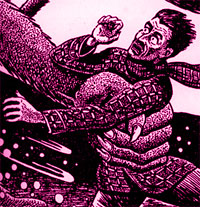
Then there’s the supernatural element itself. Simpson’s hunter-guide Défago is snatched from the very mouth of his tent by the Wendigo — snatched and carried off to race through the woods, then up into the skies, where his cries about his “burning feet of fire” echo down to the terrified Simpson. wendigoBut this isn’t all. Out of sheer boldness, Blackwood has Défago return after several days’ absence for an hour or two — or is it Défago? The thing looks like him, but that likeness could be “a mask that was on the verge of dropping off, and… underneath they would discover something black and diabolical revealed in utter nakedness.” Défago’s comrade Hank shouts that this isn’t Défago, and the thing disappears as mysteriously as it came… Then, later, we find Défago again, only this time, we’re told, it’s the real man, one utterly frostbitten, exhausted, and empty-minded. And so, is the Wendigo an actual creature? Is it a supernatural entity? Or is it a metaphor for “that other aspect of the wilderness: the indifference to human life, the merciless spirit of desolation which took no note of man”? Blackwood — as caught up in the rush of his tale as Défago is in the Wendigo’s grip — doesn’t answer, but lets the mystery remain:

“Out there, in the heart of unreclaimed wilderness, they had surely witnessed something crudely and essentially primitive. Something that had survived somehow the advance of humanity had emerged terrifically, betraying a scale of life monstrous and immature. He envisaged it rather as a glimpse into prehistoric ages, when superstitions, gigantic and uncouth, still oppressed the hearts of men; when the forces of nature were still untamed, the Powers that may have haunted a primeval universe not yet withdrawn.”

A glimpse — this is what a great weird tale should be, not an explanation. And it’s when Blackwood keeps his tales to that glimpse that he most succeeds.
^TOP

Jirel of Joiry by C L Moore

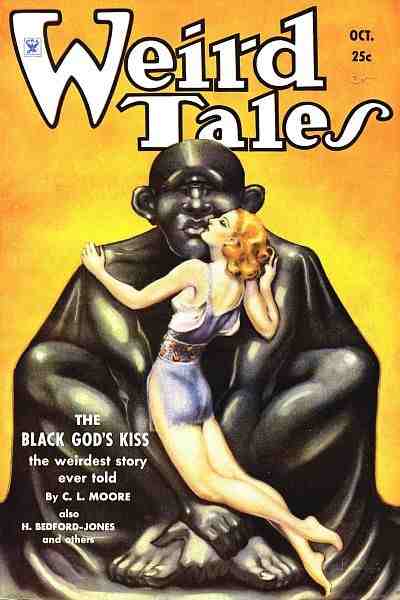
Catherine Lucille Moore wrote six tales featuring her sorcery-fighting swordsmistress Jirel of Joiry, published in Weird Tales between October 1934 (“Black God’s Kiss”) and April 1939 (“Hellsgarde”). The second, “Black God’s Shadow”, appeared in the December 1934 issue alongside Robert E Howard’s “A Witch Shall Be Born”, the story in which a crucified Conan bites back at a vulture.

Weird Tales, October 1934

Margaret Brundage cover to Weird Tales, showing Jirel of Joiry and the Black God

Impetuous, fearless and undaunted by danger, Jirel shares many characteristics with her sword and sorcery stablemate, but her stories are nothing like Conan’s. In each adventure, having been set up as a dynamic “female warrior queen and spitfire of the fifteenth century” (as Sam Moskowitz puts it), Jirel is usually plunged straight into the sort of situation where her physical prowess and combat skills count for nothing. The classic Jirel of Joiry tale, after a brief and deftly sketched actionful introduction, has her being transported to another realm, usually a highly surreal one, where magic and dream-logic replace the straightforward adventure-style jinx you expect from sword & sorcery. This makes Jirel something of a puzzle. Whereas Conan cuts through the pretensions (and the major arteries) of sorcerers, priests and eldritch things with brute force and barbaric common sense, the situations Jirel finds herself in can usually only be solved by fighting fire with fire — by finding some ally, or some weapon, as magically powerful and dangerous as the opponent she’s facing. This means her adventures can feel somewhat arbitrary, bookended as they are by magics that both get her into a fix and out of it. But it’s between these points Jirel’s real heroism comes to the fore, and it’s heroism of a strange sort, though one she shares with most 20th century pulp-style heroes from Conan to James Bond. Although, when you think of, say, Conan or Bond as heroes, you think of their way with a sword, a gun, or a fist, or their general ability at taking down a villain, the point at which these pulpsters really prove their heroism is usually a moment in which they’re being helplessly tortured or tormented — think of Conan nailed to that cross in “A Witch Shall Be Born”, or Bond making his way through Dr No’s torturous and tortuous obstacle course on his way to a date with a giant squid (or the line everyone remembers from Goldfinger: “No, Mr Bond, I expect you to die!”). Moore seems to have refined this moment to make it the centrepiece — almost the entire tale, in fact — of her Jirel stories. As Moorcock & Cawthorn put it in Fantasy: The 100 Best Books:

“C. L. Moore excels in the evocation of a pervasive, miasmic atmosphere of evil. This is achieved to a great degree by her descriptions of the distress and degradation evinced by its victims…”

Jirel of Joiry“Black God’s Kiss” starts breathlessly, with Jirel of Joiry already captured and being brought before her gloating conqueror Guillaume, who has just seized control of Castle Joiry. Delighted to find Joiry’s commander is a woman, he forces a kiss, then has her sent to a dungeon. Jirel, fired up with the need for revenge, travels to another dimension to find a means of getting her own back. Fortunately, Castle Joiry has a House on the Borderland-style trapdoor in its lowest cellar, a strange corkscrew helter-skelter passage to a black-lit world of nightmare visions. The bulk of the story is Jirel’s combined horror and awe as she crosses this land in search of a weapon to revenge herself on Guillaume. She witnesses a stream of weird and frightening sights, but at no point is she required to do anything but witness them:

“Half-way across, she saw one of the white blotches approaching her with slow, erratic movements. It bumped along unevenly, and at first she thought it might be inanimate, its approach was so indirect and purposeless. Then it blundered nearer, with that queer bumpy gait, making sucking noises in the ooze and splashing as it came. In the starlight she saw suddenly what it was, and for an instant her heart paused and sickness rose overwhelmingly in her throat. It was a woman — a beautiful woman whose white bare body had the curves and loveliness of some marble statue. She was crouching like a frog, and as Jirel watched in stupefaction she straightened her legs abruptly and leaped as a frog leaps, only more clumsily, falling forward into the ooze a little distance beyond the watching woman. She did not seem to see Jirel. The mud-spattered face was blank. She blundered on through the mud in awkward leaps…”

This realm Jirel has slipped into seems rather Freudian — that degraded woman hopping frog-like through a swamp could be an image of Jirel’s shame at Guillaume’s treatment, but also a sort of reversed fairy tale transformation, with the dark anti-prince kissing our human heroine and turning her into a frog.

Jirel of Joiry by C L Moore, Stephen Hickman cover

Jirel of Joiry by C L Moore, Stephen Hickman cover

Jirel travels to the centre of this weird realm, and finds a one-eyed statue of the Black God. Kissing it (as she feels compelled to do), she feels “something cold and stunning; something alien beyond any words” enter her. Returning to her own world, she repays her degradation by passing Guillaume the “dreadful, cold bleakness” of the Black God’s kiss — and then, in a very un-Conan-like twist, realises too late that beneath the humiliation and anger she felt attracted to this powerful man. The second tale, “Black God’s Shadow”, sees her trying to right this wrong, and returning to that weirdly black-lit world to free the dead Guillaume.

My main reaction to the Jirel stories is to find them, on the one hand, genuinely weird and wildly imaginative, and on the other, turgid with so many internalised battles with fiercely-felt but abstract emotional tussles, that they were a combination of fantastic thrills and solid drudgery to read. It’s perhaps unfair to quote a sample passage out of context, but this is the sort of thing I mean, when Jirel finds the statue of the Black God:

“Gradually the universal focusing of lines began to exert its influence upon her. She took a hesitant step forward without realising the motion. But that step was all the dormant urge within her needed. With her one motion forward the compulsion closed down upon her with whirlwind impetuosity. Helplessly she felt herself advancing, helplessly with one small, sane portion of her mind she realised the madness that was gripping her, the blind, irresistible urge to do what every visible line in the temple’s construction was made to compel…”

The passion behind even these abstract passages is undoubtable, but it can also feel so much like wading through mud, at times, having to read through so much deeply felt but abstract prose. Sam Moskowitz puts it best, I think, in his chapter on Moore in Seekers of Tomorrow:

“The climax of each story found Northwest Smith [Moore’s other series hero] or Jirel of Joiry in the formless haze of spiritual battle with the unknown. The plot situations were rarely solved by a logical sequence of events, but instead by a burst of rhetorical hypnotism.”

A young C L Moore, from the Teller of Weird Tales blog

A young C L Moore, from the Tellers of Weird Tales blog

Jirel’s adventures feel shamanic. She passes from this world to another, to face some magical evil in a world where none of the logic of this one applies — and so none of the usual action-story resolutions can be applied, either. Perhaps it’s wrong-footing to think of them as sword & sorcery because, although the Jirel of Joiry tales do include swords and sorcery, the swords and the sorcery almost never meet. In fact, the thing the Jirel stories remind me of most are fever dreams — something I thought of only when I read that, when she was young, Moore suffered from ill-health and had to spend a lot of time bed-bound, which is where she developed her love of imaginative stories.

It’s the flashes of (often horrific) imagination for which I’ll remember these tales — as at the beginning of perhaps the best of them, “Hellsgarde”, where Jirel approaches a mist-shrouded castle, expecting it to be abandoned, and finds herself confronted with a small troop of motionless soldiers. Then she realises: the guards are dead, propped into a standing position by having their own spears driven through their throats. She rides gently between them, then:

“Was that motion among the ghastly guard? Her heart leaped to her throat and she gripped the saddle between nervous knees with a sudden reflex action that made the horse shudder. For one of the men in the row before her was slipping silently toward the flagstones. Had the spear-butt slid on the bloody tiles? Had a breeze dislodged his precarious balance? There was no breeze. But with a curious little sigh from collapsing lungs he folded gently downward to his knees, to his side, to a flattened proneness on the stones. And a dark stream of blood trickled from his mouth to snake across the pavement as he lay there… Only in a nightmare could such things happen.”

Only in a nightmare, or in the stories of C L Moore.

^TOP

The Thing

Who goes there? The Thing! Four of them, in fact.

Who Goes There by John W Campbell JrThe original novella that inspired the three film versions (1951, 1982 and 2011) was “Who Goes There?” by John W. Campbell Jr (published as by Don A. Stuart, in Astounding Science-Fiction, August 1938). It has one of the best origin stories of any piece of fiction. Campbell’s mother was one of a pair of identical twins, and apparently his aunt resented the fact that her sister had married first, and that she had a child. To make things worse, Campbell’s mother would deliberately goad her sister when she visited by doting on John Jr — and the aunt would be correspondingly cold. As Sam Moskowitz writes in Seekers of Tomorrow:

“This created a bizarre situation. The boy would come running into the house to impart something breathlessly to a woman he thought was his mother. He would be jarred by a curt rebuff from her twin. Each time his aunt visited the home, this situation posed itself until it became a continuing and insoluble nightmare. Was the woman standing in front of him friend or “foe”?”

Perhaps it all sounds a little too plausible — could young John Jr really not tell his aunt from his mother, if nothing else by their clothes or hair style? But other details about his home life perhaps add to an explanation for the atmosphere of claustrophobic mistrust found in “Who Goes There?” and its adaptations. John Jr’s father, apparently:

“…carried impersonality and theoretical objectivity in family matters to the brink of fetish. He almost never used the pronoun “I”. All statements were in the third person: “It is necessary,” “One must,” “It appears that,” “One should.” Not only was he an authoritarian in his own home but a self-righteous disciplinarian as well, who put obedience high on the list of filial duties. Affection was not in his make-up, and if he felt any for the boy he managed to repress it.”

And, even when the aunt wasn’t present:

“The mother’s changeability baffled and frustrated the youngster. Self-centred, flighty, moody, she was unpredictable from moment to moment. While she was not deliberately cruel, her gestures of warmth appeared to him so transitory and contrived as to be quickly discounted.”

The essence of “Who Goes There?” is an intellectual problem: caught in a remote Antarctic base with a hostile, shape-changing alien, how do you tell who’s an alien and who isn’t? But around this science-fictional core is a deeper question that comes more to the fore in the film versions: who can you trust?

Kinner shuddered violently. “Hey. Hey, Mac. Mac, would I know if I was a monster? Would I know if the monster had already got me? Oh, Lord, I may be a monster already.”

“You’d know,” McReady answered.

“But we wouldn’t.” Norris laughed shortly, half hysterically.

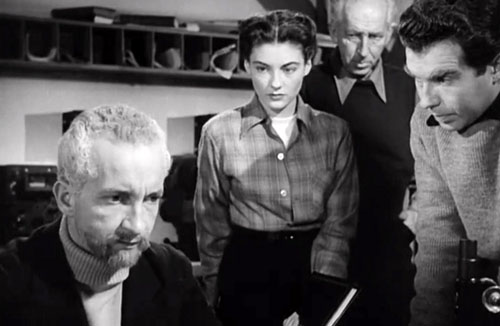
The Thing (1951) Dr Carrington

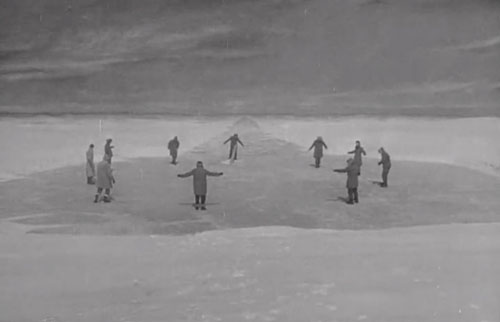
The first adaptation, The Thing From Another World, came out in 1951, and, despite being widely praised as a classic SF film of its era, is a world apart from the original novella. (Quite literally — it takes place at the North Pole rather than the South.) Here, the core of the story isn’t how-do-you-tell-who’s-an-alien, because this version’s creature isn’t a shape-changer. The Thing From Another World uses its alien to be what most 1950s Hollywood aliens were — something strange, something not-human, something plainly other, with not much need to go into why or to what degree. (1951 also saw the release of The Day The Earth Stood Still, so not all Hollywood aliens were evil.) This Thing is a Thing because it’s not an animal but a vegetable, a “super-carrot”, though one that scientist Dr Carrington claims will be so much more intelligent and (oddly) “wiser” than the humans. The real enemy in the film is Carrington himself, the obsessed scientist for whom “knowledge is more important than life.” This film’s answer to the question, “Who can you trust?” then, is: not the scientists, they invented the atom bomb. No, in Howard Hawks’ film the people you can trust are war-toughened men (and a woman who has proved she can drink harder than the toughest of the men). This was, after all, close enough to the end of WWII that the world was full of people who had proven themselves in the recent conflict, a world where even the reporter who comes to the North Pole base in search of a story can’t be entirely dismissed as a pencil-squeezing wuss, because he’s seen action, too (though he does faint at one point). The final message of the film is entirely outward-directed: “Watch the skies!” The enemy is out there, not in here. (Invasion of the Body Snatchers was a mere, but perhaps significant, five years away.) The film’s best moment — and its most cinematic — is when the party that’s gone out to examine a magnetic anomaly (which has only just appeared, rather than, as in the other versions, having been there for hundreds of thousands of years) spread out to determine the shape of what they find buried in the ice. Forming a circle, there’s no need to say anything other than: “We finally got one!” Flying saucers were enough part of the culture, they didn’t need to be named.

The Thing (1951) UFO

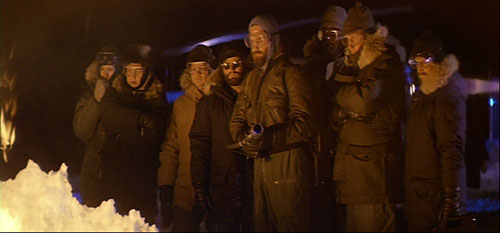
The best version of Campbell’s story, for me, is John Carpenter’s, from 1982. Its main innovation is to have the story occur as a sequel to the action that drove the initial novella: other people, in a nearby Norwegian camp, discovered, dug up, and defrosted the alien; our heroes just get caught up in the aftermath. Here we have no over-obsessed scientist types, only ordinary Joes trying to get by in a harsh world. In many of his films, Carpenter presents us with both a nihilistic, hostile world and a hard-bitten loner hero who’s the perfect answer to that world. The people in this Antarctic base are the most human of all four versions of The Thing — before the alien action even starts, they’re getting on each other’s nerves. McReady (the Kurt Russell character) is, for some reason, living in his own hut disconnected from the main base, but despite being a cynical loner, he’s the one everyone turns to when things get in a fix. (Even the base’s captain, Garry, whom nobody trusts with a weapon, feels the need to justify himself to McReady, showing that he, too, defers to the loner-hero.) This, then, is John Carpenter’s answer to “Who can you trust?”: hard-bitten loner-types. They’re the only sort that can deal with a world in which, any moment, one of your fellows might suddenly turn into a thing, all mouth and tentacles, that wants to digest and replace you. They’re hardened against such a nihilistic world, because they don’t believe in anything anymore.

The Thing (1982) - McReady

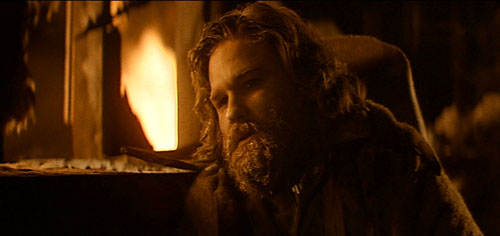
The other key character — here, and in Campbell’s novella — is Blair. He’s the one who grasps the implications of the situation before anyone else. Realising an alien monster that can take human form will not only be impossible to find, but will, if it reaches human society, rapidly wipe out the human race, his response is twofold: one, he destroys the radios and means of escape, and two, he goes insane.

The Thing (1982) Blair

This, surprisingly, is straight from “Who Goes There?” One of the remarkable things about Campbell’s novella is just how modern it feels, especially compared to the sharply divided heroes and villains of the 1951 film. Campbell’s characters are — though glimpsed through very cut-back prose that focuses on speech and action, not feelings — edgy, nervous, and some of them go insane from the pressure. “Who Goes There?” contains the most shocking moment in all of four versions of The Thing, as far as I’m concerned: when Kenner, the cook, learns that the cows he milked only an hour ago were probably alien duplicates, he goes hysterical. Locked up in the kitchen, he bothers the others with his screaming and prayers so much that someone slips out and murders him. Not because they think he’s an alien, but because he’s getting on their nerves. That, as far as I’m concerned, is the most extreme picture of human beings under pressure in any of the four versions, but Campbell doesn’t dwell too much on the morality of this action — particularly as it turns out Kenner had been taken over anyway, so it wasn’t, technically, murder. (Campbell’s novella has a few jarring moments when the action is skipped over — to emphasise its suddenness — and we get nothing but the aftermath. It’s a hard-boiled style, one that leaves you to work out a lot of implications for yourself, and sometimes, either because of its style or the period it was written in, I found myself unsure of exactly what had happened and what was being implied.)

The Thing (2011)

The Thing from 2011 is presented as a prequel to the 1982 film, ending where Carpenter’s began, with two Norwegians in a helicopter chasing a dog through the snow. But in terms of the human situation, we take a bit of a step backwards to the 1951 film — before the alien lets loose, everyone on the base is being polite to each other, apart from one, the arrogant scientist. (And maybe one other — the lukewarm boyfriend-type who too quickly gives way to the arrogant scientist, his boss, rather than backing up the heroine.) Dr Halvorson says, “As scientists, we are obliged to study,” but he’s just impatient to get past everyone’s fine sensibilities about the fact that one of them has just been eaten by the Thing, so he can dissect it. When they open it up and find their colleague’s remains, he says, “It’s fascinating.” Then, defiantly: “It is fascinating.” It’s a good remake, but it lacks the deep-down, rough-edged tetchiness, claustrophobia and nihilism of Carpenter’s.

The Thing (1982)

The Thing, in its various incarnations, works as a story through the reaction the alien evokes in the humans faced with it — will they group together, or split apart? All four are most different in their endings. Campbell’s original novella has the scientists frustrated that, in ridding themselves of the alien, they’ve lost out on learning about its technology (it had just managed to build itself an anti-gravity flying device and a small, nuclear-powered generator), while thanking God it had crashed so far from human civilisation; the 1951 film ends with a reminder of who the real enemy is (“Watch the skies!”) with an implied, “And let’s keep tabs on those scientific-types, too”; the 1982 film is the most nihilistic, but also the most heroic, its two survivors, unsure if either of them is an alien, prepared to drink away their last living moments in a hostile, very much God-less world; the 2011 film, having added the least to the idea, has the least characteristic ending.

The Thing (1982) titles

Alien owes a lot to “Who Goes There?” (not least because Campbell’s story inspired A E Van Vogt to write SF, and his Voyage of the Space Beagle is sometimes cited as an influence on Alien), but also, more specifically, to The Thing From Another World: not only is Dr Carrington very much like the Company android Ash, in that he wants to save this creature that he admires far more than his human compatriots, but also in the way that a Geiger counter is used to detect the alien’s presence, just like the motion detectors in Alien and (far more) Aliens. Carpenter’s The Thing probably owes its existence to Alien’s success, though oddly it wasn’t a huge success itself. Still, to me, it’s the best of the “Who Goes There?” bunch, with John Campbell Jr’s novella a close second.

(And, as an alternative take on the story, there’s Escape Pod’s reading of Peter Watts’ “The Things” — the events of the 1982 film, from the alien’s point of view.)

^TOP