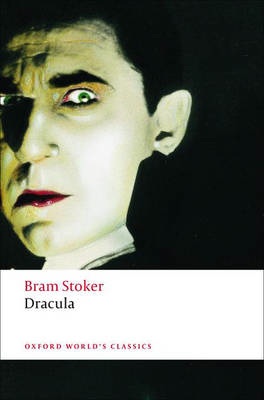
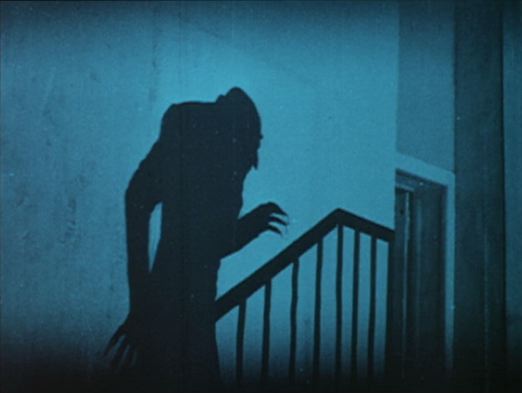
I’m re-reading Dracula at the moment, a book I’ve come to like more and more, despite vampires being a bit over-exposed at the moment, culturally speaking. Stoker always surprises me by being so much better than the Sunday writer it’s tempting to think of him as, because Dracula was his only success, and writing wasn’t his main occupation. There are occasional clunky moments, such as his always having to justify (never entirely convincingly) the plague of journal-keeping (and intimate journal-swapping) that overtakes the denizens of London at the same time as the plague of vampirism, but whenever he writes of the dreadful Count, Stoker is possessed of a real inspiration for the power and weirdness of his central creation. There’s a genuine sense of how wily and dangerous the Count is, having not only survived centuries, but having managed to retain what Van Helsing calls a “child-brain” at the same time: an ability to keep learning, to keep experimenting with the limits of his supernatural powers, and to negotiate them with a changing, modern world. There are also flashes of really weird and wonderful surprise, such as when Jonathan Harker slashes the Count with a Kukri knife and not blood but pound notes and gold sovereigns gush forth, something which seems both shocking, funny and peculiarly meaningful all at once.

Francis Ford Coppola’s Bram Stoker’s Dracula‘s Tom Waits’ Renfield
However much I like the Count, though, I’ve always had a problem with Renfield. Compared to the dark, dashing, elegant and dangerous Dracula, he’s so boring. He seems to serve absolutely no plot purpose other than to add to a generally Gothic atmosphere. I feel I have to forgive his presence in the book (though, on this most recent re-read, I’ve been surprised at how much page-time Renfield gets), simply because he fits in with the whole Victorian fascination with madness, and a lunatic like Renfield is just the sort of slimy refuse you’d find clinging to the sump-drain of an otherwise upstanding Victorian Gentleman’s dark unconscious. But I’m less forgiving of Renfield in film adaptations, because films — particularly films as worked-over as Dracula — usually pare back the plot to its absolute essentials, and Renfield, to my mind, is anything but a plot essential. Including Renfield in a film seems like nothing but an excuse for some over-the-top character actor to ham it up, something that’s no doubt great fun for the actor, but boring for this audience-member, at least.
As far as Stoker was concerned, of course, Renfield is in the novel because the waxing and waning of his madness acts as an “index” of the comings and goings of the Count. But by the time Dr Seward works this out, this is just a minor point for the reader. Perhaps if I wrote up a chart of where Dracula was and when, it might tally wonderfully with Renfield’s bouts of frothing mania, but it still adds nothing to the tension of the novel — Dracula’s very dark, shadowy silence in the middle portion of the book is far more compelling than Renfield’s outbursts could ever be.

But on this latest re-reading, I’ve been paying attention to the problem of Renfield, and I think I may be beginning to understand him. I think it’s best to see Renfield as a necessary counterbalance to the dark fantasy figure of the Count. It’s precisely because the Count is so cool, elegant, poised and powerful that we need an embodiment of his opposite — almost like a realistic portrait of how a genuine, non-supernatural vampire would be. Renfield is the real vampire, the one we might find in our world, a disgusting creature whose monomania makes him eat spiders and flies, whose over-careful and all-too-logical defences of his sanity only go to prove how mad he is, and who, after having given in to the impulse to devour his little menagerie, feels just as disgusted with himself as his carers (and readers) do. All these things have to be invested in Renfield because Stoker can’t put them in the Count; but because they are part of the whole picture of predatory vampirism — the non-elegant, non-sexy side — there’s a sort of imaginative need to have them in the novel. Whether Stoker intended it or not, this shabby shadow of his otherwise aristocratic Count has to come through. (And it’s interesting to note that Renfield, in the novel, if not an actual aristocrat, was at least a highly educated gentleman who moved in aristocratic circles before he went loopy.)

Hannibal Lecter, part Dracula, part Renfield – trussed up like a vampire in a coffin, and are those bars or fangs?
Dracula isn’t just the source of so many vampire novels and films, it’s also at the fountainhead of another modern genre, the serial killer story. And this makes much more sense when you blend Renfield and the Count into one figure. That’s when you get the sort of monomaniacal, over-clever but bloody-handed and unbalanced psychopath you see in Se7en or The Silence of the Lambs (where again we get the high/low split of the serial killer into the lofty Lecter and the lowly Buffalo Bill, only this time it’s Lecter who’s locked up and Buffalo Bill who’s loose), as well as countless other serial killer films. Just as Renfield makes obsessive notes of his fly-and-spider eating experiments in a little folded-up paper notebook, so the serial killer of Se7en puts together the scrapbooks that make up the film’s title sequence; just as Buffalo Bill invests his obsession with transformation into his keeping and breeding of Death’s Head Moths, Renfield obsessively collects insects (including “The Acherontia Atropos of the Sphinges, what you call the ‘Death’s-head Moth'”). And just like Count Dracula, these serial killers have borderline supernatural abilities in being able to kill with such horrendous violence then disappear into the night.
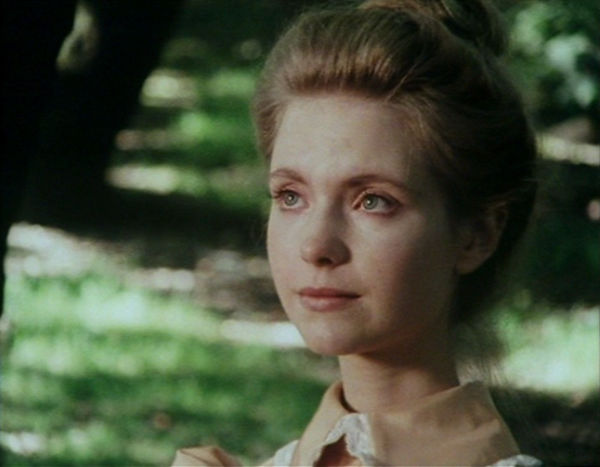
Judi Bowker as Mina from my favourite Dracula adaptation, the 1977 BBC Count Dracula
The major difference between Dracula and Renfield, though, is in how they treat Mina Harker. Renfield, still at least partly human, wants, despite his hunger for blood and life, to protect Mina from Dracula, though at the end gives in, and — in his one and only genuine importance to the plot of Dracula — lets the Count into the asylum where Mina is staying. And from this point it is she, not Renfield, who acts as an “index” of the Count’s activities. In effect, she becomes a female Renfield, and it is at this point that Renfield, now superficial to the plot, is killed, most bloodily, by the Count. And here we get another moment from Stoker that never fails to surprise me, as Mina insists that, even while the men track down the Count with the sole intent of killing him in revenge for damning her to Hell, they have pity on him. (After all, she says, “perhaps… some day… I too may need such pity.”) Mystically linked to the Count as she now is, she can also provide information as to where he is and what he’s doing. And so Stoker touches on another archetype of the modern serial killer myth — the serial-killer hunter, or psychological profiler, who can enter the mind of the killer, to the dangerous extent of empathising with, even becoming taken over by, him.
It’s all there in Stoker’s novel.


 The Terror is about the
  Drood, on the other hand, is set in more civilised climes — the London of Charles Dickens, to be precise — though parts of it prove to be anything but civilised. Narrated by Dickens’s sometime friend and fellow author Wilkie Collins, it addresses the enigma of Dickens’s final, unfinished novel, The Mystery of Edwin Drood. Drood (in Simmons’s Drood, not Dickens’s) is an almost supernatural figure, somewhat like the Phantom of the Opera in appearance, and, like the Phantom, he lives underground — in the catacombs, sewers and cellars beneath London, where an equally Dickensian sub-city exists. But the real focus of the book (though for the most part in a gently simmering subtext) is Wilkie Collins’s barely friendly rivalry with the effortlessly superior Dickens (it was Simmons’s description of Wilkie Collins as Salieri to Dickens’s Mozart that got me wanting to read the book).