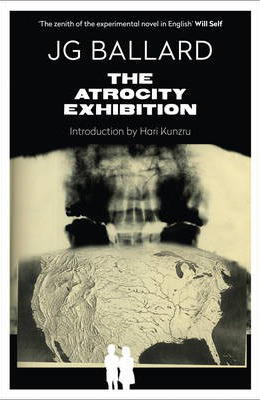
 It’s oddly comforting to know that J G Ballard’s most experimental, challenging, and controversial pieces of fiction, the ‘condensed novels’ that make up The Atrocity Exhibition, were written between, on the one hand, a children’s story for the much-loved BBC series Jackanory (‘Gulliver in Space’, broadcast 11th Feb 1966) and a treatment for one of Hammer Films’ fur bikini efforts, When Dinosaurs Ruled the Earth (1970). In contrast, The Atrocity Exhibition stories are deliberately difficult, intentionally obsessive, and wilfully confrontational. As much experiments in form as they are in content, they were Ballard’s attempt to break away from his early, more conventional (though still firmly ‘New Wave’) science fiction, to something that felt more relevant both to himself and to the time in which he was writing. As he states in a 1973 interview with Peter Linnet (included in Extreme Metaphors: Collected Interviews):
‘I wanted to write directly about the present day, and this peculiar psychological climate that existed in the middle sixties… It seemed to me that the only way to write about all this was to meet the landscape on its own terms. Useless to try to impose the conventions of the nineteenth-century realistic novel on this incredible five-dimensional fiction moving around us all the time at high speed.’
 As much as they were a response to the ‘peculiar psychological climate’ of the mid-1960s, the Atrocity Exhibition stories were also a response to Ballard’s own psychological ecosystem. The protagonists of these fragmented stories, variously called Trabert, Traven, Talbert, Tallis, Travers, or left unnamed, usually start their stories working in some sort of institute (a hospital or a university), but leave to pursue their increasingly obsessive private projects. Similarly, Ballard gave up his medical training when the urge to write became too strong. The Atrocity Exhibition protagonists’ private projects are often artistic, but always, like the Atrocity Exhibition stories themselves, highly experimental, and more often than not entirely conceptual. In the story called ‘The Atrocity Exhibition’, Travis plans to make himself the first victim in an entirely imaginary, though very real to him, World War III; in ‘Notes Towards a Mental Breakdown’, Trabert wants to somehow resurrect the Apollo 1 astronauts. These men are usually trying to somehow recreate the decade’s most celebrated tragedies — those which most challenged the post-war optimism of the 1950s — but do so in a way that somehow, this time, makes sense. Their key working method, it seems, is to collect disparate photographs, scientific images, artworks, and other ‘terminal documents’, while somehow insisting that ‘all these make up one picture’:
‘(1) a thick-set man in an Air Force jacket, unshaven face half hidden by the dented hat-peak; (2) a transverse section through the spinal level T-12; (3) a crayon self-portrait by David Feary, seven-year-old schizophrenic at the Belmont Asylum, Sutton; (4) radio-spectra from the quasar CTA 102; (5) an antero-posterior radiograph of a skull, estimated capacity 1500cc; (6) spectro-heliogram of the sun taken with the K line of calcium; (7) left and right handprints showing massive scarring between second and third metacarpal bones…’
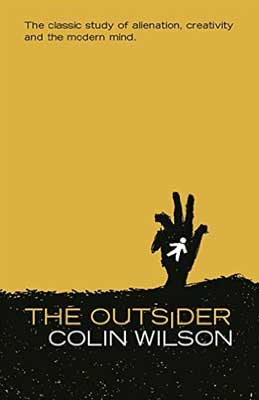 When writing about Colin Wilson’s The Outsider, I mentioned The Atrocity Exhibition as an example of what I called ‘crisis literature’ — books written on the edge of, or just past, a traumatic, and often psychologically destabilising crisis, which forced their writers into new, experimental, and often difficult narrative forms to capture and somehow master that crisis. Alan Garner’s Red Shift was perhaps the first example of this kind of book I really stuck with, and T S Eliot’s The Waste Land is perhaps the most well-known. Such books, I said, present themselves as highly intellectualised puzzles, but are really about deep emotional trauma. They take the form of fractured narratives (the multiple time strands of Garner’s Red Shift) or a barrage of seemingly unrelated fragments (the many styles and images of The Waste Land), that, like the Atrocity Exhibition protagonists’ ‘terminal documents’, the authors insist belong together as a single statement. (One such disparate list of peculiar photostats — ‘(1) Front elevation of a multi-storey car park; (2) mean intra-patellar distances (estimated during funeral services) of Coretta King and Ethel M. Kennedy…’ and so on — is titled ‘Fusing Devices’, making their function in an attempt at self-integration clear.) This is something Jung has said is a general characteristic of psychological healing: the search to resolve highly polarised, conflicting internal forces (a thesis and an antithesis) into a new synthesis, a new unity. The Atrocity Exhibition is fragmented in form (all those short paragraph-long chapters with their wonderful Ballardian titles), narrative sequence (Ballard says you don’t have to read the chapters in the order presented, but can pick and choose at random), and images. ‘At times it was almost as if he were trying to put himself together out of some bizarre jigsaw,’ as someone says of the protagonist of ‘You and Me and the Continuum’.
What may be another characteristic of ‘crisis literature’ is the way that violence, or violent images, are always waiting to burst through any apparently normal facade. Dr Nathan, one of the recurring figures in the ‘condensed novels’, who Ballard calls, in his later footnotes to the stories, ‘the safe and sane voice of the sciences’ — though with a hint that it’s not necessarily safety or sanity that are needed to solve these post-traumatic conundrums — provides a key to understanding this element of the Atrocity Exhibition:
‘The only way we can make contact with each other is in terms of conceptualisations. Violence is the conceptualisation of pain. By the same token psychopathology is the conceptual system of sex.’
T he many violent images in The Atrocity Exhibition stories — car crashes, assassinations, murders — are, then, attempts to externalise a deeply repressed or dissociated pain, a pain so intense it destabilises the very landscape around the protagonists, disconnecting them from a sense of reality, and from normal contact with their fellow human beings. Half of what happens in each of the stories is probably hallucinated — certainly, some of the characters are, including that mostly-silent recurring trinity of Kline, Coma, and Xero — while the other half is overwritten by a fictionalisation of reality which is, nevertheless, more real, or at least more meaningful, to the protagonists than reality itself.
I’m not a great one for experimental fiction. The Ballard I like is mostly the writer of weird disaster novels (The Drowned World, The Crystal World), dream-like psychological short stories, and a few of the mid-period novels (High-Rise, The Unlimited Dream Company). But after a while, reading interviews and articles about Ballard, you have to admit that, at some point, you’re going to have to read The Atrocity Exhibition, just to find out if it can really live up to all he said about it.
 In a way, what we have here is Ballard’s own commedia dell’arte taken to max — reusing the same stock figures (the mentally exhausted doctor/lecturer protagonist, the psychologist colleague who wryly, calmly comments and explains, the rather passive abandoned wife, the rather passive younger girlfriend), stock props (a torn flying jacket, a helicopter, a crashed car), stock images (the angle between two walls, cubicular screens or mirrors, vastly blown-up fragmented images of a woman’s face and body), and stock situations (car crashes, bizarre artistic exhibits) and landscapes (abandoned military testing sights, abandoned motorways, and other concrete wastelands), played and replayed, re-imagined and re-fit, in an attempt to find the combination that will unlock this particular meaning, solve this particular riddle. (The exception that proves this rule is, perhaps, ‘The Summer Cannibals’, which reads as though Ballard were deliberately trying not to use any of his standard tropes, and finds there’s nothing worth writing about. It’s the least interesting of the Atrocity Exhibition stories.)
Having read them, I have to say I didn’t find the whole as powerful as I’d hoped. The shock of the fragmented form works at first, but after a while the repetition doesn’t quite gain power through accumulation. What’s undeniable — as always — is the strength and integrity with which Ballard follows his obsessions. This is something you get, though, even in his more conventional narratives, the early novels and short stories. Here, in condensed form, sometimes the effect is of shocking juxtaposition, but sometimes it’s tired repetition. Undoubtedly, The Atrocity Exhibition was important for Ballard to write; it revitalised his novel-writing and set him on a new direction for a new decade. It’s almost as though he had to go to such experimental, obsessive lengths to break free of all the generic and standard novelistic conventions he’d been following, so as to return to them (with Crash, Concrete Island, and High-Rise) with a new strength. And I think the condensed novel form can really work, and it would be great to read other writers attempting it — if, that is, they don’t just take it as an excuse to throw together a bunch of random paragraphs. (It would work well, I think, with cosmic horror.)
If, as I say, The Atrocity Exhibition was important for Ballard to write — so as to confront, and perhaps master, the dehumanising forces of trauma, despair, and the ‘death of affect’ in his own life in the mid-60s — then his final book, Miracles of Life, was the equally important answer to it, as that book is about the humanising forces that saw him through life, most notably being his children.