The Chrysalids and The Midwich Cuckoos by John Wyndham

Just as The Day of the Triffids and The Kraken Wakes make a neat pairing as a couple of catastrophe novels, Wyndham’s next two books, The Chrysalids and The Midwich Cuckoos, are both about an evolutionary leap in the younger generation that threatens to usurp “normal” humankind. A lot of people say The Chrysalids is Wyndham’s best novel, but I prefer Midwich. In it, Wyndham’s writerly craft has progressed along several lines to a point of mild perfection. Those who accuse him of merely writing “Cosy Catastrophes” may feel justified in damning him for his “analgesic” style, but it’s precisely his urbane, mildly comic tone that allows him to smuggle in a very dark tale addressing some uncomfortable issues.

The Chrysalids and The Midwich Cuckoos are almost shadow images of one another. The Chrysalids, set in a post-nuclear-holocaust future, is about a human society struggling to re-establish itself in the remnants of a radiation-scarred world. A rigid religious dogma protects it from all mutations whether plant, animal or human: anything which doesn’t conform to its scripture of normality is destroyed. Into this world comes an invisible mutation, a handful of children who are telepathically linked. But if these children let their new ability be known, their own parents will banish them to the Badlands, if not hunt them down and kill them. The Midwich Cuckoos, on the other hand, is set in the author’s own era, when the (literally) sleepy English village of Midwich finds itself visited by a plague of pregnancies, resulting in the birth of about sixty alien children, all (again) telepathically linked, but this time able to coerce “normal” humans into doing whatever they will them to do — and therefore, though a minority in numbers, this time the mutations/aliens are in the position of power. Also — and again in contrast to The Chrysalids, which is narrated by one of the telepathic children — from the point of view of Midwich’s narrator, it is the mutations/aliens who are the “others”, the enemy.
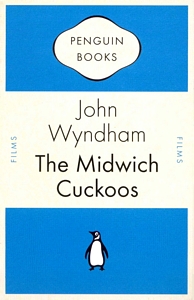
The Midwich CuckoosMidwich works, for me, in large part because of its style. Throughout his previous books, Wyndham used a first-person narrator to present his tales of “logical fantasy”, allowing him to humanise his essentially idea-led tales, while distancing his narrator from the wilder implications of those ideas (intelligent plants, invaders from another planet). The disadvantage of having a narrator, though, is that world-changing catastrophes require the relation of a lot of world-wide events, so Wyndham’s narrator gets stuck reporting a lot of things outside his immediate experience, with the result that things get told of rather than shown. This isn’t a problem in Triffids, which is mostly immediate action, but it makes Kraken a very un-involving novel, for me. In The Midwich Cuckoos, though, Wyndham strikes on two ideas that allow him to describe his incipient, worldwide catastrophe entirely in immediate terms: he first of all shrinks “the world” to the bounds of an English village, with only suggestions of similar things going on in other countries, and secondly, he gives his narrator licence to describe all the scenes at which he isn’t actually present as though he were, rather than the stricter approach of Kraken, where everything not witnessed by the narrator is reported secondhand.

Another Wyndham strand that achieves a sort of culmination in Midwich is the prophet/theoretician character he employs in all his novels (Coker in Triffids, Bocker in Kraken, Uncle Axel in The Chrysalids). This is the person who gets to speculate (always accurately) on the exact nature of the menace — the triffids’ intelligence, the fact that there is an alien invasion going on in Kraken — and also to indulge in a little thematic lecturing about the precariousness of man’s position atop a Godless evolutionary tree. In Midwich, Wyndham finds his perfect prophet/theoretician in Gordon Zellaby, a rather dufferish, doddery old writer, whose genial air of absent-minded reasonableness puts the reader off their guard, giving him complete licence to lecture at will:

“But, my dear fellow, if one is not blinded by a sense of indispensability, one must take it that we, like the other lords of creation before us, will one day be replaced. There are two ways in which it can happen: either through ourselves, by our self-destruction, or by the incursion of some species which we lack the equipment to subdue. Well, here we are now, face to face with a superior will and mind. And what are we able to bring against it?”

(Zellaby seems to be a sort of idealised version of Wyndham himself. Zellaby says he was “Too young for one war, tethered to a desk in the Ministry of Information in the next.” Wyndham grew up during WWI, and as a result thought of that as “his” war, meaning he felt oddly dislocated when he found himself serving in WWII (not his war), as a temporary Civil Servant in Censorship, and later with the Royal Corps of Signals in a cipher office.)

For most of the novel, The Midwich Cuckoos reads like a light, and very English, comedy about a rather awkward social problem — an entire village’s worth of women finding themselves unaccountably and simultaneously pregnant, with the result that certain types (a pair of live-together spinsters, a wife rumoured to be carrying on with another man, an engaged but not-yet-married couple) have some serious explaining to do. But as the novel progresses, though it keeps the same civilised, faintly amused & bemused tone, the story becomes steadily darker. The children hit out at those who threaten or accidentally hurt them. Early on, a woman is found repeatedly, and helplessly, sticking herself with a safety pin because she unintentionally pricked her golden-eyed baby; later, a man is forced to drive his car into a wall because he knocked into one of the children; later still, the village men are forced to fight each other, and everyone is telepathically forbidden from leaving the village.

By this point, Wyndham’s “comforting” narrative tone is totally at odds with the story he’s telling. It all reads so urbane and cosy, but this is a very nasty sort of war, between parents and children — and therefore a war that hits at the most fundamental note of what binds a society together. But as the children explain, there is a “biological obligation” at the heart of it:

“This is not a civilised matter… it is a primitive matter. If we exist, we shall dominate you — that is clear and inevitable. Will you agree to be superseded, and start on the way to extinction without a struggle?”

It’s a case of kill or be killed, a sort of Cold War from within, with one generation set against the next, a war of “social rules” versus “elemental struggle”. The narrative, though, keeps to the tone of “social rules” and mild social comedy, meaning the reader has to, at some point, detach from the narrator’s tone and realise for themselves just how dark a story The Midwich Cuckoos is. If you don’t question that tone — if you read it merely as a “Cosy Catastrophe” — you’re not getting the full impact.

^TOP

The Day of the Triffids and The Kraken Wakes by John Wyndham

Brian Aldiss famously dubbed John Wyndham “the master of the cosy catastrophe”, and so damned him with an adjective. John Wyndham, by MJENow, whenever anyone writes about Wyndham, they dig that one up. “The essence of the cosy catastrophe,” Aldiss says in Trillion Year Spree, “is that the hero should have a pretty good time (a girl, free suites at the Savoy, automobiles for the taking) while everyone else is dying off.” I can’t help feeling Aldiss’s scorn for Wyndham extended just as much to his readers — his many readers, I should say. This is what he says about The Day of the Triffids and Wyndham’s next novel, The Kraken Wakes:

“Both novels were totally devoid of ideas but read smoothly, and thus reached a maximum audience, who enjoyed cosy disasters. Either it was something to do with the collapse of the British Empire, or the back-to-nature movement, or a general feeling that industrialisation had gone too far, or all three.”

(There’s always an explanation for other people’s reading tastes.)

In Science Fiction: The Illustrated Encyclopedia, John Clute takes the same view:

“And in 1951 came The Day of the Triffids, a tale that captured the insecurities of the middle-class English reader in the austerity years perfectly, and envisioned to a nicety the kinds of self-protective communities that would comfort that readership… The comforting implausibility of this outcome, along with the calm, analgesic style of the Wyndham persona, contribute to what Brian Aldiss called the Cosy Catastrophe.”

“Middle-class”, here, is used with as much a sense of derision, or at least belittlement, as “cosy” and “comforting”, which is, let’s face it, a very middle-class thing to do (trying to distance oneself from middle-class guilt through being tough on the middle classes). Day of the Triffids (Penguin)Perhaps it was Wyndham’s success — and the fact that his readership inevitably would have been larger than a dedicated SF readership (far less of a sin nowadays) — or perhaps it was that Wyndham’s revolt against the way things were didn’t go far enough for Aldiss, who was of the next literary generation, SF’s New Wave, that wanted the far more extreme revolutions of the 1960s. (For me, the best New Wave response to Wyndham’s novels is Ballard’s: he rewrote them, as The Wind from Nowhere, The Drowned World, The Burning World, and the surreal The Crystal World, thus developing them, rather than merely critiquing them. Aldiss himself wrote a catastrophe or two. Greybeard was one I remember reading, but Hothouse (not a catastrophe), a far-future jungle Earth where pretty much every other plant is a triffid of some sort, is the novel of his I most enjoyed.)

I’ve never subscribed to the idea that reading should be a sort of mental & moral cold bath. I like reading for pleasure. I like things that “read smoothly” (which, to me, is evidence of craft), and don’t see why I shouldn’t. I wouldn’t go so far as to say I like my reading “cosy” and “comforting”, but I certainly wouldn’t go to a book for the purposes of self-torture.

The main “cosy” aspect of the “cosy catastrophe” is, I suppose, the fact that the catastrophe doesn’t completely destroy the world, but offers a chance to start again. As someone says in Triffids:

“The Earth is intact, unscarred, still fruitful. It can provide us with food and raw materials. We have repositories of knowledge… And we have the means, the health, and the strength to begin again.”

But this doesn’t mean there’s nothing but cosiness, comfort and having it your own way. The Day of the Triffids has an inviting air of adventure, of working out what you’d do in the hero’s place, of treating the world you know as a sort of imaginative playground for looting, shooting and uprooting; but it also has moments of real poignance, as when a young woman, blinded and now dying from disease, says:

“So futile — and it might all have been so different.”

Which perfectly captures, I think, the sense of a young life ending too early. And the beginning of chapter 13 strikes such a heartfelt note of loneliness, it’s impossible to believe Wyndham’s hero was simply having a good time in this de-populated England:

“Until then I had always thought of loneliness as something negative — an absence of company, and, of course, something temporary… That day I had learned that it was much more. It was something which could press and oppress, could distort the ordinary, and play tricks with the mind. Something which looked inimically all around, stretching the nerves and straining them with alarms, never letting one forget that there was no one to help, no one to care.”

John Wyndham, The Day Of The TriffidsDay of the Triffids is, I think, a truly good read. The opening two chapters have an almost classical perfection as openings go: the first, so tightly focused on the narrator’s immediate predicament (in a hospital bed waiting for someone to remove his eye-bandages, he starts to be aware from the sounds alone that something is deeply wrong), while the second chapter is almost pure exposition, as the appearance of the triffids is described alongside a potted biography of the narrator. After that, we’re set up and onto the adventure.

Triffids wasn’t Wyndham’s first book — he’d been published before the Second World War in the US pulps, under different names, and had had two detective novels published in the UK — but it was the first of his new approach, something he called “logical fantasy”, which downplayed the pulpier SF elements (all the wilder speculations about the triffids’ possible intelligence, for instance, are placed in the mouths of characters other than the narrator, allowing him to sound skeptical, and so reassure the reader they aren’t in the hands of a whacko).

John Wyndham, The Kraken WakesThe Kraken Wakes is a more disappointing book. Whereas the emphasis in Triffids is on the immediate survival of the characters and, later, the far-range survival of the human race, Kraken is mostly about the slow unfolding of the initial catastrophe (a lot of which is by secondhand report, distancing the reader from the action). As a result, it’s far more about something that’s only a minor note in Triffids: how reluctant people are to believe in anything outside their daily experience. In Triffids this comes out in the way most people belittle Bill Masen’s warnings about how dangerous the triffids are going to be in this newly-depopulated England. Kraken, on the other hand, is so much more about the media, and the way it, and its readership, mocks any suggestion they may be experiencing the opening stages of an alien invasion until it’s too late (and even then they still want to blame it on the Russians). So Kraken reads more like a satire on modern civilisation than Triffids’ straightforward adventure, and I don’t think Wyndham has the bite for satire. Also, in contrast to Triffids, Kraken is set in a still-socialised world, and feels bogged down in the highly straightjacketed manners of its time. So, in Kraken we get the rather dated spectacle of the protagonist’s wife having a sudden rant (about the need for the government to arm the people, of all things), then apologising for the display and taking herself off for a lie-down. Then a doctor is called, as though any sign of emotion were cause for medication.

What’s most surprising about Kraken is that, though it was published in 1953, it reads so much like a reaction to the 1956 Suez crisis, and the final end of the British Empire:

“We, a maritime people who rose to power upon shipping which plied to the furthest corners of the earth, have lost the freedom of the seas. We have been kicked out of an element that we had made our own.”

Triffids is the better book: yes, “smoothly written”, but not merely cosy. And the 1981 BBC adaptation had one of the spookiest TV theme tunes of all time (if you can call that eerie choral drone a tune).

^TOP

What is Doctor Who?

An Adventure In Space And TimeI can’t let Doctor Who’s 50th anniversary pass without a Whovian post. For me, the highpoint has been Mark Gatiss’s excellent, and wonderfully moving, drama about William Hartnell and the beginning of the whole thing, An Adventure in Space and Time, plus the recovery of The Web of Fear and The Enemy of the World. Though I wrote a while ago about Why I Like Doctor Who, I’ve been thinking that that blog entry only answers — or, perhaps, asks — half the question. I might know why I like it, but what is it, exactly, that I like? What is the thing I’m liking when I say I like Doctor Who?

Kim Newman, in his excellent little critical appraisal of the show for BFI TV Classics, offers a few nuggets. It is, he says:

“BBC-TV’s most eccentric saga, at once cosily familiar and cosmically terrifying.”

(Though I wouldn’t say it’s cosmically terrifying in the Lovecraftian sense — something else I wrote about a while back, on Lovecraftian Who. It is, however, most certainly eccentric and cosy.)

It is, he says:

“…a continually rewritten fiction…”

BFI TV Classics: Doctor Who by Kim NewmanWhich answers my own feeling that I don’t really care too much about the continuity, or world-building, aspect of the show. It doesn’t matter to me that, for instance, Atlantis gets its comeuppance in — is it three different ways? They might be alternative Atlantises in alternative time streams. I don’t care. I don’t care either that the Time Lords in The War Games seem to be different to the Time Lords in The Deadly Assassin. All I care is that there are good stories, and that each one is in done in, as a lawyer might say, a good and Doctor Who-like fashion.

So, what is a good and Doctor Who-like fashion? What is the essence of this thing called Doctor Who? Newman says:

“Boiled down to its simplest format, Doctor Who is a character actor and a police box.”

The best definition of fantasy, as a genre, comes from, I think, Brian Atterby, who says it is a “fuzzy set”. A fuzzy set is a group of things where we’re more sure of what belongs to the set than why. “Games”, for instance, is a fuzzy set. If you try to define “a game” as, say, “something with rules”, then you realise that some games don’t have rules — childhood make-believe games, for instance — or if you define it as “something done for fun”, then you realise that sports are games done by professionals, and so on. For everything you can say is a defining feature of “a game”, there will always be at least one example of something that is a game, but doesn’t have that feature, yet it shares enough other features with other games to be a game. Doctor Who is a fuzzy set, too. There have been episodes without the Doctor, and stories without the TARDIS, but they were still Doctor Who. Each story simply has to have enough Doctor Who-ish ingredients to overcome any potential non-Doctor Who-ishess, and then it can be classed as Doctor Who.

Doctor Who Weekly 1Of course, Kim Newman was writing about the TV show, and Doctor Who is so much more than that. For me, at the start, although the TV show was the focus of it all, it was such a rare event (only 26 or so episodes per year, a poor-but-perfect 25 minutes each), that other things had to make up the bulk of my Doctor Who focus. And for me, this meant the Target books and the weekly/monthly magazine (as well as an awful lot of making up stories in my head).

Without access to the TV show, you had to be a sort of archeologist, piecing together fragments of the past. Doctor Who and the Web of Fear (cover)The magazine had photos and plot summaries, the books had covers and fleshed-out stories. You married it all together in your own head. I remember, at the Brighton World Horror Convention a couple of years ago, a panel discussing people’s experience of the old black & white classic horror movies, where someone said they first learned of these old horror movies through books and magazines, where all you’d have would be the same small set of stills, and that these stills were full of such promise, it made you long to see the film. But when you got to finally see the film, the result was often a slight disappointment. My experience of much old Doctor Who has been the same. I knew those few oft-recycled stills from the old shows so well, and each new, not-seen-before photo was like a treasure. Seeing the actual shows often came as a shock — mostly, for instance, at how clumsy those fantastic-looking monsters moved (the Ice Warriors, so fearsome, noble and warrior-like in photographs, so clumsy in actual motion). Similarly, though I loved the Third Doctor’s Earth-bound adventures in the novelisations, I found him off-puttingly arrogant and short-tempered in the actual TV shows. But I wonder how much part of my experience of Doctor Who was all about that effort of reconstruction — putting together the stories with the photos, archeologically reconstructing those (as I thought) never-to-be-seen adventures of yesteryear from what remained. Being involved in Doctor Who was as much an effort of imagination as it was of passive appreciation.

Doctor Who, junkyard

I recently re-watched the first ever episode of Doctor Who — still one of its best — and realised how appropriate it is that it all starts in a junkyard. Because, if it’s anything, Doctor Who is a junkyard, a junkyard of the imagination, as much full of wonders as rubbish — and often of things that are both at the same time. Like a junkyard, one of the great charms of Doctor Who is unusual juxtaposition, the fantastic beside the familiar — Daleks trundling over Westminster Bridge, Cybermen emerging from the sewers, a hulking Krynoid charging round the grounds of some old country house, Egyptian mummies in a Victorian Gothic folly.

And, of course, junkyards are full of old things. Doctor Who is full of old things, too. And old things means nostalgia. There are, I’d say, three types of Doctor Who nostalgia. The Making of Doctor WhoThere’s the most obvious one, of revisiting the episodes I watched as a kid — and not just that, but re-experiencing the whole texture of TV back then, something that, for me, is particularly evident in something like The Brain of Morbius, with its gloomy studio feel, its flash-bang effects, and the peculiar look of the period’s video technology, that conjures up a whole aesthetic of that time. Another sort of Doctor Who nostalgia is a borrowed nostalgia that comes from learning about shows from the past that I never saw, and vicariously experiencing other people’s fondness for them — the whole quaintness of Dalekmania, for instance, or realising just how 60s the 60s shows were. But there’s a third sort of nostalgia, which is about how Doctor Who plugs you into a much larger stream of the culture as a whole. Mostly, it has to be said, this comes from the show’s own junkyard mentality, of grabbing ideas from elsewhere and trying them out — Doctor Who does Sherlock Holmes, or Doctor Who does Hammer Horror, or Doctor Who does dinosaurs — but also from the way it makes use, as any long-lived, pulpy kind of story-anthology of its type can’t help but do, of all those stock characters and situations of adventure fiction, or science fiction, or British fiction — the retired colonels, the stuffy bureaucrats, the stodgily unimaginative politicians, the mad scientists, the embittered ex-soliders-turned-mercenaries, the fanatic idealists intent on reshaping the world, the dangerously eccentric millionaires, the disfigured geniuses lurking in catacombs — from the way, then, that it plugs you into a cultural nostalgia for archetypal adventure stories.

Wheetabix QuarkPresiding over this junkyard is, of course, the Doctor — I. M. Foreman from 76 Totters Lane — who lives, and travels, in a box. It may take the outward form of a Police Box, but this is, really “the box” — the telly itself — and it is through this, the medium of telefantasy, that the Doctor travels, changing time zones and planets as you might change channel, then pausing to observe them through his own TV screen. I’ve never really cared that Doctor Who’s effects haven’t been that great; I like, in fact, its very televisualness, its staginess, its sets-and-rubber-monsters-ishness, its wobbly spaceships on strings. Perhaps this is because my initial experience of what Doctor Who was came as much from those still photos and book covers, which allowed my imagination to bring the stories to life way before I got the chance to see them (again, or for the first time) on DVD. And so I know that the TV show itself can only ever be an approximation to the real thing that is Doctor Who, which is formed within my head.

So to me, Doctor Who isn’t just a TV program. It’s a whole bunch of stuff. Particularly, it’s a whole bunch of random, weird stuff shoved haphazardly together, presided over by a cantankerous and oddly changeable proprietor, who occasionally fits these cultural cast-offs and odd bits of the past together into futuristic or fantastic shapes, and puts them to strange but ingenious uses.

When I say Doctor Who is a junkyard, I really do mean it as a compliment.

Sign off with a Zygon...

Sign off with a Zygon…

^TOP