
 “Bright Segment” (1955, in the collection Caviar) displays Sturgeon’s stylistic abilities as a writer. The story is about a slow-witted, lonely man, and is written in suitably plain language, with simple statements and and-joined sentences. This was my first encounter with this sort of writing (Hemingway is of course the main one known for writing like this, and Roald Dahl (in his early stories) and Ian Fleming took the technique from him). Sturgeon has a very flexible, often poetic, writing style, but “Bright Segment” shows him tightly focused in one cut-back voice, and using it very effectively. The plainness of the sentences and the simple actions keep you close-up focused on what the protagonist is doing, as he finds an injured girl in the street outside and very carefully, very consideredly, sews her up and nurses her back to health. The protagonist’s concentration comes out in the writer’s, and so comes through to the reader who is (I was, anyway) quickly involved in the story, and thoroughly hooked by the action. Here’s the beginning:
He had never held a girl before. He was not terrified; he had used that up earlier when he had carried her in and kicked the door shut behind him and had heard the steady drip of blood from her soaked skirt, and before that, when he had thought her dead there on the curb, and again when she made that sound, that sigh or whispered moan. He had brought her in and when he saw all that blood he had turned left, turned right, put her down on the floor, his brains all clabbered and churned and his temples thumping with the unaccustomed exercise. — “Bright Segment”, by Theodore Sturgeon
(Another example of Sturgeon as wordsmith is “Killdozer”, which is somewhat more difficult to read. This one is written from the point of view of some men using heavy digging equipment, and Sturgeon has both the nomenclature and the feel of using such equipment spot on.)
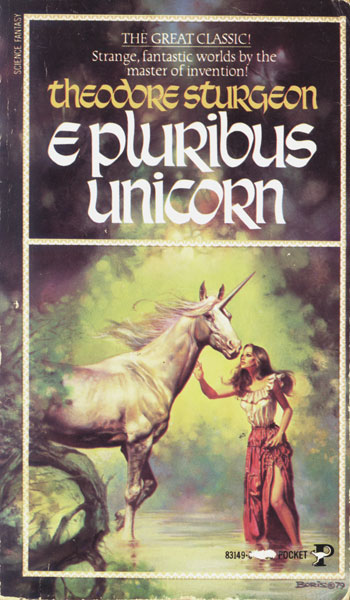 “The Professor’s Teddy Bear” (1948, Weird Tales, also in the collection E Pluribus Unicorn) always leaves me stunned at what a bizarre story it is. How does someone come up with a plot like this, and make it work? It starts with a young boy being put to bed for a daytime rest by his mother. He’s laid down with his teddy bear, who turns out not to be a teddy bear at all but some sort of parasitic psychic vampire that feeds on the boy’s future. It encourages the little boy to fantasise about events in his life to come, and change them to make terrible things happen, and as they happen, the creature somehow manages to feed on the blood that will be spilled. Then we’re actually in the future, as the boy, now a grownup university lecturer, recalls a vague memory of having once thought about being in this particular hall, delivering this particular lecture, and having the feeling that something terrible is about to happen to the brown-haired girl in the audience, and can he stop it? Sturgeon has a wonderful audacity as a storyteller, often hitting the reader with it from the first sentence and not letting go.
But it’s “A Saucer of Loneliness” (Galaxy, 1953, and again in E Pluribus Unicorn) that goes to the core of what struck me most forcefully about Sturgeon when I first encountered him. He’s a great wordsmith, and an original storyteller, but here you see how he always uses the science fictional, fantastical or horrific ideas behind his stories to talk as openly as possible about the most vulnerably human side of his characters. In “A Saucer of Loneliness”, a young woman is standing in a park in the middle of a large city when a small flying saucer descends, hovering over her head and making some sort of brief contact before leaving. After this, the girl is pursued by government agents, sensationalist reporters and UFO nuts, all wanting to know what the saucer said. She refuses to tell anyone, to the extent of living a life virtually cut off from human company, because the message the saucer gave wasn’t the usual science fictional one — it wasn’t a warning about an oncoming disaster or a scientific secret — it was a personal one, a message in a bottle sent out across the universe from one lonely being to another, and not meant to be shared with governments and other less-than-human organisations.
There are many Sturgeon stories I could mention, and many wonderful moments where a line of description lights up an otherwise average Sturgeon tale (a description of desert cacti, for instance: “It was sahuro country here, and all about they stretched their yearning, other-worldly arms upward, as if in search for a lover who might forget their thorns”, from “Cactus Dance”), but that’s three to be getting on with…
(There’s an excellent Sturgeon page here, including a pretty thorough bibliography.)


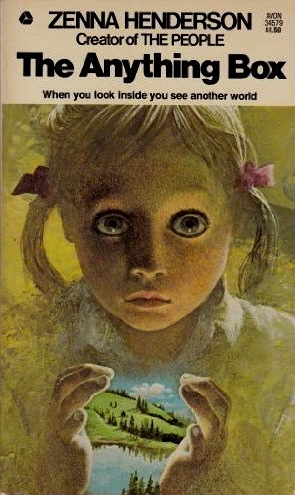
 .) I have to say that, though I can see how the People series was the perfect setting for an exploration of those themes, my favourite Henderson writing is still to be found in The Anything Box — the title story, about a young girl who escapes from domestic troubles by gazing into an invisible box in which she can see whatever she most desires, is such a pure fable of escape and imagination, it makes for a perfect short fantasy story. (Plus, it has a wonderful cover.) Zenna Henderson’s writing is not for those who can only tolerate modern styles, I think, but for me she’s certainly one of the more interesting and meaningful writers from the pre-New Wave era of SF & fantasy.