Prometheus

I will, usually, watch sequels & prequels to my favourite films, but never with any raised hopes. Ridley Scott’s Alien is one of my top three favourites (I can’t name a top one — the other two are Amelie and Hitchcock’s Shadow of a Doubt), so of course I had to see Prometheus, Scott’s prequel-of-sorts to his breakthrough film. I don’t think it’s the sort of film to be ruined by discussing its plot — I heard one review beforehand and gleaned a good enough idea of what it was about to be in no way surprised — but this is a reaction to the film, not a review, so I’ll say it now: spoilers ahead.

My main feeling was Prometheus was pretty nihilistic. This may sound like an odd criticism for a horror film, but it was only after watching it that I realised how much Alien (and Aliens), being about survival in the face of terrible odds, are so life-affirming. They use their horror elements to increase the sense of the preciousness of life. Prometheus, though it does have many similar situations, doesn’t have the same feel at all. Perhaps because it’s more preoccupied with philosophical questions, its survival/action elements are tainted with a dour fatality, a feeling of “Yeah, but survive for what?” In a sense, the horror elements — one coming from the threat to individual survival, the other dealing with the ultimate source of human life — come from both sides at once, trapping the viewer in a pincer movement, and leaving no room for a sense of hope. I’ve come across criticisms of the film saying it doesn’t answer the philosophical questions it raises, but I don’t think that’s a weak point — the raising of philosophical questions (“Where do we come from? Where are we going?”) without answers is entirely valid, as it acknowledges very real areas of doubt. And doubt is okay. There’s a lot of it about. Besides, what possible answers could the film provide that would be in any way satisfying?

So, why does the film feel so nihilistic? It could be because a core trio of the main characters are so cold to each other (one, David, being a robot, another, Charlize Theron’s Meredith Vickers, whose utter coldness at the beginning — she changes midway, with no real reason — prompted what I thought was the best line in the script, when Captain Janek asks her “Are you a robot?”). But the closest I can come to identifying it lies in the imagery of the film. Alien was famous for having a lot of H R Giger’s warped images centring on the idea of impregnation and gestation (the way the alien enters & gestates in its human prey, for instance, or the way the main action takes place in the confines of a spaceship addressed as “Mother”); while Aliens was much more about motherhood (Ripley’s adoption of the traumatised Newt, plus of course the vast alien mother she fights at the end). Prometheus‘s main image, though, is of abortion, both actually (Doctor Elizabeth Shaw’s rather tacked-on super-fast pregnancy, and its termination) and metaphorically (what the alien Engineers are planning to do to their creations). The film also brings in what could be called a paternal strand, with the selfish, unfeeling presence of trillionaire Peter Weyland, and his quest to meet his makers (expecting, for some reason, paternalistic Gods, but not, of course, getting them). And this brings up a sort of flipside to the abortion imagery, voiced by the android David, who at one point asks, “Doesn’t everyone want to kill their parents?” An idea the film seems to accept without argument. So, Prometheus seemed to be mostly about parents wanting to kill their children, and children wanting to kill their parents — actually, metaphorically, and theologically. The result is a picture of a totally bleak, uncaring, in fact actively hostile, universe, with none of the contrasting, messy, crew camaraderie of Alien, or Aliens‘ feel of an impromptu family developing in the face of danger. In Prometheus, human survival has no point, because humanity isn’t human enough.

After Alien, Aliens worked so well because it took the basic idea of the first film (the perfect killer alien let loose on a bunch of humans) and put it in a slightly different genre. Alien was survival horror, and was about the individual; Aliens was a military film, and was about the survival of the group, the protection and raising of children (and, on the flipside, a new generation of alien creatures). After Aliens, I thought there was only one way to make a third film, and that was to bring the creatures to Earth (and so be about the survival of the race). I was disappointed, then, when the third Alien film settled for a sort of half-and-half Alien/Aliens hybrid, which worked on neither score, while the fourth (made by one of my otherwise favourite directors, Jean-Pierre Jeunet, who was totally wrong for the series) might have worked as a dark comedy, had he been allowed to go really OTT, but was never going to be anything more than a footnote in the series. Prometheus, though it abandons the Alien creature, and though it is about the survival of the race, doesn’t do anything sufficiently different from Alien or Aliens to be judged on its own merits. (Considering the difference in plots, the film has an awful lot of similar scenes and situations, some of which feel they’ve been inserted merely for similarity’s sake.)

Guillermo del Toro saying he can’t make Mountains of Madness because Prometheus covers too similar ground is a great pity; Mountains of Madness would at least take the threat to Earth, and would make it that much more immediate and visceral. It also wouldn’t have had the baggage of previous films to feel it had to conform to. Not that Prometheus is bad, just that it isn’t as good as Alien or Aliens.

^TOP

Why I Like… Doctor Who

It starts with a trip down a rabbit hole — a weird, angular, metallic rabbit hole that keeps changing the shape of its iridescent walls as you fall. Meanwhile, there’s a distant alarm going off — either that, or someone’s trying to shoot you with a ray gun. From the echoing bass rattle you can hear, you might be surrounded by miles of distant, faulty plumbing. If so, someone’s emptied a boxful of pins into the system, because you keep hearing these wooshing washes of tinkliness pass by. Then up from the darkness looms an enormous face. Tom Baker, eyes agoggle. There for a moment, then he’s gone, dissolved into many colours like a prismatic ghost. And still you keep falling.

Doctor Who is weird.

The first episode of Doctor Who I saw was from Tom Baker’s introductory adventure, Robot. As that was broadcast between the end of December 1974 and mid-January 1975, I must have been three and half years old at the time, which means that seeing the programme is one of my earliest memories. (Sitting in a bath watching my chicken pox peel off comes a close, but not so fondly-remembered, second).

I pretty soon wanted to be the Doctor. (I don’t mean I wanted to act the part. I mean I wanted to be the Doctor.) But it was the monsters that most fascinated me. The two are, of course, inseparable. The Doctor is the corrective called for by the imbalancing evil of the monsters; the monsters are the shadow cast by the heroic light of the Doctor. It’s why the Doctor always has an intuitive knowledge about the enemy he faces, often before he sets eyes on it/them — as soon as he steps out of the TARDIS he knows, like he can sniff it in the air, something’s afoot. And he often knows the sort of something it is, as well as the sort of foot, sucker, or pseudopod it’s afoot on. The reason for this is that the Doctor and the Monsters are one. They’re part of the same psychological picture.

Looking over the first few seasons of Doctor Who that I saw — seasons presided over by the dream-team of Philip Hinchcliffe as producer and Robert Holmes as script-editor — there’s a lot of blurring the line between men and monsters. In The Ark in Space, the far-future human Noah turns by painful stages into an insectile Wirrn (courtesy of a generous helping of green plastic bubble-wrap). In Genesis of the Daleks, Davros, already half robot himself (the other half a distinctly withered Mr Potato Head), fast-forwards his people’s evolution into slug-like creatures encased in “Mark III Travel Machines” (banality-of-evil-speak for Daleks). There’s the Jekyll & Hyde Professor Sorenson possessed by anti-matter in The Planet of Evil, and Marcus Scarman with his mind taken over by the evil alien Sutekh in Pyramids of Mars. There’s the humanoid androids all set to take over the Earth in The Android Invasion, and a man turning into an alien plant-monster in The Seeds of Doom… Virtually every story has men turning into monsters or monsters masquerading as men. (With some, such as the Cybermen, the process is complete before the story begins.)

The Doctor and the Monsters, like Angels and Demons, are opposing absolutes. The real story takes place in between, in the human realm. Here, there’s the constant threat that you, a human being, might turn into a monster. And not just a green bubble-wrap one. There are far more insidious forms of human monster. That first season of Doctor Who I saw (the twelfth since the show began) was particularly full of fascists, cold intellectual elites, and power-mad scientists — all ways in which people can really become monsters.

To the child I was, unable to understand any of this consciously, having that inner battle between humanity and monstrosity spelled out in such clear, vivid, excitingly fantastic terms was, I think, a vital part of the appeal of watching the programme. It also perhaps explains why I felt so disgusted when Colin Baker began his tenure as the Doctor by attempting to strangle his companion. That was 1984. Dark heroes were very much of the times (Watchmen was only two years away), but I couldn’t see the point in a Doctor indistinguishable from the monsters he was supposed to be fighting. Having watched every episode since Robot with almost religious devotion, I gave up. There are still some Colin Baker stories I haven’t seen, and never will.

But Doctor Who had done its job.

Whenever I read about the formative influences of my favourite writers & artists, there’s usually a point where they discover a cache of story — a collection of myths and legends, a book of fairy tales, a copy of The Arabian Nights. Doctor Who was my story-cache, and that weird, down-a-metallic-rabbit-hole theme tune was its “once upon a time”. (The TARDIS, bigger on the inside than the out, is the through-the-wardrobe portal to the only thing that is truly bigger on the inside, the imagination.) In its gleefully pulpy way, Doctor Who regularly plundered myth, fairy tale, popular entertainment, literature, history and science for ideas and storylines. (The Hinchcliffe-Holmes era had a particular penchant for Gothic Horror, Hammer style.) As such, it was the ultimate all-in-one cultural education for the final quarter of the 20th century.

That and Blue Peter, anyway.

^TOP

Mills & Barsoom

It’s always been a problem, what to do with young men, bundles of sex and violence that they are. Each age has to come up with new ways of channelling their youthful energies, or face the consequences. The Middle Ages, all too aware of the dangers of having a bunch of steel-plated, lusty young knights roaming the countryside, developed a pair of social codes: chivalry, which said that only a fight between equals was truly honourable (so, no bashing peasants just for the hell of it), and courtly love, which said that the purest expression of a knight’s devotion was to dedicate himself to the service of a (preferably married, certainly chaste) woman, whom he could worship from afar, obey her every command, and pine for. The fiction of the times is full of honourable knights and sighingly tragic longing. Lancelot was the ideal, and though nowadays he’s most known for his massive failure to merely worship from afar, Malory, at least, was convinced of his virtue, saying that anyone who didn’t believe in it was corrupted by the cynicism of the times:

“…nowadays men cannot love seven nights but they must have all their desires… But the old love was not so; for men and women could love together seven years, and no lecherous lusts were betwixt them, and then was love truth and faithfulness. And so in like wise was used such love in King Arthur’s days.”

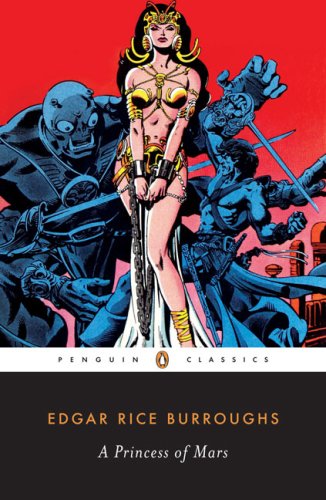
A Princess of Mars – Bruce Penngington cover

Edgar Rice Burroughs’ A Princess of Mars is a direct descendent of the same school of fiction. I first read it when I was 19 or 20, and perhaps because it was so short and so very readable, quickly moved on to its sequels, which proved just as moreish. (I think I got as far as The Master Mind of Mars (6th in the series), or perhaps even Synthetic Men of Mars (9th) — things get a bit blurry after the first three. It’s the uber-cliffhanging ending of the second, Gods of Mars, which has stuck with me.) Even while caught up in them — and they really did have that read-it-in-a-single-sitting compulsion — I knew they were basically an endless series of riffs on a single formula. The thing was, the formula was so primal, it worked even though I was aware of it.

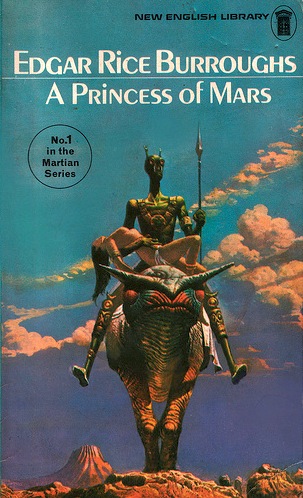
A Princess of Mars – Michael Whelan cover

It’s the romantic male daydream of rescuing a beautiful princess, either from death or a fate-worse-than, again and again and again, raised by the power of its exotic setting (one of Dejah Thoris’s would-be ravishers, Tal Hajus, is “the most hideous beast I had ever set eyes upon… like some huge devil-fish”), and delivered at such a breathless pace, the narrative barely gives you time to recover from one iteration before it lands you in the lap of the next. The hero, John Carter, goes from death-defying extreme to death-defying extreme, at one point having his flying machine shot down to crash in the middle of warring hordes of savage Tharks (six-limbed, twelve-foot-tall green Martians who think the death agonies of their enemies the funniest thing going), only to find himself fighting next to (and saving the life of) the one Thark on all the planet who knows him. The plot has enough holes to sink a heavier vessel (why does Carter, having just freed Kandos Kan in Zodanga, instead of going on to free his beloved Dejah Thoris in the same city, elect to fly all the way to the distant city of Helium, a place he’s never been to before and in which he will not be recognised, in order to get help?), and I felt, on this re-read, some of Carter’s actions were more barbaric than heroic (to rescue Dejah Thoris from being wed to the warlike Zodangan prince, Carter assembles a horde of Green Martians to massacre and imprison the whole city, many of whose inhabitants, it has been pointed out, are against the actions of their leader) but the whole thing stays buoyant through sheer narrative pace as it zings from one romantic peril to the next. Like a shark, it survives only because it keeps moving. But this shark moves fast.

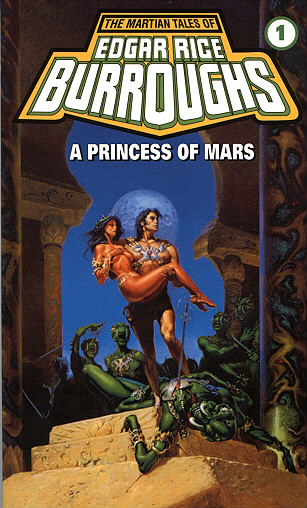
A Princess of Mars – Frank Frazetta cover

It’s not just physical peril, though, that stands between John Carter and the beautiful Martian princess Dejah Thoris (she lays eggs, don’t you know). The exotic setting allows Burroughs to put problematic cultural barriers between the two of them, from Dejah Thoris taking insult at the culturally-ignorant Carter’s unintentional faux pas at the beginning, to her later telling him that, having promised her hand in marriage to the hated Sab Than because she thought Carter dead, honour dictates not only that she cannot go back on her word, but that, should Carter kill Sab Than, she and Carter will never be able to marry.

It’s courtly love all over again.

(Apparently there’s a film out, or something.)

^TOP