Spock

Captain’s log, supplemental.
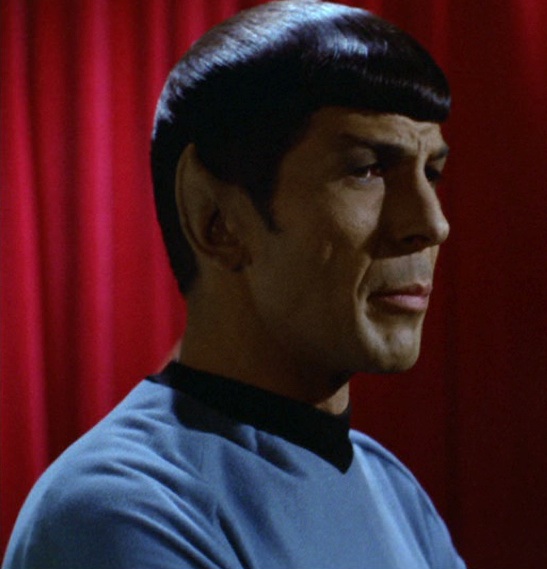
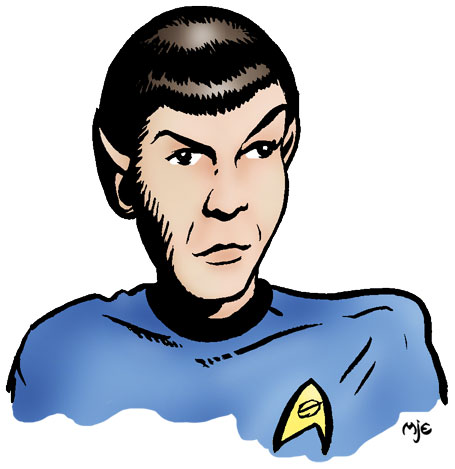
I’ve now worked my way through the whole of Star Trek‘s first season, and have watched the first episode of the second season. The thing I like most about the show — the first time around and this — has to be Spock. He is, aside from the obvious technological trappings (the Enterprise, phasers, “warp factor eight”, “beam me up”) the most science-fictional aspect of the show, being its only regular alien. The alien as unemotional, wholly logical entity was surely a bit of cliché even by the mid-sixties, but the fact that Spock was a main character meant it was something that could be explored in a bit more depth, and so you quickly go beyond the cliché. (Thanks in great part, of course, to Leonard Nimoy’s acting, which lends Spock a great deal of dignity, even managing to withstand the increasingly regular habit of Kirk & co. to end each episode with a joke at Spock’s expense. If it’s not his relentless logic, it’s his pointy ears.)

But Spock gets some of the best jokes. His way of distracting a guard prior to giving him the Vulcan nerve-grip, for instance: “Sir, you have a multi-legged creature crawling on your shoulder.” I remembered that from the first time I saw the series, and it was a little joy to rediscover. Also, when McCoy breaks off an argument with Spock to ask, “Shouldn’t you be working on your calculations?” and Spock says, coolly, “I am.” (One more Spock joke for the road. “You never told me if you had another name, Mr Spock.” “You couldn’t pronounce it.”)

The interesting thing about Spock, as a character, is how he is basically characterised in relation to the people around him. You could imagine a show featuring only Kirk — in fact we get several episodes where Kirk is isolated and has to work on his own — but it’s impossible to imagine a show with only Spock in it. Spock, on his own, would be dull. It would be just him looking into his readout device, occasionally nodding to himself, occasionally raising an eyebrow. He only comes to life, as a character, when his unemotional, logical nature is brought into contrast with the emotional, irrational nature of humans. This is an extreme example of what story guru Robert McKee calls “cast design” — where aspects of a character are brought out only by having other (usually minor) characters act as contrasts to them.
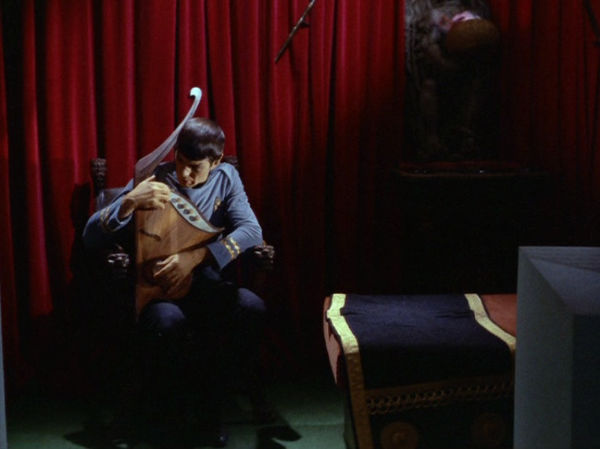
Even Spock having one of his emotional episodes — this being the main surprise his character is capable of, and so is, as a result, something that happens quite regularly — only makes sense when he has something to feel about, which means other characters. The archetypal episode in this sense is “Amok Time”, the opener of the second season. This has to be my favourite episode so far (and a better one, in my opinion, than the episode usually slated as the best Star Trek ever, Harlan Ellison’s “City on the Edge of Forever“). Here, we get Spock as a teenager, moodily refusing to explain what’s making him so miserable, then retreating to his cabin to pluck disconsolately on his Vulcanian harp. “Amok Time” was written by Theodore Sturgeon, one of my favourite writers (it is, in fact, the second of two episodes he wrote for Star Trek, the first being “Shore Leave”, a much less characteristic episode). “Amok Time” is, it seems to me (unversed in Star Trek fandom as I am) something of an equivalent to Doctor Who‘s “Deadly Assassin“, where we finally get to see the Doctor’s home planet of Gallifrey, and as a result the mythology of the whole programme moves up a gear. In fact, I’d say “Amok Time” had an effect not only on the way subsequent Star Treks built their universe of alien races, but how other (mostly US) TV SF programmes define their alien cultures, too. “Amok Time” gives us not only Spock’s famous split-fingered salute (“Live long and prosper”), but hints at the existence of an entire, ancient culture through one of its key rites of passage. This is something you see time and time again in subsequent SF TV — the Taurons’ gangsterish tattooing and coming-of-age get-togethers in the recent Battlestar Galactica spin-off Caprica, for instance. I have to admit, this approach usually irritates me, as it seems a bit superficial. In Caprica, the Taurons’ invented rituals just seemed to have been lifted from other, existing cultures — Yakuza tattooing, Jewish bar mitzvahs — and modified a bit to make them alien, but in “Amok Time”, the ritual is linked to a specific aspect of Vulcan biology. It has a reason; it’s not merely striving for an effect. As a result, it works.
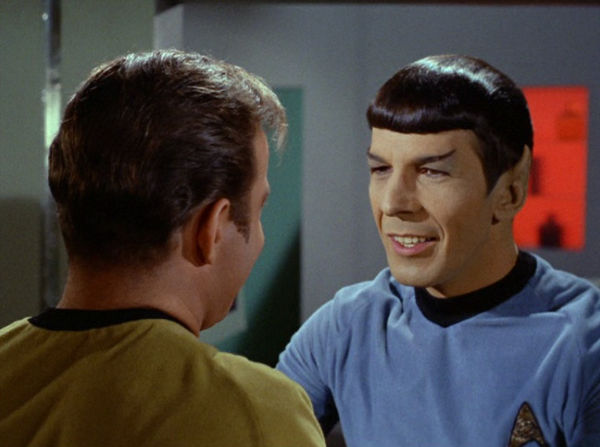
The most character-defining moment in “Amok Time”, though, is not the rite of passage, or Spock’s adolescent moodiness beforehand, it’s the moment he realises he hasn’t killed Kirk at all, and is, for a second, genuinely happy. He quickly collects himself, but from then on you know that, beneath all the illogicality and decorum, Spock is, really, just one of us. And no doubt part of his personality is down to the role he sees himself as playing as part of the Enterprise’s family — he consciously defines himself as “the one who’s not human”, and does his best to act that way. Cast design, then, is a two-way process.

But I bet he enjoys those jokes at the expense of his ears as much as the rest of the crew.
^TOP

Star Trek

Borag Thung, Earthlets! Sometime in the early, early eighties, the BBC showed what seemed like an endless rerun of the original Star Trek series. I watched every episode (they seemed to be on each weekday, at an appropriately post-school hour), but if you’d asked me at the time whether I liked Star Trek, I’d have replied with a definite no.

Why? Because I was a Doctor Who fan, of course! In my near-teens, it was a question of Catholic/Protestant proportions. If nothing else, Star Trek was US, Doctor Who was Brit. (And there was a general US invasion of British TV at the time, most of it rubbish — probably slightly better rubbish than our rubbish, but that wasn’t the point.) On a more practical level, BBC2 were showing whole weekdays-worth of original Star Trek, but no Doctor Who! And this was at a time when, thanks to collecting the Target novelisations and faithfully buying every issue of Doctor Who Weekly (then Monthly), I was desperate to see some of the old Doctor Who’s that I’d read so much about, and seen so many tantalising photos of — actually, in those pre-video days, I’d have been just as happy to see repeats of stories I’d already seen. Anything for more Doctor Who! Instead, what I got was endless Star Trek.

But, really, I enjoyed them, and it only occurred to me a few weeks ago that I’d never seen any of the original Star Trek episodes since those early eighties repeats — and certainly I’d never watched any of them while actually allowing myself to like them. So I bought the first season on DVD, and have started watching it. (I never got into the spinoffs. They seemed a bit too self-conscious of the weight of the tradition they were following; they lacked the sheer wackiness and innocence of the original series. Perhaps TV SF will never be as free again, simply because it’s become successful.)
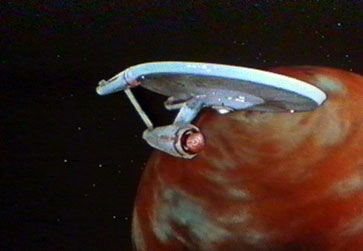
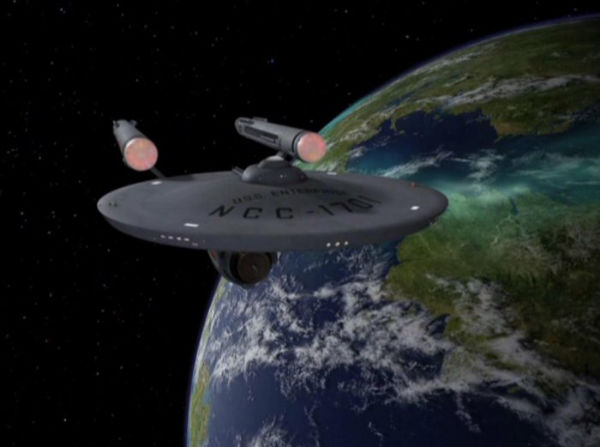
I was at first disappointed to find that, as well as being remastered, the original show had had as many effects shots as possible replaced by computer-generated digital sequences. I was prepared to be outraged. But, having watched a few — and though I do miss those endless shots of the Enterprise orbiting a different-coloured but otherwise identical swirly-atmosphered planet each episode — I have to admit the new effects don’t at all stand out like the fistful of sore thumbs I was expecting. They fit right in. (The important thing is that those studio-bound planet sets are still there — so much a part of the feel of the original series, just as the studio-bound alien landscapes of Doctor Who’s like “The Brain of Morbius” or “Planet of Evil” are. I don’t care about their lack of realism, I even quite like their obvious theatricality.)

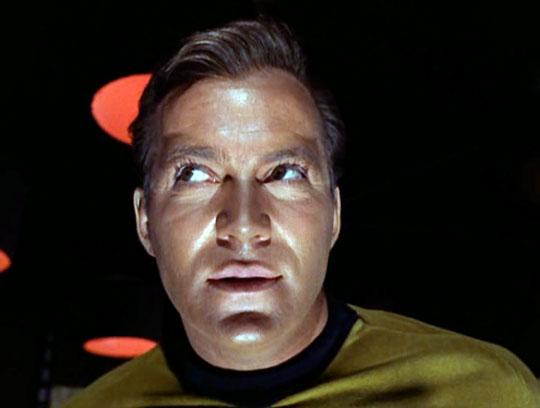
It’s been strange seeing the show after a gap of — eek! — almost thirty years. No doubt because of the age I was when I first watched it, I remembered the show begin quite different. I thought it was all action and sci-fi fantasy, but now I’m seeing a lot more character stuff than I ever was aware of at ten or eleven. Also, genuine SF-style ideas! Not every episode, but the one I’ve just watched (“The Enemy Within”) does present its theory of what makes a hero a hero, a captain a captain, with its story of Kirk’s tussle with his darker side. (An episode written by Richard Matheson, I note. That’s one thing I was never aware of when I saw the series originally: the fact that there were some big SF names involved. But then again, I’d never heard of Harlan Ellison or Richard Matheson when I saw Star Trek the first time.)

One question I had to answer was what order to watch the episodes. There seem to be so many options — by stardate (internal chronology), by production date, or by original broadcast date. I went with original broadcast date, and my initial reaction, on watching the first, “The Man Trap”, was to wonder how anyone watching it could have understood it. There was no effort at introducing the characters, let alone the SF ideas — transporters, phasers — that the show relied on. But obviously it worked.

The next thing that struck me was how every one of the five episodes I’ve watched so far — the first five to be broadcast — were about some sort of enemy within, or an enemy masquerading as a human. The Enterprise may have had its mission to explore strange new worlds, seek out new life and new civilisations, but its first five stories are really all about the invasion of the Enterprise itself. (Well, as Nietzsche said, “if you gaze into the abyss, the abyss gazes also into you”.) We have a shape-changing alien, two lots of humans transformed into monsters by the acquisition of super powers, and then two lots of strange influences that cause the crew of the Enterprise to become a danger to itself. Just when I thought this had to end, episode five was entitled “The Enemy Within”! Was this all post-McCarthy communist witch-hunt aftershocks? Or pre-shocks of the coming flower-power revolution? (The show seems to have one foot planted in the fifties — in Forbidden Planet rocket-power and spaceward-ho optimism — and another in sixties introspection, self-exploration and far-out-ness. The episode “Charlie X”, for instance, gives us a teen very much in the bryl-haired fifties mould, still innocent enough at the age of 17 to have some respect for authority, while the crew’s women are, generally, very much of the hive-hairdoed, cone-bra’d fifties type; while “The Naked Time” seems almost explicitly to be about the coming drop-out generation’s “let it all hang out” philosophy — and its use of LSD — alongside fears of society’s fragmentation as a result. The Enterprise is on a five-year trip, man.)

One obvious difference between Star Trek and Doctor Who is that the main characters in Star Trek all wear uniforms. They’re integrated parts of an established (and admirably inclusive) society. The Doctor, on the other hand, is not just an individual, he’s an outcast, an outsider, one who has rejected his originating society. This isn’t by any means a criticism of Star Trek, but it is something that makes these “enemy within” style stories possible, perhaps even necessary. Doctor Who has done something similar (right near the beginning, with the TARDIS-bound paranoia-fest, “The Edge of Destruction”), but certainly not on the scale of Star Trek. Star Trek is about a society venturing into space, facing the unknown; Doctor Who is about an individual (or a small, disparate gang) bumming around, turning up at random, doing good on principle rather than by mandate. Star Trek, which really seems more rooted in Forbidden Planet than merely its use of Commander John J Adam and crew’s mission to other planets, is much more about facing “the Monster from the Id”, and that whole Freudian idea that man can never truly live as himself in a well-ordered society, but must suppress his wilder, weirder, more alien, impulses. Doctor Who (which, if it has a single story-seed, would of course be The Time Machine, with the Thals and Daleks as its Eloi and Morlocks), though it has of course battled with its own “Monsters from the Id” (in “Planet of Evil”, it’s own Forbidden Planet rip-off), is less Freudian and perhaps more Jungian, with the Doctor’s impulse to explore the universe more along the lines of the sort of quest for individuation Jung saw as the prime psychological motive for us doing what we do.

But enough amateur psychology, I’m off to enjoy another episode.

Live long and prosper!

(Oh, and talking of Forbidden Planet, I’m really looking forward to this coming out.)

^TOP

BioShock 1 & 2

I play one or two video games a year, partly because I don’t spend many hours per week playing them, and partly because my tastes (and gaming abilities) seem to be different enough from the marketplace in general that I can’t find many I know I’m going to enjoy. (And also, of course, because they’re expensive, which puts me off too much experimentation.) I like, above all, games which tell stories — and I don’t just mean those which have a cutscene or two to explain why we’re moving from level one to level two, but games with some sort of genuine emotional content. Failing that, games which allow me to explore an atmospheric environment. Among the former, I’d place the Myst series (particularly Myst III), Final Fantasy VIII, and Ico; among the latter, the early Tomb Raider games. (I haven’t finished any of the more recent Tomb Raider offerings, but the first five are among the few I’ve played twice, all the way through.)

BioShock 2, which I finished recently, sits sort of halfway between.

The BioShock games take place in the city of Rapture, built in the 1950s by plutocrat Andrew Ryan, whose idea was to create a place in which people could live without government interference — specifically, without the government placing any limits on what profit-hungry businessmen and knowledge-hungry scientists could get up to. And as the only place to build such a city is the bottom of the Atlantic Ocean, that’s where he builds it: a magnificent Art Deco temple to consumerism, leisure, and wild genetic experimentation. In its later, semi-ruined state, it makes a wonderfully weird game environment.

Ryan’s ideals are based on those of the writer Ayn Rand. What little I know about Rand comes from my one attempt at reading her brick of a book, Atlas Shrugged, which seemed to be mostly about self-indulgent industrialists moaning at how labour laws interfere with their profit margins. Rand believed governments shouldn’t get in the way of business tycoons by imposing such things as minimum wages and worker’s rights. Life, for Rand, was meant to be a fight for survival in which the strong impose their will on the weak as much as their strength allows. Rapture was conceived of as the living example of her ideals, but it quickly descends into chaos, and by the time you visit it as an outsider in the first BioShock game, it’s nothing but a once-beautiful ruin populated by deranged, feral “gene splicers”, and a handful of holed-in entrepreneurs clinging to their failed ideals.

But the core story of BioShock is about rescuing innocence. Fifties America, from which the games get so much of their look and feel, was one of the last modern eras to have a culturally-accepted idea of innocence. It was an era that allowed itself to believe in simple ideals. This tends to be seen, nowadays, as a veneer over the decade’s intolerance and repression — as typified by the image of the housewife going quietly insane trying to live up to advertisers’ ideals of perfection, or the awful race riots in the country at the time — and anyway it was all put paid to by a combination of Senator McCarthy’s paranoia, the fear of atomic war, the disaster of Vietnam, and the assassination of JFK, among other things. By the sixties, the belief in innocence was relegated to the hippie counterculture, and then was pretty much laughed out of court. Since then, cynicism has become the cultural norm, to the point that it’s often referred to as realism.

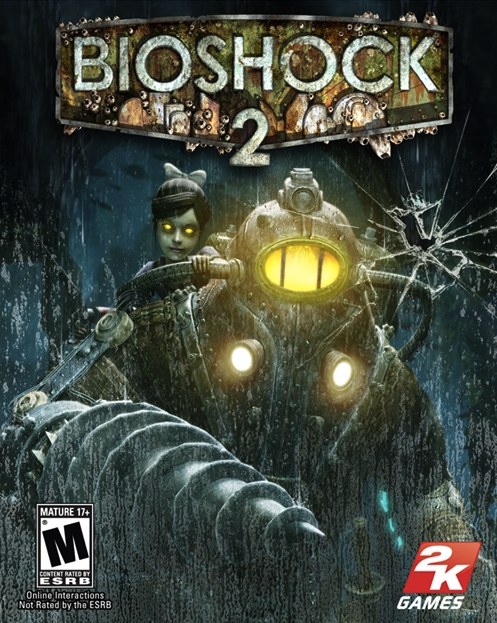
The ruined Art Deco beauty of the city of Rapture is ruined innocence in concrete, glass and formica. But it’s the figures of the Little Sisters who are the real focal point. The Little Sisters are little girls, dressed to the girliest in Alice bows and petticoated dresses, but who have evilly glowing eyes and go around draining corpses of the gene-modifying substance known as “Adam” with monstrous syringes. In this, they’re accompanied by their protectors, the Big Daddies — dumb, lumbering giants looking like old-fashioned deep sea divers, who tramp obediently after their charges and attack anyone who gets too near. But the Little Sisters are in fact real little girls — orphans, as if the screw needed a further turn — who’ve been genetically altered by Rapture’s scientists to harvest Adam. The story of both BioShock 1 & 2 is ultimately about freeing these little girls from the tyranny of Rapture, and returning them to being innocent children once more.

BioShock allows its players to make a few moral choices. You need to capture Little Sisters to get supplies of Adam, for instance, but having captured them, you can choose to rescue them, or harvest them (which gets you more Adam, but kills the girl). I, being an awful softie, just couldn’t harvest them, even to find out how it alters the game’s outcome.

Other than that, BioShock is basically a shoot-em-up. The story part progresses mostly through taped journals from a variety of characters you find throughout the game, but the gameplay generally consists of collecting a wide variety of ammo and blasting the hell out of gene-splicers and Big Daddies.

Which was fun.

As a game, I found both BioShock 1 and 2 to be wonderfully playable, and though the story never quite reached the heights of the games that really involved me in their characters (Final Fantasy VIII, Myst III), it at least had some thought-provoking ideas behind it. Games achieve their effects in a different way from films and books; the major factor is the time you spend in the game’s world, doing the same sort of action (exploring, puzzle-solving, fighting) over and over again. It’s in this area that the real meaning of a game comes out, not in the cut-scenes. And it’s in this area — the gameplay — that BioShock works best.

Nice to know there’s a bit of artistry as well as mere commercialism in games, still.

^TOP