Solaris by Stanisław Lem

Solaris was first published in Poland in 1961, and in English translation in 1970 — though this translation (the one I read), by Joanna Kilmartin and Steve Cox, is based not on the original Polish, but a 1964 French translation by Jean-Michel Jasiensko. (It’s only in 2011 that a direct English-from-Polish translation came out, by Bill Johnston, though it’s not yet available as a print edition. I’d have read this one, though, if I had done my research beforehand.)

I was prompted to read Solaris following a vague train of thought about non-horror treatments of the sort of cosmic themes Lovecraft addressed — the human individual set against the immensity of the universe, encounters with the incomprehensible/truly alien, and so on — first in Stapledon’s Last and First Men and Star Maker, and now here. Solaris certainly brushes up against the horrific — I’d say it has a more viscerally distressing moment than anything in Lovecraft’s fiction, simply because it’s magnified by the sort of emotional aspects Lovecraft left out — but though it insists on the same incomprehensibility of the cosmos, Solaris simply doesn’t treat it as horror material.

Polish first edition

The novel is narrated by Kris Kelvin, who arrives at a research station hovering above the world-spanning ocean of a distant planet, Solaris, expecting to be greeted by the station’s three inhabitants, but finds nobody around and the place in disarray. He finally locates Snow (Snaut in the original), in as much a state of disarray as the station, who at first reacts in fear. When he’s assured Kelvin is who (and what) he says he is, Snow tells him the station’s leader, Gibarian, took his own life that morning. He then gives a number of obscure but vague warnings before asking to be left alone:

“Keep a hold on yourself. Be prepared to meet — anything. It sounds impossible, I know, but try. It’s the only advice I can give you.”

The planet Solaris was discovered over a century before Kelvin was born. An apparently uninhabited world, it elicited scientific interest when it was realised the planet didn’t follow the expected orbital path around its twin suns. It should have been moving through forbidding extremes of temperature, but instead kept within a narrow range, almost as though some force were acting on it to keep its environment stable, even habitable. Could it be the planet’s “ocean”? Described as “a sort of gigantic entity, a fluid cell, unique and monstrous… surrounding the globe with a colloidal envelope several miles thick in places”, it’s a mysterious, ever-moving substance that sometimes forms itself into vast, solid structures, only to let them lapse. Could it be, scientists began to wonder, that these weren’t random effects but the thought processes of some vast sentient organism, in effect a world-sized liquid brain? And so the scientific field of Solaristics was born.

But in the hundred-plus years since, almost nothing has been definitively learned about this mysterious “gravity-controlling colloid”. Looking through one of the many exhaustive and authoritative books on the subject, Kelvin sees:

“Multicoloured illustrations, picturesque graphs, analytical summaries and spectral diagrams… explaining the type and rhythm of the fundamental transformations [of the ocean] as well as the chemical reactions. Rapidly, infallibly, the thick tome led the reader on to the solid ground of mathematical certitude. One might have assumed that we knew everything there was to be known about this representative of the category Metamorph… In fact, by no means everyone was yet convinced that the ocean was actually a living ‘creature’, and still less… a rational one.”

Every attempt to communicate with this vast thing failed. Some scientists turned bitterly against it and did everything to disprove its potential sentience. Others concluded that, however interesting it was to human observers, the ocean itself simply wasn’t interested in them. At the point where the novel begins, Solaris studies are in a lull, but nobody is quite able to break away from this fascinating yet seemingly impenetrable mystery. But things are about to enter a new phase.

Arrow books PB from 1973

Waking up on his first morning in the station, Kelvin finds a woman in his room. He knows her — she’s Rheya (or Harey in the original, though I can see why the change was made), the woman he was in love with ten years ago. The only thing is, he left her, and as a result she killed herself. This Rheya is the same age as that Rheya, and even has the needle-mark from her fatal injection visible in her arm. Yet the skin of her feet is “soft, like that of a newborn child” and her dress, when she tries to remove it, proves to have no zips, and only ornamental buttons. It’s Rheya, but not Rheya. She’s not human, but she looks and reacts too much like a human being for Kelvin to easily treat her as not human.

She doesn’t remember how she got here, and seems unable to be separated from Kelvin — doing so causes her emotional distress and even physical pain — but Kelvin is at first horrified by her. He realises this is what Snow was trying to warn him about, and learns that the other members of the crew have their own “visitors”, though of different, but equally personal significance. (We never learn what Snow’s or — the other surviving station-member — Sartorius’s “visitor” is, though there are hints that Sartorius’s is a child or, even, a dwarf. Gibarian’s, though, Kelvin does see: a tall black woman, dressed in nothing but a grass skirt, like an exaggerated racial stereotype. Snow hints the “visitors” aren’t necessarily people you once knew, but embodiments of deep, often guilt-ridden, perhaps even perverse, emotional responses, which is one of the reasons the crew members keep themselves and their “visitors” hidden away from one another. They’re like walking advertisements of one’s deepest guilt, shame and vulnerability.)

First UK hardback, from Faber and Faber

Although the “visitors” think of themselves as what they appear to be — human beings — they are different at a sub-atomic level. Kelvin, at first refusing to learn from Snow’s cynical-sounding “wisdom”, rids himself of one Rheya only to find a new one there the next morning, oblivious to what he did to her. This is part of what’s putting such pressure on Snow and Sartorius, and what drove Gibarian to take his own life: the “visitors” are a constant reminder of (in Kelvin’s case) the guilt he feels at Rheya’s death, but they cannot be escaped. Worse, the apparently human side of “Rheya” can’t help being aware that something’s wrong with her, that she’s not what she thinks she is. The scientists do their best to discuss these matters in abstract terms, referring to “Phi-creatures”, and not stating things too explicitly, so they don’t distress these “visitors” any more than necessary — while also trying to work out how to rid themselves of them, or at least understand what their purpose might be.

Are they a form of communication from the world-ocean? Are they experiments the world-ocean is performing on its new human inhabitants, or are they attempts to drive those human beings away? Or are they just one more random natural process that surrounds this weird planet of Solaris, devoid of any purpose or meaning?

Ultimately, Solaris is about the essentially unknowable aspect of a truly alien encounter. As Snow says:

“We take off into the cosmos, ready for anything: for solitude, for hardship, for exhaustion, for death. Modesty forbids us to say so, but there are times when we think pretty well of ourselves. And yet, if we examine it more closely, our enthusiasm turns out to be all sham. We don’t want to conquer the cosmos, we simply want to extend the boundaries of Earth to the frontiers of the cosmos…”

Lem says his main idea in Solaris was “to present the problem of an encounter in Space with a form of being that is neither human nor humanoid”:

“I only wanted to create a vision of a human encounter with something that certainly exists, in a mighty manner perhaps, but cannot be reduced to human concepts, ideas or images.”

Iranian cover, art by Yiran Jia

In the same piece (written in response to the 2002 Soderbergh film of the novel, which he hadn’t yet seen, but is sure he won’t like), Lem goes on to compare Solaris with Melville’s Moby Dick and “Capitan Ahab’s pernicious quest for the white whale”. His novel certainly has a few chapters that recall the whale-related info-dumps of Moby Dick, as Kelvin reviews the century of Solaris studies, including the classification of the many forms created by the world-ocean, or the trends in how the ocean’s possible intelligence is judged, at length and in hard-science-fictional detail. For me, though, the first comparison to come to mind is with ghost stories, in particular Shirley Jackson’s The Haunting of Hill House, whose hauntings were equally personally tailored and psychologically manipulative of its poor victim, Eleanor.

But there’s also Mythago Wood. In both Holdstock’s and Lem’s novels, a vast natural form (a forest, an ocean) which can be read as a symbol of the unconscious, generates physical embodiments of what dwells in the human psyche, creatures which appear human and can be interacted with as human, but ultimately are not — or, perhaps, reveal our stranger, less-human-seeming innermost depths. As the narrator Kelvin says:

“Man has gone out to explore other worlds and other civilisations without having explored his own labyrinth of dark passages and secret chambers, and without finding what lies behind doorways that he himself has sealed.”

Solaris has the rare distinction of being adapted into films by both a Soviet-era Russian (Tarkovsky in 1972) and a big-name Hollywood American (Soderbergh in 2002).

Tarkovsky’s adds a preceding section on Earth (including here some of the material that, in the novel, was in the later info-dump chapters), and adds a somewhat trippy/highly symbolic ending which perhaps contributed to its being seen, at the time, as Russia’s answer to 2001. But it’s certainly engaging with the ideas of Lem’s novel, even if (as it should) it takes them in Tarkovsky’s own direction.

Tarkovsky’s Solaris

Soderbergh’s, on the other hand, seems far too intent on hitting the emotional highs without laying the necessary groundwork of plot, situation, or character. The early part of the story is dealt with so perfunctorily, it was obvious the filmmakers had no interest in anything till the drama between Rheya and Kelvin could get underway. Solaris, here, isn’t introduced at all, and it was only in a DVD extra that I discovered the filmmakers thought of it not as a planet with a perhaps-conscious ocean, but a planet-sized entity, seemingly made entirely out of energy. Nobody talks about the possibility of contact with this thing, and the mission is purely one to evaluate Solaris for commercial exploitation. (I’m sure there’s a metaphor for Hollywood there, somewhere.) It ends with a handful of twists, some obvious, some interesting, but in the end doesn’t, in my opinion, hit any note with sufficient force to leave much of an impression.

Soderbergh’s Solaris

Lem seems to have disliked both adaptions — in the case of the Soderbergh, without even seeing it — but that’s a common enough authorial stance. Certainly, his novel provided a template for some of the more thoughtful alien encounters in SF in subsequent years (Arrival, for instance).

For me, there’s an aesthetic to Solaris — both the novel and the films — of a pristine, almost surgically-clean technological surface, an island of apparent placidity and rationality amidst the bleakness and alienness of space, but one that serves to evoke the deepest human emotions of loss, guilt, and of vulnerability to one’s own undiscovered reaches. But I think this sort of emotional evocation works best with a light, even distanced touch, something the Soderbergh adaptation certainly doesn’t do. In space, no one needs to hear you scream; the vacuum, darkness, and immensity is scream enough.

^TOP

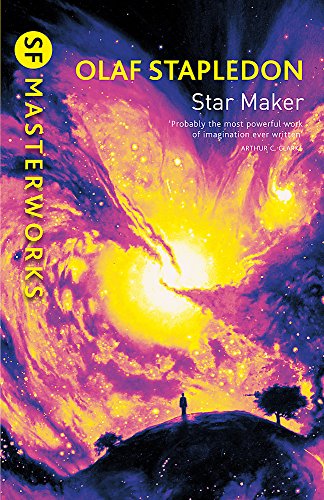
Star Maker by Olaf Stapledon

First HB dustjacket, from Methuen, art by Ethel “Bip” Pares

After his first novel, Last and First Men, Stapledon published Last Men in London (1932) and Odd John (1935), but it was 1937’s Star Maker that was the true successor to his first book.

Like that debut, Star Maker isn’t so much a story as a trip through time (and, in this case, the entirety of space as well, before moving outside both space and time in the final chapters). It starts with its narrator leaving his family home one night in a state of bitterness, to sit on a hill and regard “our own house, our islet in the tumultuous and bitter currents of the world”. Soon, it is not his own little house he’s regarding from the outside, but his world, Earth, as some force takes him up on the start of this novel’s journey:

“The Earth appeared now as a great bright orb hundreds of times larger than the full moon. In its centre a dazzling patch of light was the sun’s image reflected in the ocean. The planet’s circumference was an indefinite breadth of luminous haze, fading into the surrounding blackness of space… The spectacle before me was strangely moving. Personal anxiety was blotted out by wonder and admiration; for the sheer beauty of our planet surprised me. It was a huge pearl, set in spangled ebony.”

This makes me think of the famous “Blue Marble” photograph of the Earth seen from space, taken in 1972, and how it and other Earth photos (Wikipedia has a timeline of them) brought out the preciousness of this speck of rock that we call home, thinly coated with a life-preserving environment, an island in a vast, harsh vacuum — just as Stapledon describes it — and how that fed into the burgeoning environmental movement. (And this makes me wonder who was the first writer to properly see the Earth as such a “Blue Marble” in fiction.)

David Pelham art for 1972 Penguin PB

The narrator becomes “a disembodied, wandering view-point”, capable of inhabiting the minds he encounters, and sharing their experiences. He finds he can enter into dialogue with these beings, and that they can even become fellow travellers. Soon, the narrator is at once the Earthman experiencing all the wonders and mysteries of the cosmos, and a conglomerate of disparate beings, all journeying, like him, by mind, experiencing the many worlds they encounter, learning their stories. In their quest, this narrator becomes aware that he and his fellow travellers can move through both time and space, the only limit to their travels being that they can’t connect with — even become aware of — planets whose inhabitants have evolved to a level of consciousness too far beyond their own. They have to advance their own awareness and understanding before they can experience these more realised beings, or even perceive them as more advanced. There is, for Stapledon, no way to be a purely passive viewpoint and genuinely perceive the truth; you have to be altered by what you see.

As he/they range on this cosmological quest, the narrator becomes aware that “every world that we entered turned out to be in the throes of the same spiritual crisis as that which we knew so well on our native planets”:

“…in which the ideals of the masses are without the guidance of any well-established tradition, and in which natural science is enslaved to individualistic industry…”

This, to me, sounds so much like the modernist crisis of the early 20th century, as found in the likes of T S Eliot and Virginia Woolf: an existential crisis of meaning, driven in part by the First and Second World Wars (themselves perfect metaphors for “natural science… enslaved to individualistic industry” and taken to mass-murderous extremes), but also by the destabilisation of so many ideas and ideals thanks to the revolutions in thought brought about by Darwin, Einstein, and others. As Stapledon’s narrator sums it up at the start: “horror at our futility, at our own unreality, and not only at the world’s delirium”. But whereas the emphasis in the literary moderns, who were often staunchly elitist, is on the sensitive individual suffering from angst and despair, Stapledon sees this as a worldwide crisis, whose roots lie in the clash between the lone individual and the community:

“This crisis I came to regard as having two aspects. It was at once a moment in the spirit’s struggle to become capable of true community on a world-wide scale; and it was a stage in the age-long task of achieving the right, the finally appropriate, the spiritual attitude toward the universe.”

Les Edwards art from 1999

Star Maker, then, is an attempt to understand this early 20th century moment by stepping outside it and asking: “What if this weren’t just our own dark moment, but a stage that all intelligent races in the universe go through — what if it has a million variations throughout the cosmos? Why might it be necessary?” The answers, for Stapledon, lie in the reason for all of this — life, the universe, everything — and so in the nature of its creator, the Star Maker.

First, though, he has to confront the fundamental question of whether there is a Star Maker. There are certainly moments of cosmic despair as the narrator ranges through the universe:

“The appalling desert of darkness and barren fire, the huge emptiness so sparsely pricked with scintillations, the colossal futility of the whole universe, hideously oppressed me.”

I fully expected Stapledon to leave the question of whether there was a Star Maker hanging till the end — in the classic Lovecraftian style of ending with the moment of overwhelming confrontation — or perhaps to never answer it at all. But no, Stapledon wants to examine what such a Star Maker would be like, so he has to have one and bring it on stage. At first, his narrator becomes aware of the Star Maker through its many aspects. One moment it’s “sheer Power”, another it’s “pure Reason”, or “Love”, or “unreasoning Creativity”. But these are just the trunk, tusks, tail and legs of an elephant too vast for him to perceive as a whole. All the time:

“The felt presence of the Star Maker remained unintelligible, even though it increasingly illuminated the cosmos, like the splendour of the unseen sun at dawn.”

Peter Goodfellow art, from 1979

Even at the end the Star Maker remains — has to remain, if Stapledon is to be intellectually honest — “a dread mystery”. It’s interesting that one of the books that influenced Stapledon in his writing of Star Maker was Rudolf Otto’s The Idea of the Holy (1934), which was about the essentially incomprehensible, alien, or inhuman aspects of divinity, and how the holy is so often associated with darkness — interesting because Otto’s book was also a key influence on C S Lewis, and fed into the shadowy aspect of the primitive goddess Ungit and the not-to-be-looked-on Mountain God in Till We Have Faces. Both Star Maker and Till We Have Faces are about how we cannot even begin to perceive the nature of the divine (or of that level of reality we might call divine) until we ourselves have changed. (Lewis, though admiring Stapledon’s book, thought it “ends in sheer devil worship”.)

Stapledon’s approach (or his narrator’s), in this novel, has been to try to understand the crisis early 20th century Earth is going through by rising above it and putting it into a new and wider perspective. At first, that perspective is to learn that other worlds are going through the same crisis — in fact, have to go through it. Then, rising above that level, he discovers that not only species go through this crisis, but stars too — stars, in Star Maker, are conscious entities, and one of Stapledon’s most inventive moments is to reveal that what we think of as the universal laws of gravitation that dictate how the stars must move in their galactic orbits are, to the stars themselves, closer to social rules or aesthetics. They have no need to obey them — they are, then, not laws — but the stars do obey them, because not to do so would bring them shame and a kind of aesthetic pain.

The ultimate end of this rising-above approach is to see humankind — and the many created races that inhabit our universe with us — from the viewpoint of their creator. What, then, are we, to the Star Maker?

“And at once I knew that the Star Maker had made me not to be his bride, nor yet his treasured child, but for some other end… It seemed to me that he gazed down on me from the height of his divinity with the aloof though passionate attention of an artist judging his finished work; calmly rejoicing in its achievement, but recognising at last the irrevocable flaws in its initial conception, and already lusting for fresh creation.”

The Star Maker, it turns out, has a dual nature. It is at once outside and (when engaged in creation) inside time, evolving in response to what it has created. Stapledon’s cosmos is not an entirely top-down hierarchy. Humankind, and the other races, are not just there to be the playthings of their creator, but to teach that creator how to better create. Which could be a harsh sort of idea — our purpose, it seems, is to be flawed, and to try but fail, so the next iteration of creation might be less flawed — but it comes, for Stapledon’s narrator, as a kind of consolation:

“The incalculable potency of the cosmos mysteriously enhanced the brightness of our brief spark of community, and of mankind’s brief, uncertain venture. And these in turn quickened the cosmos.”

Jean-Michel Nicollet art from a 1979 French translation

What, for me, sets Stapledon’s cosmicism apart from, say, Lovecraft’s (who reveals what I take to be his own longing to be a “disembodied, wandering view-point” in the universe in The Whisperer in Darkness), is that Stapledon is always aware of — insists on — there being both a plus and a minus. At every stage in his narrative, an intelligent race of beings triumphs only to realise its limits, or to find there is more striving to be done; or it fails and learns and starts again. Ultimately, even the tragedies have a purpose. This can make reading Stapledon, particularly as a piece of sense-of-wonder science fiction rather than of philosophy, a mite frustrating, as every payoff is tempered, every revelation is not quite the last. (Another comparison is with Clark Ashton Smith’s The Hashish Eater, whose narrator indulges in a superficially similar experiential tour of the universe, though unlike Stapledon’s narrator he tries very much not to become involved or changed by the wonders he sees — until the final confrontation with that “huge white eyeless Face”, which is where Smith leaves it. Stapledon pushes on, still asking questions.)

Spine of the first edition

Is there a final answer, then, to the modernist crisis that kicked this novel off, and those questions the narrator asked at the start:

“Had we, perhaps, misconceived our whole existence? Were we, as it were, living from false premises?”

The response Stapledon gives is a typically Stapledonian one, in that it isn’t any sort of final answer, but is, rather, an opening up of new questions. Returning to Earth, at the end, the narrator is struck by “The littleness, but the intensity, of earthly events!” He sees his own situation, then, from not a new perspective, but from two perspectives: not just that of the human being caught up in his own troubles and all the intensity of a contingent, mortal life, but also from the cosmic viewpoint, from which his suffering is really quite a minor thing, but nevertheless part of a much larger, ultimately hopeful, project of creating something better.

This is perhaps the key thing that prevents Stapledon from writing Lovecraftian cosmic horror. He does see and acknowledge the horror, but also acknowledges that it is, however true to the one perceiving it, only one perspective among others. The point is not to be caught in one viewpoint — not that of the suffering mortal, nor that of the vastly removed Star Maker — but to move between them, to step outside or inside as required.

(Which is what I’ve always thought is one of the main benefits of “escapist”and imaginative fiction: the ability to step outside of it all, get a new and expanded, or at least refreshed, perspective, then return.)

Is Star Maker fiction or philosophy? Reviewing it in The Sketch when it first came out, L P Hartley called it “the most ambitious novel, if novel it can be called, that I ever read”. It’s certainly not a story, as most novels are. It uses the techniques of fiction to present a philosophical idea of how the cosmos might be ordered, of how the crisis of 1937 might be faced. If Stapledon had written about the nature of his Star Maker as philosophy, he’d have been dismissed as a fantasist; but by writing it as fantasy, he can say something that feels like a sort of truth, even if it doesn’t have to be taken as literally true.

At the same time, it’s a difficult read — far more abstract, and (literally) disembodied, than his Last and First Men. One of those monuments of imaginative literature, Star Maker is a book that, for me, has grown the more I’ve thought about it.

^TOP

Last and First Men by Olaf Stapledon

US HB, published by Jonathan Cape

How to approach Olaf Stapledon’s future history epic Last and First Men today? It was first published in 1930 (by Methuen, who clearly weren’t too burned by the poor sales of David Lindsay’s A Voyage to Arcturus ten years before), and its first chapters — all the ones which use such terms as Europe, America, Britain and China — were instantly outdated by the outbreak of the Second World War. These early chapters, which perhaps might be read as satire if Stapledon were of a more satirical bent, are anyway the least interesting. (The most successfully satirical moment, perhaps, is a Gulliver’s Travels-like glimpse the Second Men get of our own primitive descendants, still recognisably human but fallen into serving as beasts of burden and objects of mockery for a race of semi-intelligent monkeys, about 10 million years from now.)

It’s after the rise of the Second Men that Stapledon’s novel really becomes what it’s meant to be — not political commentary or satire, but a

“…serious attempt to envisage the future of our race; not merely in order to grasp the very diverse and often tragic possibilities that confront us, but also that we may familiarise ourselves with the certainty that many of our most cherished ideals would seem puerile to more developed minds. To romance of the far future, then, is to attempt to see the human race in its cosmic setting, and to mould our hearts to entertain new values.”

Magnum 1978 PB, art by Peter Goodfellow

Last and First Men, he goes on to say in his Preface, “is not prophecy; it is myth”.

But what sort of myth? Stapledon is writing in the cosmic mode (which might be considered the religious aspect of atheism), but not cosmic horror a la Lovecraft. Take a passage such as this, a direct pronouncement of the book’s narrator (one of the Eighteenth, and final, race of humans, dictating this novel from billions of years in our future):

“Great are the stars, and man is of no account to them. But man is a fair spirit, whom a star conceived and a star kills. He is greater than those bright blind companies.”

The first sentence could be Lovecraft, but by the third we’re in a different mindset altogether. Brian Aldiss and David Wingrove, in their history of science fiction Trillion Year Spree, point out both Stapledon’s link to, and difference with, cosmic horror by comparing him to another writer in that genre:

“We may suspect that Stapledon’s alienation was at least as severe as [William Hope] Hodgson’s; but Stapledon’s powerful intellect has shaped his mental condition into a metaphysic.”

So if it’s not horror, what’s a better term for Stapledon’s brand of cosmicism?

Dover Books omnibus with Star Maker

To him, humankind is not, as with Lovecraft, an insect-like nothing crushed by immense and indifferent alien powers, but a potentially noble race. This nobility, though, doesn’t come from being the favoured creation of a benevolent Deity. It’s self-generated, derived from an intelligent self-consciousness that allows it to appreciate both its huge potential and its immense vulnerability. Humankind, in each of the eighteen “races” Stapledon presents us with, is constantly beset with difficulties, both self-created (the “anti-social self-regard” of the First Men, for instance, which led to so many self-destructive wars), and visited upon it by the workings of a genuinely indifferent cosmos, whether this be disease, natural disaster, or shifts in the conditions of our solar system that threaten our delicate survival.

A growing awareness of this vulnerability only heightens the potential, as Stapledon sees it, for each of the races of humankind to achieve a fulfilment of its place in the cosmos — not because this is destined to happen, but because not to do so would be a waste of such a “fair spirit”. Stapledon doesn’t believe this fulfilment is guaranteed by any means, even given the many millions, if not billions, of years through which he pursues these eighteen races, each one “in spite of innumerable digressions, a single theme, a single mood of the human will”. In fact, he seems to take it as granted that such a fulfilment may never occur (unless that fulfilment is to be found in the attempt, rather than a final moment of achievement).

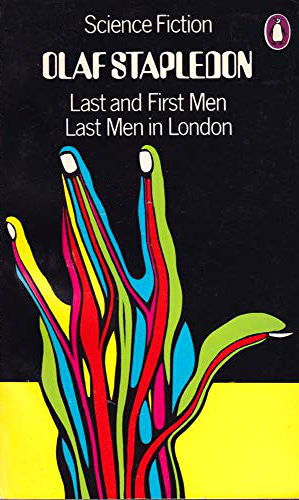
Penguin omnibus with Last Men in London, art by David Pelham

Perhaps, then, the best way of describing Stapledon’s brand of cosmicism isn’t cosmic horror but cosmic tragedy, though it’s a tragedy of genuine nobility faced with insurmountable odds, not the Shakespearian type of tragedy in which an overweening nature gets ideas above its station. (Perhaps cosmic elegy might be a better term, if an elegy can be written while its subject is still alive.)

There’s something of this tragic air in the moment when the Second Men find the knowledge-tablets of the First Men, which that initial race of human beings created so as not to lose all they felt most valuable when faced with a race-threatening disaster. Deciphering the tablets, the Second Men find little in this culmination of their predecessors’ civilisation to be of any interest:

“The view of the universe which the tablets recorded was both too naïve and too artificial; but the insight which they afforded into the mind of the earlier species was invaluable.”

The one thing the Second Men do value are the words of what the First Men called the Divine Boy, a prophet who preached an at-the-time unpopular way of understanding life:

“For I seemed to see a thousand worlds taking part with us in the great show. And I saw everything through the calm eyes, the exultant, almost derisive, yet not unkindly, eyes of the playwright.”

We should, Stapledon seems to be saying, learn to look at ourselves — our lives, our strivings, our failures — in purely aesthetic terms. Not as an excuse to escape into make-believe, but, in the words of the Second Men, so that “Seeing the depth, we shall see also the height, and praise both.” Or, as the Last Man-narrator puts it:

“But this we know: that we ourselves, when the spirit is most awake in us, admire the Real as it is revealed to us, and salute its dark-bright form with joy.”

Humankind, for Stapledon, “is dignified by his very weakness, and the cosmos by its very indifference to him”. It’s an outlook that has the same conditions as Lovecraftian horror, but which has plenty of room for things of genuine (though never lasting) human value.

The metaphor Stapledon reaches for is of “that great music of innumerable personal lives, which is the life of the race”. As the Last Men say:

“For we shall make after all a fair conclusion to this brief music that is man.”

Which reminds me of David Lindsay in Devil’s Tor — another novel of the 1930s — who uses the same metaphor, also in the same atmosphere of cosmic-level tragedy:

“It was like the ordered emotion of a far-distant orchestra numbering, not hundreds, and not thousands, but millions, it seemed, of instruments… … each instrument, with its voice of unique timbre, should be proclaiming its own peculiar message…”

C S Lewis found Stapledon (as he did Lindsay) both imaginatively inspiring and philosophically detestable. In fact it seems to be Stapledon, rather than Lindsay, who was the immediate spur to Lewis writing Out of the Silent Planet, through a need to take what he thought of as Stapledon’s “desperately immoral outlook” and critique it through the character of Weston. (And, just as Lewis found Lindsay’s A Voyage to Arcturus “detestable, almost diabolist”, he thought Stapledon’s sequel to Last and First Men, Star Maker, “ends in sheer devil worship”.)

Whereas for Lewis the world was as God made it, and it was up to humankind to fit in with the cosmic harmony or suffer, for Stapledon suffering was the only thing that was guaranteed, making it all the more important that humankind should work towards its own kind of meaning and fulfilment. For Stapledon, there was no cosmic harmony, because everything is in constant flux, and we must instead learn to appreciate this difficult cosmic music, with all its dissonances. For him, humankind reaches its apex in the Fifth Men, but they’re not the end of the story — far from it — for no sooner have they embarked on their path of perfecting the expression of their potential, than they realise the Earth will soon become uninhabitable, and they’ll have to move to a new world, one where the need to adapt will send them back into primitive forms of life, and into a whole new series of cycles of striving and failure.

Last and First Men is not an easy read. As Brian Aldiss and David Wingrove say in Trillion Year Spree:

“The atmosphere Stapledon generates is chill but intoxicating. Reading his books is like standing on the top of a high mountain. One can see a lot of planet and much of the sprawling uncertain works of man, but little actual human activity; from such an altitude, all sense of the individual is lost.”

But something of its bleak but uplifting, tragic yet elegiac, mournful yet meditative feel comes through in the recent (2020) film by Jóhann Jóhannsson. This combines Stapledon’s words (read by Tilda Swinton), Jóhannsson’s sombre music, and black and white footage of the strangely futurological/modernist “Spomenik” — war memorials in the former Yugoslavia that were intended, through their abstract forms, to be relatable by all the region’s diverse cultures and beliefs. The result is “a requiem for the Last Men and for the ideals of a failed socialist Utopia” (quoted from the statement at the film’s official website) — but I nevertheless found it uplifting, through its insistence that, even in the face of a race-annihilating threat, humankind can strive for a level of meaning, and fulfilment, on its own terms.

Stapledon, evidently, had a belief in humankind as a united thing, with values and aims in common. Their enemy, as well as their teacher, was the cosmos in which they were born, and in which they are to die, and his eighteen races of humanity, though often breaking out in war, just as often find unified civilisations through which to express a common character. It’s hard to connect this with our often very fragmented world today, but it’s nice to be reminded of it as a possibility every so often.

^TOP