Twin Peaks

Twin_Peaks_BluRayIf you plotted the quality of Twin Peaks, you’d come up with a twin-peaked graph: it started brilliantly, and ended well, but dipped somewhat in between. In an ideal world, it wouldn’t have been a parody soap opera about the town in which Laura Palmer was murdered, it would have been a weird crime series, following the adventures of David Lynch’s FBI, a bunch of borderline-shamanic all-American good boys investigating the dark forces behind the most terrible crimes. (Which sounds like a cue for The X-Files, a couple of years later.) Certainly, what drives the pilot and early episodes is following Special Agent Dale Cooper (who I like to imagine as Kyle McLachlan’s character from Blue Velvet, grown up) as he uses a combination of acute observation, sharp deduction, dream-clues, intuition and sortilege (naming possible suspects then throwing stones at a bottle, seeing which one hits) to solve the mystery of Laura Palmer’s murder. Most of the parallel plots that were unrelated to the murder — the whole tangle of insurance & blackmail surrounding the burning of the Packard Mill, the mostly unfunny comedy of super-strength Nadine’s regression to her teenage-years — I could have done without.

David-Lynch_MJEBut, I’m a David Lynch fan (though a rare one, in that I like Dune but don’t like Eraserhead), and what made me re-watch the show for the first time since it was on TV wasn’t a desire to revisit the characters or world of Twin Peaks, but a desire to revisit David Lynch and his world. For me, creative as the others can be, the episodes Lynch directed stand out. The question is why. There’s a scene in the final episode (directed by Lynch) that’s nothing but a slow advance down an empty corridor, yet somehow it’s full of brooding tension. Or take another scene, this time at the end of the pilot episode, when Laura’s mother has a vision of a hand retrieving a necklace that’s been buried in the woods. Her sudden panicked reaction makes it seem like some sort of horrendous psychic violation is taking place. What Lynch brings to these scenes isn’t just in the scenes themselves, but the world he creates around them, one in which there’s a constant potential for reality to rip open and reveal something behind it, something full of irrational terror. His world is beset by a constant note of anxiety that adds meaning, or the threat of it, to the most mundane moments. It’s one of Twin Peaks’ most notable characteristics that, though it’s mostly played as a quirky comedy, it contains moments of genuine horror. But it isn’t a horror-comedy as, say, Shaun of the Dead is. Rather, the horror is made all the more horrific by being couched in such light comedy. And what’s different in Lynch’s episodes is that, while others might contain the same quirkiness (Dale Cooper coming face to face with a llama) or directorial inventiveness (a long, slow zoom out of a hole in a wall-tile), none of them catch the uppermost peaks of outright terror or downright strangeness that Lynch does.
twin_peaks_audrey

Throughout Lynch’s work, innocence is always coming face-to-face with horror — and, in his best work, not just coming face-to-face with it, but being corrupted by it, and then, crucially, coming through that corruption to a new, more profound and hard-won innocence, a redemption or a rebirth. This type of story is only ever played out lightly, if at all, in the TV series (whose characters, in line with most comedy, don’t really change), but it’s the core of the 1992 film, Twin Peaks: Fire Walk With Me. In my view, the TV series is utterly blown away by the film, which is one my favourites, along with Blue Velvet, Lost Highway, and Mulholland Drive. (Having just watched it again, after watching the whole run of the TV show, I found I’d enjoyed it more when I watched it standalone, away from the TV series.)

twin_peaks_ring

Lynch’s own view of the relationship between the TV series and the film is perhaps best expressed by the very first shot of Fire Walk With Me, in which a TV set, showing only static, is smashed by a baseball bat. Fire Walk With Me is Twin Peaks freed of its TV fetters. The opening half-hour — a further episode in the adventures of Lynch’s FBI boys, this time Chris Isaak as Special Agent Chester Desmond — is set in an out-of-the-way nowhere-place that’s all the town of Twin Peaks isn’t: its sheriff, unlike donut-noshing Harry S Truman, is utterly unhelpful and actively obstructive to the FBI (a deleted scene shows a fist-fight between him & Chester Desmond), the diner is manned not by former Miss Twin Peaks Norma Jennings, but fag-in-the-mouth cynic Irene, and the main residential area isn’t Twin Peaks’ upper middle-class suburbia but a rundown trailer park. The film still has the TV series’ surrealness and some moments of quirky comedy, but it has darkness in oodles — in nerve-jangling, nail-baiting, razor-laden dollops, until it’s almost too much to take. Twin Peaks: Fire Walk With Me is one of the most harrowing films I’ve ever seen, but one that nevertheless keeps me watching, and leaves me, at the end, feeling I’ve been through a genuine catharsis.
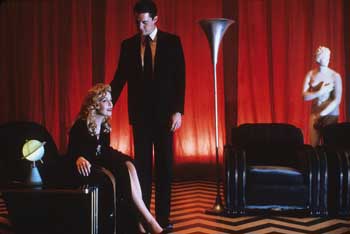
twinpeaks_fwwm

In it, Lynch raises Laura Palmer from being the clichéd beautiful murder victim of a serial killer to sort of a scapegoat, a victim of the disconnect between the town of Twin Peaks’ cosy surface and its dark underside. Caught between having to play the homecoming queen and dealing with the horror of abuse by the demonic Bob (whose supernatural nature can be taken as her own refusal to see who’s really abusing her — though this is a position undermined by the less ambiguous TV series), what sense of self she has grows thinner and thinner, till she has to say to her best friend: ‘Your Laura has disappeared. It’s just me now.’ It’s a drama that can only be resolved by switching from the normal reality of Twin Peaks (all cherry pie and damned fine coffee) to the weird, dreamlike otherworld of the Red Room, where the White Lodge and the Black Lodge are battling for her soul. Or are they working together for her redemption? It’s characteristic that Fire Walk With Me has less of the good-versus-evil, White Lodge-versus-Black Lodge feel to it: Red Room, White Lodge, Black Lodge — the alchemical significance of the colours Laura passes through is perhaps the key here, not the sort of duality the TV show was setting up.

^TOP

Neither the Sea nor the Sand by Gordon Honeycombe

Honeycombe_NTSNTSAnnie Robins, in her first venture away from an unloving mother and stroke-disabled father, travels on a whim to St Helier, Jersey, and there, despite her ‘unsociable, solitary nature’, falls deeply in love with Hugh Dabernon, seven years older but of a similarly solitary nature. They move in together, first into the house Hugh shares with his disapproving brother George, then into their own, more solitary home, above the island’s coast near the lighthouse at Corbière. Wanting, somehow, to get even further from human society, they take an unseasonal holiday in the far northwest of Scotland, and there, on a beach, Hugh drops dead. He gets up again some time later, but he’s still dead. Dumb (because breathless), blind to all but Annie (his gaze follows her even when she’s in another room), he does his limited best to obey the commands of the one and only love of his short life, though he can barely climb stairs. It’s all that Annie, in her distress, can do to get him home to Jersey, thinking there everything will be alright. When it isn’t, she calls George Dabernon, hoping he’ll know what to do with this dead-yet-not-dead brother, but she doesn’t get the response she hoped for:

‘It was the worst moment of George’s life, for it was unexpected, inexplicable, and tinged with blasphemy. Appalled at this resurrection, he gaped at the two of them…’

GordonHoneycombe

Gordon Honeycombe

This is a strange book, of just the sort of strangeness I like. It’s one, I can’t help feeling, that could only have been published before the Stephen King-led horror boom of the 1970s (Neither the Sea nor the Sand first came out in 1969), after which, commercial pressures would have skewed it more to outright horror than the ambiguous weird it is. Though it does feature a walking corpse, it’s not really horror; nor is it properly a love story, though love is the driving force. Whatever it is that binds Annie and Hugh together, the novel is more about Annie’s attempt to catch up with her always-just-out-of-reach Hugh, who is older, taller, more knowledgeable, more adventurous, and more robustly solitary than she is. The book opens with her trailing behind as he clambers up a steep hill in the Scottish wilds and she can barely keep up. Later, even when it’s he (now dead) who’s following her, the feeling is that he’s gone ahead, this time into death, though there’s a lingering part of him drawn back to her, as though she, or her love for him, were a lighthouse shining into the dark realm where he’s fallen. (The image of a lighthouse haunts the book, as does the sea.) The book is full of sequences of Annie following Hugh or Hugh following Annie, with one trailing behind, trying to catch up — right to the end, when we, as readers, follow a policeman, a doctor, a boy and a dog, who are following Annie, who’s following Hugh…

When we’re not following Annie or Hugh, we’re usually in the presence of some other character or (more often) pair of characters — a farmer and his wife, a GP and a neurologist, a policeman and his son — trying to understand what’s going on. They make no headway, whether they use common sense (the farmer and his wife), religious dogma (brother George), medical knowledge (the GP and the neurologist) or logical deduction (the policeman and his son). Annie, on the other hand, accepts Hugh’s return without the need to understand it, and it’s only when she has a moment of rational clarity, and sees him for what he is — a corpse, still walking — that she reacts with horror, and falls her furthest behind. Love, for these two, has to remain a shared irrationality, a thing that exists on the border between life and death, not at all a clearly-defined or explicable thing, which is perhaps why the pair need such solitude, as then there’s no need to explain. Annie comes through — after falling into her own death-like state, as though to experience this new way of being that Hugh has discovered — and finally finds a way of catching up with the man she loves.

NTSNTS_film02

Neither the Sea nor the Sand was the first novel of Gordon Honeycombe, best known as a newsreader for ITN in the 1970s, and for TV-AM in the 1980s, though a quick glance at his site’s biography reveals him to be a man of many accomplishments: an actor on stage (including with the RSC) and screen, a theatre director, adapter, writer, a TV and radio presenter. I can’t remember what brought me to this novel, but I was prompted into re-reading it when I recently found it had been filmed, in 1972. Honeycombe is credited with the screenplay (additional dialogue by Rosemary Davies). The main change is that Anna, played by Susan Hampshire, isn’t fleeing loveless parents but a collapsed marriage. This, for me, strikes the wrong note, as part of the reason the book works is that Anna is so young, vulnerable, innocent, and wilfully self-blinded to anything but the desperate fact of her one true experience of love, you can believe her unwillingness to accept Hugh’s death because she so needs it not to be true. The film’s Anna seems more down-to-earth, and the uniqueness of the bond between the two becomes that much less charged with whatever anguished power it is that draws Hugh back from the dead. Still, it’s an interesting film, part 60s in style, part 70s. Ex-Doctor Who companion Michael Craze is in it. It was retitled The Exorcism of Hugh in the US.

NTSNTS_film01

^TOP

Space: 1999, Series 1

Anything can happen in the next 1,339 words. There will be fist-fights, aliens, explosions, spaceships, laser guns shaped like staple-guns, and cosmic psychedelia, all bookended by what may be the third best SF theme music ever (after, of course, Doctor Who and Star Trek), which, like the show itself, is a mix of somewhat slow profundity (grandiose strings) and sudden bursts of pulpy shock (wah-wah’ed guitar). But is Space: 1999 the third best SF TV show (after, of course, Doctor Who and Star Trek)? Perhaps not to anyone who didn’t grow up with it. Only, Space: 1999 wasn’t really a show I grew up with. I saw it when I was about five or six (perhaps when series 1 came out in 1975, or maybe via later repeats), but then it disappeared, lingering only as a few fragmentary memories, till I watched it again recently on Network’s excellent Blu-Ray box-set. As far as I could remember, it was something like Star Trek (a militaristic journey through the depths of space, with a new planet/alien spacecraft/floating disembodied god-like entity each week), only a little more transatlantic, neither entirely British (no wobbly sets) nor entirely American. The most tellingly British detail: whereas Trek’s Captain Kirk solved the unsolvable Kobayashi Maru training exercise, Space: 1999’s Commander Koenig breaks the five-hour Moonbase Alpha jigsaw puzzle record… No, what Space: 1999 actually was, as I discovered on this re-watch, was a much stranger beast.

Space 1999 Title

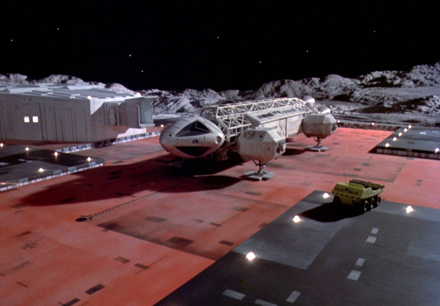
Launched a year or more before the game-changing Star Wars, Space: 1999 seems far more rooted in Kubrick and Clarke’s 2001: A Space Odyssey — in fact, it’s more of an odyssey than 2001, due to its never-ending journey from space-island to space-island, meeting god-like cosmic entities, psychic-powered sorcerers, and the constant risk of lotus-eating lures at each new potential home. Whereas a Trek episode would most likely peak in Kirk having a fist-fight with his latest adversary, Space: 1999 usually culminates in a psychedelic sequence that packs the ultimate meaning of the episode. Kirk & co. were on a mission, a sort of UN-like reaching out to the many peoples of the universe; Koenig & co. are scrabbling for survival in a universe that’s not only hostile, but incomprehensible, full of powers much greater, and much stranger, than anything our constantly wonder-struck heroes could ever be prepared for. Even though Trek’s crew met their share of god-like entities, it never caused them to question their fundamental place in the universe. With Space: 1999, a sort of awestruck humility before the vastness and weirdness of space is the whole point. What other SF show would feature lines such as these:

‘Every star is just a cell in the brain of the universe.’

‘The line between science and mysticism is just a line.’

‘Eva, we’re living in deep space. There’s so many things we don’t understand.’

‘We have learned many things. But above all, we have learned that we still have much to learn.’

Whereas in Trek the survival of the crew of the Enterprise always comes down to one of its members’ superior skills (Spock’s logic, McCoy finding a cure, Kirk punching or kissing someone), the people of Moonbase Alpha can only watch in helpless awe as they pass through a black hole, or are toyed with by inhuman ultra-powerful forces, and come through on luck alone.

Or is it luck? ‘Something brought us home,’ is a line from the third episode, ‘Black Sun’, in which our wandering moon passes through the titular (and then-highly-speculative) astronomical entity — a very strange episode, and even stranger as a third episode. In any other series, it would come much later in the run, as it’s the sort of story that shows us a different side to what ought to be long-familiar characters, testing them to helplessness in the face of utter annihilation. It’s odd, then, to have it happen when we’ve hardly got to know these characters.

Space1999_Eagle

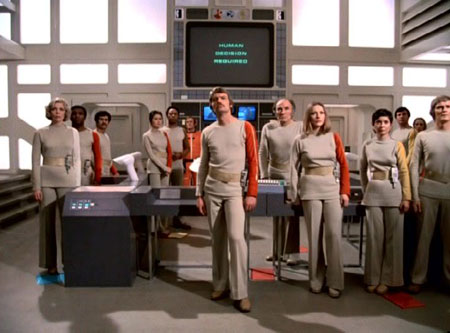
But that’s another thing about Space: 1999. The characters. Or, the lack of them. With Kirk & co., as with the Doctor and his feisty young TARDIS companion, we’re dealing with charismatic leads, clashing and bonding in the face of alien menaces and science fictional adventure. Martin Landau and Barbara Bain, playing Commander Koenig and Doctor Helena Russell, were the stars of Space: 1999, whose presence made the show US-money-friendly, but they play their roles in such a muted, almost deliberately bland way, it brings to mind another 2001 comparison: Koenig and Russell speak in such hushed, overly-reasonable tones, they remind me of HAL at his most murderous. To be nice, I’d say the people of Moonbase Alpha are meant to be everymen and -women, representatives of humanity itself, trying to survive in the weird, black void of space. But being more honest, I have to say it’s perhaps Space: 1999’s major failing that there’s no real interplay between any of the characters outside of their operative function on the base. They’re not people, but roles. Koenig is the commander: his role is to worry and command. Russell is the medical officer: her role is to worry and deliver medical advice. The others (Ziena Merton as Sandra — the most memorable face, for me — Nick Tate as gung-ho Alan Carter, Clifton Jones as David, the Computer operator, Prentis Hancock as Paul) have no scripted character, and need the actors’ natural charisma to bring them to life.

Space1999_Bergman

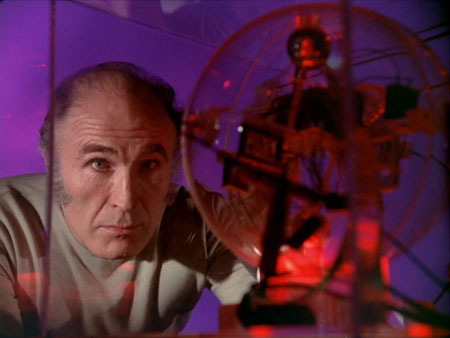
The exception, for me, is Barry Morse’s Professor Victor Bergman. Described by Morse as ‘a kind of space uncle’, he’s the exact opposite of the emotionally controlled Spock. Bergman is about the only person on Moonbase Alpha to have a personality. He delivers scientific — or, more often, pseudo-scientific, if not outrightly mystical — speculation with a shrug and a smile, even when he’s saying this may be the end of the human race, or that they may be facing forces beyond their comprehension, or that this might be a space-time-ghost so we should hold a scientific exorcism. He’s the source of most (if not all) of those quotes above.

Space1999_crew

Space: 1999 is a much more thoughtful show than either Trek or Who, but this is hardly the sort of praise to win over the network executives, let alone regular viewers. What is it that brings you back to a show? The characters. With SF or fantasy, it may be the world as well — the wonders, the action, the adventure — but it’s rarely the themes, the thoughtfulness. Those ought to be there, but as the icing on the cake, not the cake itself. With Space: 1999, the things that linger are the look (still good), and the weirdness.

But Space: 1999 wasn’t afraid to try things out. The penultimate episode of the first series — usually when you can expect a 24-episode run to be feeling a little tired — shocked the hell out of me. Suddenly, in a show that had so far been mostly staid and quietly psychedelic, in ‘Dragon’s Domain’ we have outright horror, with a multi-tentacled, single-eyed space-spider sucking in its hypnotised victims and spitting out their smoking, desiccated corpses, not once but three times in a row, in an extended, horrific sequence. In the same episode we get the first substantial flashback to pre-1999 Earth (as well as the first scene of actual emoting from Koenig and Russell — he gets angry at her, then makes up and she gives him a kiss, even if just on the cheek). Only Space: 1999 would make a show featuring so horrific a space-monster mainly about whether it existed in reality or merely in the mind of the man who survived it, but that just makes the episode even more interesting.

Space1999_tube

Space: 1999 changed in its second series. It lost the title music (why?!), it lost Victor Bergman (why?!!), it changed its set to one a lot less sparse and more seventies-coloured (why?!!). It did gain a shape-changing metamorph (dotty-eyebrowed Maya), but I’ll have to wait till Network release series 2 on Blu-Ray (hopefully later this year) before finding out how (or if) the stories themselves changed.

^TOP