Space: 1999, Series 1

Anything can happen in the next 1,339 words. There will be fist-fights, aliens, explosions, spaceships, laser guns shaped like staple-guns, and cosmic psychedelia, all bookended by what may be the third best SF theme music ever (after, of course, Doctor Who and Star Trek), which, like the show itself, is a mix of somewhat slow profundity (grandiose strings) and sudden bursts of pulpy shock (wah-wah’ed guitar). But is Space: 1999 the third best SF TV show (after, of course, Doctor Who and Star Trek)? Perhaps not to anyone who didn’t grow up with it. Only, Space: 1999 wasn’t really a show I grew up with. I saw it when I was about five or six (perhaps when series 1 came out in 1975, or maybe via later repeats), but then it disappeared, lingering only as a few fragmentary memories, till I watched it again recently on Network’s excellent Blu-Ray box-set. As far as I could remember, it was something like Star Trek (a militaristic journey through the depths of space, with a new planet/alien spacecraft/floating disembodied god-like entity each week), only a little more transatlantic, neither entirely British (no wobbly sets) nor entirely American. The most tellingly British detail: whereas Trek’s Captain Kirk solved the unsolvable Kobayashi Maru training exercise, Space: 1999’s Commander Koenig breaks the five-hour Moonbase Alpha jigsaw puzzle record… No, what Space: 1999 actually was, as I discovered on this re-watch, was a much stranger beast.

Space 1999 Title

Launched a year or more before the game-changing Star Wars, Space: 1999 seems far more rooted in Kubrick and Clarke’s 2001: A Space Odyssey — in fact, it’s more of an odyssey than 2001, due to its never-ending journey from space-island to space-island, meeting god-like cosmic entities, psychic-powered sorcerers, and the constant risk of lotus-eating lures at each new potential home. Whereas a Trek episode would most likely peak in Kirk having a fist-fight with his latest adversary, Space: 1999 usually culminates in a psychedelic sequence that packs the ultimate meaning of the episode. Kirk & co. were on a mission, a sort of UN-like reaching out to the many peoples of the universe; Koenig & co. are scrabbling for survival in a universe that’s not only hostile, but incomprehensible, full of powers much greater, and much stranger, than anything our constantly wonder-struck heroes could ever be prepared for. Even though Trek’s crew met their share of god-like entities, it never caused them to question their fundamental place in the universe. With Space: 1999, a sort of awestruck humility before the vastness and weirdness of space is the whole point. What other SF show would feature lines such as these:

‘Every star is just a cell in the brain of the universe.’

‘The line between science and mysticism is just a line.’

‘Eva, we’re living in deep space. There’s so many things we don’t understand.’

‘We have learned many things. But above all, we have learned that we still have much to learn.’

Whereas in Trek the survival of the crew of the Enterprise always comes down to one of its members’ superior skills (Spock’s logic, McCoy finding a cure, Kirk punching or kissing someone), the people of Moonbase Alpha can only watch in helpless awe as they pass through a black hole, or are toyed with by inhuman ultra-powerful forces, and come through on luck alone.

Or is it luck? ‘Something brought us home,’ is a line from the third episode, ‘Black Sun’, in which our wandering moon passes through the titular (and then-highly-speculative) astronomical entity — a very strange episode, and even stranger as a third episode. In any other series, it would come much later in the run, as it’s the sort of story that shows us a different side to what ought to be long-familiar characters, testing them to helplessness in the face of utter annihilation. It’s odd, then, to have it happen when we’ve hardly got to know these characters.

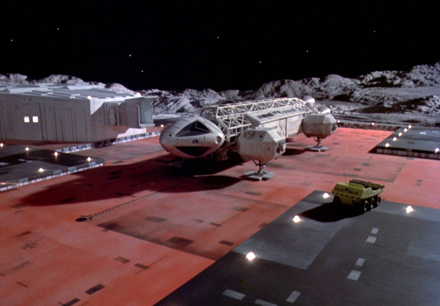
Space1999_Eagle

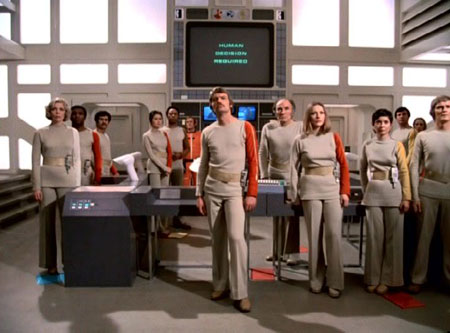
But that’s another thing about Space: 1999. The characters. Or, the lack of them. With Kirk & co., as with the Doctor and his feisty young TARDIS companion, we’re dealing with charismatic leads, clashing and bonding in the face of alien menaces and science fictional adventure. Martin Landau and Barbara Bain, playing Commander Koenig and Doctor Helena Russell, were the stars of Space: 1999, whose presence made the show US-money-friendly, but they play their roles in such a muted, almost deliberately bland way, it brings to mind another 2001 comparison: Koenig and Russell speak in such hushed, overly-reasonable tones, they remind me of HAL at his most murderous. To be nice, I’d say the people of Moonbase Alpha are meant to be everymen and -women, representatives of humanity itself, trying to survive in the weird, black void of space. But being more honest, I have to say it’s perhaps Space: 1999’s major failing that there’s no real interplay between any of the characters outside of their operative function on the base. They’re not people, but roles. Koenig is the commander: his role is to worry and command. Russell is the medical officer: her role is to worry and deliver medical advice. The others (Ziena Merton as Sandra — the most memorable face, for me — Nick Tate as gung-ho Alan Carter, Clifton Jones as David, the Computer operator, Prentis Hancock as Paul) have no scripted character, and need the actors’ natural charisma to bring them to life.

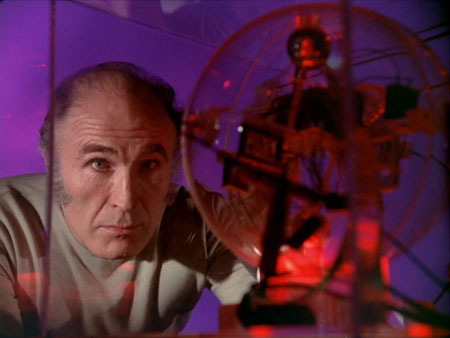
Space1999_Bergman

The exception, for me, is Barry Morse’s Professor Victor Bergman. Described by Morse as ‘a kind of space uncle’, he’s the exact opposite of the emotionally controlled Spock. Bergman is about the only person on Moonbase Alpha to have a personality. He delivers scientific — or, more often, pseudo-scientific, if not outrightly mystical — speculation with a shrug and a smile, even when he’s saying this may be the end of the human race, or that they may be facing forces beyond their comprehension, or that this might be a space-time-ghost so we should hold a scientific exorcism. He’s the source of most (if not all) of those quotes above.

Space1999_crew

Space: 1999 is a much more thoughtful show than either Trek or Who, but this is hardly the sort of praise to win over the network executives, let alone regular viewers. What is it that brings you back to a show? The characters. With SF or fantasy, it may be the world as well — the wonders, the action, the adventure — but it’s rarely the themes, the thoughtfulness. Those ought to be there, but as the icing on the cake, not the cake itself. With Space: 1999, the things that linger are the look (still good), and the weirdness.

But Space: 1999 wasn’t afraid to try things out. The penultimate episode of the first series — usually when you can expect a 24-episode run to be feeling a little tired — shocked the hell out of me. Suddenly, in a show that had so far been mostly staid and quietly psychedelic, in ‘Dragon’s Domain’ we have outright horror, with a multi-tentacled, single-eyed space-spider sucking in its hypnotised victims and spitting out their smoking, desiccated corpses, not once but three times in a row, in an extended, horrific sequence. In the same episode we get the first substantial flashback to pre-1999 Earth (as well as the first scene of actual emoting from Koenig and Russell — he gets angry at her, then makes up and she gives him a kiss, even if just on the cheek). Only Space: 1999 would make a show featuring so horrific a space-monster mainly about whether it existed in reality or merely in the mind of the man who survived it, but that just makes the episode even more interesting.

Space1999_tube

Space: 1999 changed in its second series. It lost the title music (why?!), it lost Victor Bergman (why?!!), it changed its set to one a lot less sparse and more seventies-coloured (why?!!). It did gain a shape-changing metamorph (dotty-eyebrowed Maya), but I’ll have to wait till Network release series 2 on Blu-Ray (hopefully later this year) before finding out how (or if) the stories themselves changed.

^TOP

The Western Canon by Harold Bloom

The Western Canon by Harold BloomPublished in 1994, Harold Bloom’s The Western Canon is a celebration of great literature. It has achieved a certain notoriety for Bloom’s taking a stance against what he saw as the unwanted politicisation of literary criticism (‘the School of Resentment’ as he calls it, being deliberately provocative), when for him the key to all ‘deep reading’ is the experience of the individual, alone with a book. ‘Such a reader,’ he says, ‘does not read for easy pleasure or to expiate social guilt, but to enlarge a solitary existence.’ But the real core of the book is Bloom’s attempt to, as he puts it, ‘confront greatness directly’. Doing this, he necessarily talks about ‘the canon’ — his particular Valhalla of great works from Western literature — but whether you agree with his choices or not is beside the point. It’s the conclusions he draws, or the aspects he celebrates, that are the reason to read The Western Canon. My own experience certainly chimes with his:

‘When you read a canonical work for a first time you encounter a stranger, an uncanny startlement rather than a fulfilment of expectations.’

As well as the standard reasons you’d expect for a work to be considered great — ‘mastery of figurative language, originality, cognitive power, knowledge, exuberance of diction’ — Bloom adds another, ‘strangeness’:

‘…a mode of originality that either cannot be assimilated, or that so assimilates us that we cease to see it as strange.’

Bloom_ShakespeareWildest of Bloom’s many wild ideas is that the way we’ve come to see ourselves as human beings has been, at least in part, formed by the representations of human beings in our greatest literature. For him, Shakespeare is the greatest of the greats, and the most influential on human nature itself. His pronouncement that ‘The more one reads and ponders the plays of Shakespeare, the more one realises that the accurate stance towards them is one of awe’, may sound overblown, but frankly, it’s nice to be in the presence of someone who allows themselves a little bombast when talking about what they love. ‘Shakespearean drama,’ Bloom writes, ‘seems at once utterly familiar and yet too rich to absorb all at once.’ And whether you agree or you don’t — or whether such statements could ever be lived up to by any work by any writer — I certainly find them inspiring, both as a reader as a writer. And that’s one of the things I like about this book: it makes me want to read better, to read ‘deeper’ or ‘stronger’, as he puts it. Bloom’s model as a reader (and critic) is Dr Johnson, who is, he says, ‘everything a wise critic should be: he directly confronts greatness with a total response, to which he brings his complete self.’

Reading properly, then, makes you both human and whole.

Bloom’s canon is no mere dusty list. It is, rather, an eternal battlefield on which current works must fight it out with the greats of the past to win a place: ‘a conflict between past genius and present aspiration, in which the prize is literary survival or canonical inclusion.’ Bloom’s judgements and summaries of writers and their works have a wonderful strangeness of their own, being utterly unverifiable but always illuminating, intriguing, and provocative, like the literary criticism version of Zen koans. ‘Shakespeare,’ he says, ‘is the inventor of psychoanalysis; Freud, its codifier.’ Or, to put it another way: ‘Hamlet did not have an Oedipus complex, but Freud certainly had a Hamlet complex and perhaps psychoanalysis is a Shakespeare complex.’ Later he says, ‘Freud, slyly following Shakespeare, gave us our map of the mind; Kafka intimated to us that we could not hope to use it to save ourselves, even from ourselves.’

Agon by Harold BloomThe thing that brought me to Bloom’s book was when someone told me he’d included David Lindsay’s A Voyage to Arcturus in his long list of canonical works (a list required of him by his publishers, apparently, rather than being something he set out to compile). In an earlier book, Agon (from 1982), Bloom devotes a chapter to sketching out a ‘theory of literary fantasy’, which he then applies, in some detail, to Lindsay’s novel (as well as offering an explanation of sorts for his one venture into fiction, his — dull, in my opinion — attempt at a Lindsay-esque novel, The Flight to Lucifer). This ‘theory of literary fantasy’ is short, but I’ve always found it to apply whenever I pause to test it on a work of fantasy I’m reading. Rather than an all-encompassing theory, it’s an attempt to understand a peculiar aspect of fantastic literature: why, when given the freedom to invent anything, and therefore to potentially indulge oneself in nothing but power-fantasies and pleasurable daydreams, great fantasy literature ends up confronting genuinely difficult and meaningful themes — in other words, what rescues truly good fantasy from the accusation of escapism:

‘What promises to be the least anxious of literary modes becomes much the most anxious… The cosmos of fantasy, of the pleasure/pain principle, is revealed in the shape of a nightmare, and not of hallucinatory wish-fulfilment.’

Fantasy, for Bloom, is the ‘compounding of Narcissism and Prometheanism’ (which sounds like a neat counterpart to Brian Aldiss’s definition of SF as ‘hubris clobbered by Nemesis’). It certainly applies to the best of the fantasy books I’ve reviewed on this site — think of, for instance, Ursula Le Guin’s Threshold, where two characters seek to escape from their daily lives in a fantasy world, only find themselves on a quest to face something even more dangerous and difficult; or a similar situation in William Mayne’s A Game of Dark, where an escape from a difficult home life is illuminated by a parallel quest to destroy a truly disgusting dragon.

Harold Bloom, photograph by Jeanne Bloom

Harold Bloom, photograph by Jeanne Bloom

Bloom’s The Western Canon has persuaded me to read a few of his choice of great books (among them, appropriately, Jane Austen’s Persuasion), though by no means all of them. But always, dipping into it, I’m revitalised as a reader. My canon is not, and will never be, Bloom’s (I’d put Peake’s Gormenghast books in there for sure, as well as Le Guin’s first two Earthsea books), but I can’t help but agree with him about the core purpose of reading, and of writing about what one reads:

‘Aesthetic criticism returns us to the autonomy of imaginative literature and the sovereignty of the solitary soul, the reader not as a person in society but as the deep self, our ultimate inwardness.’

‘Our ultimate inwardness’ — the thing I, for one, certainly search for between the covers of a book.

^TOP

The Buried Giant by Kazuo Ishiguro

The Buried Giant (UK cover)Although there’s said to be a giant buried beneath a plain the elderly couple Axl and Beatrice cross early in their quest to join their son in another village, the ‘buried giant’ Ishiguro’s novel’s title refers to is metaphorical, not literal: it is the violence and atrocities of a recent past in which Christian Britons under ‘the great and beloved Arthur, now many years in heaven’ subdued the pagan Saxons, and which resulted in the two peoples now living together in apparent peace. But this is also a land under a strange curse: a mist of forgetfulness has fallen on its people, and many of them have almost no recollection of those terrible events. Axl and Beatrice have uneasy feelings about unremembered difficulties in their own long marriage, too, and can’t quite recall even what their son looks like, though they’ve set out to find him, always sure he’s only a village away in the pre-hedgerow English wilds. On their way, they encounter several figures who bring them back to a realisation of what the land has been through, including the aged Sir Gawain (long charged with killing the dragon Querig, whose breath some say is the cause of the land’s forgetfulness), and the young saxon warrior Wistan, who has his own reasons for travelling from his people’s native fenlands to complete the task Sir Gawain is tarrying over. Rumour has it the local lord Brennus has found a way to tame a dragon so it can be used in a genocidal war he intends to make against the local Saxon people, a rumour the militant Saxons of Wistan’s country believe because they, unlike Axl and Beatrice, remember the betrayal and slaughter of innocents that ended the recent wars.

This is not new thematic territory for Ishiguro, whose past novels — A Pale View of Hills, An Artist of the Floating World, and The Remains of the Day — explored the idea of buried, terrible secrets scattered among the recollections of seemingly blameless, otherwise unremarkable lives, particularly (with those latter two) in relation to the events of the Second World War. An article on The Guardian goes into why Ishiguro chose to set his latest assault on this theme in a fantasticated Dark Ages England:

‘[Ishiguro] said The Buried Giant’s fantasy setting served as a neutral environment to explore the idea of collective memory and how societies heal after atrocities by forgetting the past. He revealed that he considered Bosnia, America and post-second world war Japan and France as potential settings, but worried that sort of a recent historical scenario would make the story too political. “I always feel the pull of the metaphorical landscape, I am not a straightforward realist,” he said. “As far as I am concerned, I am trying to make a universal statement.”’

Unfortunately, Ishiguro found himself stepping on an unanticipated Buried Giant of his own, no way near as terrible as past war crimes or genocide, but still incendiary to some of the more Saxon (pagan, angry, armed with tech) areas of the internet: the 20th century’s culture war between genre and the literary establishment, now long decided (the genre side won, though there are diehards who remain unaware of the fact) because the internet undermined the cultural elite’s ivory strongholds (literary magazines, print reviews, the major publishers). What was once a ghetto within the world of publishing is more mainstream now than the mainstream itself. But some survivors of the conflict — Ursula Le Guin being one — still smart when they hear someone protesting, ‘It’s not fantasy’ or ‘It’s not SF’, and rattle their sabres. I don’t think Ishiguro intended to distance himself from the genre, but he evidently didn’t walk as carefully as he needed to over this particular unquiet burial mound.

Buried Giant 02Is the book fantasy? Undoubtedly. As well as the dragon Querig, there are ogres, pixies, and some sort of undead peeled-looking dog-thing met in an underground escape-passage. These aren’t treated exactly as a genre writer would treat them, keen to point out how they’ve re-thought and revitalised standard tropes. Ishiguro handles them almost too lightly for the fantasy reader in me (though in a way that recalls Gene Wolfe). His ogres are almost never glimpsed fully or alive — the first appearance of one in the book, outside rumour, is of a severed lump of featureless flesh, at first mistaken for a head, later realised to be a sliced-off piece of shoulder, while another is seen dying at the bottom of a pit, covered in the remains of a torn-apart poisoned goat(!). The pixies are the most intriguing. They get one brief appearance:

“A sound made him turn, and he saw at the other end of the boat, still bathed in orange light, the old woman slumped against the bow with pixies – too many to count – swarming over her. At first glance she looked contented, as if being smothered in affection, while the small, scrawny creatures ran through her rags and over her face and shoulders. And now there came more and more out of the river, climbing over the rim of the boat.”

I’d like to know more about those pixies, but unlike your true fantasy author, I doubt Ishiguro intends The Buried Giant to be the first in a series, so that’s all we’re getting. The dragon, meanwhile — which I was quite prepared to accept was going to be wholly projected superstition — turns out to be an actual dragon, but like the creature met at the end of Le Guin’s Threshold, or Mayne’s A Game of Dark, one whose monstrousness only serves to emphasise the genuinely human element of the evil or wrongness that dominates The Buried Giant’s Britain, rather than being a full, Smaug-like evil in its own right.

The Buried Giant 03I found The Buried Giant patchy. Moments really worked for me. The way, for instance, the warrior Wistan sees a monastery the travellers visit as the re-purposed Saxon stronghold it is, down to the way various parts of it exist for no other reason than to trap and kill the enemy in the largest possible numbers. Occasionally, though — as with the last Ishiguro novel I read, and the one that put me off reading him, When We Were Orphans — I found the world and characters almost ludicrously unconvincing, as when Sir Gawain (in a slightly age-addled reverie, it has to be said), recalls helping a woman get revenge for the death of her husband. A battle is raging (or is just over), yet Gawain puts her on his horse, rides straight to the man she wants to kill, despatches the three other soldiers with him, and all without any sign of any other enemies, even though the man she wants to face is presumably important enough to be in some sort of encampment. And then another important character just wanders in. It’s more like the sort of abbreviated battle scene you get in Shakespeare, but at least there you accept the lack of realism because it’s being staged. Here, I just couldn’t help wishing Ishiguro had concentrated a bit on making it more realistically convincing, despite being fantasy. But then there’s the occasional bit of writing which surely even Le Guin would agree passes her Poughkeepsie test. There’s no denying this particular warrior is of Elfland (even though a Saxon):

‘The giant, once well buried, now stirs. When soon he rises, as surely he will, the friendly bonds between us will prove as knots young girls make with the stems of small flowers. Men will burn their neighbours’ houses by night. Hang children from trees at dawn. The rivers will stink with corpses bloated from their days of voyaging. And even as they move on, our armies will grow larger, swollen by anger and thirst for vengeance.’

It’s not a plot-driven book, but a theme-driven one, and as usual with such books, I find they may dissatisfy along the way, but they usually end well. The final chapter, in which the lesser buried secrets of Axl and Beatrice’s marriage are brought out and put to the test by a boatman who can only be the Ferryman himself, is both moving and meaningful. Elsewhere shot through with moments that work and some that don’t quite, I’d say The Buried Giant is not as good as it could have been were it a full-blown fantasy (which has often dealt with similar themes to Ishiguro’s — the Harry Potter series, for instance, in its later novels, deals with the past atrocities of Voldemort’s first spree and the way people try to forget this ever happened, and how this allows a new, fascistic magical government to gain power), but it didn’t leave me unsatisfied at the end.

^TOP