Tom Baker’s Rasputin

One of my earliest memories is of Tom Baker’s first appearance as Doctor Who when I was three, which may be why he seemed so perfectly suited to the role — for me, he defined it. As a result, there’s always been the need for a little mental adjustment whenever I see him in anything else, and I find myself thinking of how much this other character he’s playing is like his version of the Doctor. (Of course, Tom Baker is one of those actors who excels in a part precisely to the degree he’s allowed to play the one character he does so well — I’d say himself, only I don’t know the man, so can’t tell whether it is himself or, as is more likely, some fantasy version that’s only allowed to be let loose as part of a performance.) It’s odd to think that his gaining the role of the Doctor was a bit of a departure from the direction his career seemed to have been heading, considering the two major film parts he had before it — Koura in The Golden Voyage of Sindbad, and Rasputin in Nicholas and Alexandra — were both villainous types, something his smouldering glare seemed perfectly fit for. As the Doctor, he occasionally played up this darker side — the side that made up the whole, really, of his sorcerer Koura in The Golden Voyage, a role that was only hampered by Baker not being able to incorporate his other, more humorous side, which was the other essential element he brought to the Doctor.

This may be one reason why, although I hadn’t seem him in 1971’s Nicholas and Alexandra — till last night, that is — I thought Rasputin would be a perfect part for him, encapsulating, as it does, that almost bipolar mix of brooding gloominess and sudden impulsive generosity that characterised his Doctor. Rasputin is (in the film, at least) a peculiar combination of visionary religious fervour and an all-too-human weakness for that old trio of wine, women, and political influence. The character has the potential to become a sort of Falstaff, endlessly and engagingly self-justifying his faults while at the same time promoting a heroicised, fantasy version of himself. Rasputin knows he is a sinner, but also knows God loves sinners, because he made so many of them into saints. This is certainly how a Tom Baker Rasputin could have been, if only he’d had the film to himself. As it is, Nicholas and Alexandra is, of course, mostly about Tsar Nicholas and Tsarina Alexandra, and although Rasputin plays an important part in their story, it’s their far more sober, not to say somber, restrained character that presides. Baker’s Rasputin is a bit like a Dostoyevskian madman straitjacketed into a more urbane Tolstoyan world — and as a result, he never quite manages to take off. If he were allowed to, he’d certainly swallow up the whole film. (Though there are an awful lot of excellent British character actors in the other parts, so this isn’t to detract from them; it’s just that they are mostly playing more well-bred types.) As it is, he’s allowed plenty of opportunities to glare his bulbous eyes hypnotically at whoever he’s talking to — this glaring-from-under-the-brows look was no doubt the thing that landed him the role, as the director makes sure to include one shot of it in each scene where Baker appears — but doesn’t really get a chance to do anything other than smoulder. The burning vitality beneath the glare only comes close to being unleashed in Rasputin’s final scene, where we get a rather muted moment of decadence, a roar of defiance, then a drawn-out death.

Baker was nominated for two Golden Globe awards for his role in Nicholas and Alexandra (one for Best Actor in a Supporting Role and another for Best Newcomer, according to Wikipedia, though Baker’s own site says he was only nominated for one), but to me the film seemed to be straining at the bounds of its genre — it was a late version of the big historical epics of the 50s and 60s, and was perhaps a little too polite for what the actor was really capable of.
^TOP

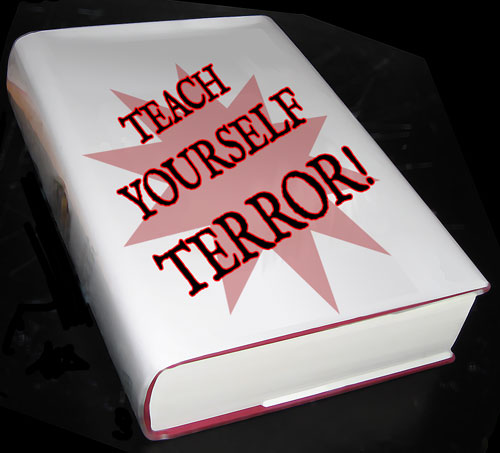
Teach Yourself Terror!

A rhyme for Halloween…

Teach Yourself Terror! the book’s cover said:
“How to be frightened of things not-quite-dead!”
“How to be scared of the creatures of the night!”
“How to see things that aren’t there, and take fright!”
“How to imagine weird shapes in the dark!”
“How to hear werewolves at night in the park!”
“How to feel creepy things creep up your back!”
“How to know your mind is starting to crack!”
The table of contents was equally scary
With chapters on “Fear” and “Fright” and “Being Wary”
And “Tingling Sensations of the Lower Back and Spine”
And “Paranoid Psychosis — Know the First Signs!”
While one spoke of “How to be Mortified at a Glance”
Another was “Gut-Wrenching Terror (Advanced)”
The index alone could have given you chills
With its alphabetical listing of all sorts of thrills
From “Anxiety attacks” to “Zoomorphophobia”
Everything that was likely to shock, shake or scare ya!
The acknowledgements listed all the experts in fear
Most of whom, it turned out, had been dead many a year
While the author himself, to judge by his photo
Was a living wreck, and hadn’t much longer to go
What a book! What a fine work of scholarship it was!
Yet I left the shop without it, and did so because
A handsome, heavy volume, a deluxe slipcased edition —
The price alone was enough to scare me to perdition!

(And a previous one.)

^TOP

Dean Spanley

Who would have thought Lord Dunsany would get a film adaptation in 2010? Even in these post-Potter, post-Jackson-LOTR days when fantasy is enjoying a filmic boom, he’s hardly the author you’d expect to be the beneficiary of a decent film budget. And even then, would his short 1936 novel, My Talks with Dean Spanley, be the one to choose over something more flashy and Hollywood-friendly, like, say, The Sword of Welleran or The King of Elfland’s Daughter? As fantasy goes, Spanley is really quite mild, being about a dean who, under the influence of his favourite wine, Tokay (which has something of a fantasy pedigree, as it appears in the first chapter of Pullman’s Northern Lights, too), falls into reminiscences of his previous life as a dog. No car chases, no fights, no massive effects sequences — no effects sequences at all, as far as I could tell. No romance, either. The cast is all male, apart from one ageing housekeeper.

But what a charming film!

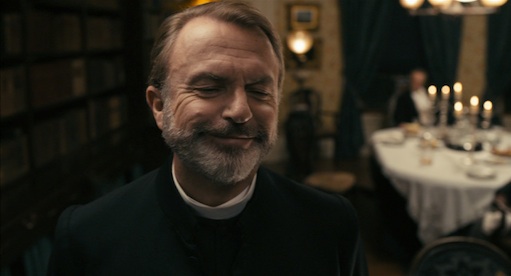
Partly this is down to the excellent cast. Peter O’Toole is the frankly frightening Horatio Fisk, an unforgiving, staunchly unemotional old man, teetering on the awkward edge between wilful rudeness and outright dementia. Jeremy Northam is his son, painfully trying to get his father to open up just a little bit about the deaths of Northam’s brother (during the war) and his mother (afterwards, from grief). Sam Neill is the rather unsociable Dean Spanley whose Tokay-induced reminiscences have to be coaxed out of him, but who, once going, provides a wonderful insight into the life and worldview of a dog, and his relationship to “the master”.

But also, the film’s particular charm comes down to that rare thing in films these days, particularly fantasy ones (he says, having recently reviewed the Clash of the Titans remake) — a story that’s not only good, but which is allowed time to breathe, to develop, to gather momentum, to bring out its subtle emotional undercurrents and let them build into full-size waves. At first, I must admit, the story was so slight I wasn’t sure there was even going to be one. Just how much, after all, can you get from the reminiscences of a closemouthed dean about a previous canine incarnation? But before I knew it, the gentle pace, mild manners and the sheer, quiet, confidence of the film won me over, and suddenly I found it was packing a real emotional punch. In one scene near the end, Peter O’Toole’s face, so impassive, not to say death-like at the beginning, suddenly — and so subtly — thaws, with just the tiniest of shifts in expression, and suddenly the whole tone of the film is changed.

Really a lovely film.

^TOP