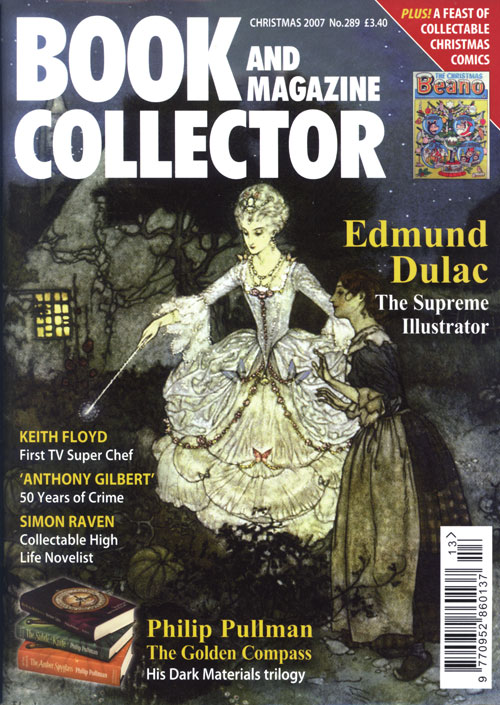
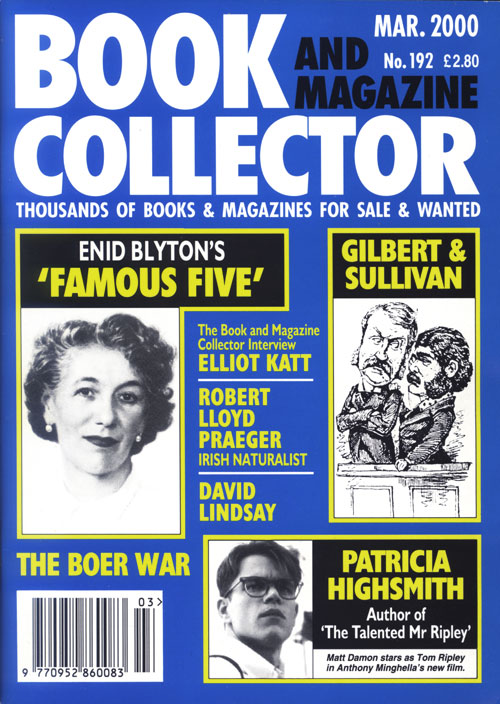
This December sees the last ever issue of Book & Magazine Collector, after 26 years of publication. I was never a regular buyer, but usually had a look at the contents, and bought it if there was an author I was interested in. (I also went on a couple of back-issue binges over the years.) It was always gratifying to see how many fantasy, science fiction and horror authors the magazine covered.
 It’s tempting to say the internet killed it, and this must be partly true, if only because B&MC was always at least half made up of wants & for-sale lists — stuff which came to seem quaint, not to say dated, when you consider how the internet has changed the buying of secondhand books. (Not all for the good, no — it’s almost impossible to find a bargain nowadays, and some prices get artificially inflated. But not all for the bad, either. I loved hunting through booklists for titles I wanted, but love far more being able to quickly search multiple booksellers and find all the available copies and editions of the book I want.) I never used that part of the magazine anyway. What really interested me were the articles about individual authors & illustrators, and that’s the thing I’ll miss.
But surely the internet has blogs and wikis enough to make up for that? In theory, yes. There’s nothing to stop people writing in-depth, well-researched, well-written articles about authors’ oeuvres and posting them on the internet. But, on the other hand, there’s nothing to spur them to do so, either. And that, really, is the difference with the internet: not in what it can do, but in what, in practice, it does do.
If nothing else, print magazines encourage higher standards. For the reader, they act as a stamp of quality; and the same stamp pushes the writer. This isn’t something that’s impossible on the internet, but, let’s face it, Wikipedia doesn’t seem to have a tag for “this article reads like it was written by a committee more interested in facts than readability”, as it does for “this article needs more references”. Good, expert writing tends to be led by examples set by the likes of B&MC. It’s all too easy, in a Wikified world, to forget what good writing is like.
 Also, there’s just finding the information. When I started my website on David Lindsay (back in 1998), I assumed that, soon enough, every writer would get a website dedicated to them, providing all the information you want to know about them, including news, a bibliography, a biography, and so on. But it’s rather disappointing to see how few authors that I’m interested in have well-run, up-to-date websites — even the living ones! Fritz Leiber, for instance, is surely crying out for something as good as, say, this Tim Powers site, or this Joan Aiken one. (But Fritz Leiber is perhaps starting to see something of a revival, what with a new Selected Stories, a collection of rarities, and the cornucopia of download delights recently on CthulhuWho’s’s blog. So, there’s hope.)

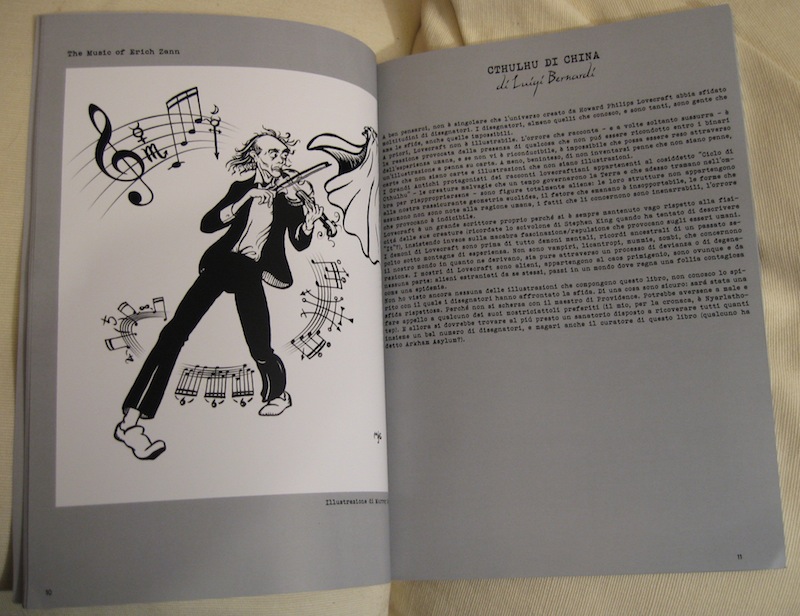
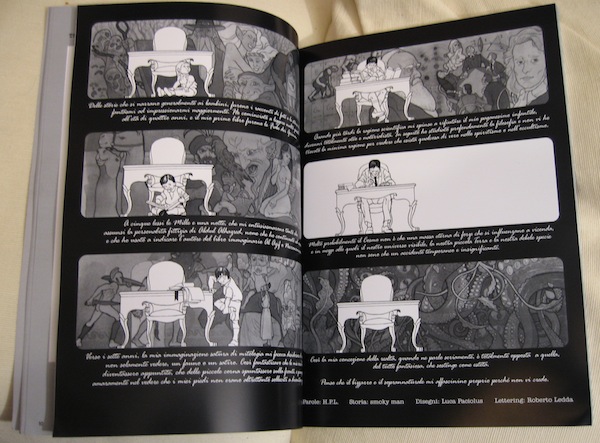
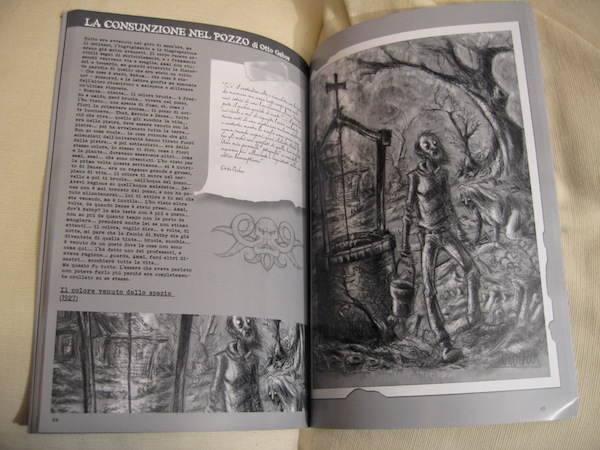
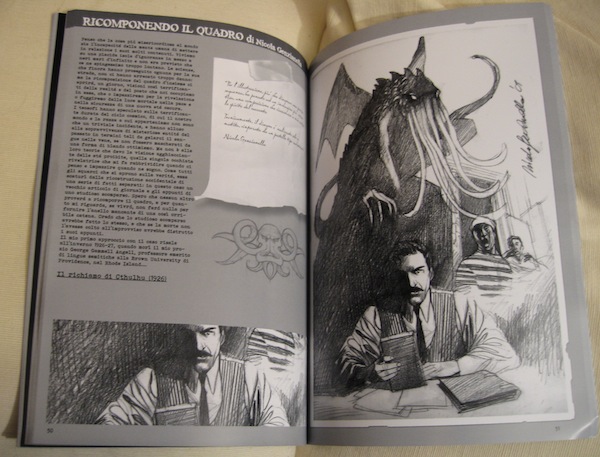
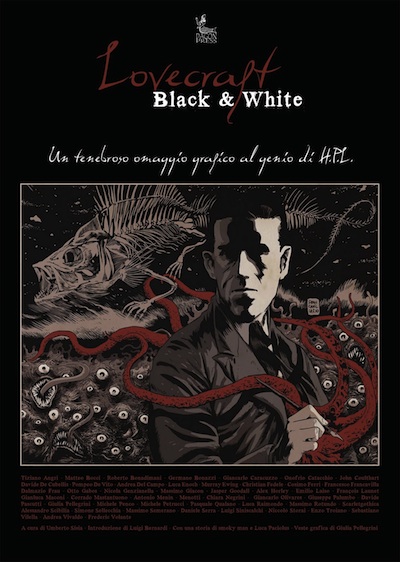 Earlier this year I was asked to contribute to Lovecraft Black & White, a volume of original illustrations inspired by the works of H P Lovecraft, published by Dagon Press in Italy, and today my contributor’s copy arrived! There’s a lot of high-quality work here, which puts my offering rather in the pale, I can’t help thinking. I was among three who chose to depict “The Music of Erich Zann” — or “La musica di Erich Zann”, I should say, as the book is in Italian, of course.