You’re All Alone/The Sinful Ones by Fritz Leiber

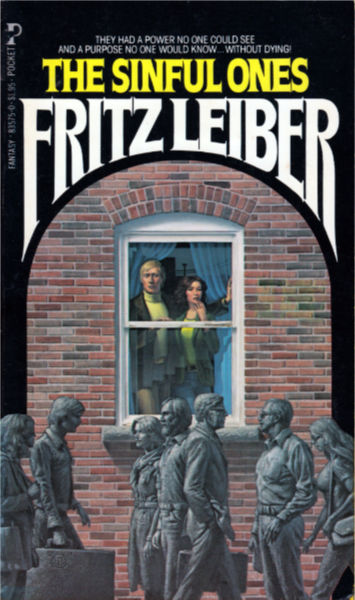
The Sinful Ones, Pocket Books, cover by Michael Whelan

What if the universe was one big machine, and human beings merely parts of it, unconsciously playing their roles, day in, day out? And what if, one day, you stepped out of the machine? This is the idea behind what Fritz Leiber called “the unluckiest, the most ill-starred and dogged by misfortune” of his novels, which he began, as You’re All Alone, in 1943.

The story starts with Carr Mackay, working in the General Employment office in Chicago, matching interviewees with likely jobs. One day, he notices a frightened-looking young woman sit down in the waiting area, followed shortly by an impressive-looking blonde (“If ever there was a woman who gave the impression of simply using people, of using the world, this was she.”). The blonde stands in front of the young woman, staring at her, but the young woman does her best to pretend she can’t see her. Eventually, the young woman walks over and sits the other side of Carr’s desk, but when he starts to talk to her, she at first ignores him. When she realises he is actually talking to her, she’s at first even more frightened, saying to him, “Don’t you know what you are?” Refusing to explain, she leaves, but, as she’s on the way out, the blonde comes over and slaps her in the face, so loud that everyone in the office would surely have heard. But nobody reacts, and the girl simply leaves the office as though nothing has happened.

What’s happened, though, is that Carr has just had the first hint that he’s “awakened” — that he’s stepped out of the big machine. Both the blonde (Miss Hackman) and the frightened young woman (Jane Gregg) are awakened, and because they’ve left their usual places in the machine, nobody else can see them — unawakened people continue to react to where the person would have been if they’d kept playing their part — which is why Jane is surprised when Carr speaks to her, and also why she pretended not to see the blonde, or react when she slapped her. Miss Hackman is part of a small gang of individuals who go around taking advantage of their awakened state, having cruel fun with the helpless unawakened, and occasionally, even more cruelly, forcing awake a chosen victim to really get down to some torture and domination. But the awakened gang are also scared of other awakened people, who might spoil their fun, so they have to be sure who’s awakened and who’s not. Hence Miss Hackman’s testing of Jane by slapping her in the face — an unawakened person wouldn’t react, so Jane does her best not to. It’s her only way to stay safe.

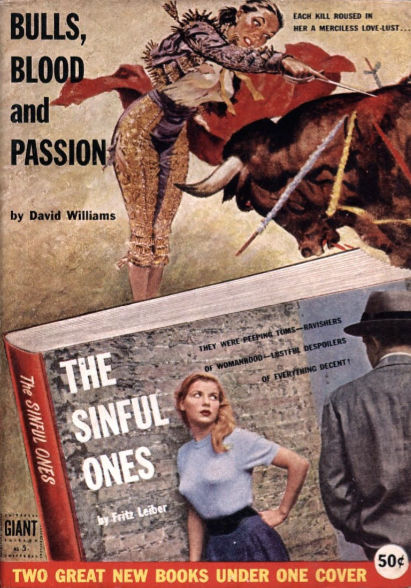
Universal Publishers and Distributors’s version, two great new books under one cover

Leiber’s idea was perfect for the sort of high-concept playful fantasy published by Unknown magazine — which was the only market he thought would take it. So, when he wrote the first four chapters and sent them to Unknown’s editor, John Campbell, hoping for an okay to continue, he was crushed to find that, because of wartime paper shortages, the magazine was to cease publication. With no other possible market, he put the unfinished novel aside. He took it up again at the end of World War II, having heard of a firm that — uniquely, for the time — were interested in publishing fantasy fiction in hardcover. But, after a couple of failures, the publisher gave up on the idea, so Leiber just had his agent (fellow author Frederick Pohl) hawk the book around, and went through the usual business of collecting rejections. Pohl suggested Leiber try it with Fantastic Adventures magazine, who accepted it, provided he cut the 75,000 word novel to 40,000. Instead of cutting it, though, Leiber took the bold step of going back to his initial four chapters and rewriting the story from there, as he would have, had Unknown been interested in taking it, back in 1943. The result was published as a novella, You’re All Alone, in July 1950. But the novel-length version was still being sent around, and that, too, found a publisher. It was bought by Universal Publishers and Distributors, who retitled it (The Sinful Ones), spiced up the love scenes, added lurid chapter titles (like “The Shimmering Garment”, “Bleached Prostitute”, and “Gigolo’s Home” — Gigolo, in the book, is a cat) and issued it twinned with a novel about a female bullfighter, called Blood, Bulls, and Passion.

Things got more complicated still when, in the 1970s, Leiber was approached by Ace Books, who wanted to reprint You’re All Alone. Leiber felt he ought to get the permission of his Sinful Ones publisher, and found he could buy the rights back. So he did, and You’re All Alone was published, along with a couple of other stories, to make it a reasonable length book, in 1972. Then Pocket Books got interested in reprinting The Sinful Ones, so Leiber, finding the previous publisher’s spicy bits pretty dated, went through the book and rewrote them. The Sinful Ones came out in this version in 1980, meaning there were now two versions of the same-but-differently-written Leiber story on the market.

So, knowing this and wanting to read it, what did I do? I read them both.

Fantastic Adventures, July 1950, art by Robert Gibson Jones. The dog becomes a black cheetah in The Sinful Ones.

Of the two, I preferred the shorter version, You’re All Alone. I can’t help feeling Leiber was a bit freer when writing for a pulp magazine than for hardcover publication. The novella has more linguistic playfulness and flights of fancy, of the sort I associate with Leiber’s better writing, including a dream in which Carr sees himself as a puppet freeing itself from its strings, and a brief daydream in which he thinks of himself and Jane as a prince and princess escaping the clutches of an evil archduke — neither being essential to the plot, but certainly giving it some imaginative spice. Oddly, for a shorter version, You’re All Alone actually contains more information about the characters and their backgrounds and world, perhaps because Leiber felt that, with fewer words available, he ought to be more direct. And so it’s made pretty clear early on exactly what sort of nastiness Miss Hackman and company are up to, and how it is, basically, sexually motivated. (The luridly named Sinful Ones, on the other hand, despite having “spicier” scenes — of which the main one felt pretty much shoehorned in, to me — doesn’t make it as clear what the gang is doing and why.) Also, one key character gets to tell his story in You’re All Alone, but is left a mystery in The Sinful Ones, to the latter novel’s detriment. Overall, The Sinful Ones (which I read first) feels a bit more poetic, having more passages about Carr’s horror at the idea of the universe being just one giant machine, but the plot lacks pace, and the poetry doesn’t quite make up for the lack of plot. The Sinful Ones adds a mysterious character at the end, Old Jules, who hints at a change taking place in the world, so perhaps Leiber was hoping he’d be asked to write a sequel, but, read as it is, I preferred You’re All Alone.

Leiber’s novel could be seen as addressing the same sort of ideas as the likes of Camus and Sartre, in their early works written around the same time. When Carr thinks of what he now knows about the universe and feels a “formless dread that kept surging through you until you almost wanted to retch”, he could be talking about Sartre’s term for existential dread, “nausea”, particularly as this dread is associated with the idea of the universe being “a place of mystification and death, with no more feeling than a sausage grinder for the life oozing through it”, and Carr’s fellow humans as being little more than automatons:

“Couldn’t robots perform the much over-rated ‘business of living’ just as well?”

At other times, it feels like the sort of cosmicism Lovecraft (with whom Leiber corresponded, briefly) wrote about:

The universe was a machine. The people in it, save for a very few, were mindless mechanisms, clockwork things of flesh and bone. So long as you made the proper clockwork motions, they seemed to react intelligently. But when you stopped, they went on just the same.”

And I’m sure that lover/hater of dark cities Lovecraft would have responded well to Leiber’s description of Carr’s Chicago as a “Dead city in a dead universe”:

“Teeming Chicago was a city of the dead, the mindless, the inanimate, in which you were more alone than in the most desolate wilderness.”

Which also reminds me a bit of Eliot’s “Unreal city” of post-war London in The Waste Land, with its “I had not thought death had undone so many”.

But Leiber’s take on the idea is, ultimately, very un-Lovecraftian. Lovecraft, for instance, surely couldn’t have let the “big machine” idea go without at least some dark hints as to what sort of inhuman entity was behind it all, and for what dark purposes human beings were employed as its parts. Leiber has one brief passage in which Carr wonders about the philosophical implications:

“Have machines infected men, turning them into things like themselves? Or has man’s belief in a completely materialistic universe made it just that? Or… has the world always been this way — just a meaningless mechanical toy?”

But mostly he’s dealing with another aspect of the idea, and a far more human one. Jane, at one point, sums up both her and Carr’s experience when she says:

“Other people weren’t alive, really alive, like you were. You were all alone.”

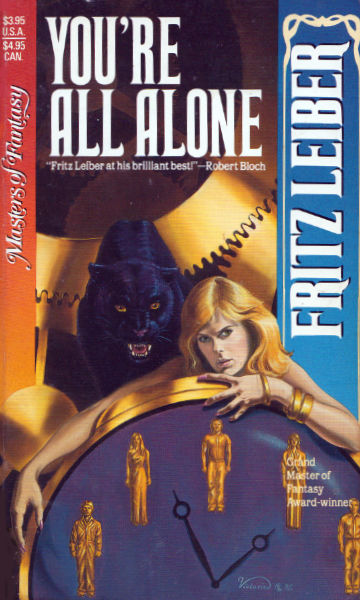
You’re All Alone, Ace Books, cover art by Victoria Poyser. Here we see the black cheetah from The Sinful Ones, even though it’s a hound in You’re All Alone

“Awakening” isn’t about becoming aware of the true nature of the universe, but looking around at one’s fellow human beings and realising there’s a uncrossable gulf between you and them. They might as well be dead to you, or be unfeeling robots. So what do you do? Retreat back into the machine and pretend to go along, eking out your life in fear of discovery while always being alone? Or do what Miss Hackman’s gang do, abandon human feeling altogether and get your kicks in as cruel a way as possible, while you can? (Or even what Carr’s “unawakened” girlfriend, Marcia, does, who likes to “agonize” her men — i.e., play power games with them.) Carr finally finds his answer in Jane, a person who’s had the same experience as him, and so who lives in the same emotional world as him. Leiber’s answer — not a solution to the universe-as-machine, but a way to stay human and live through it — is love. As he says in one of the little teaser passages he adds at the start of the chapters of the novella version:

“Love doesn’t make the world go round, but it sure puts a spark of life in the big engine.”

Leiber used the same basic idea of the world as a machine in much shorter form in the story “The Big Engine”, which was published in Galaxy magazine in February 1962, and which can be read at Project Gutenberg. (And he seems to have incorporated that story, in part, into The Sinful Ones, as Old Jules’s speech near the end of the book, which perhaps means Leiber did more than just a few edits to the book before its republication.)

In all, a book with a complex publishing history and several finished versions. Not Leiber’s best, but an interesting read all the same. (And an early version of the same sort of idea behind 1999’s — coincidentally, the number of words in this blog post — The Matrix.) There are reviews of The Sinful Ones and You’re All Alone at the Lankhmar Fritz Leiber site.

^TOP

Devoured by Anna Mackmin

The narrator of Anna Mackmin’s debut novel is a 12-year-old girl growing up at Swallow’s Farmhouse, a hippie commune in early-70s Norfolk, where she lives with her mother (Beth, an agoraphobic potter), Anthony (her father, a poet), Star (her younger sister, who at the start of the novel has been electively mute for some time, and has the habit of pulling out her hair), along with a small handful of fellow seekers after an alternative lifestyle, plus a dog, a goat, a cat called Great Uncle Elizabeth (a detail surely crying out for an explanation), and several chickens.

I call her the narrator, though at first glance the book appears to be written in the second person. But its use of “you” isn’t a literary device to involve you, the reader, a little bit more in the action, it’s the narrator’s way of telling her story to herself, addressing herself directly (as you do), which soon comes to feel more natural than the “I” of most first person narratives. It’s that little bit more intimate, as though this is a genuinely private interior monologue. (The narrator does have a name, but as this is only revealed about 300 pages into a 328 page book, it feels wrong to give it away in a review. It gains a certain comic punch by being delayed. In this Guardian interview with Mackmin, the narrator is referred to as “Nearly Thirteen”, which is a name used for her in the book, but only by one of her fellow commune-dwellers, and as he uses it with a distinctly lecherous slant, it really seems wrong to call her by it.)

The book has a couple of other stylistic quirks. Speech gets no “he said, she said”, but has the speaker’s name after what they’ve said. As in:

“These are my kids.” Mummy…
“They come through you, they are not of you.” Laura.

Which again quickly feels natural, though it did leave me hunting ahead, with the longer passages of speech, to find who was speaking before I read what they said. Also, double quotes are used for speech in the present, single quotes for remembered speech, which was quite a good device once I’d spotted it, as it allowed things people had said in the past to be interpolated as a commentary on what was happening in the present.

But back to the farm. Swallow’s is, despite being an idealistic experiment in alternative living, somewhat less than a utopia. House meetings quickly descend into petty squabbles, and usually end with someone bursting into tears (something the narrator occasionally makes herself do, just to get a meeting over with). It soon becomes apparent there’s not such an obvious dividing line between the quest for a more natural way of living (they don’t eat processed foods at Swallow’s Farmhouse, they “don’t believe in telly”, and they don’t believe in shoes, either) in which people can find themselves and live free of the shackles of conventionality, and the use of vague and un-thought-through ideals as an excuse for simply being self-centred. The perfect illustration of this is the way the adults deal with food — food being important in the novel, whose narrative is peppered with little recipes. Presented with a multi-course meal — with all the dishes laid out at once, as bringing them out in ordered stages would infringe people’s right to choose for themselves how they eat — the adults scoff the sweet stuff, grabbing as much for themselves as they can. And it’s the kids — the narrator and her sister — who do the cooking.

If Swallow’s Farmhouse is a topsy-turvy place for adults, its even more so for the children, who are pretty much expected to be adults, “old souls” in young bodies, though they’re excluded from some things, such as poetry readings, and are often fobbed off with excuses like “adults are complex and have complex needs and you will understand fully when you’re an adult”. These are the sort of people who believe you aren’t supposed to trust anyone over thirty, but it’s also clear they haven’t much patience for those who are younger than themselves, either. This is an environment with a childish idealisation of the innocent state of youth that doesn’t want to bother with the sometimes difficult innocence of children:

“What it boils down to is this: kids need to get a move on and grow up lickety spit and adults need to screech to a halt… Young is the thing.”

“My daughters are more like sisters,” Beth, the mother, says at one point, but the actual pair of sisters are the only ones really taking care of each other. It’s their relationship that’s at the core of the novel, though its power comes through largely in how little is said about it. The girls are always communicating with little looks and glances; they have their shared, private rituals; when Star remains mute, the narrator knows what she wants to say and says it for her; and some of the most poignant moments are when one has something the other hasn’t — a friendship, for instance — and there’s an obvious conflict between wanting them to have it and feeling separated from them by not being able to share in it.

On the one hand, Devoured is a comic novel, satirical of these supposedly idealistic adults’ utter failure to see their own hypocrisy, but it’s powered by genuine, deep emotion, and a real sense of danger. The lightest moments come when the narrator and Star are joined, briefly, by two boys from a nearby commune. A letter has arrived saying that an inspector will be coming to check on the children’s education, so the two communes team up to put on a show as “the Rainbow School”. It’s as disastrous as everything else the adults do, but the interaction between the children is wonderful, particularly as the narrator and thirteen-year old Orion fence their way towards a spiky friendship, neither wanting to admit how little they know about the real world, while trying to gain what insight they can from the gaps their communes’ slightly different ideals have left. (Orion’s parents, for instance, do believe in telly, leading to some light comedy when the narrator has no idea what Blue Peter, or who Valerie Singleton, is. They also, much to the narrator’s delight, believe in shoes.)

And that sense of danger. It centres on Bryan, the commune-dweller who calls the narrator “Nearly Thirteen”. The narrator, thinking she knows all about the adult world because nobody’s told her otherwise, doesn’t realise the danger she’s in when she flirts, experimentally, with him, or even what the danger properly is. And he, unsure of the rules in this more open, do-it-as-you-feel-it world, is obviously not sure, at first, of the damage he’s willing to do. But you know from the book’s title, and how the adults — particularly Bryan — gobble up anything sweet, what’s going to happen there.

The narrator’s determination to be herself in often difficult circumstances reminds me somewhat of Morwenna in Jo Walton’s Among Others — though that book is entirely about the immediate aftermath of escaping a damaging upbringing — which I reviewed a while back. Ultimately, Devoured is the tale of a survivor, and an excellent read.

^TOP

The Palace of Morgana by John Sterling

cover art by Richard Dadd

I first heard of the early-19th century writer John Sterling through Brian Stableford’s Dedalus Book of British Fantasy: The 19th Century, which included one of his tales, “A Chronicle of England”. Introducing it, Stableford said:

“Sterling would surely have become one of the leading writers of his day had he not died so young, and he might well have become the most important nineteenth century fantasy writer; his prose fantasies are more various and more adventurous than any other contemporary work.”

“A Chronicle of England” paints a delightful, fairy-haunted picture of England in the days before it received its first human inhabitants. The constant battles between the semi-substantial, light-loving fairies, and their brothers, the thunderous, brutal giants, often feels like a poetic allegory of England’s changeable weather — sunny one moment, cloudy the next — particularly when, at one point, the giants open a great cave to unleash a mist upon the land. The story certainly felt different in the richness and poetry of its fantasy elements compared to the other writers in the anthology, and I wanted to find out more.

Sterling was born in 1806 and died of tuberculosis in 1844. During his short life he’d been co-proprietor of the literary magazine The Atheneum, a disciple of the elderly Coleridge, and a friend of Thomas Carlyle. He wrote novels (Arthur Coningsby, published in 1833; The Onyx Ring, serialised from 1838 to 1839), poetry, and numerous essays, plus enough short fantasy stories to fill a slim volume. His shorter writings were mostly collected in a two-volume, posthumous Essays and Tales in 1848 (which you can find at archive.org), and these contain almost all of his fantasy output. (His novel Arthur Coningsby also contains some easily-separable stories, as told by its characters, some of which are published on their own in Essays and Tales, but I found two more of a fantastical nature that merited being collected as tales in their own right.)

cover by Murray Ewing

Once I’d sought these out, cleaned up the text, and assembled them together for my own reading, I thought I’d put them out as a book, because, although the Essays and Tales are freely available as a PDF, I think the fantasy tales are worth issuing on their own, and in a more readable form.

Are they worthy, though, of Stableford’s high praise? It’s impossible, of course, to tell if Sterling really would have become one of his age’s most important writers, but his fantasy stories certainly show signs of developing in a unique direction. Aside from an attempt at Orientalism (“The Caterpillar”), which at least has the virtue of ending with a humorous moral to its tale of what happens to a young woman who thoughtlessly flicks a caterpillar off her arm, Sterling’s early tales published in The Atheneum were mostly set in or around the world of Ancient Greek myth. “Zamor”, for instance, is a sort of Vathek-in-miniature, providing three glimpses into the life of Alexander the Great, first as a carefree but ambitious boy, then as a world-conqueror granted a glimpse of the afterlife horrors awaiting all world-conquerors, and finally as a broken man haunted by that terrible vision. Perhaps the best tale of this period is the poignant “The Last of the Giants”, in which a fifteenth-century man, wandering among wild mountains after a shipwreck, gets a privileged but mournful glimpse of the titular creature.

The Arthur Coningsby tales are slighter but see an opening out in the sort of fantasy Sterling wrote. “The Crystal Prison”, for instance, is about a man punished by being imprisoned in a crystal sphere, in which, wherever he looks, he sees only his own face (an idea also used, if I recall rightly, in “The Hell of Mirrors” by Japanese writer Edogawa Rampo in 1926), and “The Sons of Iron” is a sort of early robot fable, about men made of metal who spend their lives making more men out of metal.

Portrait of John Sterling, by J Brown

Near the end of his life, Sterling began publishing a series of stories under the shared title “Legendary Lore” in Blackwood’s Magazine, and it’s here his writing really shows the promise Stableford alluded to. “A Chronicle of England” and “The Palace of Morgana” (a virtually conflict-free idyll about bright young things flitting around the grounds of a paradisal palace, amusing themselves with displays of magic — Stableford calls it “a uniquely delicate prose poem”) have left the world of Classical Greece for a fantasy that seems to owe more to the Shakespeare of A Midsummer Night’s Dream and The Tempest. The fantasy in these two tales is poetic and playful, strange and wondrous. Also published in Blackwood’s was “The Suit of Armour and the Skeleton”, a dialogue between two relics in an old church, one of whom (the suit of armour), despite being hollow, is rather full of himself, for having once been worn by a somewhat brutal duke, while the skeleton, of humbler origins, proves to have a more down-to-earth and inclusive outlook, as well as a greater claim to be on display in the church. The title and form both reminded me of Clark Ashton Smith’s prose-poem dialogue, “The Corpse and the Skeleton”, which has a similarly satirical (though more darkly cynical) flavour.

If these three, the best of Sterling’s tales, point the way to how his work might have progressed had he lived, he’d certainly have deserved Stableford’s praise. Ralph Waldo Emerson wanted to get Sterling’s works published in the US, and Carlyle, Sterling’s friend and literary executor, wrote a book on his life, but today he’s mostly forgotten. I’d like to imagine though, that, had the Ballantine Adult Fantasy line continued, it might one day have had a Sterling volume such as this. (I was aiming for something of that feel with my cover.) His language is often poetic and archaic (and I like it all the more for that), and he may rely, on occasion, on certain Romantic clichés (most of his heroines are unworldly, innocent types devoted to their ageing, widowed fathers, but have a longing to witness strange and sublime sights), but if you like classic fantasy, I think there’s something to enjoy in them.

The Palace of Morgana and Other Fantasy Tales is now available on Kindle, ePub and in paperback (and, of course, you can read most of the tales in Essays and Tales at archive.org).

^TOP