The Adventures of Alyx by Joanna Russ

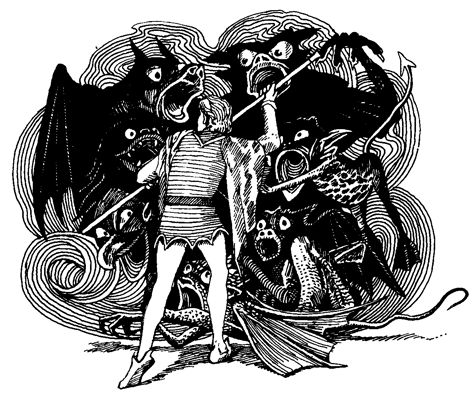
Russ's The Adventures of Alyx, cover by Judith Clute

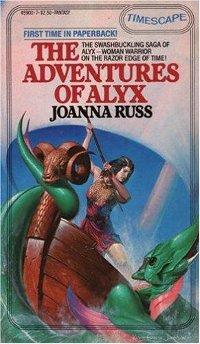
Russ’s The Adventures of Alyx, cover by Judith Clute

I bought Joanna Russ’s The Adventures of Alyx a while ago because I read somewhere of it having affiliations with Fritz Leiber’s Fafhrd & Gray Mouser stories. For a long while it sat on my ever-lengthening to-read shelf, because whenever I picked it up for a shall-I-read-it skim, it seemed more SF than sword & sorcery. So I did some Wikipedia research — it turns out Alyx the Pick-lock is referred to in “The Two Best Thieves in Lankhmar” and “Under the Thumbs of the Gods” — then started reading.

The first Alyx tale, “Bluestocking”, has several Leiberish resonances: a Lankhmar-like city called Ourdh, whose name recalls Leiber’s Ourph the Mingol (later stories make it clear the setting is Earth at the time of ancient Greece); most of the story has its two main characters adrift on the ocean in a small boat, reminiscent of Leiber’s “Their Mistress, the Sea” (though that story was first published in 1968; “Bluestocking” appeared in 1967); and at one point Alyx mentions having known a “big Northman with… a big red beard — God, what a beard! — Fafnir — no, Fafh — well, something ridiculous.” “Bluestocking” begins with pickpocket Alyx being hired by a slightly spoiled rich girl, Edarra, to help her flee an impending marriage. During their time together, Edarra loses her more refined, delicate edges, and Alyx gets to kill a sea-serpent and a trio of pirates. In the following story, “I Thought She Was Afeared Until She Stroked My Beard”, jumping back in the character’s timeline, Alyx leaves her abusive husband and pairs herself with a far less chauvinistic pirate — though she still has to teach him a lesson or two in true equality, when she matches his body-count in a bloody fight.

Joanna RussAs in so many sword & sorcery tales, what these initial stories are about is defining a hero. And here, unlike the usual S&S strategy of defining a hero by what he or she fights, Alyx is more often portrayed in contrast to a companion — the spoilt Edarra in “Bluestocking”, the well-meaning but still slightly prejudiced Blackbeard in “I Through She Was Afeared…” In these first two stories, I felt that was pretty much all that was happening — they were far more about defining Alyx as a character than telling a story with her, though this defining is nevertheless an important step when a writer is trying to do something new. As Russ says in her biographical note at the start of the Women’s Press collected edition: “I had turned from writing love stories about women in which women were losers, and adventure stories about men in which the men were winners, to writing adventure stories about a woman in which the woman won. It was one of the hardest things I ever did in my life.” (This was the late 1960s. As Aldiss & Wingrove say in Trillion Year Spree: “Russ’s Alyx stories were something quite new to the genre. Alyx is a female rebel. A thief and adventuress. A highly competent and aggressive woman. She was a revolutionary fictional character, challenging the competent male/wilting female syndrome that had dominated the magazine genre for forty years.”)

The first tale that really worked for me is the third, and the most sword and sorcery-like of the lot, “The Barbarian”. Here, Alyx is hired (as so many S&S heroes have been down the ages) by a sorcerer in need of a bit of thievish skill and swordly brawn. This story has some of the best writing in the series, for instance when Alyx leads her sorcerous employer through the benighted rooms of a building they’ve broken into:

“Her fingers brushed lightly alongside her, like a creeping animal: stone, stone, a gap, warm air rising… In the dark she felt wolfish, her lips skinned back over her teeth; like another species she made her way with hands and ears. Through them the villa sighed and rustled in its sleep. She put the tips of the fingers of her free hand on the back of the fat man’s neck, guiding with the faintest of touches through the turns of the corridor…”

The ending shades into science fiction, but in the well-established manner of the Unknown school — with a primitive protagonist encountering advanced technology and defeating it through uneducated but nevertheless scientific thinking. I’m not really sure if that’s cheating or not, but it works, as a story, and the goodie wins, which is the main point…

Picnic on ParadiseThe next tale, “Picnic on Paradise” marks a break in two ways: it’s much longer than the previous stories (it was initially published as a separate novel, in 1968); and in it, Alyx has been whisked into the future by the Trans-Temporal Military Authority to guide some tourists across hazardous alien terrain to the safety of a base where they can be taken off-world. Things go wrong, of course, but not before Alyx’s relationships with the leisure-softened, over-psychoanalysed tourists doped up on “stimulants and euphorics” have been stretched past their plastic limit. This short novel is, really, an expansion of that initial story where Alyx was stuck in a wilderness (the ocean) with a pampered rich girl, whom she brought into more vibrant contact with the feeling of being alive. It’s a sort of science-fictional version of Crocodile Dundee (not at all meant as an insult — Kurosawa’s Dersu Uzala would be a similar comparison). Like the best sword & sorcery, the Crocodile Dundee type of story is about getting back in touch with far more real, far more meaningful and basic values through a bit of down-and-dirty, barbaric common sense. But here, the picture isn’t as clear cut as in Crocodile Dundee, as, ultimately, Alyx gets as affected by her contact with these over-civilised future civilians as they do by her. But we do get, at last, her heroic credo:

“…nobody ever let me do anything in my life before and I never let that stop me.”

Alyx doesn’t appear in the final story in the collection, “The Second Inquisition”, which seems to have been included here only because it mentions the Trans-Temporal Military Authority, unless I’m missing something. Set in 1920s Earth, where the narrator’s family are, for some reason, putting up a visitor from the future, it reads very much like Gene Wolfe at his most oblique — peppered with a stream of apparently inconsequential little details which made me feel that, if I only I knew which detail was significant and why, the whole thing would become clear, but as I know neither which nor why, I wasn’t entirely sure it was worth the effort to read it again to find out.

The_Adventures_of_AlyxI found my level, Alyx-wise, with “The Barbarian”. It’s the most sword & sorcery-like tale, though made all the more refreshing by its emancipated protagonist. Alyx constantly gibes and annoys her employer, never taking him as seriously as he thinks he ought to be taken, questioning his orders and being disobedient, then puncturing his technological/magical superiority with a bit of very non-technological/non-magical violence. Like all sword & sorcery heroes should.

Alyx, as a character, was a sort of experiment on Russ’s part, and once she’d proved herself in the old-style arena of sword and sorcery, there was nothing for it but to move onto far more of-the-times science fiction in “Picnic on Paradise” — only for her to be left out of the picture altogether by the time of “The Second Inquisition”. I’d have loved to have read more stories in the style, and the world, of “The Barbarian”, but I think that, in writing it, Russ had made her point and it was time to move on.

^TOP

Devil’s Tor by David Lindsay

Devil's Tor by David Lindsay, Putnam'sWriting to his latest publisher (Putnams) shortly before they issued this, his fifth novel, David Lindsay said: “Between the philosophies of Arcturus and Devil’s Tor there seems to be a chasm of contradiction. As both books were sincerely and independently written, and were long matured, no doubt the contradiction is more apparent than real…” He goes on to say his next (never-to-be-finished) project, after the release of his 1932 “monster”, Devil’s Tor, will be “a larger synthesis… a new and higher truth”, but it seems to me that the worldviews of A Voyage to Arcturus and Devil’s Tor are really not that different. Both reject our “terrible temporary world of mud, blood and bubbles” for another we can only have hints of (“sublimity should not represent a natural state of the soul, but be, as it were, its homesickness”). What Devil’s Tor did do was add a key element all but absent from Lindsay’s first book, which, it could be said, he’d spent his post-Arcturus novels (The Haunted Woman, Sphinx, the then-unpublished Violet Apple, and even his ‘pot-boiler’ The Adventures of Monsieur de Mailly) trying to fit into place. For, despite a handful of strong, or at least interesting, female characters (Joiwind, Oceaxe, Tydomin, Sullenbode), the world of A Voyage to Arcturus is ultimately male: the heroes, their guiding deities and would-be deities are all male, from Maskull to Nightspore, Krag to Crystalman. Devil’s Tor’s presiding figure, though, is the Great Mother, and it’s through her that Lindsay works towards a deeper understanding and acceptance of what, in A Voyage to Arcturus, he’d rejected wholesale: existence itself. The Goddess in Devil’s Tor (who shouldn’t be taken as female in the human sense, but as the yin to Arcturus’s yang) represents “the source of the universe”:

“The Virgin-Mother is explanatory of the world, as the others are not — for nothing is explained by the dogmatic assertion that God made the world…”

A Voyage to Arcturus, Ballantine Books, cover by Bob Pepper

A Voyage to Arcturus, Ballantine Books, cover by Bob Pepper

All of Lindsay’s novels can be thought of as battles for the soul of their central character. This is most obvious in A Voyage to Arcturus, whose protagonist Maskull is presented with a series of forthright philosophies, worldviews and ideals, each of which he gives himself to wholeheartedly, only to reject (often violently) when they prove false. In the end, the ultimate falseness of Tormance — the demiurge Crystalman in one of his many guises — tries every last temptation to win Maskull to his side, but Krag, the only real truth in Lindsay’s first novel, wins him in the end with pain — which is the closest, Lindsay says, we can get to truth in a world “rotten with illusion from top to bottom”.

In Devil’s Tor the soul to be battled for is Ingrid Fleming’s (whose name — names mean a lot in Lindsay — I take to contain a hint of ‘flaming’, fire being one of Lindsay’s signs of sublimity). She is, effectively, presented with three would-be husbands or potential soul-mates: the artist Peter Copping, the scholar Stephen Arsinal, and the adventurer Henry Saltfleet. But her soul already belongs to the Goddess, and what’s being battled for is not hers so much as the world’s soul: she is to be the mother of a coming saviour, a redeemer, and only one of those would-be husbands is fated to be the father. And he wins her not as Krag does, with pain, but with the two virtues Lindsay praises most of all in Devil’s Tor: disinterestedness and magnanimity. (David Lindsay is, I suspect, not the one to go to for dating advice, unless perhaps you do your dating at WagnerianHeroines.com.)

The Violet Apple by David LindsayThe novel of Lindsay’s Devil’s Tor most resembles in plot — it could almost be a heightened, intensified version of it — is his then-unpublished The Violet Apple. That book begins when an antique glass ornament, shaped like a serpent, is accidentally shattered, releasing an ancient pip said to derive from the Tree of the Knowledge of Good and Evil in the Garden of Eden. In Devil’s Tor, a forbidding “Devil’s Head” monument atop the titular Tor is shattered in a storm, revealing a tomb that contains, like the pip of The Violet Apple, one half of an egg-shaped meteoric stone. In both cases, a symbol of new life or rebirth (a pip and an egg-shaped stone) is released when its devil-shaped guardian is accidentally/fatedly broken. And in both cases, this breaking-open releases supernatural powers intent on bringing together, against the wishes of their families, friends and existing fiancés, a man and a woman who are unrecognised soul-mates. (Lindsay likes to throw every worldly difficulty he can in the way of his hero and heroine. He even seems to prefer that they don’t feel any attraction for each other, but are drawn together under pain, duress, and in situations of the utmost tragedy. What a romantic.)

There isn’t a lot of action in Devil’s Tor. Whole chapters are given over to detailed dissections of characters’ reactions to mere moments: someone enters a room and everyone retreats into themselves to review their thoughts on fate. It’s a difficult read; it was probably a difficult write for Lindsay, who’s constantly descending into Yoda-speak (“Reserved of heart she was, proud of temper beneath her domestic obedience; femininely romantic of the imagination she had never been…”) for pages at a time. When it came out, though, it fared better than Arcturus, finding a few sympathetic reviewers. Hugh I’Anson Fausset in The Guardian called it “a vast, formidable, and over-powering book” that “at once engrosses and exhausts us”. To read it is, he says, “to suffer an unforgettable experience, to be excited, appalled, and finally purged.”

How Lindsay must have loved that review: “to read it is to suffer”.

It’s hard to recommend Devil’s Tor. Like the fatedness of its own characters, you’re either compelled to read it (through a fascination with Lindsay’s work) or you pass by, appalled at the tragedy. But it repays the effort put into it, even if the final repayment, so full of renunciation and fate, is a very bleak sort of catharsis.

^TOP

Sky

SkySky (first broadcast in 1975) manages to tick just about every box in the 70s kids’ TV checklist: standing stones, the next step in human evolution, psychic powers, Merlin, magic, advanced technology masquerading as magic, warnings about mankind’s over-reliance on technology, environmentalist predictions of coming disaster, even a hint of class tension.

It starts with the blue-eyed, golden-haired alien Sky (and if he looks a bit like an Axon, perhaps that’s because the show’s writers, Bob Baker and Dave Martin, wrote The Claws of Axos for Doctor Who) appearing in the middle of an English forest, only to be immediately attacked by the surrounding greenery. Found by young Arby Venner, the leaf-smothered Sky pleads: “Take me away from living things.”

An alien and far-future time-traveller, Sky has missed his intended era, and now finds himself rejected by the very life-force of a world he does not belong to. Begging to be taken to “the Juganet” (“The Juganet is a circle. The circle is a machine. The machine is a crossover point. The point is a paramagnetic intersection. That is where I must be.”), which he can use to jump to the correct time, he claims (when asked by Arby’s sister, Jane) that despite his seemingly helpless state, “I suppose, in your terms, I am to be a god.”

Sky_03

Meanwhile, the “animus of the organism” — the riled life-force of our world — manifests itself as the black-cloaked Ambrose Goodchild, whose purpose is to track down and do away with this unwanted alien by any means, be it by summoning more smothering greenery, or posing as a surgeon so he can operate on him. Arby, Jane, and the slightly posher boy next door, Roy Briggs, do their best to help the importunate Sky, despite having no idea what he’s on about most of the time.

Luckily, there’s a mad Welshman to hand. (And that’s another 70s kids’ TV box checked: mad Welshman who knows.) Old Tom may be touched in the head (“He’s supposed to be simple.” “No. It is you who are complicated.”), but he can hear Sky’s thoughts and see Sky’s telepathic pictures, and he once visited a place that looks like this Juganet thing, though he can’t recall where, or what, it was. So Arby and Jane borrow their dad’s Land Rover (they’re late teens: Arby drives a Land Rover and Roy’s got a motorbike), kidnap mad Tom and the hospitalised Sky, and take them on a jaunt to Glastonbury Tor. Which, it turns out, isn’t the Juganet, but is getting close.

Sky_02

Sky is a bit like E.T. Only, whereas E.T. isn’t above a little emotional bonding while he tries to phone home, Sky is only interested in his human helpers when he wants rescuing. Once he’s recovered, he wants to be left alone so he can find the Juganet and leave this age that he knows only — and ominously — as “the Decline”. His task is to help humankind after “the Chaos”, not before it. As far as he’s concerned, before it, we’re beyond help.

Sky is, it seems, intended as a chastening reminder that our modern age is but one tiny step — and, most likely, a mis-step — on its way to some future evolution we can’t even begin to appreciate. He believes “It is the destiny of all intelligent beings to stand outside space and time,” and that modern man’s mistake is to “believe in machines”:

“You do not reach the stars with rockets, any more than you invent radios by shouting at the sky.”

Goodchild, on the other hand, seems even more reactionary:

“…the way to intelligence is the way to destruction… You have made man an alien. An alien force throttling life on this planet.”

Sky_06

Sky could almost be a prelude to The Changes, shown at the start of the same year (Sky was ITV, The Changes BBC). The coming “Chaos” could be the “Changes”, in which a Merlin-like force (Goodchild’s first name, Ambrose, links him with Merlin) initiates a UK-wide revolt against machines. Both shows seem to be both rejecting hippie back-to-nature idealism (Sky is taken in, briefly, by a hippie couple awaiting a mystic traveller foretold in the prophecies of Merlin; he repays their kindness by disillusioning them, then attracting enough creeping greenery to destroy their caravan), while also wagging the finger at our love of technology.

What happened between the 1970s and the 1980s, when the whole idea of technology as a step too far seems to have been quietly dropped? (As were standing stones, and mad Welshmen.) There’s a real feeling that these 70s kids’ TV shows — Sky, The Changes, to a lesser extent The Moon Stallion — were grappling with issues that aren’t to be found in their 80s equivalents (The Moon Dial, Elidor, The Box of Delights), which were just as, if not more, magical in content (no more technology masquerading as magic, though — it was pure magic all the way), but don’t seem to be addressing social issues beyond the coming-of-age adventures of their protagonists. And so, while perhaps those 80s shows are that much more timeless, they don’t necessarily have the unity, depth, and cultural relevance of the best of the 70s ones. Or is that just my own nostalgia?

^TOP