Last Men in London by Olaf Stapledon

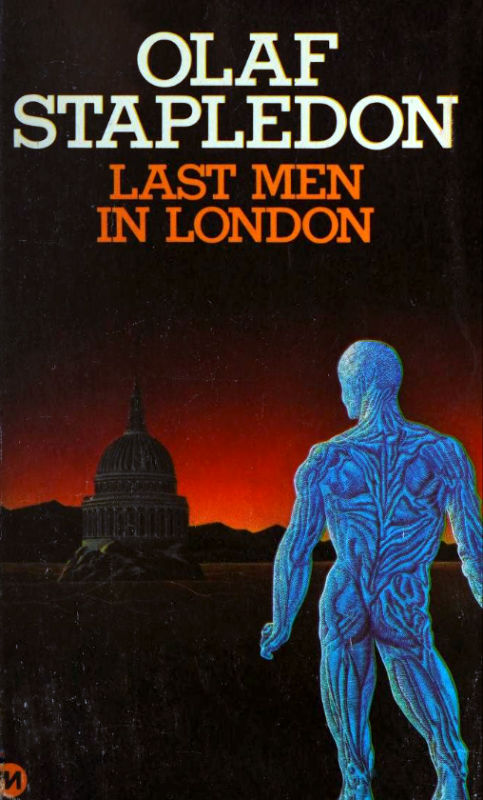
1978 paperback, art by Peter Goodfellow

Olaf Stapledon’s second novel, published in 1932, is not so much a sequel to Last and First Men (1930) as a sort of pendant to it (as his next novel, Odd John, started out as an appendix to this one). Like that first book, it’s dictated by a Neptunian from the far-future final race of humankind, who have developed the ability to project their consciousnesses into minds of the distant past, and not just witness events, but influence them to a certain extent, too. (Stapledon gets over the difficulty of the future being able to influence the past with a little handwaving: “Thus when I am observing your mental processes, my activity of observing is, in one sense, located in the past.” Or, for a little more detail: “though future events have indeed no temporal being until their predecessors have ceased to exist with temporal being, all events have also eternal being. This does not mean that time is unreal, but that evanescence is not the whole truth about the passing of events.”)

Instead of the vast, thousands-of-millions-of-years sweep of Last and First Men, Last Men in London concentrates on one comparatively tiny sliver of time, but one that is nevertheless “a crucial incident in the long-drawn-out spiritual drama of your species”: the First World War and its immediate aftermath. And the Neptunian chooses to approach this period through the consciousness of one individual, a relatively ordinary man called Paul. His intent is to present a deeper understanding of the causes of what was then known as the Great War, but also, by introducing Paul to glimpses of the more cosmic worldview of the Eighteenth Race of humankind, to see how this affects a man of our age. “It is my task,” he says, “to tell you of your own race as it appears through the eyes of the far future…”
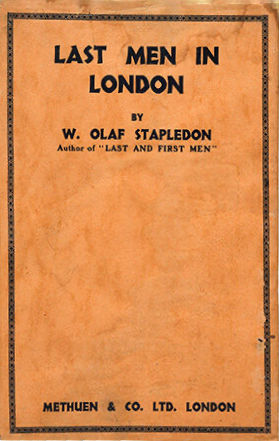
Methuen hardback, 1932

After the immensely compressed tale of multiple human species in his first novel, focusing on a single individual might make it sound as though Last Men in London would read like a more straightforward narrative. In fact, it’s even less of a traditional novel (in terms of character, plot, and so on) than Last and First Men. After an initial chapter which details life on far future Neptune, we get a brief glimpse of Paul as he hesitates before an army recruitment centre in London, wavering between social pressure to join up and his more deeply held belief in pacifism. But this is one of the few conventional scenes in a book that has only about three or four named characters, and almost no scenes with dialogue, action, and so on. Following the introduction of Paul, the narrator digresses for two long chapters on the causes of the Great War (whose roots are not in the messiness of Imperial European politics as you might think, but in the very nature of our simian ancestry), before returning to Paul and his personal experiences in the war, and then onto his life in the years that followed.

This is only partly a criticism—you come to Stapledon for ideas, not realism—but I have to say I still find Stapledon at his most readable when he’s following a narrative, whether it be of the human race as a whole as in Last and First Men, or the life of an intelligent dog in Sirius. (To be fair, Stapledon declares early on: “Though this is a work of fiction, it does not pretend to be a novel. It has no hero but Man.”) Here, he has his exposition dials turned up to eleven—which isn’t a criticism as such, but I have to say I did find these sections, though interesting, a bit of a slog.
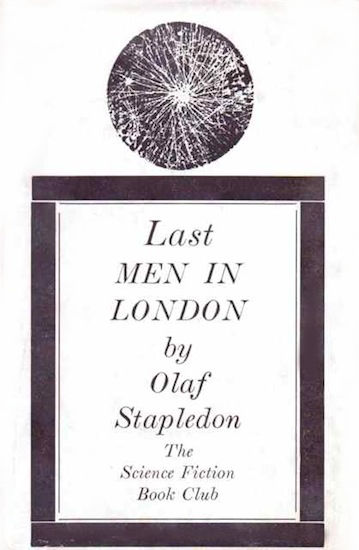
1963 SF Book Club editionBut Last Men in London could also be a kind of autobiographical novel. Like Paul, Stapledon refused the call-up into the army, but elected to serve in the Friends Ambulance Unit as an expression of his pacifism—and, like Paul, he won the Croix de Guerre, and was intensely aware of the irony of a pacifist winning a war medal. Also like Paul he spent time as a teacher. All this leads me to suspect you can probably read Paul’s education in a wider worldview as Stapledon’s own philosophical awakening, with the Neptunian narrator/educator a sort of fictional stand-in for Stapledon’s inner, guiding, slightly alienated deepest self. (It might even be better to read this novel as Stapledon’s attempt to write about the causes of the First World War being derailed by an inner need to tell the story of his own philosophical development.)

As to the causes of the Great War, from the Neptunian perspective it comes down to humankind’s “practical intelligence” getting ahead of its deeper self-understanding, plus a tendency in the First Men (as the Neptunians call us) towards “the importance of personal triumph over others in the great game of life”—the tendency to value heroic individuals over humankind itself, with a corresponding belief in nations as a sort of communal hero-self, with one nation necessarily triumphing over others being the accepted state of things. From the Neptunian point of view, the Great War was on the cards from the moment we came down from the trees (we have “a will that is still in essence simian, though equipped with dangerous powers”), but awaited the technological breakthroughs of the nineteenth century for its fruition:

“…your ‘modern’ world came too soon. In the century before the war it developed with increasing acceleration. You had neither the intelligence nor the moral integrity to cope with your brave new world.”
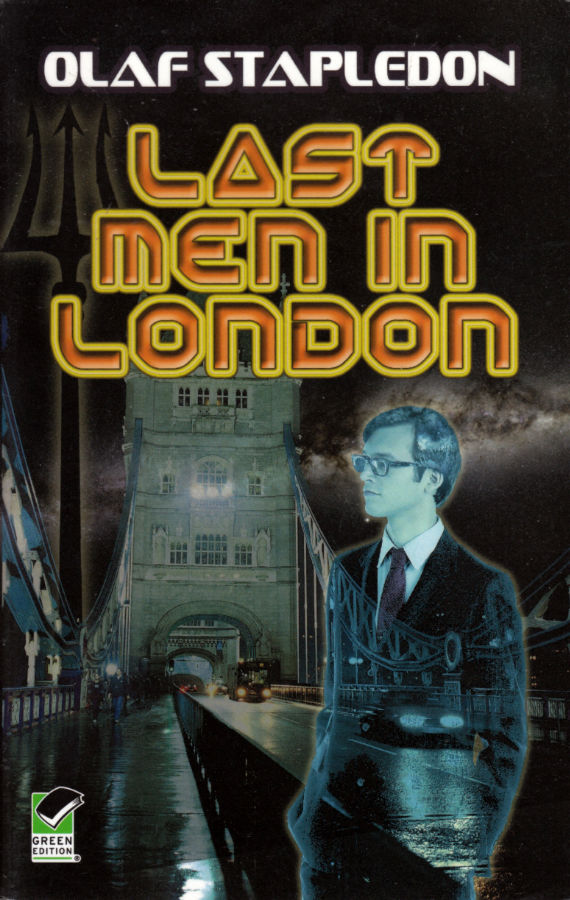
Dover Books edition

More interesting from a present day perspective, perhaps, is Stapledon’s insight into the mood during and after the Great War. There was, he says, a “suspicion in all the combatants that human nature had failed”, its ultimate effect being to “undermine man’s confidence in his own nature”. He goes on, in perhaps his most passionate and forthrightly critical section of the book, to detail how various sectors of society—politicians, religious leaders, teachers, artists and writers, common people—contributed to the war by turning a blind eye or justifying it to themselves. Perhaps the most useful passage to read today, as it still has such relevance, is this:

“Many people seemed to Paul to unearth a new self to cope with [the war], a simpler, less doubting, more emotional self, a self that concealed under righteous indignation a terrible glee in the breakdown of old taboos.”

Post-war, Stapledon describes the mood as one of:

“…a deep and deadly self-disgust, a numbing and unacknowledged shame, a sense of huge opportunities missed, of a unique trust betrayed, and therewith a vast resentment against earlier generations, against human nature, against fate, against the universe.”

Though Paul, in moments of particularly Stapledonian insight, still finds himself thinking:

“How can things be so wrong, so meaningless, so filthy; and yet also so right, so overwhelmingly significant, so exquisite?”

Which is perhaps one of the things that led John Kinniard to write, in Starmont Reader’s Guide 21: Olaf Stapledon, that “Stapledon’s philosophy is best approached as a challenge and a corrective to the disillusionment that became the dominant attitude of the Nineteen-twenties.”

So, what is Stapledon’s answer to all of this? It can be summed up in ideas that were already present in Last and First Men: “loyalty to man and worship of fate”. Or, as the Neptunian narrator puts it in a way that perfectly sums up Stapledon’s mix of the acceptance of cosmic doom with a defiantly joyous optimism:

“The story of your species is indeed a tragic story, for it closes with desolation. Your part in that story is both to strive and to fail in a unique opportunity, and so to set the current of history toward disaster. But think not therefore that your species has occurred in vain, or that your own individual lives are futile. Whatever any of you has achieved of good is an excellence in itself and a bright thread woven into the texture of the cosmos. In spite of your failure it shall be said of you, had they not striven as they did, the Whole would have been less fair.”

Does this help us at all, though, in the prevention of future wars? Stapledon’s notion of “loyalty to man and worship of fate” is a little too vague to be practically useful (unless one were to be faced with a catastrophe that really did threaten the species as a whole like, say, an increasingly unstable climate). Who is to say what best serves “man” or what should be regarded as “fate”? Elsewhere, Stapledon criticises the pursuit of happiness for this very reason:

“For if happiness alone is the goal, one man’s happiness is as good as another’s, and no one will feel obligation to make the supreme sacrifice. But if the true goal is of another order, those who recognise it may gladly die for it.”

Reviews at the time, though fewer than for Stapledon’s first novel, were mostly positive: “one of the most impressive things I have read” (The Birmingham Weekly Mercury), “engrossing and equally stimulating to the imagination and the reflective capacity” (The Aberdeen Press and Journal), “approached seriously, it will be found a rich, stimulating book” (The Daily News). Hugh I’Anson Fausset, in the Yorkshire Post and Leeds Intelligencer, though, offered up a criticism of the Neptunian narrator:

“He may personify ‘the mature individual who has wholly escaped the snares of private egoism,’ and whose will is for the racial good, but only by ceasing to be a person with a real unity of being and a spiritual centre.”

Around the same time, Fausset reviewed (positively) David Lindsay’s Devil’s Tor, a novel which has a few similarities with Last Men in London: both are books in which events and characters are manipulated by science-fictional beings (one from the future, one from space); both touch on the early evolution of humanity and talk of a coming, better race; both make use of sometimes quite intense examination of characters’ inner motives; and both ultimately move towards the metaphor of music made up of many individual instruments as a way of apprehending the cosmic story (and Stapledon’s declaration that “There is no music without the torture of the strings” might have interested Lindsay).
John Wyndham’s Chocky (1963) is a much more readable take on the theme of the alien/futuristic visitor inside one’s own head. I’m sure Wyndham must have read at least some of Stapledon’s works, and wouldn’t be surprised if he’d read them all. Whether he remembered it while writing Chocky is debatable, but there’s a hint of Stapledon’s cosmic vision in Chocky’s parting statement about intelligent life being “the rarest thing in creation, but the most precious. It is the only thing that gives meaning to the universe. Without it, nothing begins, nothing ends…”

Last Men in London is not one of Stapledon’s essential works, but it does make interesting reading as a historical document (its insights into the postwar mood), and as a transition point in Stapledon’s own creative direction: here, he’s working out how to take the themes of Last and First Men and apply them to his evident interest in the philosophical development of an individual. His treatment of Paul’s life is rather distant and unengaging, but he ends the novel with a short episode in which Paul, as a teacher, encounters a weird-looking child prodigy who proves to be, like the next novel’s “Odd John”, a throw-forward to the next step in human evolution. Writing Last Men in London, then, perhaps showed Stapledon the way he should be going, and which he’d do more successfully in both Odd John and Sirius.

^TOP

The Shadow by E H Visiak

After The Haunted Island (1910) and Medusa (1929), E H Visiak’s only other substantial work of weird fiction was the novella The Shadow, which was published in 1936 as part of a fat, budget volume (560 pages for 2 shillings and 6 pence) called Crimes, Creeps and Thrills (“Forty-Five New Stories of Detection, Horror and Adventure by Eminent Modern Authors”), with no listed editor, but online sources have John Gawsworth in that role. (And he is the co-author of two tales in the book under his own name, and one under his real name Fytton Armstrong, which feels like confirmation.)

The Shadow is a departure from Visiak’s previous two novels, in that it’s contemporary, and not a sea adventure. It’s told in two parts. In the first, the main character Edmund Shear is fourteen years old, and is spending his school holiday at the house of a fellow pupil, Anthony Layton. The two aren’t exactly friends, as Anthony’s main means of relating to people seems to be mockery and contempt, with the occasional retreat into self-pity when things go wrong. Edmund’s father is a painter of seascapes, and Edmund himself is obsessed with the sea (“His mind ran much upon nautical imaginations”), making him possibly a stand-in for Visiak himself.

In the room where Edmund sleeps is a portrait of one of Anthony’s ancestors, Hamond Layton, who was “a sort of pirate—a smuggler, anyway”, and was hanged for it. The portrait affects Edmund profoundly, as though the long-dead Hamond has perhaps, at moments, started to possess him.

One of eight uncredited illustrations to Visiak’s story.

An initially confusing array of other characters is introduced, including an old sailor known as “Jerusalem John” who actually knew Hamond Layton, a ship-owner called Archie Anderson, a Mr Jervons who spends a lot of his time at Anthony’s home (Anthony’s mother is a widow) and is the main male influence — though “an embittering, belittling, restraining influence” — on the young Anthony’s life, a “prophetess” of the New Idealism called Mrs Evans, her granddaughter Margaret Conyers who writes poetry, and finally a painter, Reginald Rudderford Thurston, who is described by one of the other characters as “a monster in human habit, a psychological octopus”, a vivacious but violent, sly and domineering and perhaps supernaturally-possessed man, “thrilling with ravening spite”.

So many of the relationships between these characters are about various forms of domination. Anthony tries to bully those he perceives as within his range (Edmund and Margaret, neither of whom gives in). Anthony in turn is domineered by the sarcastic Mr Jervons, who has clearly installed himself in the Laytons’ home and is living off it. Mrs Evans so believes in the truths of her New Idealism (whose main tenet is that there is no such thing as evil, only ignorance) that she bosses everyone around (“a look of complacent domination in her eyes”), assuming they’ll come round to her way of thinking and thank her for it. But worst of all is the almost Devil-like Thurston, who seems to have a supernatural insight into others’ secrets, and revels in manipulation, bullying, and generally being extremely unpleasant, and whose one redeeming virtue is that he does it so excessively he is clearly the villain of the piece, even if it’s never clear what he’s up to and why.

The second half of The Shadow leaps forward to Edmund as a young man, having just inherited Mr Anderson’s shipping firm. He returns to the scene of the first half of the book (near Lowestoft) and experiences some sort of breakdown. Ever since encountering the portrait of Hamond Layton (which he now owns), he has moments when the old pirate/smuggler seems to take him over, turning him angry and domineering. In the midst of his breakdown, he’s taken in by his old headmaster, Mr Atwell, who speculates on what might be going on with the young man, and so provides the story’s only lucid explanation. It seems that the smuggler Hamond Layton was, at one point, presented with a choice, either to continue his life of crime, or marry a woman who loved him. He made the wrong choice and was hanged for it, but perhaps his lingering essence is seeking redemption through the young Edmund. But to do this, Edmund has to learn to tame the angry, domineering aspect of Hamond-the-pirate, before he can find love (with poetess Margaret). This makes a sort of sense of most of what’s going on in the novella.

But it raises the question of what the villainous Thurston’s role is. At one point, Thurston is said to be “a representation, in some way, of Hamond Layton”, but if so it’s only of his darker nature. However, Edmund is already battling that darker nature within himself, so why have another character represent the same aspect? It seems more that Thurston is a (or even the) Devil, taking it on himself to try and drive Edmund to the same fate as Hamond — a life of crime, followed by hanging. And certainly Thurston takes a Devil-like joy in sowing discord and misery all around him. Anthony Layton has fallen particularly under his spell, and Thurston urges him to seduce Margaret, to take her potentially redeeming influence away from Edmund.

If one of the story’s main themes is the dominance of some people over others — as well as all those domineering types such as Mr Jervons, Thurston and Mrs Evans, there’s the “shadow” of Hamond Layton’s supernatural dominance over Edmund — a secondary theme is how this domineering impulse, in the male characters at least, is tied to sex.

We’re told early on that the boy “Edmund’s absorbing interest in nautical things had kept his thoughts away from sexual aspects.” At one point, after having met Margaret for the first time, he has a particularly troubling dream, which implies that “nautical imaginations” are, for him, a sublimation of his adolescent sexuality:

“…a woman had changed into a ship; and the ship — which was such a fine one! — had to be sunk for it to become a woman again…”

(Which is perhaps also linked to Hamond Layton, who named his ship Barbara, after the woman who loved him.)

Mr Jervons and the adult Anthony Layton are both casually predatory on women. It all seems to tie in with Visiak’s belief that the Eden-like state of childhood comes to an end with adolescence purely because of the introduction of sexuality — though, here, it seems to be redeemable by love. (Mr Anderson, the main adult male character who isn’t domineering, was in love with a woman who died before they could marry. Edmund and Margaret’s love, when it’s admitted, seems to be the redemption both for Edmund and the shadow of Hamond Layton.)

Mrs Evans’ New Idealism, though probably satirising many beliefs both then and now, is perhaps most notable for its idea that there is no such thing as evil. But Visiak is clearly presenting us with evil in the form of the barely-human Thurston. Visiak, I’d say, believes in real evil.

The Shadow is quite a confusing novel. The opening introduces a lot of characters, all of whom seem to be basically unpleasant and domineering in various ways, painting a very dour picture of the world of human relations. Even by the end, things aren’t very clear, and if it wasn’t for that one chapter where Mr Atwell speculates to himself on what might be going on, I’d probably have no clue as to what Visiak had intended. Take out the supernatural influence of the “shadow” of Hamond Layton, and you’d have the story of a young man with troubled moments of dark, almost hallucinatory depression and bouts of anger, perhaps rooted in a sexuality that can no longer safely be sublimated into boyish thoughts about boats. Perhaps another read might make it all clear… But perhaps not.

However, further clues might be gleaned from Edmund’s speculations at one point, which strays into the territory of cosmic horror. Is it being put forward as a valid interpretation of Visiak’s supernatural world, or is it just a throwaway — if frightening — thought?:

“Perhaps superhuman beings used us as we used animals, for food and work — a different sort of food and work.”

Visiak had another tale in the same anthology, a collaboration with John Gawsworth called “The Uncharted Islands”, that is, again, a sea-adventure, but with no supernatural element.

^TOP

Swastika Night by Murray Constantine

SF Masterworks cover, art by Eamon O’Donogue

Swastika Night is described by the Encyclopedia of SF as “the first Hitler Wins tale of any significance”, and the interesting thing about this (and the thing that made me want to read it) is that it was published in 1937 — i.e., before World War II. At least one contemporary review notes that “Murray Constantine” is a pseudonym, but it was not generally known that the author was in fact Katharine Burdekin (1896–1963) until the 1980s.

The novel is set in the Year of Our Lord Hitler 720 — presumably measured since the end of the “Twenty Years War”, or what we would call World War II. The globe is, at this time, divided between two empires, the German and the Japanese, which have been in a static truce for centuries. There are no uprisings (the Germans “ruling with such realistic and sensible severity that rebellion became as hopeful as a fight between a child of three and an armed man”), and Nazi rule is ensured via a religion in which Hitler is a god, not born of woman but exploded into existence, who took the form of a seven foot tall, blond, bearded giant. The catechism of this religion enforces a rigid hierarchy, beginning “As a woman is above a worm // So is man above woman”, and goes on to place Nazis above all foreign men, and the elite Knights (hereditary descendants of the Teutonic Knights created by Hitler) above everyone else. (As well as worms, women do get to be above one other thing: Christians.)

Women are kept separate from men, in huts in caged compounds, and are allowed only once each month into the swastika-shaped temples to worship Hitler. Their hair is kept shorn. They have no right to refuse any man, and if they give birth to a male child, it is taken from them after eighteen months.

Gollancz HB, 1937

Not unsurprisingly, their numbers are declining, though this is not something anyone but a few Knights have noticed, at this point. In fact, the German Empire as a whole is in a state of deep stagnation, and the only thing that prevents it being attacked and defeated by the Japanese is that their empire, equally hierarchical and militaristic in nature, is in a similar state.

The story follows a middle-aged English mechanic, Alfred, on a once-in-a-lifetime pilgrimage to the Holy Land (i.e., Germany). He seeks out a German friend, Hermann, who spent some time in England, and who is clearly in love with Alfred. A rather happy-go-lucky man unafraid to speak his mind, Alfred tells Hermann that he knows how to defeat the German Empire: not through violence, but ideas. It only rules, after all, thanks to the ideals and values it forces on its subjects. Key among these is the notion of “the Blood”, the hereditary nature of the Nazi that makes him essentially superior to all others. Alfred has decided that such a belief is in fact a weakness, and that “acceptance on my part of fundamental inferiority is a sin not only against my manhood but against life itself.” The Nazi ideals of “pride, courage, violence, brutality, ruthlessness” are, he points out, “characteristics of a male animal in heat”, and “A man must be something more, surely?”

Feminist Press PB from 1985, cover by Odilon Redon

Hermann, loving Alfred too much to do the patriotic thing and turn him into the authorities, merely groans helplessly. Later, the two meet a German Knight, Friedrich von Hess who, sensing something in Alfred, takes him into his confidence and shows him (and, at Alfred’s insistence, Hermann), two things that will give a new focus to his airy talk of bringing down the German Empire. The first is a book containing an account of the true history of the world before the founding of the German Empire (which has taught its subjects they were savages before it civilised them); the second is a photograph of the real Hitler, proving him to be not a blond giant but a shortish, dark-haired man with a silly moustache. But Hitler’s true physical nature isn’t the real revelation of that photograph. Perhaps the best moment in the book is when it’s revealed to Hermann and Alfred that the youthful, vigorous and attractive long-haired blond creature standing next to Hitler is not a boy, as they immediately assume, but a girl…

The bulk of the book is devoted to conversations between von Hess and Alfred, about how the German Empire set about consolidating its power — by destroying all knowledge of the before-times, and eradicating all culture except music. The result is that the Empire has come to a dead end:

“We can create nothing, we can invent nothing—we have no use for creation, we do not need to invent. We are Germans. We are holy. We are perfect, and we are dead.”

The moment when the “boy” in the photograph with Hitler is revealed to be a girl is an illustration of what this book does so well: capturing how deeply people justify their irrational beliefs, all the better to cling to them. As someone in this book says of women with their shorn heads:

“Why, if they were meant to have hair on their heads they would have it on their faces. Have you ever seen a woman with a beard like mine?”

2017 French edition, art by Jean Bastide

As with Orwell’s Nineteen Eighty-Four, which this novel is often compared to (there’s no evidence, apparently, Orwell read Constantine’s book), Swastika Night has encapsulated some essential ideas about how power warps reality in order to entrench its rule, and how difficult it can be to make one’s way out of the dead end this creates, once all alternatives, and even the possibility they once existed, have been eradicated.

Contemporary reviewers seem generally united in finding the book “as entertaining as it is frightening” (from The News Chronicle, 23 June 1937), but some reveal surprising caveats about the focus of the book’s attack — surprising, anyway, from the position of looking back with a knowledge of subsequent events.

Phyllis Bentley, for instance, in The Yorkshire Post, felt it was unfair of the author to project such a horrible future and blame it on a real people:

“That it is fair, right, and civilised, even in a work of fiction, to throw the onus of creating such a nightmare of a future on any specific nation, whether German or Japanese or other, I have strong doubts; but if we will take the satire ourselves, and regard it as the results of those human tendencies towards fear, greed, and stupidity which must be conquered if they are not to prove fatal, the lesson is striking enough.”

H S Woodham, in The Daily Independent (in Sheffield), makes a statement I still can’t quite fathom, unless it’s a comment on how so many intellectuals between the wars sought to condemn nationalism of any type — both the war-like and the prideful — as a means of preventing future conflicts:

“Murray Constantine is the nom-de-plume of a very able individual who seems to dislike the Nazi system without also disliking his own country—which borders on the unusual.”

He goes on to conclude:

“I do not imagine that the author believes this fantastic picture for one moment; he has exaggerated and caricatured with deliberate intent. Even so the story is fascinating, whether we agree with its trend or not.”

That “with deliberate intent” sounds oddly like the accusation of a crime, and is surely nonsensical, as the alternative is that Constantine wrote the book without intent, i.e., by accident.

Katharine Burdekin

Perhaps the fact that Swastika Night is about Nazis specifically (rather than, as with Orwell, an invented and therefore multiply-applicable ideology) might obscure its insights into the workings of power generally, seeming to relegate its problems to history (though it was certainly prescient in its time) and not the ongoing need to prevent the rise of any such form of totalitarianism. But its core lesson, that you must look to the most ill-treated members of society to understand how the forces in power achieve their ends, remains valuable. (As Perry Farrell of Jane’s Addition puts it: “How you treat the weak is your true nature calling.”) I have to admit I found the conversations in the book a little too long, particularly when they weren’t dealing with the book’s themes but its plot (which is slight), but Swastika Night remains a classic for its key ideas, as well as its boldness in stating them before a world that was, at the time, perhaps not quite ready to listen.

^TOP