
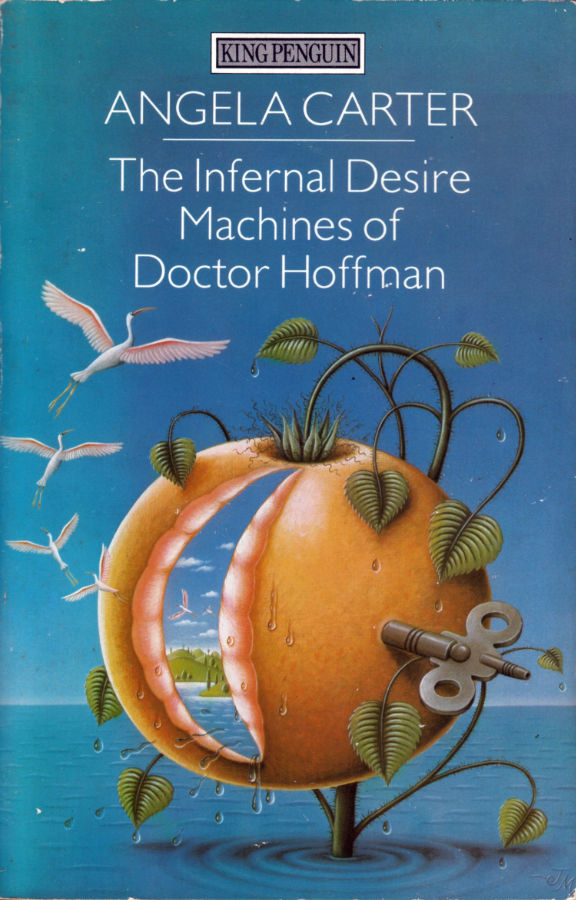
The Infernal Desire Machines of Doctor Hoffman by Angela Carter

1987 PB art by James Marsh

Begun while Carter was still living in Japan, and first published in 1972 (after her return to the UK), The Infernal Desire Machines of Doctor Hoffman is Carter’s most outrightly fantastic novel, and deservedly finds a place in Moorcock & Cawthorn’s Fantasy: The 100 Best Books and David Pringle’s Modern Fantasy: The Hundred Best Novels. (It was retitled The War on Dreams in the US.)

It begins in an unnamed city in an unnamed South American country. The narrator is Desiderio (“the desired one”), writing the memoir of his young life, when he was branded a hero for his role in ending the war that Doctor Hoffman launched upon the people of that unnamed city—and upon reality itself. Hoffman’s assaults warp time, space, and reason, causing people to sprout peacock feathers, warehouses to turn into palaces, and apparitions of the dead to appear. As Desiderio writes: “in the early days of the war, life itself had become nothing but a complex labyrinth and everything that could possibly exist, did so… the city was no longer the conscious production of humanity; it had become the arbitrary realm of dream.”

The Minister for Determination (to whom Desiderio is private secretary), constitutionally resistant to unreality (he’s convinced Hoffman has released a virus “which causes a cancer of the mind, so that the cells of the imagination run wild”) attempts to counter this encroachment of dream with a series of futile measures, from the use of radar to the use of torture as a means of forcing the unreal to differentiate itself from the real. Sensing they’re losing the war, the Minister gives Desiderio a secret mission: to find and assassinate the elusive Doctor Hoffman.
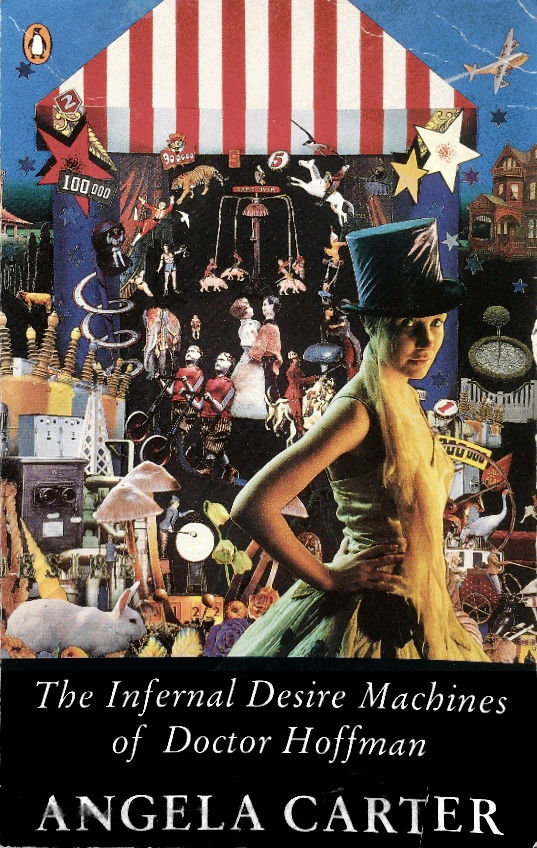
1990 PB, cover art by Andrew Wyatt

Desiderio leaves the city for the town of S, where the proprietor of a travelling peepshow is rumoured to be one of Hoffman’s disciples. Thus begins a series of picaresque adventures that see our young hero living with the native river people (with whom he, having part native parentage, seamlessly blends), working with a circus, travelling with a monstrous libertine known as the Count, stranded with a tribe on the coast of Africa and, finally, dwelling amongst a community of centaurs—before finally arriving at the “Wagnerian castle” of Doctor Hoffman. Throughout, Desiderio is haunted by, and often accompanied by (in a series of disguises he always sees through) Hoffman’s beautiful daughter Albertina, with whom he has, of course, fallen in love.

Just as Heroes and Villains was about the conflict between desire and need, this novel is about the conflict between dream and reason, or desire and reality. At first it seems the Minister (“not a man but a theorem, clear, hard, unified and harmonious”, who “had never in all his life felt the slightest quiver of empirical uncertainty”) represents reality and Doctor Hoffman dream, but when we finally meet Hoffman, he is an equally unimaginative patriarch (“cold, grey, still and fathomless—not a man; the sea”, who “had examined the world by the light of the intellect alone”). Both form a type with other such controlling paternal figures (which includes Doctor Donnelly from Heroes and Villains and Uncle Philip from The Magic Toyshop—what Lorna Sage, in her Writers and their Work volume on Carter, calls “Carter’s puppet-masters”). Contemplating Hoffman, this supposed unleasher of dreams, in all his disappointing rationality, Desiderio writes: “I did not think he knew what desire was.” (And, he muses, perhaps of Carter’s work as a whole: “Were all the potential masters the world held for me to be revealed as nothing but monsters or charlatans or wraiths?”)

1972 HB, art by Martin Leman

If these are the dark fathers, balancing maternal figures seem absent—Desiderio’s mother was a prostitute who left him to be raised by nuns, Albertina’s mother (Hoffman’s wife) is dead (though she was, at least, a poet). Rather, the presiding maternal force is even more implacable and desire-less than those two male figures: mother nature, at her most arbitrary and indifferent. When the entire circus with which Desiderio has been travelling is killed in a freak natural event, he notes that “the landslide could only be a simple assertion of the dominance of nature herself”. On the coast of Africa (later revealed to be a fantastic coast, and an emanation of the monstrous Count’s desire for self-destruction), Desiderio meets a people who represent “Man in his constitutionally vicious, instinctively evil and studiously ferocious form—in a word, in the closest possible harmony with the natural world”. Mother nature, then, is no refuge from dark puppet-master fathers.

Desire and dream come across as perhaps the only humanising elements in a world otherwise caught between the polarities of cold intellect and a starkly uncaring nature. But even then, desire in The Infernal Desire Machines of Doctor Hoffman is no romantic fantasy. In Carter’s hands, it’s full of casual brutality, tragedy and the darker extremes of perversity. Desiderio’s story takes him through a series of episodes, in each of which he enters a period of narrative stasis, where he lingers among a group of people and experiences their way of life. When he’s with the river-people, we get a disquisition on their beliefs and customs (outwardly placid, they prove to include cannibalism and paedophilia); we learn the histories and nature of the various people who make up the circus, some poignant (as with Madame la Barbe, whose beardedness raised her from being an ordinary girl to being “immensely handsome, widely travelled”, but, nevertheless, “the loneliest woman in the world”) others grotesque (the all-male troupe known as the Acrobats of Desire, who are capable of exchanging body parts with one another, and who gang-rape Desiderio). As far as trigger warnings go, this novel should come with a submachine gun logo on the cover.
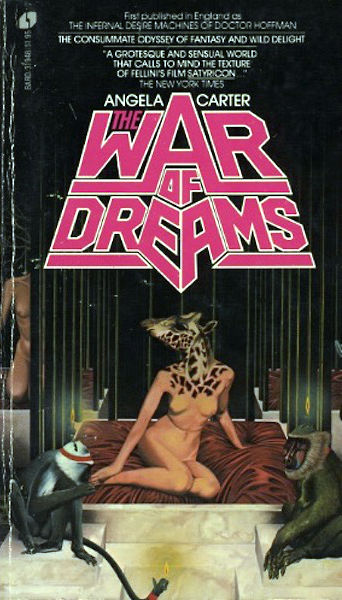
1977 US PB, art by Peter Goodfellow

Perhaps the most notable episode is that of the Count, a figure I can’t help feeling is based on de Sade (and Carter would go on to write a study of de Sade a few years after The Infernal Desire Machines). So incredibly self-centred he never seems to speak to anyone but himself, the Count is “a connoisseur of catastrophe”, “a blasphemous libertine, a blood-thirsty debauchee”, who claims to have “devoted my life to the humiliation and exaltation of the flesh”. Perhaps it’s characteristic of all the male “father” figures in the novel that Desiderio at one point thinks the Count might be the Minister, then later that he might be Doctor Hoffman…

The Infernal Desire Machines has been called a Surrealist novel, but I think that though Hoffman’s efforts are creating a surrealist reality, the novel doesn’t have Surrealist fiction’s lack of narrative coherence. Carter isn’t just letting “psychic automatism” (as the Surrealists have it) take over; rather, her narrative is a balance between the strange images of Surrealism and a conscious engagement with the more nebulous forces of the human condition: desire, dream, imagination, cold reason. Unlike pure Surrealism, it comes with thought applied.

Set as it is in South America, it naturally feels as though it might be called Magical Realism, but I think it’s one of those novels that absorbs so many genre labels—Gothic, Fantastica, Picaresque—without entirely belonging to any of them. (It’s tempting to read the “War on Reason” as sourced in the same media-frenzied, accelerated 1960s as Ballard addressed in The Atrocity Exhibition. But Carter isn’t presenting a dystopia, here. Hers is a world in constant conflict, though the feeling is not of warning about how things might become, it’s about how, for her, the world simply is.)

Carter is generous with her references, and has obviously absorbed a lot of imaginative literature and cinema—far more than would have been admitted in your standard English literary novel of the day: The Cabinet of Dr Caligari and Rotwang’s laboratory in Metropolis get a mention, as does Gulliver’s Travels and Freud. And there’s a distinct air of Kafka, de Sade, ETA Hoffmann and Borges too. There’s a certain Moorcock-ishness to the Law-versus-Chaos conflict between Reason and Dream/Desire, though it’s probably not down to influence. To my surprise, Lovecraft gets a direct quote (“the oldest and strongest emotion of mankind is fear”). And I’d even throw in the 007 films, as Hoffman’s castle, with its high-tech inner chambers, represents nothing so much as a Bond villain’s lair.
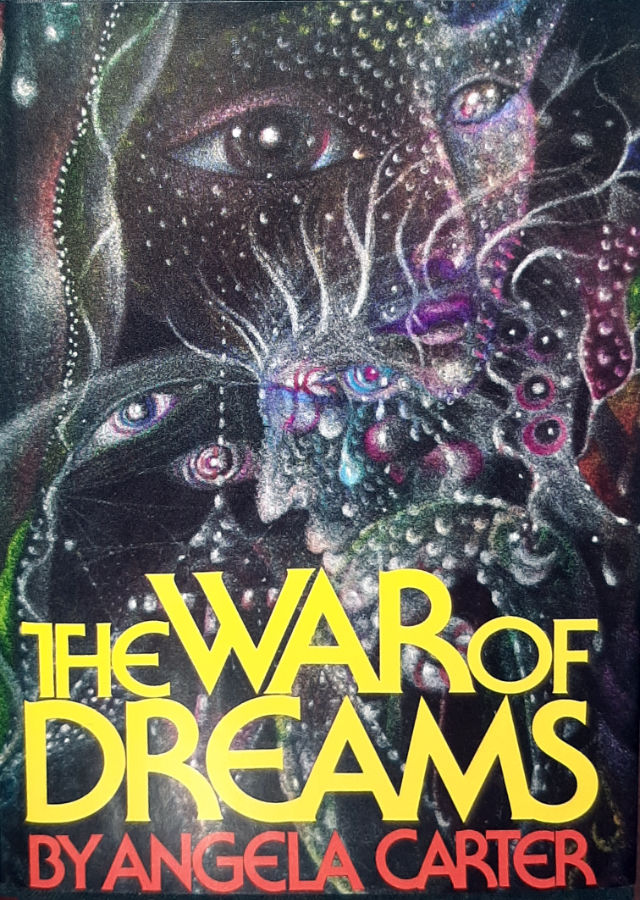
US HB, art by Linda Gardener

Me being me, I even suspected David Lindsay’s A Voyage to Arcturus might have been part of the mince fed into this particular sausage-machine, not just for their shared picaresque form which leads to a disillusioning/mind-opening revelation (which goes back at least to Apuleius’ The Golden Ass), but some specific details. For instance, shortly after meeting the monstrous Count, Desiderio says “His quality of being was more dense than that of any man I have ever met”, which instantly reminded me of Lindsay’s Spadevil, another larger-than-life figure met on the road whom the protagonist takes up with, and whose “body seemed to be composed of some substance heavier and denser than solid matter”. Later, Carter gives us a vision of nature at its most chaotically creative, mixing animal and plant forms: “nature had absolved her creations from an adherence to the formal divisions so biology and botany were quite overthrown and the only animals we saw… seemed more an ambulant vegetable than anything else.” Lindsay’s Matterplay (coming at a similar point in his novel) has a walking tree spontaneously forming from mid-air, before noting “Pure plants and pure animals by degrees disappeared, and their place was filled by singular creatures which seemed to partake of both characters.” Later still, Desiderio meets a hermaphrodite in Hoffman’s castle, with “a voice like a sexual ’cello”; Lindsay’s third-sex Leehallfae has an equally musical voice, “oddly suggestive of a mystical forest-horn, heard from a great distance.”

Throughout, Desiderio is led on by Hoffman’s Fah Lo Suee-like daughter—but is she like Muspel fire drawing Maskull on, or like Crystalman in one of his many deceptive forms? Their relationship is less fraught than that of Marianne and Jewel in Heroes and Villains—unless you read the messiness of that pairing as being externalised in all the horrors and brutality that surround them on their journey—but ultimately it ends as all such highly-strung desire must end: Desiderio tells us early on that Albertina is dead, and that he killed her, even as he loved her.

There is so much going on in The Infernal Desire Machines, it would be impossible to say it was trying to say one thing. It’s not saying desire is good or bad, or that reason is good or bad, rather it’s exaggerating both, and the conflict between them, and laying them out in all their messy, tangled complexity, with lashings of casual brutality, surreal imagery, and a lot of good writing. (My favourite line in the book is early on in the dream-beleaguered city, where Desiderio falls into “a sleep which had now become as aesthetically exhausting as Wagner”.)
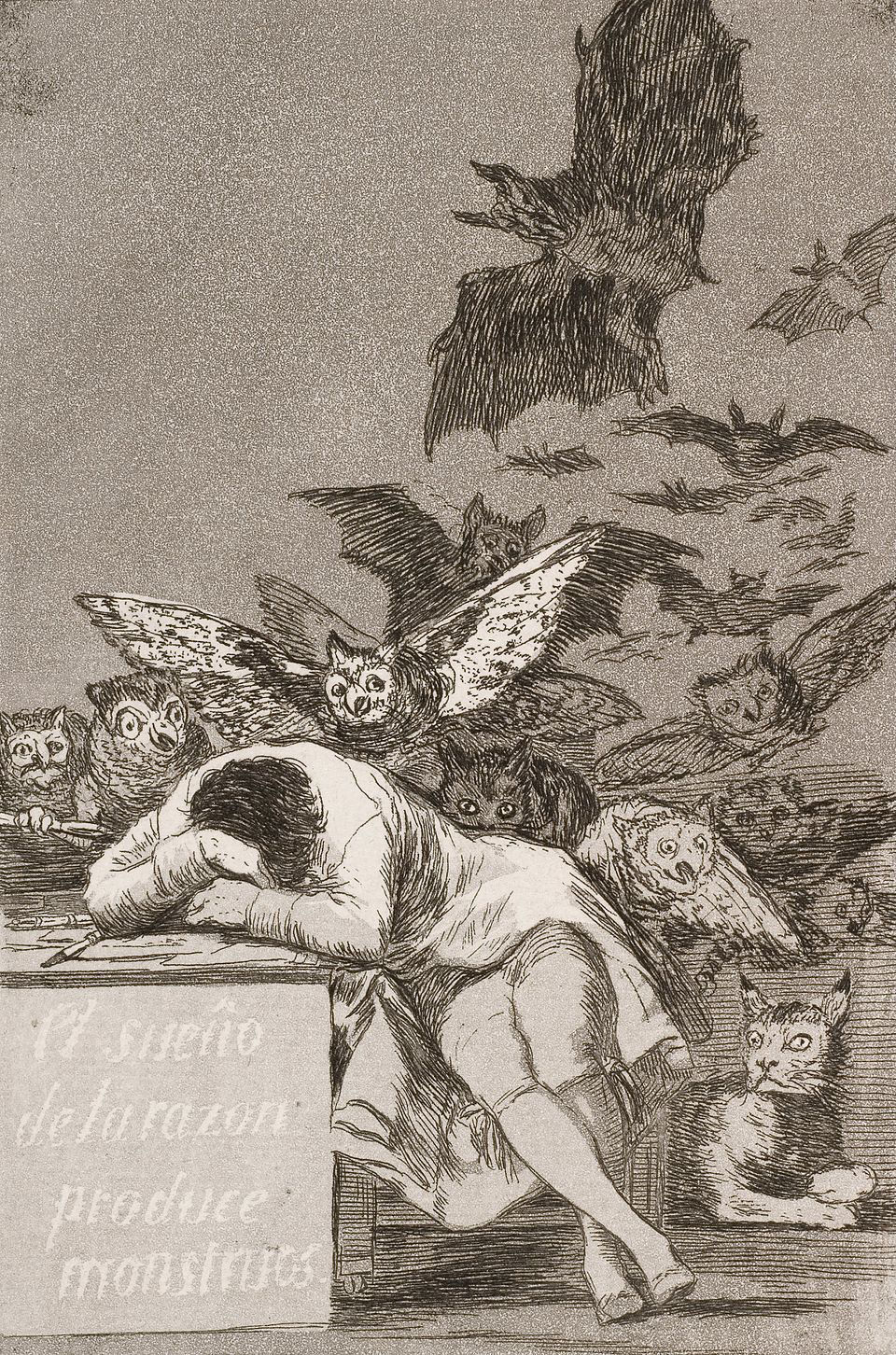
Goya, “The sleep of reason breeds monsters.”

From what I’ve read, there’s a lot more going on in The Infernal Desire Machines than I would be aware of: references to continental philosophy (are the principles of Hoffman’s philosophy to be taken as philosophy, or a satire upon such attempts to intellectualise the unintellectualisable?). At one point Albertina says: “the most monstrous aberrations are bound to flourish in soil once it has been disinfected of the imagination”, which seems the complimentary opposite of Goya’s “The sleep of reason breeds monsters.” Which is true? If both are, and the ideal is balance, then The Infernal Desire Machines of Doctor Hoffman is not a book about finding a balance. Although, as Albertina says, “Love is the synthesis of dream and actuality”, The Infernal Desire Machines itself pursues both to the point of breakage, leaving poor Desiderio old and alone, living with the memories of the desires of the past, plus a hot drink at bedtime. Perhaps “the time of actualised desire”, as he calls the invasion of the real by dream, was simply his youth.

Lorna Sage notes that The Infernal Desire Machines of Doctor Hoffman was “ignored, or treated with incomprehension and contempt, by most mainstream critics”, perhaps because the taint of the fantastic—particularly in a novel that so evidently takes a glee in its own imaginative fecundity—wasn’t generally considered acceptable at the time by the British literary establishment.
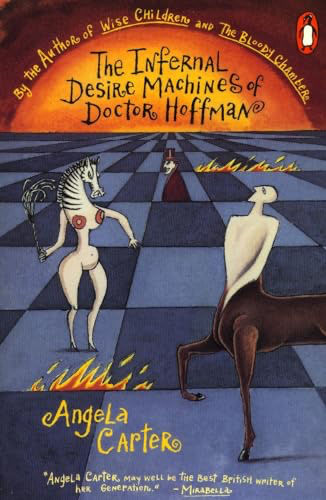
cover art by Roxanna Bikadoroff

Although I am ultimately impressed, I wasn’t always engaged by the book. When the narrative slowed to examine, at length, the lives of the river-people or the brutal centaurs, I was puzzled as to what it was doing. Maybe another read might make it fit together, but for now I have to think of such moments as sparks of imagination given free reign, jewels thrown into this bag of strange riches. It’s part of this novel’s character that it contains such a cornucopia of ideas, scenes, characters, and even longueurs.

(And the jewel image reminds me of Fritz Leiber on Clark Ashton Smith, who said Smith’s tales were “Innsmouth Jewellery; like strange ornaments, the metal elaborately inlaid and fired, studded with unknown semi-precious stones, from an unknown and timeless culture.” And Leiber, oddly, is another fantasist I found contained in Carter’s capacious novel, in the image of a night-time visitor to Desiderio’s rooms—Albertina, again, in yet another guise—a being with transparent flesh, so she appears as a “miraculous bouquet of bones”. Like the ghouls of Leiber’s Llankhmar. Had Carter read Leiber, too? Or was it just that her imagination was so wild, in this novel, it lapped on all these far shores of the fantastic?)

^TOP

A Voyage to Arcturus by David Lindsay

My cover to the Bookship hardback

David Lindsay’s first novel, which he called Nightspore in Tormance but his publishers renamed to the slightly more comprehensible (if bland) A Voyage to Arcturus, came out one hundred years ago this month. I first heard of it thanks to Moorcock & Cawthorn’s Fantasy: The 100 Best Books, which I’d bought because I’d grown dissatisfied with the sort of genre fare I was finding in my local bookshops, and was wondering if I shouldn’t give up reading fantasy altogether. I decided if I couldn’t find something in Moorcock & Cawthorn’s list to re-enthuse me, I’d look for a different genre to read.

Their summary of A Voyage to Arcturus left me somewhat mystified as to what the book was actually about, and certainly didn’t sell it to me:

Arcturus itself is not an ingratiating work; the shelf it occupies is a short one, reserved for titles more often to be found in lists than in reader’s pockets. The message it spells out is no comforting one.”

I’d probably never have read it had I not found it in a secondhand bookshop with that lovely Bob Pepper cover and thought “Might as well.” Even then, it sat on my shelf for a while before I actually picked it up and gave it a go.

Bob Pepper’s artwork for the Ballantine paperback of A Voyage to Arcturus

At first, I continued to be nonplussed. It seemed a little old-fashioned in style, and along with the freedom of imagination you often find in novels written before their genre conventions gel, it had that quaint lack of scientific or logical consistency that comes from somebody building a world before the idea of world-building set in. It was a strange book, yet not with the poetic strangeness of Clark Ashton Smith, or the uncanny strangeness of Lovecraft. If anything it seemed, stylistically, to be doing its best not to seem strange, but rather to present all its odd characters, sights, and events in as matter-of-fact a manner as any mundane travelogue:

Before many minutes he was able to distinguish the shapes and colours of the flying monsters. They were not birds, but creatures with long, snake-like bodies, and ten reptilian legs apiece, terminating in fins which acted as wings. The bodies were of bright blue, the legs and fins were yellow. They were flying, without haste, but in a somewhat ominous fashion, straight towards them. He could make out a long, thin spike projecting from each of the heads.

“They are shrowks,” explained Oceaxe at last. “If you want to know their intention, I’ll tell you. To make a meal of us. First of all their spikes will pierce us, and then their mouths, which are really suckers, will drain us dry of blood. . . . pretty thoroughly too; there are no half-measures with shrowks. They are toothless beasts, so don’t eat flesh.”

But then something happened. Pushing on through the book (more for the sake of finishing it than anything else), I became aware that some inner part of me, some second, more discerning reader — my inner Nightspore to the outer Maskull — was really caught up in it. It seemed to be saying: Something is going on in this book, and I have no idea what! I finished it in a rush, because I’d suddenly realised I hadn’t been paying it the attention it deserved, and I needed to start reading it again, this time making notes.

Various covers, art by (clockwise from top left): Peter A Jones, Ron Miller, …, Florence Magnin, Karl Stephan, Kato Naoyuki, Lucien Levy-Dhurmer, Jean Delville (design by John Coulthart)

In a sense, I’m still doing that. I’ve re-read Arcturus countless times, and each time I feel the need to read it again, paying still closer attention — or I feel the need to plough through the rest of Lindsay’s novels in succession, to try and grasp them all as one thing in my head and this time work it out. (I’ve even wondered if it’s not part of some “Lindsay effect”, a trick of that matter-of-fact literary style that leaves you constantly feeling you’ve almost-but-not-quite grasped something utterly intriguing.)

Soon after I first got on the internet, I started a website dedicated to Lindsay, mostly because I’d managed to acquire Colin Wilson, J B Pick, and E H Visiak’s book, The Strange Genius of David Lindsay — for £3! — and, feeling privileged to have got it, wanted to share the information inside it, feeling there had to be other people out there as hungry for information on Lindsay as I was. At first I added my own commentaries about the books, but soon removed those sections, feeling that the more I read Lindsay’s work, the less I knew about it. I kept The Violet Apple site (named after a posthumously published Lindsay novel which was the first book I bought online — thanks to Blackwell’s rare book search service, in fact) strictly factual for a while, apart from one article (“Four Approaches to A Voyage to Arcturus”), which was more about how the book defied any single interpretation than an attempt at offering an understanding of it.

(Another thing that has shifted in my view of the book, and Lindsay’s work as a whole, is its darkness. Initially encountering Lindsay and Arcturus, you can get caught up in that darkness — after all, it’s a novel about world-rejection, where only Pain can redeem you from all the terrible pleasures of life; and meanwhile Lindsay himself, after a lack of success as an author, died quite unpleasantly from self-neglect. But the more I’ve read it, the more I’ve seen that actually it’s a book shot through with a vitality that defies the darkness, and seeks something better. With Arcturus, the darkness is not the end point, but the beginning, and the impulse behind it is one of uncompromisingly seeking something better.)

Ad from The Times, September 1920

I like how open to interpretation A Voyage to Arcturus is, even while it has an evident meaning. Yes, it’s a gnostic text, but also it’s an exploration of a certain sort of psychological state that (in my view) is more fundamental than any religious or philosophical outlook: if you are not your authentic self (if you are Maskull, as opposed to Nightspore), then the world will seem like Crystalman’s prison, and it will be hard, dangerous work trying to untangle yourself from it. (Lindsay’s friend, E H Visiak, read the book in completely Christian terms; Colin Wilson read it as an allegory of consciousness; J B Pick saw it as vision.)

Most recently, I’ve come to see A Voyage to Arcturus as an incredibly rich archetype of the quest for truth. (And I think it’s in the book’s archetypal, or mythical, structure that its power lies — it certainly wasn’t its ideas that grabbed me on that first read, but something far more instinctual, mythical, musical even.)

Romanian edition

The protagonist Maskull begins the book not really invested in any search for truth as such, but once he gets caught up in it, he goes through all the possible stages of being deceived, wrong-footed, sidetracked, aggrandised, defeated, converted, bamboozled, disillusioned and overwhelmed, before finally, worn out through a series of breakneck back-and-forths, he snaps, and finds the simplicity and truth he was seeking all along — a simplicity that transforms him from Maskull to Nightspore, and turns the world from benighted deception into one lit by a beacon of pure truth (Muspel-fire).

I still find Lindsay himself something of a mystery. The power of his first novel was never quite equalled — except in snatches — in his subsequent books, though I have found all of them more and more interesting the more I read them. But the question I’m still undecided on is how in command of his material Lindsay was. Did he know what he was doing? I don’t think any creative artist of any real power does entirely, but there’s still the question of how much they know what they’re doing. A Voyage to Arcturus’s utter strangeness could be down to a certain naivety on Lindsay’s part, a beginner’s luck approach of letting his wild imagination go utterly free before the self-consciousness of post-publication hit him with how he ought to write. But hints in his letters — a reference to the mystical German writer Jakob Böhme for instance — make it clear he wasn’t an entirely innocent wanderer in fairyland, either.

Lindsay from the cover of Bernard Sellin’s Life & Works of David Lindsay

“Only a very few people will ever read Arcturus,” he reportedly once said to Victor Gollancz, “but as long as even two or three people will listen to Beethoven, two or three people will read it.” A Voyage to Arcturus now seems to have found an established place on many lists of classics of SF, fantasy, and imaginative literature, as well as Scottish novels, and even early 20th century fiction generally, and every few days I get a Google Alert telling me that someone, somewhere, on Twitter or some obscure internet forum, is recommending it as one of the strangest and most compelling books they’ve read. (Or, more rarely, saying it’s the most boring or incomprehensible book they’ve ever read.)

In a way, then, Lindsay has been proved right. Beethoven is certainly in no danger of not being listened to; now, I hope, A Voyage to Arcturus is in no danger of ever not being read, even if just by a few.

^TOP

Wuthering Heights by Emily Brontë

(most probably) Emily Brontë by her brother, Branwell

Wuthering Heights (1847) is the subject of my favourite book review ever, in a letter from Pre-Raphaelite artist & poet Dante Gabriel Rossetti to Irish poet William Allingham, in September 1854:

“…it is a fiend of a book — an incredible monster, combining all the stronger female tendencies from [poet] Mrs Browning to [murderer] Mrs Brownrigg. The action is laid in hell, — only it seems places and people have English names there.”

My first attempt at scaling Wuthering Heights was when I was trying to work through all the books in Cawthorn & Moorcock’s Fantasy: The 100 Best Books. I was perhaps feeling a little jaded by that book’s eccentricities by that point, as I’d read Moby Dick thanks to their recommendation, and couldn’t quite see the relevance to fantasy. (I can perhaps see their point a bit better now, and mean to reread Moby Dick at some point, free of false preconceptions — which is the best way to enjoy a classic novel.) A little way into Wuthering Heights, I began to feel it was going to be another of Cawthorn & Moorcock’s more eccentric inclusions, and gave up on it. (I really wonder if I’d have been able to appreciate it properly anyway, back then.) On recently learning that David Lindsay thought highly of it, though, I decided to give it another go, and am glad I did.

Wuthering Heights has had a long association with the more subtler and supernaturally-tinged fantastic. As Julia Briggs says in her study of the English ghost story, Night Visitors (1977):

“…the whole tenor of the book… implies a coherent universe wherein man, nature and spirit interact closely, and where the cruel and uncompromising power of love is more ruthless and compelling even than death.”

Most surprisingly of all, considering its reputation as perhaps the most darkly romantic of all love stories, H P Lovecraft liked the book — Lovecraft, who reacted so strongly to a “few touches of commonplace sentimentality” in William Hope Hodgson’s House on the Borderland. In “Supernatural Horror in Literature” he says:

“Though primarily a tale of life, and of human passions in agony and conflict, its epically cosmic setting affords room for horror of the most spiritual sort… Miss Brontë’s eerie terror is no mere Gothic echo, but a tense expression of man’s shuddering reaction to the unknown.”

Both of these quotes make it clear it’s the atmosphere of the book that speaks of the supernatural and fantastic, rather than the details (though there is, of course, ghostly Cathy’s “ice-cold hand” through the window one night, which may be a dream, but nevertheless imparts some details the narrator couldn’t at that point know). In fact, a lot of the power of the book comes from its narration being so low-key and realistic, thanks to the down-to-earth servant’s-eye-view of Nelly Dean, whose general lack of judgement only makes all the violence and brutality centred around Heathcliff seem that much more violent and brutal, lacking as it does the narrative cushioning of explanations, justifications, and condemnations.

Faber and Faber cover

It’s around Heathcliff this dark air of the supernatural accumulates, from the moment he first appears in the story, a “dirty, ragged, black-haired child” with an oddly old-looking face. Mr Earnshaw, who brings this child back the 60-miles walk from Liverpool, names it after a dead child of his own, adding to the feeling it may be a fairy changeling or a soul retrieved from hell. Like one of Le Fanu’s supernatural companions, it sucks the life out of those around it, as both Mrs (who most dislikes it) and then Mr Earnshaw (who most likes it) fade away and die after it’s brought into the home. (And the detail that, as well as presenting this unwanted child to his family, Mr Earnshaw discovers that the gifts he was asked to bring have either been lost or broken seems almost Aickmanesque. Did Earnshaw have to struggle to bring the child along with him? Or, did the child’s mere presence supernaturally spoil all attempts at affection, however minor, from that point on? The weird creeps in where the explanations are lacking.)

By name and nature, Heathcliff is more a landscape than a person — or, perhaps, a Gothic castle in human form, bleak, forbidding, oppressive, imperturbable, dark and haunted, monomaniacal. He feels like a character from a different mode of fiction altogether, a blood-soaked Webster tragedy, perhaps, or one of the wilder folk ballads. Placed in an otherwise respectable early-Victorian novel, he becomes a sort of black hole, pulling everyone in his orbit down into the dark pit of his loveless world.

Puffin cover

And that’s the thing that most struck me about this novel. By reputation, Wuthering Heights is a love story, but it seems to me the whole point about Heathcliff and his world is it (and he) cannot express, or even understand, love. Heathcliff’s relationship with Cathy, for instance (who’s too infantilely self-absorbed to express love herself: “I thought, though everybody hated and despised each other, they could not avoid loving me…”). Their relationship seems more about possessiveness than love, but a possessiveness so deep that Cathy feels it as identification (“Nelly, I am Heathcliff!”). So, it doesn’t matter that she doesn’t marry Heathcliff, because she and he are already one. Heathcliff himself seems only able to express anger, resentment, and a dark joy in revenge. He teaches the young Hareton Earnshaw, who lives with him at Wuthering Heights, “to scorn everything extra-animal as silly and weak.” When Isabella Linton marries Heathcliff, and lives with him at the Heights, she’s forced to ask, of the affable narrator Nelly Dean:

“How did you contrive to preserve the common sympathies of human nature when you resided here? I cannot recognise any sentiment which those around share with me.”

I still find it hard to express what I felt as I read Wuthering Heights for the first time. It was like a constant series of affronts, as Nelly Dean’s calm and seemingly level-headed narrative was peppered with acts of sudden anger and violence, some of which didn’t serve the plot, but just added to the air of devastation. The way five-year-old Hareton, for instance, reacts to the woman who, till six months before, had been all but mother to him: he throws a heavy flint at her head, and not out of anger at her, but more a sort of feral rejection of all human beings. There’s something about the way these brutal emotions swamp out the more human ones that recalls, to me, the way the children in The Turn of the Screw have been in some undefined way defiled by the depredations of Peter Quint, at the other end of the 19th century.

Wordsworth cover

And I think Wuthering Heights has more in common with The Turn of the Screw and those great horror stories of the end of the 19th century than that. Just as the ghost story at that time made the transition from pure fright-tale to a new and deeper exploration of human psychology, so Wuthering Heights’ power derives, in large part, from its presenting the sort of tumultuous passions brewed up in those earlier Gothic novels in a more realistic — and so, undeniably recognisable — way. It makes the novel’s characters and story that much more believable, and its horror all the more horrific — and so, I’d say, the psychology all the more insightful. This is, it feels, an authentic layer of human experience that no amount of civilised society can do away with.

It’s Heathcliff who’s haunted in Emily Brontë’s novel — “The entire world is a dreadful collection of memoranda that she did exist, and that I have lost her!” — but the result is itself a haunting narrative, still shockingly powerful and weirdly irresolvable.

And you can’t talk about Wuthering Heights without mentioning Kate Bush. Her song, I think, stands alongside Jefferson Airplane’s “White Rabbit” and Queen’s “Fairy Feller’s Masterstroke” as rare examples of songs inspired by other works of art that equal them in artistic power.

^TOP
