The Adventures of Monsieur de Mailly
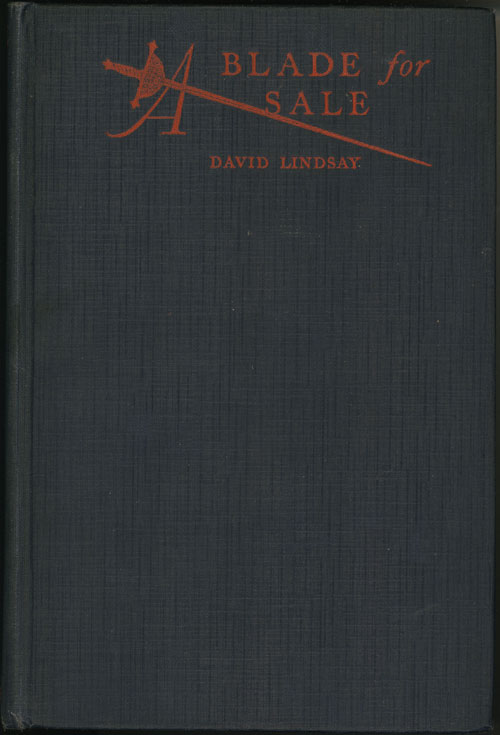
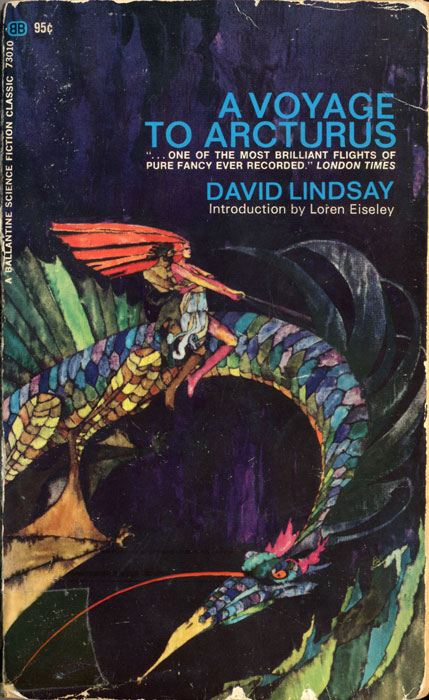
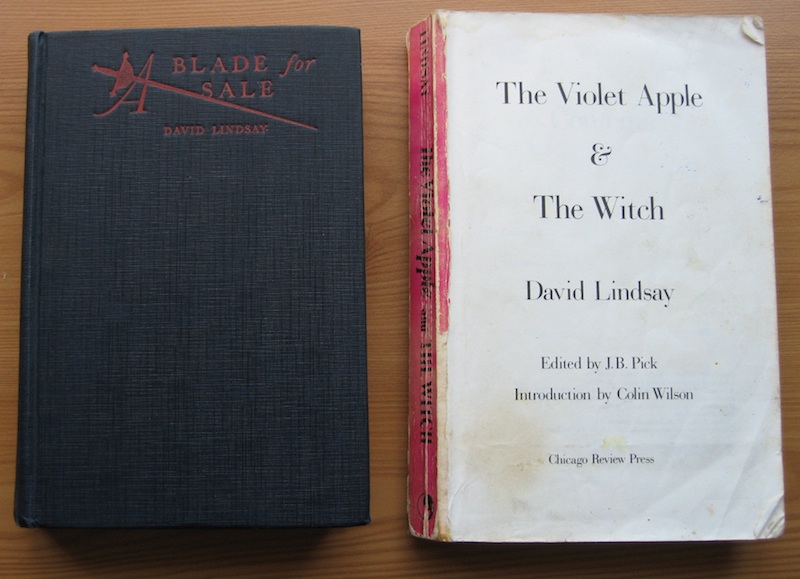
 , published in 1926 (1927 in the US, as A Blade for Sale), is usually regarded as the exception among David Lindsay‘s writings. Dismissed as a potboiler, it’s passed over quickly, if it’s mentioned at all, in any examination of Lindsay’s more serious novels. It is, as J B Pick says, “the only book of Lindsay’s without metaphysical overtones”, and it’s those “metaphysical overtones” which tend to draw readers of A Voyage to Arcturus on to Lindsay’s other works. But if, like me, you’re interested in Lindsay as a writer, rather than a philosopher or metaphysician — and despite the serious themes in his works, it’s the human dramas at their core which bear the weight of meaning, so The Haunted Woman, Sphinx, The Violet Apple and Devil’s Tor aren’t novels by accident, nor are they merely philosophical tracts candied up into stories — then de Mailly is an interesting book, if only because it presents a side of Lindsay not to be found in any of his other works.
As to its being a potboiler, it is. Or, it tries to be. And it’s perhaps in its failings as a potboiler that it’s the most interesting.
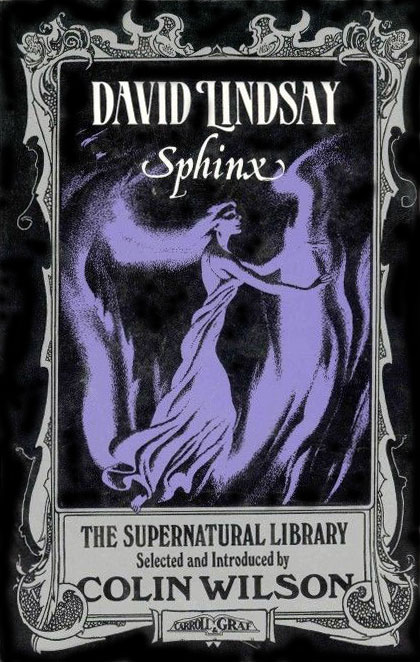
 At the same time as Lindsay was writing de Mailly, he was also writing his third published novel, Sphinx, which contains some thoughts on potboiling. Central to Sphinx is the character of composer Lore Jensen, who once created works of great profundity (including the piece which gives the novel its name), but, through having to write more popular music to earn a crust, has become creatively bankrupt. Accused of potboiling, she bursts out with: “But if I don’t boil my own pot, are you going to boil it for me? I suppose you think it’s bad art to have a pot!” But her drug-taking and dissolute lifestyle give the lie to any pretence she’s just following the demands of her muse; something has gone rotten within her. In a rather subtle little irony, Lindsay has her briefly engaged to a music critic — the ultimate symbol of the composer wedding herself to the demands of public taste!
But I don’t think anyone can blame Lindsay for attempting a potboiler — I certainly don’t. If it had funded another “metaphysical” novel, I’d have quite happily had a shelf-full of de Maillys. The trouble was, even though it was the first of his novels to be republished abroad, de Mailly didn’t result in financial success.
The key to the sort of novel Lindsay was aiming for in de Mailly is that it should be closer to a wish-fulfilling daydream than to real life. It should have heroes & baddies, adventures & romance, danger & derring-do. In his lead character, Gaston de Mailly, Lindsay may have been trying to create a series character of the sort popular at the time (new Sherlock Holmes stories were still being published in the 1920s, and de Mailly has some similarities to Holmes). To start with, the novel is episodic, and might even have been intended as a series of short stories. The first episode, for instance, lasts just two chapters, the second lasts three. After that, though, the episodes get longer. The third “story” lasts six chapters, while the fourth spans the whole of the remainder of the book — more than half its 319 pages. This could, of course, have been Lindsay’s intention — to warm up with a few short stories then extend to a novelette — but I think there’s another explanation, which lies in the sort of stories Lindsay was telling.
The Adventures of Monsieur de Mailly is set in the France of Louis XIV, in 1700, and thus slap-bang in the middle of the longest recorded reign of any European monarch. It is an age of wit and sophistication, politics and diplomacy, but also of warfare and swordplay. Gaston de Mailly, our hero, declares himself firmly allied to the latter path. A gentleman by birth (though he starts the novel in financially straitened circumstances), he’s a soldier by trade:
“For my part, I am not a politician… I care nothing for this dry paper warfare where we fight at invisible range, and where the beaten enemy will come to life again the next day.”
 His adventures, though, rarely require him to resort to his blade; his wits are his main weapon. (In the longest action sequence in the book, near the end, de Mailly combines cunning and swordplay to neatly defeat multiple opponents.) The best example of de Mailly in action is to be found in the second episode of the novel, in which our hero makes his first ever visit to the Court of the Sun King at Versailles. Initially, he’s out of his depth, and in danger of becoming the butt of a reputation-ruining practical joke. Brought before the King to explain himself, though, he manages to turn the situation around, to make the jokers the victims of their own joke, and ends up gaining himself a cool eight thousand crowns, not to mention the respect of the King.
de Mailly’s wit, then, is as sharp and nimble as his blade, and the main appeal of his adventures is seeing how he applies his cunning to the various situations he finds himself in. At times, his deductions from a few clues are almost Holmesian (at one point, for instance, he deduces the nature of the plot he’s entangled in from the mere fact that his sword has been stolen and swapped with another), and he even indulges in a soliloquised pean to “Divine Logic”:
“‘Tis truly astonishing what a load logic will bear when compelled! … It is to follow a thread through chaos… There is even beauty in it. To the divine sciences of astronomy, music, poetry, and philosophy, we must assuredly add logic as a fifth. ‘Tis a picture of the soul struggling through the gross appetites and passions of the world. Pulled down on all sides by material considerations, she is ignorant of her destination, which is heavenly; but she deduces it from her own resources, and this deduction possesses more of certitude than all the flesh, blood, and gold of the visible cosmos!”
That “picture of the soul” passage is almost A Voyage to Arcturus in miniature, though with a slightly higher dose of optimism, and is evidence, perhaps, of Lindsay’s more serious authorial DNA showing through.
Heroes who survive on their wits were popular at the time de Mailly was being written. I’ve already mentioned Sherlock Holmes; Agatha Christie’s first novels were being published in the twenties, too, and detective stories in general (of the era, anyway) were all about the triumph of deductive intelligence over the messy world of the passions. So it seems that choosing to make his hero a derring-do swashbuckler with the keen logic of a Holmes or a Poirot was a shrewd move on Lindsay’s part, or certainly one in keeping with the times. There were two problems with Lindsay’s use of his hero, though.
The first, more minor, problem, was in the way Lindsay introduces de Mailly. In the first episode, our hero tries to help a nobleman at risk of losing his inheritance because a widow is intent on marrying his rich, bachelor uncle, to whom he is sole heir. de Mailly comes up with the perfect plan — the young nobleman should marry the widow himself! — but is immediately thwarted when the widow kidnaps the uncle and whisks him off in carriage, with a priest in tow. So, in this first adventure, where you’d expect the newly-introduced hero to prove his credentials, de Mailly in fact fails, despite coming up with a clever stratagem. This wrongfoots the reader from the start. It’s as if Lindsay can’t quite sustain the daydream level of the pulp adventure, but has to bring in the messiness and unpredictability of real life, in which no clever plan, however clever, can be a sure success. In fact, of the four adventures of Monsieur de Mailly we have in the novel, our hero only succeeds in two; in the others, his clever planning comes to nothing (in both cases, by the sudden intrusive action of a woman, which could perhaps be taken to represent Lindsay’s scornful muse, bursting in to destroy his hero’s house-of-cards faith in logic).
The second problem lies in the complexity of the final adventure in the novel. de Mailly finds himself caught in a night-time scheme to assassinate a minister, but every person involved in the plot seems to have conceived a way of twisting it to their own ends. Thus, de Mailly has to disentangle himself from not one, but many plots and counterplots, and also has to come up with a stratagem of his own to ensure he comes out on top, too. (This is one admirable aspect of de Mailly — in making his protagonist a “hero of wit”, Lindsay doesn’t then set him up against idiots, but against people as capable of thinking and rethinking their way through a plot as de Mailly himself.)
The point about this problem with de Mailly is best summed up by J B Pick:
“A writer who is more interested in theme and purpose than in plot tends to overdo the elaboration and intricacy of any story in which plot is a major consideration. De Mailly has so many twists and turns that the reader is eventually lost in the maze.”
It’s as if, by the fourth episode, Lindsay has already tired of the daydream aspect of his hero’s adventures, and has had to resort to incredibly complicated plot convolutions to sustain his own interest. This fourth episode is readable, and enjoyable, though not in that easy-reading way you’d expect from a pulp-style adventure. It’s more like a tightly-played chess game between not two but a handful of opposing players.
Taken as an attempt at writing a pulp-style series of adventures, then, de Mailly is flawed, but is not a total failure by any means. The second episode, in the Court of the Sun King, is a perfect little story of the triumph of de Mailly’s wit, while the fourth episode is a sort of Bach Fugue of interweaving plotlines whose sharp about-turns, plots and counterplots have an almost breathtaking elegance, if only you can hold each individual character’s wants, expectations, understandings and misunderstandings in your head. But when it comes down to it, it seems that Lindsay just couldn’t quite sacrifice his integrity towards his own (often pessimistic, certainly difficult) worldview, in which the gaining of what one wishes for is a struggle that wrenches the very soul, not just something that takes a little wit and swordplay. In addition, when the lower-intensity storytelling of de Mailly began to drag, Lindsay had to amuse himself with increasingly complicated plots.
In writing de Mailly, Lindsay took some pains with regards to historical accuracy — he mentions, to give one instance, the fact that calling a married woman “madame” was only, in 1700, a practice of the nobility, yet to filter down to the middle classes — but he by no means shoves his research down the reader’s throat. Generally, the tone of the book is one of witty adventure, more along the lines of The Three Musketeers, or a Grey Mouser episode from Fritz Leiber, with Gaston de Mailly’s dry, cynical wit being one of the key pleasures along the way. I end with a few examples:
“In politics, as elsewhere, there are nine pedants to one man of resource.” — (an early version of Sturgeon’s Law)
“You are a lawyer, Fleurus; which is to say, an animal trained out of noble sentiments.”
“He who has a bad wife is dipped in the Styx against all other calamities.”

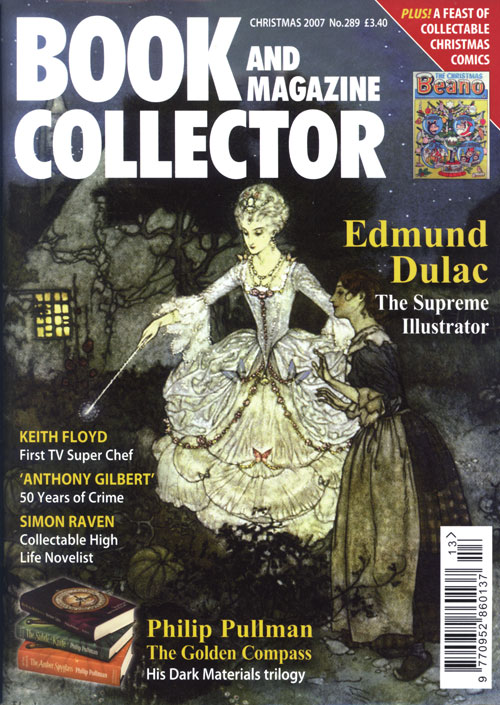 It’s tempting to say the internet killed it, and this must be partly true, if only because B&MC was always at least half made up of wants & for-sale lists — stuff which came to seem quaint, not to say dated, when you consider how the internet has changed the buying of secondhand books. (Not all for the good, no — it’s almost impossible to find a bargain nowadays, and some prices get artificially inflated. But not all for the bad, either. I loved hunting through booklists for titles I wanted, but love far more being able to quickly search multiple booksellers and find all the available copies and editions of the book I want.) I never used that part of the magazine anyway. What really interested me were the articles about individual authors & illustrators, and that’s the thing I’ll miss.
 Also, there’s just finding the information. When I started my website on David Lindsay (back in 1998), I assumed that, soon enough, every writer would get a website dedicated to them, providing all the information you want to know about them, including news, a bibliography, a biography, and so on. But it’s rather disappointing to see how few authors that I’m interested in have well-run, up-to-date websites — even the living ones! Fritz Leiber, for instance, is surely crying out for something as good as, say, this Tim Powers site, or this Joan Aiken one. (But Fritz Leiber is perhaps starting to see something of a revival, what with a new Selected Stories, a collection of rarities, and the cornucopia of download delights recently on CthulhuWho’s’s blog. So, there’s hope.)