
 Strange Evil was written in 1955, by the fourteen year old Jane Gaskell, and published in 1957. It belongs to that small class of genuinely unique sports of imaginative fiction from the time before fantasy was a commercial genre. In a sense, it was published in another age. As the publisher’s preface states (after basically apologising for the fact that the book was written by a “prodigy”), the manuscript was submitted in “eight little blue exercise books”, something which wouldn’t even get a cursory glance nowadays. But they published it “not because it is remarkable to have written a novel at all at fourteen, but because we think Strange Evil is, in itself, a strange, arresting and beautiful book.”
The question is, is it still worth reading today? In the preface, the publishers go on to say: “That it has faults and immaturities we know; revision has deliberately been kept to a minimum and has been carried out by the author herself, for we felt that the youthful sparkle of her writing should at all costs be preserved.” One of the things that makes the book still worth reading is its style. And the point about Strange Evil‘s style isn’t its maturity, or lack of it (though I don’t see much of the lack of it myself), but its originality.
As an example:
“Flowers thanked the blue sky with perfume. Perfume was wafted down to her — not only from the great beds on the sunlit terraces, but from those bright assemblages of flowers far away on the mountainside. At the top of the slope trees were massed in shades of jewel-green. White blossoms peered and peeped among them, blurry pearls in the midst of the hard vividity of the rest of the colours of the day. A blue sky rose above them and arched its back as though it, too, were alive and vital. It was certainly sun-soaked. It was blue as though it depended on its living for it.”
“It was certainly sun-soaked” might be immature, but you’d have to have no poetry in your soul not to immediately forgive it for the sentence that follows it, which is just one of the many little sparks of surprise dotted throughout the book. Here’s another:
“A red butterfly perched on her shoulder, and, frightened by the texture of her blouse, darted off again. She followed it until she lost it in its gay philanderage among the flowers.”
Has a butterfly’s flight ever been better described than as a “gay philanderage”? (Taking both words in the 1950s sense, of course!) But the poetry of Gaskell’s style isn’t only reserved for the beauties of her world — though it is far more colourful than most writers’ worlds — as this example from a long and bloody battle at the end shows:
“Once, as she fled and slipped again, it was upon five separate fingers in the pool — they were like five little sticks which clutched at her feet.”
The thing about these examples is they’re so vivid and unique. I’ve read enough fantasy novels by full-fledged adults to know that you don’t find images as arresting as those “five separate fingers” often, however violent things get. One thing you can say about Gaskell’s writing that sets it apart from the “immature” is that it is unclichéd. Most fourteen-year-old writers would simply be rehashing what they’d read before, and in a similar style. It takes a certain maturity to break free of other writers, and Gaskell certainly has that.
 The basic plot of the book isn’t so original, as fantasies go, but is so full of weird invention that you either won’t notice it, or won’t care. Judith, our heroine, receives a last minute note telling her that a cousin she has never met is coming to stay. It turns out this cousin, Dorinda, and her fiancé Zameis, aren’t human, but are what could best be called fairies, as Judith realises when their golden antenna become visible in a particularly sunny London restaurant. For some reason, knowing their true nature means Judith can’t be left in our world, but must go with them to theirs, though this is something she seems happy enough to do. They travel to Paris, to jump off the roof of Notre Dames, which happens to be one of the places where our world touches theirs. Judith and her two companions find themselves on a moving silver road, which takes them across the many disparate regions of fairyland.
They are making for a mountain, which Dorinda, Zameis, and other “Internals” live inside. But before they can reach it, they’re kidnapped by “Externals” — a mix of exiled Internals and conscripted satyrs, who grow food for the Internals in exchange for brief returns to the inside of the mountain (which the Externals need to do regularly in order to survive). But it turns out that the Internals have finally denied the Externals any entry to the life-giving interior of the mountain, and the Externals, driven to desperation, are ready for war.
Judith, neither an Internal nor an External, at first finds herself free to move about, but soon comes to the attention of one of the Internal nobles, who thinks she is an agent of Death come to kill him. War breaks out. Judith, finding the decadence and pleasure-loving perversity of the Internals not to her taste, sides with the Externals, and finally confronts the Baby — a monstrous giant god in the shape of a vastly overgrown human baby who represents the selfish, sybaritic nature of the Internals’ religion, “just sheer, puffed-up, spoilt, colossal selfishness”. (This, I suppose, is what China Mieville was referring to when he said Strange Evil had “the most extraordinary baddy in fiction”.)
The book is sprinkled with weird moments that go way beyond the imaginations of most generic fantasists. At one point, heading for the final battle, Judith witnesses the passing of a “colossal black woman”, so big that:
“She stepped over the mountain as though it were flat grass on a plain, and Judith knew her to be one who cared nothing for the little ways of men. Truly there were dreadful things in this world.”
It’s a brief pause that adds nothing to the plot, but does everything to open up the sense of being in another, totally alien world, where potentially vast forces might at any moment come into play. (It may have been inspired by Goya’s “The Colossus“. The back flap of Strange Evil says Gaskell “derives the inspiration for some of her descriptive passages from studying paintings”.)
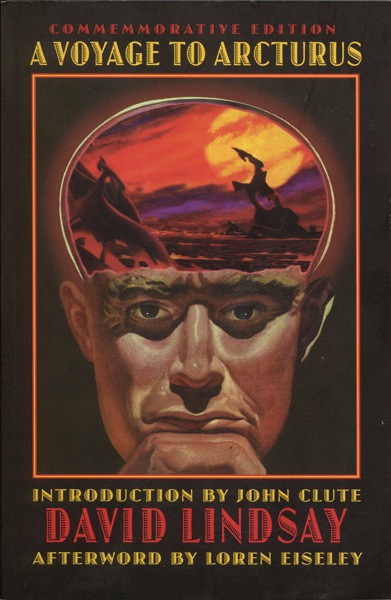
So, I think Strange Evil is still worth reading, not for the fact it was written by a fourteen-year-old, but because it is the product of a unique imagination. I’d even say there’s an air of David Lindsay’s A Voyage to Arcturus in the home-grown, one-offness of its fantastic invention, and the authenticity of its intent. This is something that’s still rare today, when it’s so easy to fall into the wheel ruts of genre fiction and follow them through the usual standard plots, standard styles, and standard fantastic images, for the standard reasons.
Jane Gaskell went on to write the Atlan fantasy series, which I haven’t read, but I will certainly be on the look out for.
 , I mingle with academics, writers, and several musicians, including the onetime bass player from Blondie,
  , and
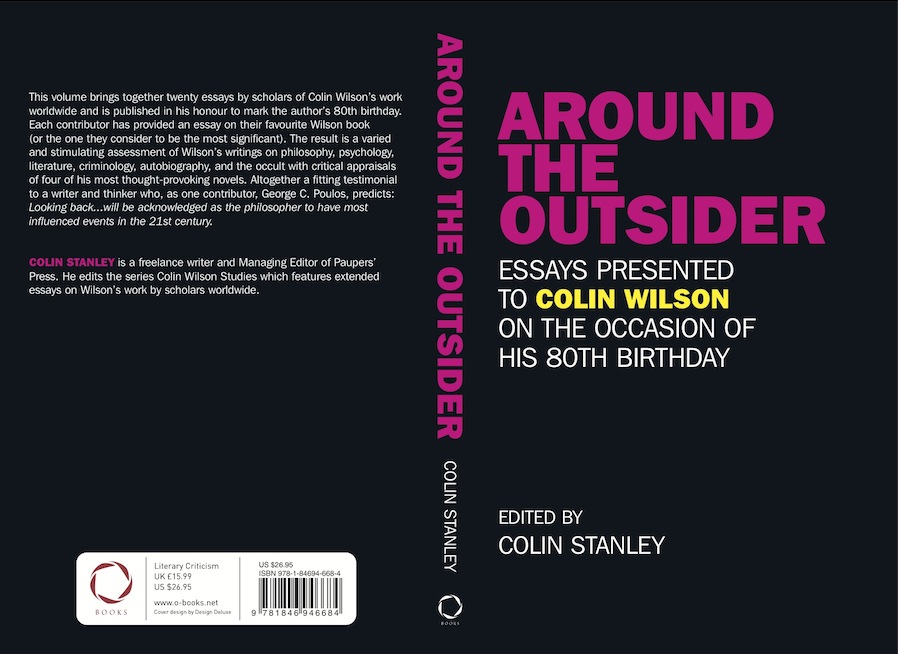
, and  — which I used in researching my Lindsay essay) seem to me to be continuing very much in the spirit of Wilson himself; and also David Power, who has published a book on David Lindsay,
  (which has an introduction by Colin Wilson).