
 This week I’ve mostly been reading a recently-released collection of book reviews by Colin Wilson, Existential Criticism, from Paupers Press. (If the title sounds rather dry, the contents are anything but, as I several times found myself laughing out loud.) After finding his first book, The Outsider, in a bookshop in Tunbridge Wells and buying it on an impulse, I was instantly hooked on Wilson’s writing, and went through a period of reading everything by him I could get my hands on. In those pre-internet days, when the thrill of the hunt was a large part of book collecting, this, combined with the wide range of Wilson’s interests, resulted in my reading books on subjects I’d not normally be interested in, such as serial killers (in often rather grisly detail), cult leaders, and UFOs. Then, almost as abruptly, I suddenly had my fill of Wilson, got rid of most of the books by him I’d collected, and read him no more. Or almost no more, because I’d occasionally dip in when he released a new book (I reviewed The Angry Years on this blog a few years ago), and have slowly been warming to him again. When Existential Criticism arrived in the post last Saturday, I sat down for a quick dip-in and soon found myself absorbed as I remembered all the things I’d liked about his work from before.
Colin Wilson’s writing is incredibly moreish. Every so often I go through my bookshelves, pulling off books, flipping through, and asking what it is the authors have that makes their writing work, and I always end up with a Colin Wilson book in my hand. Other writers may have a characteristic prose style, or a unique imaginative world, but Wilson writes in a straightforward manner, and his best writing is as likely to be his non-fiction as his fiction; nevertheless, he’s compulsively readable.

Why? It comes down, I think, to two things. The first is his intense interest in what he’s writing. Whatever he’s writing about, he goes at it like a hungry fox eyeing the fat rabbit on the other side of the field — wily, but determinedly singleminded. Wilson is also tremendously knowledgeable. At times, he seems to have read just about every book in existence — and not just the ones that would make him “well-read”, but the dregs, too, and read with no preconceptions, meaning he’s found value where others wouldn’t stoop to look, and been unimpressed by what others universally praise. There’s a real feeling of the stuff-of-life in Wilson’s writing. He’s willing to throw every element into the pot — and that means the tawdry, quirky, gossipy messiness of it as much as the idealistic striving. Whether he’s writing about murderers or philosophers, science or the occult, he accords it all equal value as a source of potential understanding, of ideas. (And this may be the reason he’s not as appreciated as he ought to be — his more culturally po-faced critics get embarrassed by his serious approach to things they think beneath them.) This leads to the second essential element that powers his writing, the easy-going confidence that is, perhaps, its most attractive quality.
But what was it that stopped me reading Wilson’s work? Weirdly, it’s the thing that Wilson himself would consider the most important element in his writing: the existentialism.
I don’t disagree at all with the philosophical element of Colin Wilson’s writing, which basically comes down to the idea that boredom, or the deeper feeling of purposelessness or meaninglessness, isn’t (as it was taken to be by Existentialists such as Sartre) an essential fact of human existence. It can be overcome, simply by making the effort. And the effort involves merely making yourself interested in something. The more intense the interest, the more meaningful life will seem. Wilson has obviously achieved this. Viktor Frankl, in Man’s Search for Meaning, identifies this finding a focus in life, this creating a meaning from the inside rather than waiting for it to arrive from the outside, as a key factor determining which of his fellow-prisoners survived the concentration camps of the Second World War.
As I say, I had no problem with this idea, and was happy for Wilson to bend every subject he treated round to it, as he inevitably did, so he could rehearse its main points. I had no problems, either, with him treating the writings of the likes of Rilke or Sartre — who I haven’t read and don’t intend to — as testing grounds for his philosophy. But it started to grate when he turned his attention to writers whose work I love, and almost always found them seriously wanting. H P Lovecraft, for example, was damned pretty thoroughly in The Strength to Dream. And though Wilson was a key figure in rescuing David Lindsay‘s A Voyage to Arcturus from near-oblivion, his interpretation of Lindsay’s work has, as a result, sometimes been taken as the only interpretation, one that seems to me quite reductive, particularly when applied to Lindsay’s second novel, The Haunted Woman. All this began to grate on me, and the feeling returned when I read, in Existential Criticism (p. 57): “Borges is not a great writer because he is not a mature writer. He has remained in a kind of perpetual adolescence.”
Back when I first encountered these criticisms, I couldn’t get over them. I felt Wilson had missed the point, but overawed as I was at the time by his evident intelligence and confidence, I couldn’t bring myself to admit this. Instead, I gave up reading him. Now, though, I find it easier to simply say, “I beg to differ,” and read on, still enjoying the Wilson I used to enjoy, and taking the rest as a challenge to what I’ve since come to think. Because, yes, it’s easy to criticise Lovecraft for being a pessimist, for being overwhelmed by the threatening bleakness of the universe. And no, Lovecraft didn’t provide an answer to the existential problem of life’s apparent meaninglessness, but what he did do was encapsulate the problem in an entirely new imaginative form. This can only be regarded as a failure if you treat fiction as a form of philosophy. But I think it’s the other way round. Aesthetics contains philosophy, not vice versa. And this, I think, is one of Jorge Luis Borges’s strengths. Borges takes obscure philosophical ideas and plays with them as easily as a poet plays with words. Wilson may take this as evidence that Borges didn’t believe in anything with any conviction; I’d say it means Borges believed that the world is not one thing, with one single interpretation, but a manifold thing worthy of a million interpretations, none of which is wholly right nor wholly wrong — a multiverse rather than a universe — which is a very Borgesian idea (the Aleph, the Book of Sand, and Shakespeare’s Memory are also many-things-in-one), but also, surely, the same as the existential idea that “meaning is not in the world, but one’s head” (as my version of Alice puts it). In fact, if you want to get properly philosophical about it, it’s the idea William James (a frequent Colin Wilson touchstone) wrote about back in 1907, in A Pluralistic Universe.
In the Borges review, Wilson does go on to say that he enjoys Borges as a writer, just finds him lacking in an existentialist sense. Wilson has even dedicated a book to him (The Philosopher’s Stone), and has written stories in the Lovecraftian mode (“Return of the Lloigor”). So, I’m going to get over it, and carry on enjoying Wilson, having left him alone, I think, for too long.
 In the words of Futurama’s dithery Professor Farnsworth, “Good news, everyone!” — apparently, I am incredible. At least, I am according to this rather fatuous report,
 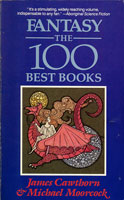 I haven’t always been like this. I used to be un-incredible, at least most of the time. (Except as a kid. All kids demand re-reading of the books they like. They’re not stupid.) I can’t actually pinpoint when my incredible, perhaps even mythical, status kicked in, but aside from re-reading favourite
 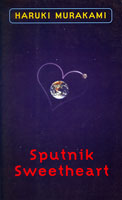 The main objection to re-reading a book is that there’s no point because you know what’s going to happen. But, to me, knowing what’s going to happen not only doesn’t matter, it actually makes it better. Exposed to stories as much as we are, we’ve all developed enough of a “story sense” to second-guess where a story is going anyway, and the real pleasure of a twist-in-the-tale is not so much the twist itself, as how skilfully it’s handled. My two most recent re-reads are both minor books by favourite authors — Sputnik Sweetheart by Haruki Murakami, and The Violet Apple by David Lindsay. The first time I read Sputnik Sweetheart was when I’d just discovered Murakami. At the time, I’d only read his massive (genuinely tome-like) The Wind-Up Bird Chronicle, and in comparison found the slim Sputnik Sweetheart a bit disappointing, though with a strikingly weird bit in the middle (where a young woman gets stuck at the top of a Ferris wheel for the night and has an experience that turns her hair completely white), mainly because I wasn’t sure how to understand the end. Re-reading it, knowing how it ended, everything fell into place and made sense, and I had time to relax and understand other things about the book, like how each of the three main characters faces the same sort of strange crisis, but one evades it, one falls before it, and one — maybe — triumphs. With The Violet Apple, I found that knowing what was going to happen at the end only made the build-up much more poignant and emotionally powerful. (That’s how tragedy always works. Macbeth’s downfall was only a surprise for Macbeth himself.)
 To end off, a not-necessarily-complete list of books I’ve read four times or more (with no explanations or apologies — though, to intensify my weirdness, I’ll say that at least two in this list are books I’ve re-read straightaway after reading them for the first time): Moving Zen by C W Nicol, The Belgariad by David Eddings, A Voyage to Arcturus by David Lindsay, The Outsider by Colin Wilson, The Tombs of Atuan by Ursula Le Guin, Steppenwolf by Hermann Hesse, The Influence by Ramsey Campbell, The Drowned World by J G Ballard, V for Vendetta by Alan Moore & David Lloyd… Not to mention the countless short stories I’ve re-read many more times than four or five. Short stories are, after all, so much more re-readable. But simply reading short stories nowadays is enough to commit you to a very dark and dingy corner of the asylum reserved for book-readers. Catch you re-reading the things, and they throw away the key. Before you eat it, or do yourself an injury with it or something.