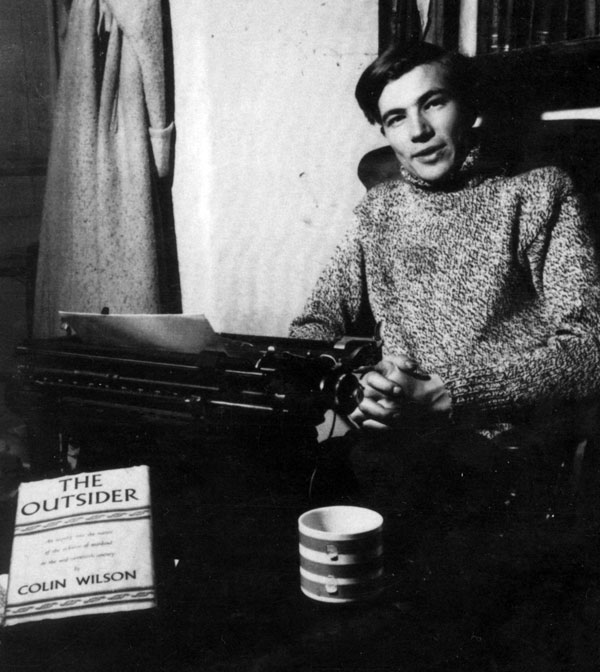
The first horror author I read was H P Lovecraft. I’d heard about him because of Chaosium‘s Call of Cthulhu roleplaying game, which I may have bought before reading any of Lovecraft’s fiction, I’m not sure. (I remember having a long and inconclusive conversation with my karate teacher about whether the Necronomicon actually existed, largely because of the serious scholarly tone of the appendix notes to the Call of Cthulhu rulebook.) The first Lovecraft story I actually read, thanks to an anthology in the school library, was “The Outsider”. I was blown away.
“The Outsider” has a bit of a reputation as a gimmick tale, as nothing more than a story with an obvious twist. (I have to say that, however old I was when I read “The Outsider”, I didn’t see the twist coming, which was perhaps why I was so blown away by it.) But I’d like to defend “The Outsider”. Rereading it recently, I found it an extraordinarily moving story about alienation and emotional isolation. The twist at the end, which on a rereading of course you know is coming, then takes on the feel of something the narrator must know about himself, but is fervently trying to deny, which makes his desperate attempts to end his loneliness all the more affecting. The next Lovecraft tale I recall reading was “The Horror in the Museum”, which also, at the time, blew me away. A rereading of that hasn’t been as kind.
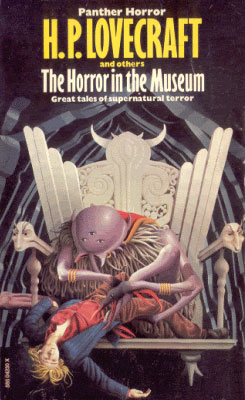 I said in the first of these “Me & Horror” posts that I didn’t read any horror fiction till I was 16 or 17, but looking back on it, I realise I must have first read Lovecraft when I was about 11 or 12. The thing is, I just didn’t think of him as a horror writer. Perhaps because I’d approached him via the gaming route; perhaps because his stories were set in the 1920s, and in America, and that had enough of a distancing effect to muffle the horror (as is true of most classic ghost story writers — their tales take place in a world of carriages, housemaids, leisured gentlemen and weekend stays at country houses — all part of their charm, but also what makes their fictional worlds so resolutely fictional to me, though nonetheless effective); perhaps because his fiction was sufficiently similar to the Doctor Who books I’d spent so much time reading (alien monsters at work among us — very Doctor Who). Or it could just be that Lovecraft’s horror is more conceptual than sensational. I mean, in a Lovecraft story, the horror resides in the ideas, in the ultimate significance of what’s going on, rather than the evocation of a few chills through some creepily-described scenes. To Lovecraft, the appearance of a monster was an affront to reason and scientific law, and that was the true horror; but to me, reading as a kid, I just wanted to know what the monsters looked like — the philosophical subtleties didn’t register. To “The Colour Out of Space”, for instance, my first reaction would have been, “But where’s the monster?” Reading it now, it’s the bleakness of its sheer cosmic indifference to human life that’s horrific. And “The Shadow Over Innsmouth”, which had monsters, took me years to start to appreciate. I at first thought it a bit too adventury, too much an “action” tale, to be satisfying on the level I expected of Lovecraft. Now, I think it’s Lovecraft’s fear of heredity madness that’s at the real root of the horror in that story. It’s become one of my favourite Lovecraft tales.
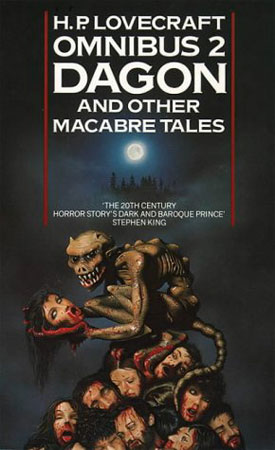 The one thing I do remember about my early encounters with Lovecraft was how they gained a tinge of excitement from just how difficult they were to find. (Odd, really, because Lovecraft was ubiquitous in the early 70s. I guess by the early 80s it was assumed everyone had read him.) Lovecraft’s writings seemed forbidden, Necronomicon-like, and it wasn’t till the big fat Granada paperbacks came out (around 1985, with those gory Tim White covers) that I actually managed to get a proper dose.