Algernon Blackwood, photo by Douglas
Of all those early-20th century weird writers (Arthur Machen, M R James, Lord Dunsany, H P Lovecraft, Clark Ashton Smith), Algernon Blackwood seems the most difficult to really know. Reading Lovecraft — the very type of the weird writer — you can’t help being aware that HPL has a definite idea of what a weird tale should be, and that he’s doing his best to capture it in form, content, style and idea, honing his approach tale by tale, in theory and in practice. Blackwood doesn’t seem to have an aesthetic ideal; his fiction is an outpouring of all sorts of stories and styles, ghostly, adventurous, romantic, comedic. (Lovecraft himself calls Blackwood’s work “voluminous and uneven”, though says it contains “some of the finest spectral literature of this or any age”.) He does though, like Lovecraft, have a central belief that acts as the DNA that shapes and unites all his fiction — “an interest in the Extension of Human Faculty”, as he puts it — but it seems to me that, in contrast to Lovecraft’s fiction, where the best tales are usually those that most embody Lovecraft’s stated ideals, those where Blackwood most explicitly captures his views on “extended or expanded consciousness” are usually the least successful as fiction. Fortunately, Blackwood has another force driving the production of his stories, and it’s where this is most evident that he’s at his best.
In his introduction to The Insanity of Jones and other tales — a selection of his fiction written between 1906 and 1910 — Blackwood says:
“I recall, anyhow, that these tales poured from me spontaneously, as though a tap were turned on, and I have often since leaned to the suggestion that many of them derived from buried, unresolved shocks… These ‘shocks’ had come to an exceptionally ignorant youth of twenty who had drifted into the life of a newspaper reporter in New York after a disastrous cattle-farm and a hotel in Canada, and the drifting had included the stress of extreme poverty and starvation… the New York experiences in a world of crime and vice had bruised and bludgeoned a sensitive nature that swallowed the horrors without being able to digest them, and… the seeds thus sown, dormant and unresolved in the subconscious, possibly emerged later — and, since the subconscious always dramatises, emerged in story form.”
The best of the tales in this book are those most obviously rooted in real experience and vividly-created, authentic-feeling settings. The weird desolation of the wilds of the Danube in “The Willows”, and the truly vast and primal wilderness of Canada in “The Wendigo” are two obvious ones, but Blackwood isn’t only a wilderness man.  The New York of “Max Hensig”, with its evocation of the alcohol-sodden, sleep-deprived world of city reporters is just as convincing — and gripping — an environment. Elsewhere, although Blackwood can be poetic (as in, say, “The Dance of Death”, or “The Old Man of Dreams”, which mostly work because they’re short), the difference begins to tell in those stories written purely as stories rather than outpourings of genuine experience (“Miss Slumbubble”, in which an overly-anxious woman finds herself trapped in a haunted train carriage, or “The Insanity of Jones”, where a young clerk is given the chance to enact a karma-free revenge on a man who tortured him to death in a previous life) are the least substantial, and least convincing.
The key (with all weird writers, I suspect, particularly those who have a philosophy to expound) is mystery. Whatever a writer’s beliefs, while they’re conjuring the mystery — the awe, the fear, the terror, the wonder — they include us all, but as soon as the explanation arrives, the portcullis clangs down. The perfect example is Blackwood’s “May Day Eye”, which starts as a vivid evocation of the borderline panic of being lost in a mile or two of English countryside as dark descends — then, suddenly it’s all technical talk of “elementals”, and it’s not convincing. The point at which this tale changes is where the narrator meets with an expert on folklore who has all the necessary explanations. Such a mouthpiece character doesn’t always appear in Blackwood’s fiction, but when he does, he usually spoils it, for me. The most obvious example is the “psychic detective” John Silence (if only he would be silent), one of whose tales, “The Camp of the Dog” is in this book. John Silence is absent for much of the tale, and before he comes we get — again — a great evocation of an environment, in this case a vast collection of tiny islands north of Stockholm, and a growing tension between the small group of campers holidaying there, a tension taking a dangerously lycanthropic turn. Then John Silence arrives and talks all about “vital forces”, “the Subtle Body” and all things “fluidic”, and puts a dampener on what was building up to be a rather hothouse tale of teenage lust at odds with civilised values.
But when Blackwood’s good, he can be very good, and he’s good when his tales are backed up by a solid grounding in real places and situations. In “Max Hensig”, the New York reporter, Williams, gets to interview a psychopathic doctor on trial for the poisoning of his second wife. 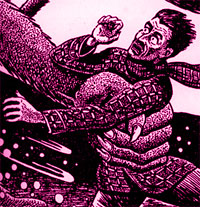 Williams is convinced Hensig is dangerous, and writes so in the papers, but Hensig — who is clearly a psychopath, and is openly contemptuous of so unimaginative a way of killing someone as poison — is released, and then Williams knows Hensig is after him. The interviews, with Williams one side of the prison bars and Hensig the other, feel like Hannibal Lecter territory, and when we know Hensig is on the loose once more, hard-drinking Williams’ descent into near-nervous collapse is as thick and sticky as an alcoholic sweat.
But the best tale in the book, for me, is “The Wendigo”. (“The Willows” is here, too, but I think that, despite Lovecraft’s endorsement, it has to take third place after “The Wendigo” and “Max Hensig”.) For a start, the environment is wonderfully realised:
“In front… lay the stretch of Fifty Island Water, a crescent-shaped lake some fifteen miles across from tip to tip, and perhaps five miles across where they were camped. A sky of rose and saffron, more clear than any atmosphere Simpson had ever known, still dropped its pale streaming fires across the waves, where the islands — a hundred, surely, rather than fifty — floated like the fairy barques of some enchanted fleet. Fringed with pines, whose crests fingered most delicately the sky, they almost seemed to move upwards as the light faded — about to weigh anchor and navigate the pathways of the heavens instead of the currents of their native and desolate lake.”
Then there’s the supernatural element itself. Simpson’s hunter-guide Défago is snatched from the very mouth of his tent by the Wendigo — snatched and carried off to race through the woods, then up into the skies, where his cries about his “burning feet of fire” echo down to the terrified Simpson.  But this isn’t all. Out of sheer boldness, Blackwood has Défago return after several days’ absence for an hour or two — or is it Défago? The thing looks like him, but that likeness could be “a mask that was on the verge of dropping off, and… underneath they would discover something black and diabolical revealed in utter nakedness.” Défago’s comrade Hank shouts that this isn’t Défago, and the thing disappears as mysteriously as it came… Then, later, we find Défago again, only this time, we’re told, it’s the real man, one utterly frostbitten, exhausted, and empty-minded. And so, is the Wendigo an actual creature? Is it a supernatural entity? Or is it a metaphor for “that other aspect of the wilderness: the indifference to human life, the merciless spirit of desolation which took no note of man”? Blackwood — as caught up in the rush of his tale as Défago is in the Wendigo’s grip — doesn’t answer, but lets the mystery remain:
“Out there, in the heart of unreclaimed wilderness, they had surely witnessed something crudely and essentially primitive. Something that had survived somehow the advance of humanity had emerged terrifically, betraying a scale of life monstrous and immature. He envisaged it rather as a glimpse into prehistoric ages, when superstitions, gigantic and uncouth, still oppressed the hearts of men; when the forces of nature were still untamed, the Powers that may have haunted a primeval universe not yet withdrawn.”
A glimpse — this is what a great weird tale should be, not an explanation. And it’s when Blackwood keeps his tales to that glimpse that he most succeeds.