Visions from Brichester by Ramsey Campbell

visions-from-brichester-hc-by-ramsey-campbell-3452-pVisions from Brichester aims to collect all of Ramsey Campbell’s Lovecraftian fiction that came after (or was not included in) his first, extremely Lovecraftian, collection, The Inhabitant of the Lake. Doing so, it spans 40 years of writing, from “The Stone on the Island” (1963) to his 2013 novella, The Last Revelation of Gla’aki. What’s more, it spans several interesting changes in Campbell’s writing.

The first, and most obvious, change is the basic one of finding a voice — the themes that inspire him, and the techniques that work for him. To me, the very early stories in this book (“The Stone on the Island”, and “Before the Storm” (1965)) may be imaginative takes on horror ideas, and have the occasional arresting image, but they just don’t work as stories. Certainly not as those from 1966 and 1967 (“Cold Print” and “The Franklyn Paragraphs”) do. It’s illuminating to compare the latter two stories with their early drafts, included here as appendices. “The Successor”, from 1964 (which was rewritten as “Cold Print”) attempts to blend Lovecraftian horror with details from Campbell’s own life and environment, but the literary and biographical influences feel like separate, unmixing streams. “Cold Print”, on the other hand, is a definite artistic success. It draws a clear parallel between its prurient protagonist Sam Strutt’s interest in hard-to-find power-fantasy smut with those ‘searchers after horror’ who, as Lovecraft puts it, ‘haunt strange, far places’. At the end, it even manages to turn the tables on the reader, reminding them of their own dubious pleasure in witnessing Strutt’s comeuppance (‘somewhere, someone had wanted this to happen’). It’s as much a story about horror as it is a horror story. The same goes for “The Franklyn Paragraphs”. The early version is a straightforward horror story; the rewrite is playful, and, once more, about horror, questioning the legitimacy of writing about the supernatural if you don’t believe in it. Yet, it’s also a tale with a genuine horror element — and a genuine human element — as it’s about being trapped: by relationships, by beliefs, or simply by being a conscious, living mind stuck in a corpse in a grave.

Ramsey CampbellBy the mid-seventies, Campbell is very much in my favourite mode, combining the kitchen-sink realism of sixties British cinema with an often psychedelically-tinged Lovecraftian horror. Examples of this are “The Tugging” (1974), “The Faces at Pine Dunes” (1975) and “The Voice of the Beach” (1977). The latter two are both set in a real place, Freshfield, where, Campbell says in his afterword, ‘I had several seventies chemical experiences’. Here, the supernatural or cosmic horror is utterly entwined with character-based horror, most notably in “The Faces at Pine Dunes”, whose trapped young male protagonist, living a peripatetic life in his parents’ caravan, starts to find his own place in the world, only to have his few personal gains immediately overwhelmed by awful truths about his parents, himself, and (this being a Lovecraftian tale) the universe.

Going straight from these seventies tales to “The Horror under Warrendown” (from 1994), completely wrongfooted me — I was so intent on the serious mode of those earlier stories that I was halfway through “Warrendown” before I got the joke, let alone that it was a joke. An utterly straight-faced (and highly Lovecraftian) handling of an idea that’s very funny, “The Horror under Warrendown” ends in a brilliant but loving parody of Lovecraft’s febrile crescendoes of prose freaked with scientific terminology (‘Partly vitrescent, partly glaucous… pullulating… internodally stunted…’), which is twice as funny once you realise what it’s describing.

Black Wings, front coverIt’s not all comedy from here on. We have another grim piece of socially-minded horror in “The Other Names” (1998), and a tale of writerly horror, “The Correspondence of Cameron Thaddeus Nash” (2010, from Black Wings), whose narrator’s tone can perhaps be detected to a certain extent in Campbell’s own early piece of criticism, “Rusty Links”, also collected here. But Campbell’s later writing as a whole is perhaps best represented by his darkly slapstick Lovecraftian novella, The Last Revelation of Gla’aki (originally published standalone, in 2013). His take on “The Shadow Over Innsmouth”, it’s the tale of university archivist Leonard Fairman travelling to the seaside town of Gulshaw to retrieve what is, for him, ‘the rarest Victorian book’, a complete set of the multi-volume Revelations of Gla’aki. He’s at first frustrated to find the inhabitants are intent on running him something of a dance, as, rather than being handed the full set in one go, he has to collect it a book at a time from different people. His strained relationship with his girlfriend (‘He’d learned to find fondness in her voice, since she hadn’t much time for nicknames or other expressions of intimacy’) is contrasted with the very warm welcome of the people of Gulshaw, who insist on calling him by his first name, and seem intent on making him feel one of them. It’s that same theme again from “The Faces at Pine Dunes” and “The Franklyn Paragraphs”: how human relationships can become traps, and how the supernatural can present a weirdly welcoming alternative, where you can become part of something larger than yourself, though perhaps too literally.

the-last-revelation-of-gla-aki-jhc-by-ramsey-campbell-out-of-print--[3]-2057-pThe Last Revelation of Gla’aki is, like The Grin of the Dark and The Overnight, at once both stark horror and slapstick comedy; its constant playing with perception is halfway between gleefully nonsensical punning and paranoid horror. Is Leonard’s tale one of cosmic horror or deep fulfilment? It seems to be both — but that’s also a brink Lovecraft seemed to be teetering on in his later tales, such as “The Shadow Over Innsmouth”, “The Shadow Out of Time” and “At the Mountains of Madness”.

Visions from Brichester ends with some of Campbell’s Lovecraft-related non-fiction. The early pieces are of mostly historical or biographical interest (in particular his denunciation of HPL, then his denunciation of that denunciation), but the final piece, “On Four Lovecraft Tales”, from 2013, is a brilliant piece of criticism, an insightful look at how Lovecraft achieved his effects through orchestration on a prose level. It’s almost a shock, after the intense, paranoid-hallucinogenic prose of the stories, to find Campbell writing in such a measured, calm and collected manner. I’d love to read more of such in-depth studies by Campbell like this.

^TOP

Demons by Daylight by Ramsey Campbell

Cover to Demons by Daylight (Star)I’ve always been fascinated by the moments when artists and writers first find themselves, when they move out from the shadow of early, formative influences to speak with their own voice. Ramsey Campbell’s shift from taking Lovecraft as the defining mode & tone of horror fiction (as in his first collection, The Inhabitant of the Lake and Less Welcome Tenants) to something much more personal and of its time in his second collection, Demons by Daylight, is one of the better-documented, most notably by Campbell himself.

Demons by Daylight came out from Arkham House in 1973, though most of the stories were written by 1969. So different was the approach, Campbell felt that, though he might have been doing something entirely new in horror fiction, it could be that no one else was doing it because it wasn’t going to work. But some people got it, including T. E. D. Klein, who wrote an ‘extraordinary piece in Nyctalops, in which basically he identified everything I wanted to be in the book in the first place’ (as Campbell says in a lengthy interview in Necronomicon Press’s booklet, The Count of Thirty), and which proved ‘sufficiently encouraging to make me attempt to try to make my living from writing.’

What makes the shift between the Lovecraftian stories in The Inhabitant of the Lake to those in Demons by Daylight so pronounced is that it wasn’t just one thing that changed: it wasn’t only the style (from wordy mock-Lovecraft to something a lot more literary and impressionistic), or the storytelling approach (structured crescendoes of Gothic horror to jump-cut art-house snippets, more like the realistic cinema of the day in tone), or the themes (from cosmic horror to something rooted in human psychology, and human relationships), it was all three. It could seem that Campbell was deliberately going as far from Lovecraft in every direction possible, but I think what he was doing was making the very necessary shift from basing his writing on what he’d read, to his actual experience of life (the Inhabitant of the Lake stories were all written before he was 18). Also, by having a wider artistic palette to choose from. (Campbell mentions his discovery of Nabokov as being the second great revelation of his reading life, after Lovecraft.)

Cover to Demons by Daylight (Arkham House)Changing so much means a lot of experimentation, and Campbell talks of spending ‘the first couple of years basically getting it all wrong’, having to draft and re-draft stories till they worked. I still find some of the stories in Demons by Daylight don’t, quite, for me. This could be because many still use the Lovecraftian device of having the final sentence provide a sort of release or clarification of the horror — or seeming to do so. But whereas Lovecraft’s tales were structured to feed all their clues into a single, horrific revelation at the end, Campbell’s can be too impressionistic for this to work in the same way. (‘The Stocking’ is one that left me wondering what I’d missed. Is its final sentence a further twist, or just a cut-off point?) The real heft of Campbell’s stories isn’t in that final impact, but the overall impression: a whole psychological reality, not a single horrific fact.

It’s the themes, not the techniques, that make Demons by Daylight. These are not, in the main, tales of cosmic horror. Though ‘The Franklyn Paragraphs’ is still quite Lovecraftian — S T Joshi has called it ‘the summation of Campbell’s Lovecraftian work’ (in an essay in The Count of Thirty) — with its documentary style, its inhuman horrors, and it being based on the correspondence between two authors (recalling Lovecraft’s ‘The Whisperer in Darkness’), but it’s also the most stylistically varied of the Demons stories, with its narrator (Campbell himself) quoting Errol Undercliffe’s letters (one of which is written while drunk, and which ends with a parody of Lovecraft’s cut-off narrative, in this case not for the monster to come in and kill the writer, but for the inebriated Undercliffe to be sick), and quotes from Roland Franklyn’s book of supernatural revelations. It also has a highly Aickmanesque scene where the narrator meets Franklyn’s widow, who talks offhandedly about the supernatural events she’s witnessed, and which she’s fed up of having to live with. They’re more of a bother to her than a dark revelation.

cover to The Count Of ThirtyThe chief theme of Demons by Daylight is repression. Campbell’s characters are trying to grow, change, and find themselves, but are caught in stifling social and emotional nets. (A fitting theme for a book about Campbell writing himself out of his Lovecraft-shaped cocoon.) The horror emerges, all too often, as a bursting out of far-too-repressed emotional forces. So, in ‘Made in Goatswood’, the rather pagan-looking garden gnomes the narrator buys his Christian girlfriend end up dragging her off and assaulting her in a pagoda where she’d previously cut short his own advances. And ‘The Second Staircase’ has the protagonist vicariously — and helplessly — participating in a similar assault, an expression of his own repressed desire. The forces of repression themselves aren’t supernatural — they’re parents, parents-in-law, girlfriends, teachers. What’s repressed, though, emerges in supernatural ways. The source of the horror is inside the characters, not, as with Lovecraft, in the deepest abysses of space & time.

As well as being part of Campbell’s own writerly and personal journey, this bursting free of repression was part of the times. Here, Campbell engages directly with the Liverpool and London of the late 60s, and its changing social mores. There are references to films of the time, pop music, and the counter-culture. T. E. D. Klein’s review said that drugs were the key to Demons by Daylight, but Campbell says he’d ‘never gotten anywhere near drugs at that point’. The opening story, ‘Potential’, is about this very fact, about ‘being this sort of suited figure on the periphery’. (The story’s be-suited protagonist turns up at a rather disappointing ‘Be-in’, but gets invited to something far darker.)

For me, the best tale in the book is ‘The Guy’. It feels the most fully-formed as a story. Whereas the other Demons tales end on jarring eruptions of horror, this is about a man who’s lived with a single moment of horror all his life, and has even made it a positive part of his own purpose. ‘The Guy’ is about a friendship between two boys from different social classes, with the narrator learning to overcome his middle-class parents’ prejudices. It’s the sort of story, you can’t help feeling, that Lovecraft himself — hidebound by his own social prejudices — could never have written, but this aspect of it doesn’t feel at all like a reaction against Lovecraft; it emerges naturally from the story itself. Which is, I suppose, the surest sign of a writer having shrugged off the more artificial props of formative influence to be himself.

cover to Letters to ArkhamCampbell’s correspondence with Arkham House editor August Derleth, which covers the period of Campbell’s finding his own voice, has come out in hardback from PS Publishing this week, so it’ll be interesting to see what light that throws on Campbell’s formation as a writer.

^TOP

Wizardry and Wild Romance by Michael Moorcock

I’d like all the writers I like to like each other. But writers, self-centred and individualistic as cats, are often the worst at being objective about other writers. There’s too much stepping on each other’s toes, too much “You don’t want to do it like that!” and “I was going to do that, and do it better!” As a result, I’ve learned to take a cruel joy in finding out that the writers I like in fact hate each other. There’s M R James on Lovecraft (“whose style is of the most offensive. He uses the word cosmic about 24 times”), Machen on Blackwood (“Tennyson said ‘the cedars sigh for Lebanon’, and that is exquisite poetry; but Blackwood believes the cedars really do sigh for Lebanon and that… is damned nonsense”). Both Tolkien and C S Lewis met and liked E R Eddison, but hated his outlook (Tolkien: “I thought that, corrupted by an evil and indeed silly ‘philosophy’, he was coming to admire, more and more, arrogance and cruelty”); while Fritz Leiber wrote of Tolkien, “He’s not interested in women and he’s not really interested in the villains unless they’re just miserable sneaks, bullies and resentful cowards…”

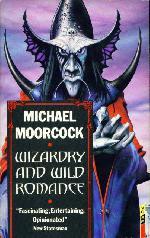
Wizardry & Wild Romance cover

Wizardry and Wild Romance, Gollancz (1987), cover by Les Edwards

Michael Moorcock’s Wizardry and Wild Romance is subtitled “A Study of Epic Fantasy”, but it’s no academic exercise in objectivity. I’ve read it many times, but reading it used to depress me, and it’s taken a good few years (and re-reads) to understand why. It is, of course, that Moorcock is a practitioner of the form he’s examining, and his “study” is more a cry than a critique. One of the reasons I’ve so often come back to reading it is that I wanted it to be like Lovecraft’s “Supernatural Horror in Literature”: a critical history of a genre by one of its major practitioners. But Lovecraft’s essay is, really, a critical history only by way of being a writer’s manifesto, a definition of what Lovecraft himself was trying to do. Because Moorcock shies away from explicit definitions (though he does offer one: “I am referring specifically to that body of prose fiction distinguished from myth, legend and folktale by its definite authorship and not genuinely purporting to be a true account of historical or religious events”), it leaves a sort of gap, the black hole of a definition which can only be inferred from the penumbra of praise and damnation that makes up the bulk of Wizardry and Wild Romance. And one of the problems is that Moorcock is so much better at damnation:

“…a new school is emerging of would-be Romantics, desperately striving to discover fresh sensibilities in the way repressed products of the middle-classes tried to loosen up with drugs and sentimental egalitarianism in the sixties. These people learned the school rules too well, however, and the main impression given by their fabulations is of red elbows and other miscellaneous bits of anatomy poking out through holes they have, with much effort and personal discomfort, rubbed in the straitjacket.”

And:

“Often the prose is little more than a mindless imitation of the euphonious aspects of the verse which, lacking the substance of the original, takes on the aspect of a mute attempting desperately to sing a Mozart song by mouthing an approximation of the sounds he has heard.”

And, most famously:

The Lord of the Rings is a pernicious confirmation of the values of a morally bankrupt middle-class. The Lord of the Rings is much more deep-rooted in its infantilism than a good many of the more obviously juvenile books it influenced. It is Winnie-the-Pooh posing as an epic.”

Like many an internet commentator, he brings the Nazis into the debate early on (mentioning Rudolph Hess in the Foreword). And he has a particular downer on HP Lovecraft:

“An aggressive, neurotic personality, though not without his loyalties and virtues, Lovecraft came under the influence of Poe, Dunsany and the imaginative writers of the Munsey pulp magazines and produced some of the most powerful infantile pathological imagery and some of the most astonishingly awful prose ever to gain popularity, yet his early work, written primarily in homage to Dunsany, from where he borrowed the idea of an invented pantheon of gods, is lighter in touch and almost completely lacking in the morbid imagery of his more successful horror stories in which death, idealism, lust and terror of sexual intercourse are constantly associated in prose which becomes increasingly confused as the author’s embattled psyche received wound after wound and he regressed into an attitude of permanent defensiveness.”

Whew.

That word, “aggressive”, occurs quite often in Moorcock’s little critiques, whether it’s of Lovecraft, John Norman, Tolkien or C S Lewis. But its use does itself come across as, well, quite aggressive:

“One should perhaps feel some sympathy for the nervousness occasionally revealed beneath their thick layers of stuffy self-satisfaction, typical of the second-rate schoolmaster, but sympathy is hard to sustain in the teeth of their hidden aggression which is so often accompanied by a deep-rooted hypocrisy.”

The thing I always failed to notice in my early readings and re-readings of Moorcock’s book (which usually left me feeling how much he must hate the genre, and wondering why he bothered to write a book about it) was his evident passion for it. He swipes so eloquently against the writers he hates precisely because he feels so strongly about what they’re doing — or, to his mind, mis-doing. He does praise writers, some not unequivocally — Clark Ashton Smith, Robert E Howard — others highly — Fritz Leiber, M John Harrison, Robert Holdstock, Mervyn Peake — though never, sadly, as eloquently as his criticisms. But he also presents, if you can spot it amidst the fusillade, evidence of having not only read a great deal of it, but a good deal about it.

Rodney Matthews cover

Rodney Matthews cover

And, of course, he has written a lot of it himself. But here, Moorcock doesn’t discuss his own work, which may account for the key gap I find in Wizardry and Wild Romance (whose title I always assumed was a quote from a genuine poem, till I tried to track it down, and found that the “Wheldrake” it’s attributed to is a Swinburne pseudonym (used, appropriately, to write bad reviews of his own work) as well as, later, a Moorcock character).

Wizardry and Wild Romance was the first book about fantasy I read, and it certainly taught me a lot:

“An intrinsic part of the epic fantasy is exotic landscape…. and no matter how well drawn their characters or good their language writers will appeal to the dedicated reader of romance according to the skill by which they evoke settings…”

And:

“Melodrama and irony work very well together; the best fantasies contain both elements, which maintain tonal equilibrium…”

Moorcock may bash the “morally bankrupt” middle-classes, and he may sometimes present a rather defensive maturismo somewhat reminiscent of Jackie Wullschläger’s in Inventing Wonderland, but you have to admit he does it with style. And if you can stand back far enough not to be splashed by the acid he spits, there’s a good deal of enjoyment to be had from the sheer wit of the book, even if you disagree with the points being made:

“If the bulk of American sf could be said to be written by robots, about robots, for robots, then the bulk of English fantasy seems to be written by rabbits, about rabbits and for rabbits.”

And, perhaps the most revealing statement about Moorcock’s own tastes in fiction:

“If we must be given stories about talking animals, let them at least be sceptical, sardonic and world-weary talking animals.”

While to me, it’s to find recourse from scepticism, cynicism and world-weariness that I turn to fantasy in the first place — that, to me, is what literary magic is all about, what Tolkien called “re-enchantment” — but that, of course, is my own bias.

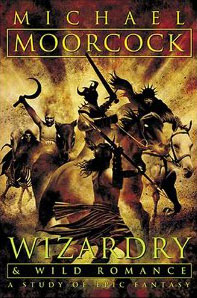
cover

John Picacio cover

Although it was updated in 2004 for the Monkeybrain Books edition, Wizardry and Wild Romance is, really, a product of its time, and is best read that way. It came from a writer witnessing the commercialisation of what had been, to him and the writers he admired, a deeply individualistic, often revolutionary art form — but that’s a battle that has long been lost, the commercial element of heroic fantasy being here to stay. The updates to the book, to me, feel a bit tagged on and less part of the central, anguished cry that spawned the kernel essay, “Epic Pooh”, back in — when was it? According to the Foreword, parts of Wizardry and Wild Romance were published as early as 1963, and that’s over fifty years ago!

Wizardry and Wild Romance is a book I will come back to and re-read, as I have come back to it many times in the twenty seven years since I first read it. But it’s been a process of learning how to read it: not as objective criticism, more as the expression of a passion, and of an ideal, that Moorcock never clearly states, but certainly defends — in style.

^TOP