Crash by J G Ballard

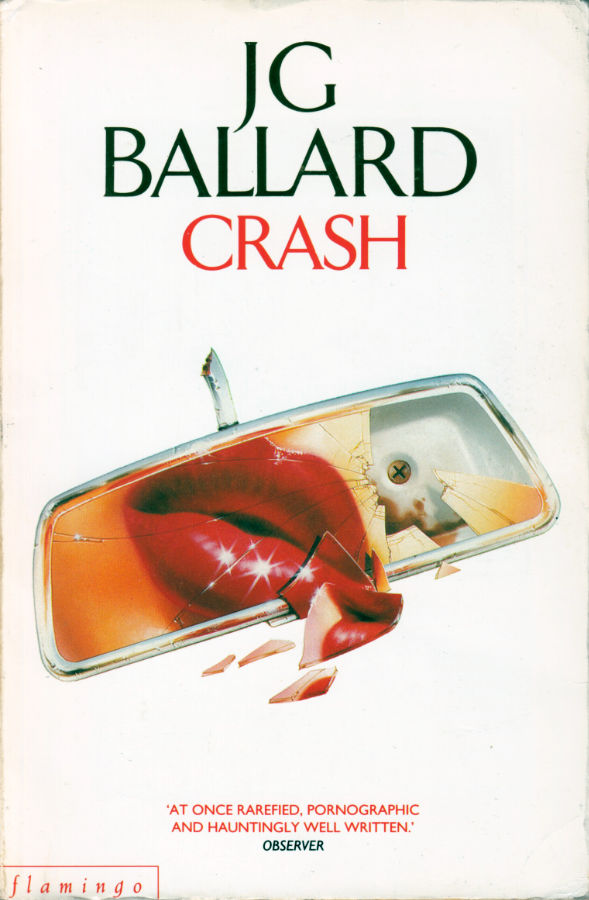
Flamingo 1993 PB, art by Larry Rostant

A year or so after the Cronenberg film of Crash came out, I went into a branch of Waterstones and bought Ballard’s latest paperback, Cocaine Nights. The man behind the counter asked, with a somewhat puzzled air, what I’d made of Crash, which led me to feel I was going to have to justify this suddenly re-controversialised novel. Unused to unexpected conversations as I am, and certainly on difficult subjects, I had no idea what to say. Now, a little less than thirty years later, I thought (in l’esprit d’un très long escalier) I’d give it a go.

Crash the novel has its origins in “Crash!” the story that formed part of Ballard’s collection of condensed novels, The Atrocity Exhibition (1970). Written in 1968, “Crash!” takes the form of the sort of scientific report that Vaughan, the obsessive character from the novel, would have either written himself, or would have had a supply of xeroxed copies of, to hand out to prospective co-obsessives. It led to an April 1970 exhibition of crashed cars that Ballard arranged at the New Arts Lab, a gallery and former pharmaceutical warehouse in London whose proper name, as if this wasn’t all Ballardian/Cronenbergian enough, was the Institute for Research in Art and Technology. After that, in 1971, BBC2 broadcast a short film also called “Crash!” (at 8:30p.m. on Friday 12 February—just before the watershed), featuring Ballard driving around the sort of roads that would form the backdrop for his novel, perusing cars both new and wrecked, accompanied/haunted by a young woman played by Gabrielle Drake. (Who was best known at the time as the purple-wigged Lt. Gay Ellis in Gerry Anderson’s UFO. She was also the sister of ill-fated folk singer Nick Drake, and may have bonded a little with Ballard as she, too, was born out east—in Lahore—and lived in Burma before coming back to England as a child. She evidently made an impression, as Ballard apparently mentioned her by name in an early draft of the novel, as one of the celebrities the obsessive Vaughan was pursuing. Her name lingered in the published version as one of Vaughan’s clique.)
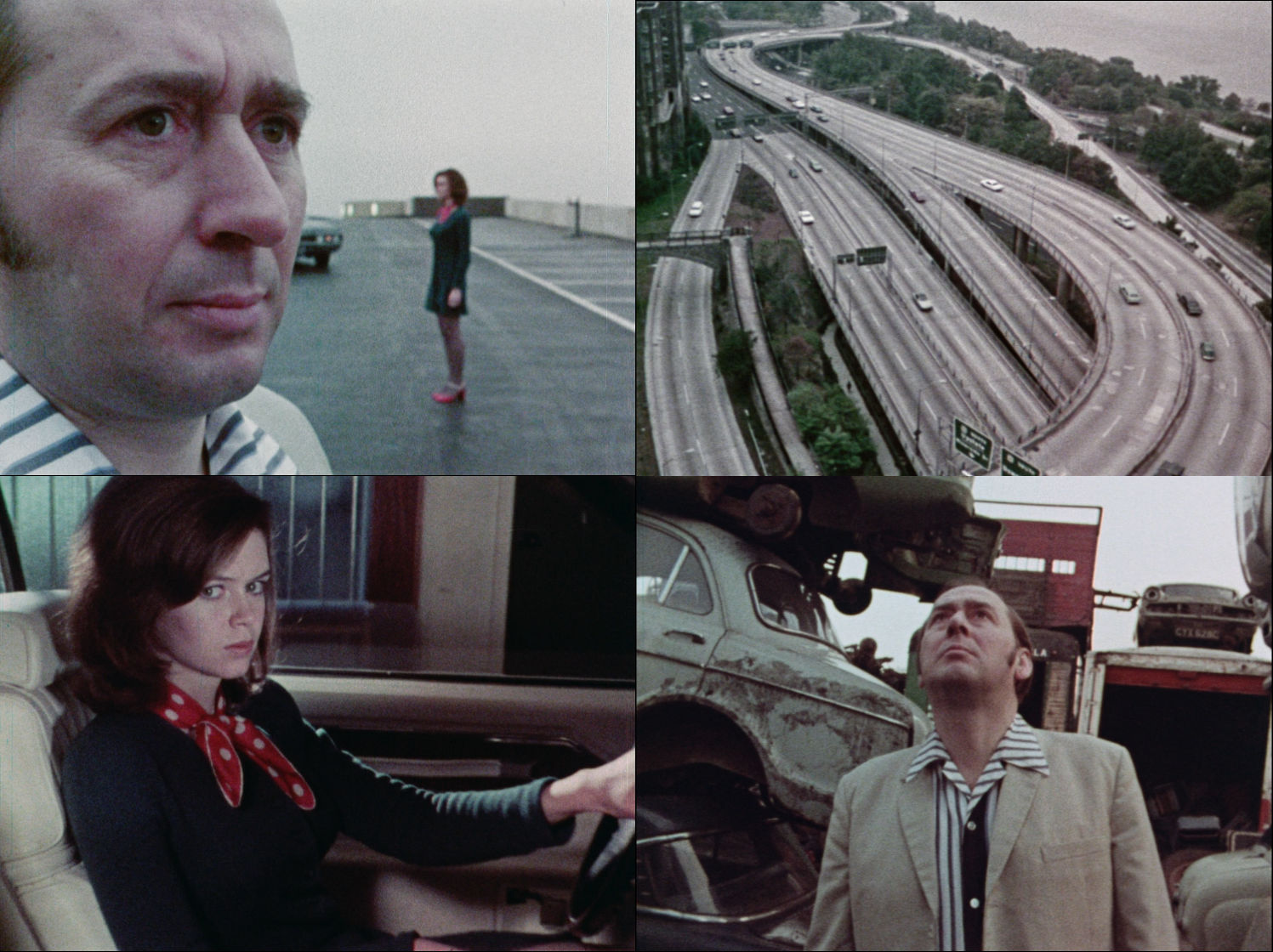
“Crash!”, the 1971 BBC film, featuring Ballard and Gabrielle Drake

The novel Crash was first published in 1973, though the first draft had apparently been completed towards the end of 1970. It would become the first novel of his “urban disaster triptych”, followed by Concrete Island (1974) and High-Rise (1975), and is, perhaps, his most famous novel nowadays (depending on whether Empire of the Sun is still being read)—and certainly his most infamous.
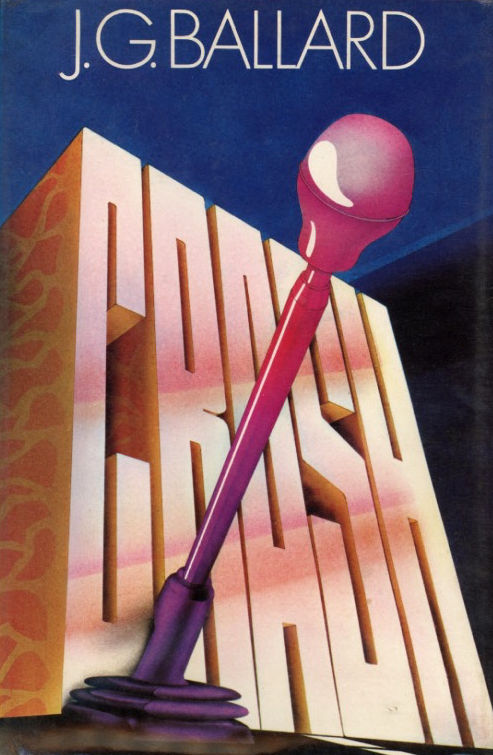
First UK HB, art by Bill Botten

Its first-person narrator is one James Ballard (to avoid confusion, I’m going to call him James; Ballard will refer to the author). He works at a studio in Shepperton producing TV ads; his wife Catherine works for Pan Am’s foreign tours division. The couple spend their time pursuing a series of affairs, which they talk about openly: “Before my accident,” James says, “our sexual relationship was almost totally abstracted, maintained by a series of imaginary games and perversities.” They live in an apartment near Heathrow (which Ballard refers to as London Airport, as it had been known till 1966), nestled amongst a network of conjoining carriageways, flyovers, turnoffs and roundabouts. One day, James loses control of his car and collides head-on with a married couple in another vehicle, killing the man and injuring the woman, Dr Helen Remington.

Convalescing in nearby Ashton Hospital, James encounters Dr Robert Vaughan, whom he at first assumes is a medical consultant. In fact, Vaughan is—or was—“one of the first of the new-style TV scientists”, currently pursuing with fetishistic intensity an obsessive interest in car accidents. This is no detached scientific study: Vaughan (“this hoodlum scientist”, as the novel calls him), judging by the network of scars on his face and body, has been through a fair number of collisions himself—incidents he seems to actively encourage—and has utterly invested all his energies, intellectual, creative and sexual, in the notion of the car crash as some sort of ultimate meaningful experience, with the road-death of a celebrity (his current target being Elizabeth Taylor) being, for him, the ultimate of ultimates.
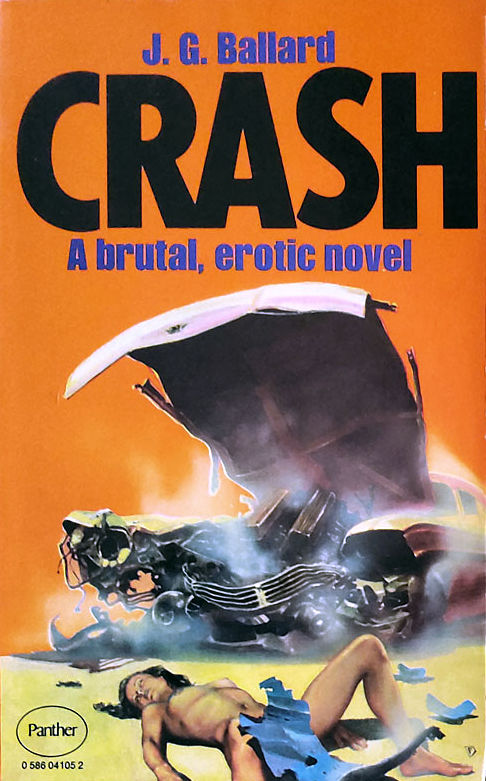
Panther PB, art by Chris Foss

Vaughan has a small coterie of followers, including the permanently concussed stunt driver Seagrave, Seagrave’s equally sozzled wife Vera, and Gabrielle, a young woman left permanently disabled by a major road accident. James and Helen soon join this group, as they get drawn in by Vaughan’s domineering obsession.

Vaughan is absolutely a Ballard type, what David Pringle, in his 1979 study Earth is the Alien Planet, has described as “these regal madmen” who make up the third in a Ballardian trinity of Lamia, Jester, and King. I tend to think of the archetype of this figure as Hathaway in Ballard’s short story “The Subliminal Man”, a combined philosopher-scientist and terrorist, with all the mad, nervous energy of Dennis Hopper at the end of Apocalypse Now!, combined with the dark certainty and purpose of Marlon Brando’s Kurtz. (In a way, all of Ballard’s novels could be read as variations on Conrad’s Heart of Darkness, being about a character who over-adapts to a new or changed environment.)
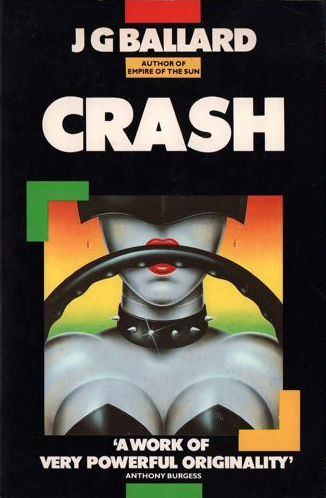
Triad PB, art by James Marsh

Here, though, Vaughan starts to show a somewhat different side. Hathaway in “The Subliminal Man” is eloquent about his obsession (the dominating effect of subliminal advertising on modern city-dwellers), but Vaughan, as far as I recall, never justifies or explains his fixation on the car crash. He convinces not with words, but the magnetism of his own obsession. In fact, as the novel progresses, Vaughan speaks less and less, until soon he communicates entirely through his presence and the actions he takes. Combined with his increasingly dishevelled appearance (his stained clothes, multiple minor injuries, and the fact that he basically lives in his beat-up car), he starts to feel less like a “hoodlum scientist” and more like some half-starved feral child forced to come up with his own highly individual response to what can only have been a traumatic entry into adolescence. Described as “a strange mixture of personal hauntedness, complete confinement in his own panicky universe, and yet at the same time open to all kinds of experiences from the outer world”, he feels, in fact, rather like the young Jim of Empire of the Sun, but with a (troubled, and fatally warped) adult sexuality. And swapping occupied 1940s Shanghai for the roads, car parks, and hospitals around 1970s Heathrow has made no difference: both, in the eyes of these Ballardian characters, are post-traumatic landscapes, heading towards some transcendent apocalypse indistinguishable from death. (Jim in Empire of the Sun is ultimately freed from the Japanese POW camps by the dropping of the atom bomb; this novel’s hinted “autogeddon” blurs woozily between a world-wide motorway pile-up and some sort of LSD-fuelled ascension into the skies.)
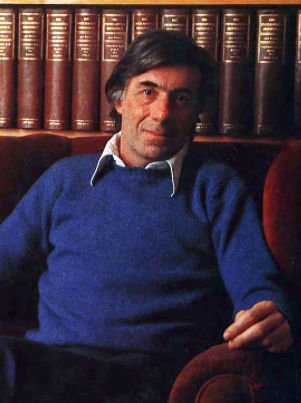
Dr Christopher Evans, looking very un-Vaughan-like

(There’s an element of Ballard’s best friend, the real-life TV scientist Christopher Evans, in Vaughan, as Ballard writes in Miracles of Life: “In appearance he resembled Vaughan, the auto-destructive hero of my novel Crash, though he himself was nothing like that deranged figure.” At one point, Ballard’s exhibition of crashed cars was going to be more of a performance, which Evans was going to narrate—somewhat as Vaughan does in the novel. As well as being a prophet of the microcomputer revolution—in the late 1970s he predicted our lives would be transformed by wristwatch communicators—Evans was also the scientific advisor for The Tomorrow People.)

To me, Crash makes best sense when viewed as an essential next step in the overall movement of Ballard’s oeuvre at the time, a deepening exploration of the theme of modern-life-as-post-traumatic-daze, initially put forward in The Atrocity Exhibition. Ballard at that time pointed out that his fiction was often about isolated individuals, and the car is a particularly potent symbol of modern isolation. People shield themselves in the steel and fibre-glass shells of their vehicles, insulating themselves from the thousands of others they pass on roads and motorways as they head about their daily lives. (Early on, James uses his car’s safety features as a form of distancing from the secretary he’s been having an affair with: “the safety belt I had deliberately fastened to save her the embarrassment of embracing me”.) Within such isolating units, specifically designed to encase and protect, the only way for people to interact as warm, living beings is through collisions violent enough to crack these all-enclosing carapaces. The alternative is to invite someone into your car, but in Crash, at least, driving together is only done in search of sex or car crashes, or some combination of both.
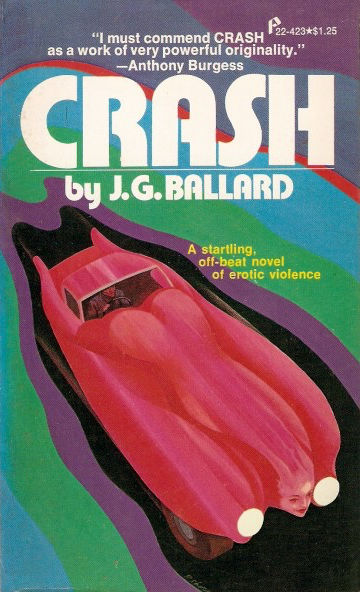
US PB, art by R Shore

There’s a feeling, in the novel, of modern life being so divorced from authentic experience that it’s only in the extremes—the car crash—that the characters reawaken to what it means to be alive. James’s head-on collision becomes “the only real experience I had been through for years”, which to me recalls Bessel van der Kolk on the suddenly reduced range of meaningful experience suffered in PTSD:

“Somehow the very event that caused them so much pain had also become their sole source of meaning. They felt fully alive only when they were revisiting their traumatic past.”

Another van der Kolk quote—“traumatized people have a tendency to superimpose their trauma on everything around them and have trouble deciphering whatever is going on around them”—feels like it comes through in Ballard’s novel in the moments immediately after James’s crash: “the narrow angle between the bonnet and fenders seemed to my exhausted mind to be repeated in everything around me”, as though the world had shattered into a million fragments of reflective glass.

US PB, art by Chris Moore

Vaughan, James, Helen and the others have all had their range of meaningful experience reduced to the ultra-narrow window of the car crash and nothing but the car crash, into which they funnel the entirety of their emotional and physical energies. Squeezed as they are by such a tiny aperture, everything becomes an undistinguished super-heated jumble (“hostility and affection, emotions which had become interchangeable”) instantly drained of all meaning (encounters between human beings—sexual or violent—become “conceptualised acts abstracted from all feeling”).

In Earth is the Alien Planet, David Pringle identifies two of Ballard’s key themes as imprisonment and flight, and, in a way, the car is the perfect combination of the two. Cars are (like Hawkwind’s “Orgone Accumulator”) social isolators, moveable protective boxes, but their speed and smooth movement gives them a hopeful hint of dream-like flight. And towards the end of the novel, James has visions of the many automobiles around London Airport yearning to take to the skies from the flyovers and feeder roads, as though the novel were about to move into some Unlimited Dream Company-style transformation of magical flight.
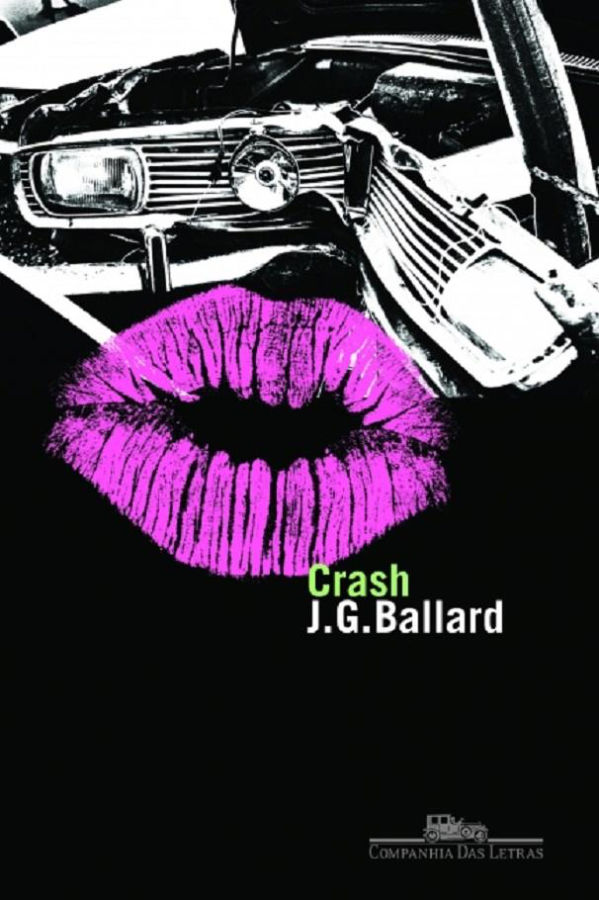
Brazilian edition, from 2007

For me, the essence of Crash isn’t in its story, but its prose, which is absolutely where its roots in Ballard’s Atrocity Exhibition-era fiction show. Encounters between characters are described with a remorseless medical precision, with sex scenes reading more like instructions for assembling some particularly challenging piece of flat-pack furniture, and Ballard’s well-bred dialogue is never used to better (affectless) effect, as it leaches the emotion from all human exchanges. Nevertheless, there are moments of pure Ballardian poetry, as in this transcendent description of a traffic jam:

“The enormous energy of the twentieth century, enough to drive the planet into a new orbit around a happier star, was being expended to maintain this immense motionless pause.”

It’s for this reason I find it so difficult to process David Cronenberg’s film version of Crash, which came out in 1996. There are only hints of the filmic equivalent (obsessive close-ups of car parts) of Ballard’s prose. And as soon as you put Ballard’s dialogue into the mouths of good actors, they can’t help but add more emotion than it should have. (Which is perhaps why James Spader and Deborah Kara Unger, as James Ballard and his wife Catherine, speak so quietly, as though to deaden as much of their humanity as they can. It doesn’t quite work, for me. The adaptation needs crash test dummies, not actors.) The characters who do work, in the film, are the ones who were most defined in the novel by their physical presence: Vaughan, and the disabled Gabrielle (whose mix of human flesh and straps, supports and buckles pushes her the most into Cronenbergian “new flesh” territory).
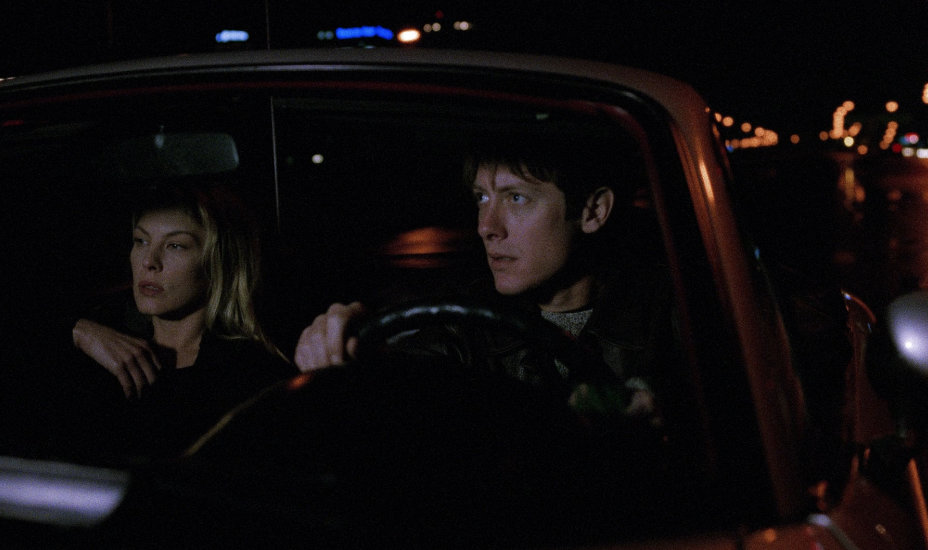
James Spader and Deborah Kara Unger in Cronenberg’s film of Crash

I’m sure the film works better when viewed purely as part of Cronenberg’s oeuvre, though I see it too much as an adjunct to Ballard’s to do that. (Perhaps a run-up of other Cronenberg films might help.) I have no idea how people who are into neither Ballard nor Cronenberg processed the film, though that may be demonstrated by the controversy around its release back in 1996. (Neither the novel nor the film are as extreme as earlier works from these two creators.)

I don’t know if Crash is the first novel to read if you’re thinking of getting into Ballard’s writings, but perhaps that’s just because I approached it by way of the early environmental disaster novels and short stories. Who knows, an in-at-the-deep-end approach (to this drained concrete swimming pool) might produce different results.
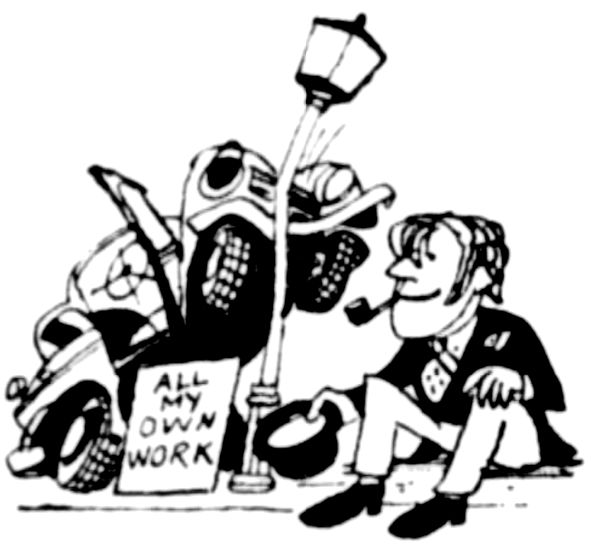
from the Sunday Express, 12 April 1970, accompanying a brief piece on the crashed car exhibition

^TOP

J G Ballard’s Space-Sickness Trilogy

Booklet published by Interzone, 1982

Between 1981 and 1982, J G Ballard wrote what David Pringle, in his Ballard Chronology (published in the Deep Ends anthologies), has referred to as a “time trilogy of long short stories”: News from the Sun, Myths of the Near Future, and Memories of the Space Age. Ballard himself lumped these together in a 1984 interview, saying his recent work included “three long stories all about the same theme, really — … Light and time.” Not a trilogy in any conventional sense (they have different characters, and the nature of the “space sickness” in each story’s world is slightly different) they nevertheless share so many elements that they belong together in the same way the stories in The Atrocity Exhibition do. They could even be seen as a later, more thoroughly digested (and conventionally narrated) treatment of the same Atrocity Exhibition material, with their gone-rogue doctors/architects/pilots engaging in highly conceptual (not to say insane) artistic projects intended to solve some combination of personal trauma and cultural/global malaise.

[Note: I got the order these three stories were written in wrong. “Myths of the Near Future” was actually written first. See David Pringle’s comment below.]

All three of these early 80s stories are set in the now-unpopulated areas around an abandoned Cape Kennedy, years after the cessation of the US Space Programme. In all three a space-sickness, identified in some way with our venturing outside the Earth’s atmosphere, has taken grip on the world’s population, its symptoms consisting of an ever-increasing retreat from the world and an altered perception of time, which are in many ways reminiscent of the “supersaturation of time” portrayed in Ballard’s most hallucinogenic disaster novel, The Crystal World.

Ambit #87

In News from the Sun (first published in Ambit #87 in Autumn 1981), people are falling into a series of ever-lengthening “fugues”, mental absences during which they simply stop mid-action, coming back to consciousness minutes or hours later. Once started, these fugues increase daily to the point of total retreat from waking life. The protagonist, Robert Franklin, is a former NASA physician now caring for space-sickness patients in the environs of a derelict Cape Kennedy, while staving off his own increasing fugues. One of his patients is Trippett, the last astronaut to walk on the moon, whose daughter visits every day, urging Franklin to drive her father around at dangerous speeds (and anything over 10mph is dangerous, given that Franklin could fugue at any moment), in the belief it will counter the sickness. Trippet, on the verge of a fugue, seems to see the desert landscape around the space station full of lush vegetation.

The one man who’s managed to stave off the sickness is Slade, a former air-pilot. Frustrated in his desire to walk on the moon by having been declared (by Franklin) unfit for space travel, Slade engages in a whirlwind of semi-artistic activity including the assembly of “shrines” of seemingly unrelated objects, the building of an airport made of wood, and flying a man-powered aircraft rather too low over Franklin, while wearing nothing but a pair of aviator’s goggles. All this, Slade claims, is part of his own “space programme” (in the same way the Atrocity Exhibition protagonists were all trying to enact their own version of World War III, or some other disaster).

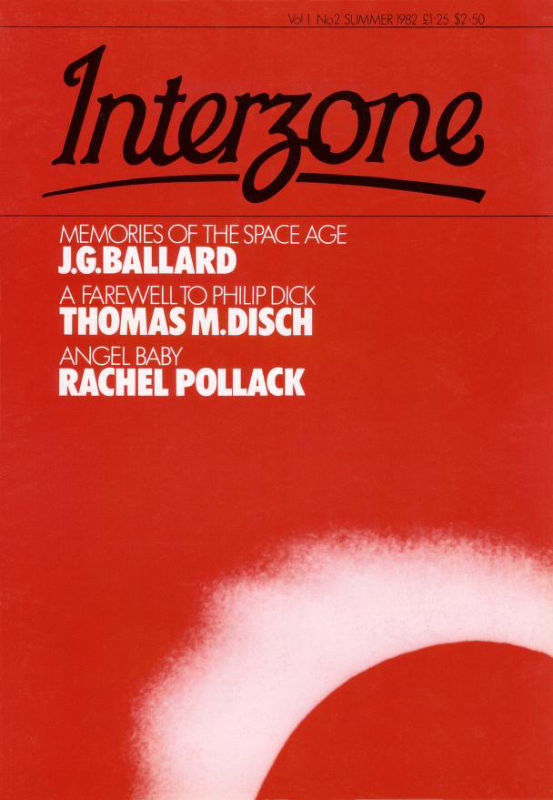
Interzone #2

In Memories of the Space Age (first published in Interzone #2 in Summer 1982), the space-sickness is a subjective slowing of time, leaving people paused in (as they perceive it) a single moment, only to emerge hours later back into the consensus timeline. The protagonist is, again, an ex-NASA physician, Edward Mallory, who has returned with his wife to live in an empty hotel near the now-abandoned Cape Kennedy. This time, there are two characters flying their self-powered aircraft dangerously low over the protagonist’s head. The first is Gale Shepley, who calls herself Nightingale — “a punk madonna of the airways”, as Ballard puts it — the daughter of the first astronaut to be murdered in space. The other is Hinton, her father’s murderer, whose pet impossible/conceptual project is to achieve wingless flight, which he’s attempting to do by piloting a series of ever more primitive flying machines.

F&SF Oct 1982

In Myths of the Near Future (published in F&SF in October 1982), the space-sickness is less well defined, starting with a vague reluctance to go out of doors and an increasing sensitivity to sunlight, followed by a “taste for wayward and compulsive hobbies”, until finally — almost comically, in all but Ballard’s hands — “the victims became convinced they had once been astronauts”. (This detail underlines how so many aspects of these three stories are interchangeable, including the titles. With its false-astronaut memories, Myths could so easily have been called Memories of the Space Age; equally, with a line like “he felt that the entire human race was beginning its embarkation, preparing to repatriate itself to the sun”, it could just as appropriately have been called News from the Sun — and vice versa with the other two stories.)

The protagonist this time is Roger Sheppard, an “outwardly cool architect who concealed what was in fact a powerful empathy for other people’s psychological ills”. He has come to an overgrown and abandoned Cape Kennedy to find out if his ex-wife, a sufferer of the space-sickness, is dead. This time, though, it’s Sheppard who does the buzzing with a low-flying aircraft, and his victim is a young neurosurgeon, Philip Martinsen, who was/is caring for Sheppard’s ex-wife.

Paladin PB, art by Chris Moore

Summing up the similarities between these three stories — even worse, listing all the resonances they set up with Ballard’s previous fiction — would be the work of a not insubstantial thesis. For me, the standouts, as already mentioned, are The Atrocity Exhibition and The Crystal World, whose crystal-forming time-dilation effect these three stories seem to be moving towards, particularly the third, Myths, where Cape Kennedy, rather than being a desert as in the first two stories, is overgrown with lush forest, and Ballard’s descriptions of various light effects approach the hallucinogenic vibrancy of that earlier novel’s prose. (And produce similar images. For instance, in Myths we have: “a large alligator basked contentedly in a glow of self-generated light, smiling to itself as its golden jaws nuzzled its past and future selves.” While in The Crystal World, there’s: “Invested by the glittering light that poured from its body, the crocodile resembled a fabulous armorial beast. Its blind eyes had been transformed into immense crystalline rubies…”)

(As another aside, I did find myself wondering, having since finally read Ballard’s keystone work Empire of the Sun, how much his more visionary and hallucinogenic passages evoke young Jim’s hunger- and fever-driven fugues as he wanders war-torn Shanghai, rather than LSD, as everyone assumed when The Crystal World came out. Certainly, these three stories are full of the sort of Ballardian imagery that would come together in Empire — drained swimming pools, abandoned motels, low-flying aircraft, not to mention the frequently emaciated and hallucinating protagonists. A particularly resonant quote, from Memories: “Cape Kennedy was even more sinister than he had expected, like some ancient death camp.”)

1984 Paladin PB, art by James Marsh

The most significant Ballardian trope in these three stories, for me, is the presence in each of what I might call a Vaughan-like character (to use the name of the instigator of Crash’s car-crash re-enactments). Here, he’s an ex-aviator or ex-astronaut, driven to create his own conceptual version of the space-programme, often trying to enlist the protagonist in some way as a means of saving him from the space-sickness while, all too frequently, also attempting to kill him. (Again, echoes of Empire of the Sun, in young Jim’s uneasy relationship with the American Basie, who takes the boy under his wing, but is just as ready to hand him over to the occupying forces or leave him to die, at a moment’s notice. Ballard is an authentic creator of rogues in the literary tradition of Long John Silver.) This Vaughan-like character always has some unspecified link to the protagonist’s wife, or she’s in some way drawn to him. It might be a former affair, or it might be pure fascination. Either way, the wife abandons the protagonist for this rival: the muse belongs to the artist, however crack-brained he is.

Reading these three so similar tales together, I got the feeling Ballard was fine-tuning his imaginative engine, delicately adjusting the weighting of each of his stock characters, images, and situations, finding the balance point that would allow the whole thing, as it were, to fly.

Arkham House HB

And something does seem to have clicked. News from the Sun and Memories of the Space Age both spend more time establishing the space-sickness as a real-feeling (even if magical-realist) phenomenon, and end with their protagonist sinking into a final fugue, with the stated hope that this would lead, in some way, to a new sense of inner fulfilment. (Though, to me, it always sounded far more like a euphemism for death.) But in the third story, Myths of the Near Future, it feels we’re dealing with a more developed form of this mutating narrative. For a start, Ballard seems impatient to get the establishment of the space-sickness over with, and is less interested in making it seem like a real thing (however weird), than just having it there, in place, ready for the next stage of this particular myth to play out. Significantly, he shifts the balance between his protagonist and the Vaughan-like rival. Now it’s the protagonist, Sheppard, who’s doing the menacing low-flying, while the rival figure is no longer an elder or peer, but a young neurosurgeon. It’s like we’re now seeing the same story from another perspective — a madder, but also perhaps more vital and artistic one. Whereas the first two stories move towards the protagonist’s loss of his wife both to the space-sickness and to the Vaughan-like character, Myths starts with the protagonist already having lost his wife — both to divorce and the space sickness — and setting out to recover her.

Myths ends with a far more genuine sense of fulfilment, however otherworldly it must be when combined with the ongoing symptoms of the space-sickness. By the end, the four main Ballardian archetypes that populate this loose trilogy fall into a sort of unity, as though about to adopt a peculiar four-way marriage: the now Vaughan-like protagonist, the young neurosurgeon, the protagonist’s no-longer-dead wife, and the young woman psychologist Anne Godwin (whose role was played by the astronauts’ daughters Ursula in News and the “Nightingale” from Memories). What’s more, Myths’ landscape isn’t the arid desert of the earlier two tales, but a place of lush, often glowing forest — “a world nourished by time”, as Ballard has it.

Of course, the fulfilment is of a distinctly Ballardian type, filled with strange light and a new relationship with time, but at least it doesn’t, this third time, feel so much like a hand-waving euphemism for death.

1982 Jonathan Cape PB, art by Bill Botten

What’s going on here? What space-sickness is Ballard himself afflicted by? It’s tempting to take his own advice from Myths of the Near Future: “It was always best to take the mad on their own terms.” In the same tale, regarding his suitcase containing a Terminal Documents-like collection of oddly-assorted objects (“film strips, chronograms and pornographic photos, the Magritte reproduction”), Sheppard says: “I’m trying to construct a metaphor to bring my wife back to life.” Which has a raw biographical resonance in the confrontation with Ballard’s own wife’s death that lay behind so much of The Atrocity Exhibition. Though, it can be hard to tell, with Ballard. Grief and loss aren’t emotions that ever seem to be foregrounded in his fiction — perhaps, however, that’s because they’re so much part of his world at an almost molecular level, they can’t be felt as something separable. Myths, or either of the other two stories, could be read as a post-grief phantasmagoria from start to finish.

Art by Tom Breuer

Another thing these stories address is Ballard’s feelings about the Space Programme. The space-sickness is at first presented as a punishment for daring to fly so high: “By leaving his planet and setting off into outer space man had committed an evolutionary crime.” — which, to me, recalls C S Lewis’s idea in his Space Trilogy that man shouldn’t leave Earth because his Creator said so, something I can’t imagine the futurophilic (and atheistic) Ballard would chime with. Another take on the cause for the space sickness, from Memories, is that “by travelling into space… [mankind] was tampering with the elements of his own consciousness.” So, is Ballard saying we just don’t have the psychological resources to deal with the vast void of the heavens, and the disappointing barrenness of its heavenly bodies?

In Myths, though, there’s a slightly more positive idea: it isn’t that we’re not meant to go into space, rather that it needs to be appreciated for the immense leap it is, analogous to the moment our fish-like ancestors crawled out of the sea onto the land, and not simply a moment of media spectacle:

“Could it be that travelling into outer space, even thinking about and watching it on television, was a forced evolutionary step with unforeseen consequences, the eating of a very special kind of forbidden fruit?”

(To which I just have to add this far more eloquent image of our psychological and technological poverty when it comes to facing up to the challenge of entering the void, in News from the Sun: “the rusting dish of a radio-telescope on a nearby peak, a poor man’s begging bowl held up to the banquet of the universe.”)

In a 1979 interview (in fact, a chat with his friend, the psychologist and computer scientist Dr Chris Evans), Ballard had this to say:

“…we’re at the climactic end of one huge age of technology which began with the Industrial Revolution and which lasted for about two hundred years. We’re also at the beginning of a second, possibly even greater revolution, brought about by advances in computers and by the development of information-processing devices of incredible sophistication. It will be the era of artificial brains as opposed to artificial muscles… Now it’s my belief that people, unconsciously perhaps, recognise… that the space programme and the conflict between NASA and the Soviet space effort belonged to the first of these systems of technological exploration, and was therefore tied to the past instead of the future. Don’t misunderstand me — it was a magnificent achievement to put man on the moon, but it was essentially nuts-and-bolts technology…”

I can’t help feeling that these three longish stories somehow resolved — or began to — the fragmented trauma captured in The Atrocity Exhibition over a decade before, and by doing so, perhaps, opened the way for Ballard to more clearly address the true root of it all, his formative childhood experiences in wartime Shanghai that in so many ways provide the skeleton key for understanding where the many obsessive images in his fiction come from. Despite being utterly magical-realist and surreal in imagery, these three stories are some of the purest pre-echoes of the world presented in Ballard’s most-read novel; and they could be seen as a summing up, and tying together, of so many Ballardian obsessions before he moved on to addressing a deeper, perhaps purer, version of the same thing in Empire of the Sun.

^TOP

Concrete Island by J G Ballard

1992 PB, art by Chris Moore

After the literary “incident” (to use the terminology of motorway signage) of Crash in 1973, 1974’s Concrete Island, in its slightness, can come across as something of a leftover, a using up of spare energies — the literary equivalent of a hubcap still trundling along the tarmac in the wake of a major collision. It’s the second volume in what has been called Ballard’s “urban disaster triptych” — the others being Crash and High-Rise (1975) — but aside from the fact it starts with a car crash and takes places in a concrete-bounded patch of wasteland, as a novel it doesn’t really share those two longer books’ future-shock levels of deadpan, maxed-out satire. Concrete Island isn’t, in the end, about the modern world, but, as with Ballard’s early, landscape-based fantasies (The Drowned World, The Crystal World), it’s about a retreat into the inner landscape of its protagonist.

The story begins with 35-year-old architect Robert Maitland emerging from a feeder tunnel adjoining the Westway/M4 [correction: A40(M), see comments] interchange when a tyre blowout throws him off the road into a triangle of long-grassed wasteland bordered on two sides by steep motorway embankments, and on the third by an impenetrable chainlink fence. Recovering from the accident, he finds his leg injured, perhaps broken, and when he struggles up the loose soil of the embankment to try to flag down a passing car, soon realises nobody’s going to stop — they’re all going too fast — and almost gets himself run over for his troubles. Retreating, exhausted and injured, he returns to the “island”, as he terms it, and starts working out how to get help, as well as how to survive on his limited resources in the meantime.

US HB, 1974, art by Paul Bacon

After a period of hunger and fever, punctuated by the constant frustration of his every attempt to signal for help, he begins to explore the island and finds it anything but barren. Beneath its long grass it’s “a labyrinth of depths and hollows”, containing the vestiges of some Edwardian terraced houses, a World War II air-raid shelter, the basement of a ruined post-war cinema, and an abandoned printer’s shop. Far from empty, the island — “this immense green creature eager to protect and guide him” — is almost alive. What’s more, he’s not its only inhabitant.

Despite its harking back to those earlier inner-landscape novels, to me there’s also a feel of hints, in Concrete Island, of new directions in Ballard’s writing. Jane Sheppard, one of the two people Maitland finds living in what he’d assumed to be a wasteland, is different from the usually cool, mature and glamorous fifties-Hollywood-style femmes fatale Ballard presents us with as the female lead/object of obsession in his fiction. Rather, she’s young, spiky, and dresses like a “cheap tart”; she swears and smokes pot. About the only thing she shares with Ballard’s usual female characters is that’s she’s clearly damaged, but unlike the overly-cool, deeply traumatised Giocondas he usually produces, Jane makes no attempt to hide it. Writing in 1980, David Pringle said this character was “the nearest thing to a ‘well-rounded’ female character in all [Ballard’s] novels”.

Another hint of something new comes when, at one point, Jane breaks into a stream-of-consciousness rant — but it turns out (from an interview reprinted in Extreme Metaphors) these passages were the result of Ballard transcribing a recording he’d made of a real-life angry outburst from his girlfriend. Nevertheless, these passages come across as a rare moment of stylistic wildness in Ballard’s usually very controlled prose, an opening up to something new.

1974 HB, art by Bill Botton

The other character on the island is Proctor, a clumsy, wounded ex-acrobat with the intellect of a child. Proctor, and the way Maitland takes command of him, makes it easy to suggest some parallels for Ballard’s novel: Robinson Crusoe (with Proctor as Man Friday), or The Tempest (Proctor as Caliban). In which case, is Jane, with her ability to leave the island, Ariel? (At one point I found myself wondering if Jane’s name didn’t suggest Maitland as a sort of Tarzan of the urban jungle, with Proctor as the chimp Cheetah.) And there’s the inevitable feeling, as with High-Rise, that this might devolve into a sort of inner-city Lord of the Flies, with Maitland hoping to be rescued while trying to fend off the breakdown of even this little, three-person social structure, before it murders him.

But Maitland, it turns out, was already living on a sort of island. He’d carefully arranged his life to keep a certain distance between himself and everyone else. He won’t be missed after his accident because his wife (the “cool, formal house with its large white rooms” he shares with her gives a good idea of the temperature of that relationship) will assume he’s with his mistress, and his mistress will assume he’s with his wife; meanwhile, his son will make his own way home when he’s not picked up from school, and his office is too used to his not turning up for days at a time to be concerned.

1976 Panther PB, art by Richard Clifton-Dey

The roots of this isolation are deep. The concrete island begins to remind Maitland of the main image he has of his childhood, of him playing alone in a high-walled garden. Are, then, Jane and Proctor some warped evocation of his divorced parents? Is Proctor an image of himself as an un-grown-up child in an adult body, socially awkward and clumsy? Is Jane some confused mix of all the women in Maitland’s life, the caring then suddenly distant mother, the coolly transactional lover, and the vulnerable, damaged little girl?

There’s definitely a feeling that what’s going on here is not some moral fable about the disconnection of modern life, but a psychodrama with its roots in childhood. (John Baxter, in his biography of Ballard, calls this book “the most overtly self-analytical of his novels”, but to me it doesn’t really come across as especially personal to Ballard — though perhaps that’s just in retrospect, with the Empire of the Sun a couple of novels away.)

Maitland, it seems, was only too eager to find himself marooned on this concrete island, and once he is, his real work is not to be rescued, but to let these nagging figures that the accident has shaken free from his brain — whatever they represent — run through their dramas until, played out, they leave him genuinely alone at last. Concrete Island, then, is about a man in search of a moment of inner peace — even if it takes a car crash, fever, and near starvation to achieve it.

1985 PB, art again by Chris Moore

The book has an interesting writing history. After its first draft, Ballard wrote a screenplay (now housed in the British Library) adapting what he’d written. He then went back to the novel and revised it extensively into its final, published form. The screenplay went unfilmed, but seems to have acted as a way of getting perspective on the novel prior to honing it into its final shape.

It remains something of a minor Ballard novel, lacking the iconic feeling of those books that grapple with the sort of archetypal (modern or timeless) landscapes found in The Drowned World, The Crystal World, Crash and High-Rise. But the book’s touching on childhood, in combination with its protagonist’s extended periods of hunger and fever, point towards it being another step closer to his autobiographical novel Empire of the Sun. After all, once the post-collision hubcap stops rolling and comes to halt, its bright chromium surface provides a perfect little mirror for what Ballard is doing here: a moment of self-reflection after some traumatic event.

^TOP